Tag Archives: thoughts

Nudity & Society I : What’s the Big Deal about Nudity?

This is the first of four articles addressing nudity and society. Although a series, the first three will stand alone; the fourth article will be a selection of useful supporting links. Consequently there will be overlap of material between the articles. The articles are not fully referenced (hence Article IV), although a Google search on “nudity society body acceptance” (or similar) will find many articles (academic and otherwise) relevant to the whole series, starting perhaps with British Naturism’s 2020 Submission to Parliament.


Every one of us has a body, but the simple act of showing it – or even talking about it – can set off a storm of reactions. In some parts of the world, a bare shoulder or a topless photo will cause moral panic, outrage, or even legal trouble.

So why is nudity such a big deal? Because it hasn’t always been. Homo sapiens has been wearing clothes for only the last few thousand years, or an estimated 1-2% of the species existence.

As recently as the Ancient Greeks the human form was celebrated as a thing of strength and beauty. Their statues and athletes were unapologetically nude, and there was nothing inherently scandalous about it.

However as religion and moral codes evolved – particularly through the Abrahamic religions – the idea of nakedness became entangled with sin and shame; and over time we came to see our skin as something to be hidden, controlled, or covered. And the mindset stuck.

Most of us are taught as children being naked is something to be embarrassed about, and we’re conditioned to see nudity as dangerous; it instantly crosses some invisible moral line.

Such conditioning confuses the natural with the sexual. The human body can, of course, be sensual, but it’s still human. It eats, breathes, moves, and ages! – although it’s rarely represented that way in mainstream media. Instead it’s airbrushed, idealized, and used to sell everything from perfume and lingerie to cars and kitchen refits.
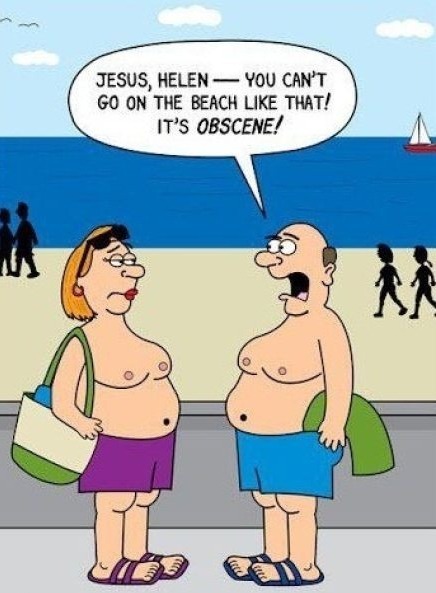
Not everyone experiences these double standards the same way. Women’s bodies, in particular, have been both glorified and policed for centuries. For example there’s the current-ish debate around #freethenipple: men can go shirtless in public without a second thought, but when women do the same, it’s indecent or provocative. It’s a small example of a much larger issue – the use of modesty to enforce social control, especially over women.

Cultural differences play a huge part in this. In some communities – especially indigenous or equatorial societies – nudity isn’t shocking or taboo; it’s practical; even ordinary. By contrast in most of the West, it’s still wrapped in moral judgment. Religion, tradition, and colonial history all shape how we decide what’s “appropriate”, even if the rules no longer make much sense. The
taboo is supposedly to protect children from seeing anything not “age appropriate” – which means essentially anything the child’s parents/guardian may be uncomfortable with.

Art, however, provides an interesting contradiction as restrictions mostly don’t apply in public museums or art galleries. Nude art has been celebrated for centuries; it’s beautiful and pure: as long as it’s in a museum. But when similar images appear in the media, they’re labelled obscene. The line between “artistic” and “inappropriate” shifts continually, thus revealing our that discomfort isn’t really the body itself but about context and control. Only half jokingly, I often say that a B&W nude photograph is art; but in colour it’s pornography.

The recent rise of the body positivity and naturism movements has tried pushing back against all this. The message is simple: seeing real, unfiltered bodies makes us more accepting of ourselves and others. If we stop treating nudity as shameful and inappropriate, we’ll stop treating our bodies as problems to be fixed. But old habits die hard, and society’s obsession with modesty and image continues to dominate.

So why is nudity such a big deal? The answer is essentially because it sits at the crossroads of morality, power and identity. Our discomfort with the naked body says less about the body and more about the cultural stories told about it. Questioning those narratives can lead to a healthier and more honest relationship with ourselves and others.

Although they seldom realise it, what really makes people uncomfortable isn’t the naked body itself, but the vulnerability and honesty that come with it.

I Blame Harold Wilson

This is an opinion piece (an op-ed if you will) which I’ve been thinking about for a long, long time.

Back in 2014 Roy Hattersley wrote in the Guardian …

[In 1964] Harold Wilson was elected prime minister of Great Britain and Northern Ireland. Labour won because its leader caught the mood of the time. Wilson was the politician as technocrat, the man in the Gannex overcoat who complained that, in a world in which “even the MCC has abolished the distinction between amateurs and professionals, in science and industry we are content to remain a nation of Gentlemen in a world of Players”.

Maintaining the technocratic image helped him to keep a fractious party more or less intact. But nobody doubted that the pragmatism about which he boasted was, in truth, guided by a principle which he set out in the language of the time. “The Labour party is a moral crusade or it is nothing.”

Two or three weeks into the new parliament, he invited the dozen or so youngest Labour MPs to Downing Street. The most self-confident […] told him that the government had made a crucial mistake in not devaluing the pound. They were right …

Harold Wilson brought a paradigm shift to government in the UK, and to the functioning of society as it finally surfaced from the deprivations of WW2. Wilson took advantage of the changing mood of the times. As a consequence many attitudes in the UK, and thinking within government – not to say many of the current problems which afflict the country – have their roots in the actions of the Wilson administrations of 1960s and 1970s.

Think about the following …

Comprehensive Schools
Wilson said he wanted everyone to have his grammar school education and in an attempt to achieve this effectively all schools became comprehensive. But the law of unintended consequences meant what happened was that by mixing the bright with the dim, the brightest got dumbed down, given no incentive to work hard and be stretched, while the less bright gained nothing. Actually the less bright also lost out because the previous secondary modern schools had never been properly constituted (with good curricula) and consequently the change of focus meant there was no foundation to fall back on.

Expansion of the Universities
To be fair this was started under Harold Macmillan, but the expansion of the mid-60s was the first step on the slippery slope to the destruction of Technical Colleges, Polytechnics and apprenticeships. This has, in turn, led to a shortage of technical training for plumbers, bricklayers etc. – we didn’t need them: Wilson’s “white heat of technology” would do it all. But we do need them and so we have ended up importing them from places like Eastern Europe.

Another consequence is that we now have too many, low quality, universities running courses of little worth and awarding over-inflated degrees. Why? Because over time everyone has become entitled to a university education – and government wanted to keep the unemployment figures down. Not a direct result of Wilson, but built upon the foundations he laid.

Soundbite Government
Wilson was the first to blatantly use the media as a tool of government and to provide snappy soundbites. Remember “the pound in your pocket”, “the white heat of technology”, and “beer and sandwiches at No.10” to win over stroppy union leaders?

Media Freedom
It isn’t clear which is chicken and which is egg, but with soundbite government the media started to feel they had much more freedom and fewer constraints, and they became more available with the advent of regular TV news bulletins. News became more immediate; and the public started to see, and recognise, politicians when previously they had little inkling of the machinations of government, who those people were, and what they did. This inevitably (over time) led to the broadcasting of Parliament, with politicians being interviewed at every turn – and spinning every story for their benefit.

Government and Industry
The beginning of politicians and government obviously, openly and blatantly in cahoots with industry for their own benefit. Remember Wilson’s Gannex mac? This was doubtless nothing new, but it was now out in the open or at least much more easily probed.

Destruction of British Industry
Wilson’s watch saw the rise of unprecedented union power, which was allowed to cripple manufacturing (think cars, steel, shipbuilding) and which continued until Thatcher broke the miners in the 1980s. That’s not to say unions haven’t been a force for good in improving working conditions etc., but under Wilson they very much had the upper hand (which is now really evident only in the rail unions as most of the rest have been emasculated). This ultimately led to substantial wage rises, high inflation, wage restraint, and high unemployment.

British Rail & Utilities
The actions of Dr Beeching in massacring Britain’s rail network were, admittedly, started under Harold Macmillan, however the pressure was continued under Wilson with BR, and indeed many other public utilities, being subjected to unprecedented attention from government accountants – something which continues to this day – and threats of nationalisation. This was in large part undone by the privatisation policies of Margaret Thatcher’s administration which has left many of our utilities in a position where it would be almost impossible to fully renationalise them.

Financial Crisis
All of this led, inexorably, to a financial and economic crisis, a series of failed economic measures, and the consequent devaluation of the pound by 14% in November 1967. Arguably the economy and the country’s financial situation has never recovered from this.

Social Agenda
Under Wilson’s administration we saw the first Race Relations Act (1965), the Sexual Offences Act (1967) and the abolition of (almost all) capital punishment (1965); followed later by an expansion of the welfare state. Our current social policies (including welfare payments) are very much built upon these foundations and are, in my estimation, a large factor in the current entitlement of much of the population.

Corrupt Patronage
Patronage, and corrupt patronage, has always happened. But because of the greater freedom of the media and its availability to all, Wilson’s patronage of people like Marcia Falkender (his political secretary and alleged mistress) and Lord Kagan (of Gannex macs) became open knowledge, if not actually more blatant.

I’m not saying that all our current ills are directly attributable to Harold Wilson. Nor am I saying that Wilson didn’t do some good things (eg. the welfare state). But much of where the UK is now, at least internally, is built upon the foundations set by his administrations.

That, at least, is my assessment. YMMV.

There’s much, much more about Harold Wilson on Wikipedia.

#MeFirst

I’ve been thinking recently about personal attitudes and the state of society. There has been a marked shift in the willingness of people to be active in the community, for the greater good of the community.

It’s been happening for quite a while, but has got worse since the beginning of the COVID pandemic. We now live in a world which has shifted away from community spirit to an almost ubiquitous focus on personal gain: “what’s in it for me?”.

People get angry about being inconvenienced. Their plans matter more than public safety, or the community. It’s selfish and ultimately destructive.

We’ve lost the civilising philosophy of “Do unto others as you would wish them to do unto you”.

As I say, this was happening before COVID; however the isolation of lockdown, the fear, and in many countries the indifference (or worse) of government have multiplied this “me first” attitude. Everything has become focussed on “how does this affect me?” rather than the broader picture of “how does this protect us?”, “how does this benefit the community?” or even “do I really need this?”.

Freedom has shifted from living peacefully with others in society, within the law, to “I can (and will) be allowed do whatever I want, regardless of anyone else”. That’s not to say that we should all be mindless, conforming drones. There is still, and always must be, a place for free speech, a variety of opinion, demonstration, and challenging the status quo. Nor am I saying that self-care doesn’t matter. But we’ve been brainwashed into a view that everything is a service we pay for (especially when it’s free!) and is therefore a right which must be provided here and now, or else.

This has not been helped by the political modus operandi which has become so polarised that there is no thought of compromise and common ground. Worse, what are people supposed to think when they see the politicians avoid any consequences for their lies, malfeasance and broken promises. The USA is demonstrating this in spades; and they aren’t the only ones. What’s sauce for the goose is sauce for the gander.

We’ve gone from “we, we, me” to “ME, ME, maybe we”.

We’re seeing this in so many areas. One place I see it is as Chairman of my doctor’s patient group: patients are demanding to always have a face-to-face appointment with their GP – today! – rather than trusting the GP to make a decision based on the clinical need. Because if a phone call is sufficient (as it is in a majority of cases) it benefits everyone: it is less disruptive, quicker, and thus better for everyone as the GP can get to treat more patients (who may be at greater need). But no, I must come first; my desires are paramount.

How many these days voluntarily put themselves forward for community roles? For example: as school governors; as charity workers; as interest group newsletter editors. Judging by the number of organisations advertising (internally or externally) for people, the answer is “very few”. I don’t recall this being an issue when I was younger; there was almost always a volunteer willing to step up. And it is all levels of society, top to bottom, regardless of which method you use to slice the “society cake”.

The idea of contributing, even sacrificing, something for the community has pretty much disappeared. When enough people are putting themselves above the group’s wellbeing, things shift, trust turns to suspicion, every obstruction engenders anger; and the community starts to fracture. When “we” becomes “me” the community dies. Just as we’re currently seeing in society – worldwide.

It’s not so much #metoo as #MeFirst.


There’s a fuller exposition of this in the article When “What’s In It for Me?” Kills Community … . Ignore the naturist foundations to the article; it’s just as appropriate for any community, of any size.