Category Archives: thoughts

Unblogged June

Some things, and thoughts, from June which I didn’t otherwise write about.


Monday 1
Looking at the trail camera shots for the last week I noticed that one of our (at least three) foxes has a striped tail. It was very noticeable side on at a distance, but less so when I saw the fox walking away from the camera. Sadly no useful image as it was low light and a low-res camera.


Tuesday 2
This afternoon we had not one, but two big thunderstorms. The first (about 14:30) was the larger and longer with some really torrential rain. It then drizzled on and off all afternoon until the second storm arrived about 17:00. Then it cleared to leave a nice sunny evening.


Thursday 4
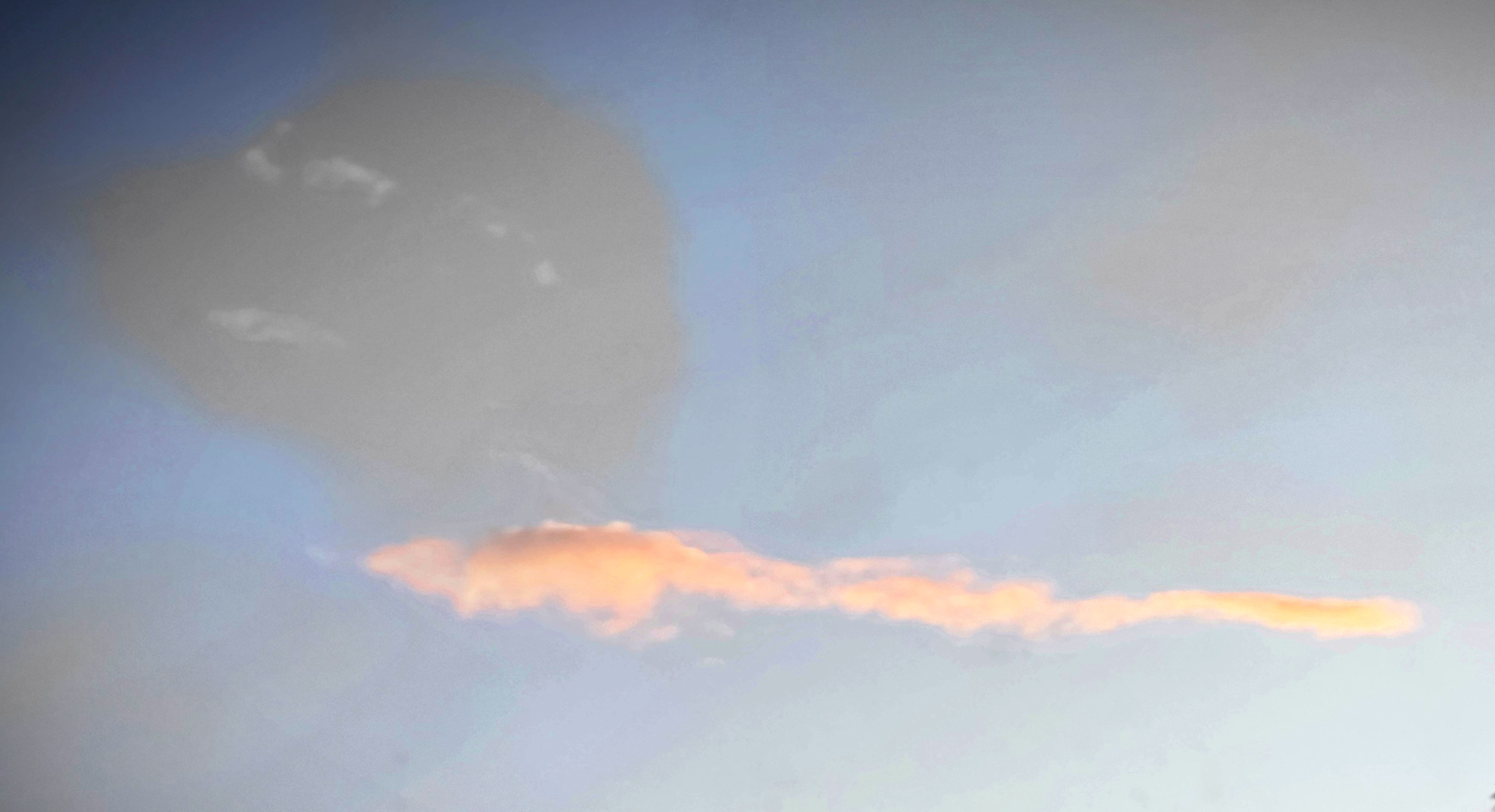
A couple of evenings ago, there was a wonderful fire-breathing dragon in the western sky.dragon shaped cloudNot a brilliant photo as it was a grab shot, through the window with my phone – and a few minutes earlier the cloud had been less linear and more dragon-like.

Sunday 7
What a dismal day. Grey, windy and should have been raining. Inside I felt completely drained, stressed and depressed. Everything enlivened slightly by an evening meal of steak and chips with a bottle of Champagne.


Monday 8
Phew! We’re solvent again this month.


Friday 12
Spent the last few days fighting off an attack of vertigo. Not the worst attack I’ve had, but enough to stop me doing much.


Monday 15
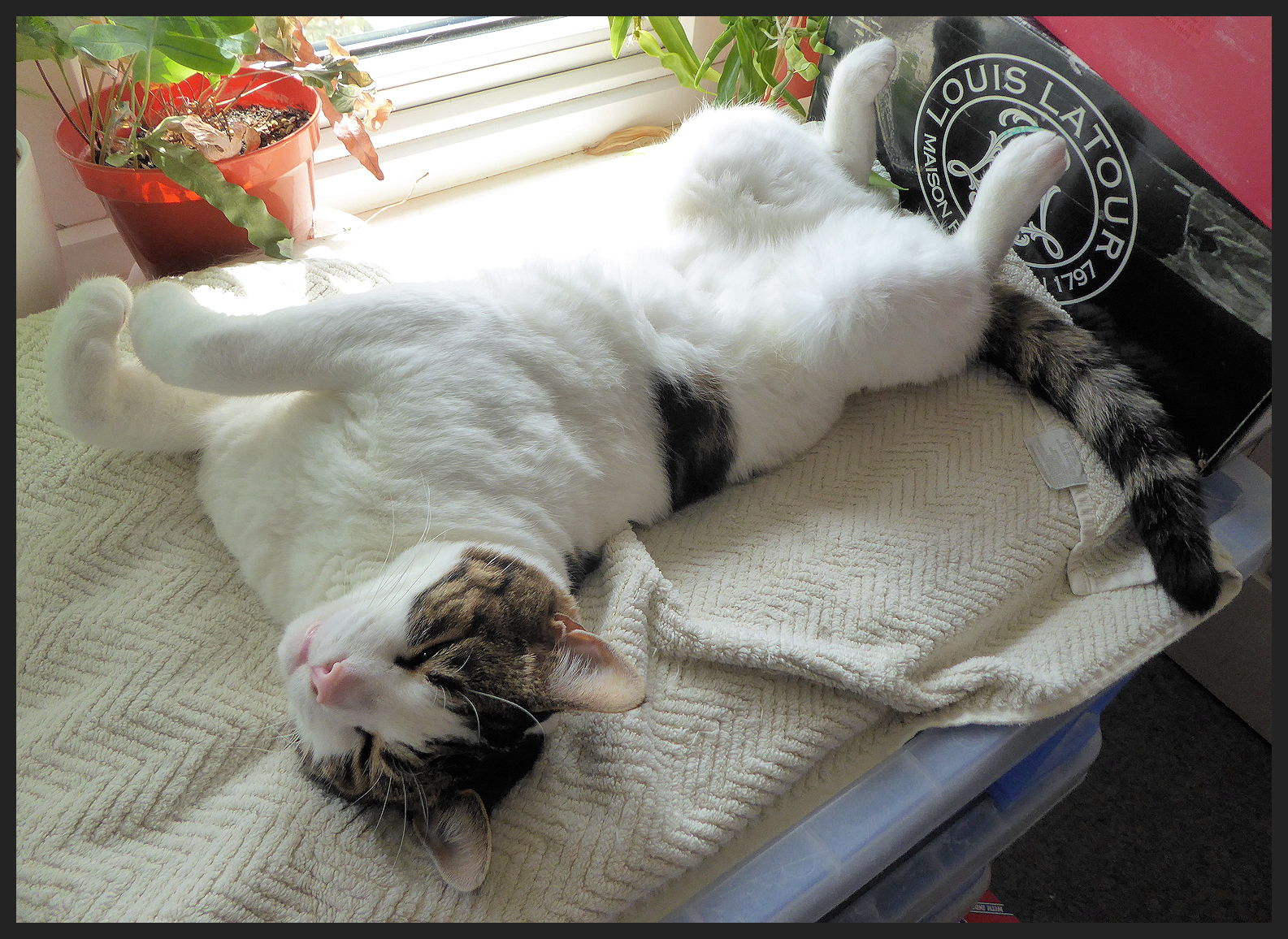
Still trying to get rid of the last vestiges of the vertigo; it’s left me really drained. Meanwhile Boy Cat had the right idea this morning lying in a sunbeam.white and tabby cat upside down, feet in the air


Thursday 18
So yesterday I felt fine; vertigo gone away. Awoke this morning with it back with a vengeance; much worse than last week and ended up horizontal for the majority of the day. So now have a call out with the doctors.


Friday 19
Head feeling a bit better. Weather feeling uncomfortably hot and sticky.


Sunday 21
I’m surprised we haven’t got local Ice Cream Van Wars. We have at least three which seem to tour the locality, each with a more irritating jingle than the last. But they never seem to coincide; maybe they have a rota worked out. (Unless, of course, it is one van with three different jingles.)


Monday 22
So Starmer has chickened out of being PM. Idiot. See my blog post for more thoughts.


Tuesday 23
Blimey, I was woken just after 3 this morning by an epic thunderstorm. Lots of very bright lightening, and massive rolls of thunder, although none right overhead. This went on for at least an hour as I dropped off to sleep again about 4. Heaven knows how much rain we had with it. And then today has been relentlessly hot and humid; so uncomfortable.


Wednesday 24
Record breaking temperatures: the UK’s hottest ever June day. Unbearable.


Thursday 25
It hasn’t felt quite so unbearably hot today, possibly because there’s been a nice breeze all day. It’s just as humid and sticky though. And again record breaking temperatures.


Friday 26
The supermarket have cancelled our weekly delivery today. They say they’ve had “system problems”, whatever that means. I’ve put the order in again for Sunday morning, but had to do an expensive “top up” delivery from the local store – which took them forever to organise. And it all wasted the whole morning. Still at least the supermarket have had the grace to give us £10 off our next order; 20% would have been better compensation.


Saturday 27
The buddleia is in full bloom for several days – so early! – and not a butterfly in sight.


Sunday 28
Phew! Well at least today has been significantly cooler – it’s still warm, but just comfortably summer hot, rather than desert hot. And there’s been a good “seaside” breeze for most of the day. Actually not a bad day to play cricket, although some bowlers wouldn’t have relished the breeze.

In other news, customer services at the supermarket got a fairly snotty email today (not that it will do any good). Our rebooked delivery was scheduled for 11:00-12:00 and finally arrived something after 13:00 with a driver who couldn’t have been less interested and engaged with his job. They’ve not had an impressive weekend.


Monday 29
Out yonder we have a small mulberry bush in a tub and today, for the first time after several years, we had a handful of small black mulberries. There really weren’t enough to do anything with, so I put them in a mixed fruit salad with some raspberries and blueberries (plus a little sugar and a tot of peach schnapps). They worked well and added a little something to the other fruit, although I’d be had pressed to describe the actual taste of the mulberries. Mind you, they don’t half stain; it’s taken several good washes to even start getting the purple dye off the fingers.


Tuesday 30
Yesterday I found myself wearing a pair of shorts almost all day. Yeah, so what? Well it was the first time for a week that I have worn any clothes at all because it has been so hot – except for a couple of hours on Saturday and Sunday when I knew I was likely to have to go to the door. At most times I had a pair of shorts to hand in case the doorbell rang. It’s summer, it’s hot, and I’m always warm (I have a good covering of blubber!), and our house is naturally warm. So why wear clothes? Why not be like this all the time? Oh wait, I do; even in the depths of winter I seldom wear more than a pair of legs and a t-shirt around the house and at this time of year it is at most a pair of shorts. As regular readers will know I can’t be doing with all this fuss about nudity and the like. We all know what’s under each other’s t-shirt and jeans, so really where is the problem. There is no legal prohibition on nudity, either in private or in public, unless one is deliberately causing someone else harassment, alarm or distress, or performing a sexual act – all of which is enshrined in Police and CPS guidance. So be comfortable. Go attired or not as you wish.


Thoughts on the Political System

I don’t generally comment on politics and current affairs, but I’m going to offer the following two (probably unpopular) thoughts.


Thought 1

The author of The Empty City Blog contends that:

Getting rid of six Prime Ministers in ten years is a sign of a working political system. It is that we keep appointing poor Prime Ministers that is the problem: an input issue not an output issue.

Wrong!

It is the product of relatively unthinking, sheep-like MPs not understanding enough of the system**, naïvely believing the grass is always greener on the other side, and being preyed on by self-serving commentators and billionaire media owners with their own divisive agendas (after all it sells copy and makes them money). The media have forgotten what their role is: to report what’s happening, not to wage personal vendettas.

[** Unless they’ve worked very closely inside Number 10 no-one has any idea of the complexity at that level. And no new Prime Minister has a flying clue what’s hit them.]

We’ve lost the understanding of peoples’ role and place in the system (and that doesn’t have to mean rigid, traditional roles); the ability to see beyond the brick wall; and the confidence to allow people to get on and do the job they’ve been entrusted with. Meanwhile the media have run off with the sausages.

But this isn’t new. Just in my lifetime we did it to, inter alia, Alec Douglas-Home, Ted Heath and Jim Callaghan.

And it is stupid that we have eight (soon to be nine) living former Prime Ministers. Two or three maybe, but nine shows just how dysfunctional the system is.

FFS grow some spine and learn to tell the media to f*** off.


Thought 2

If Andy Burnham becomes Prime Minister it will be a disaster and he’ll not last two years.

He’s out of touch with Parliament, and will effectively have to relearn the ropes. Most new MPs seem to have a tough time adjusting to the role and finding their place in the system. He should not, and should not expect to, walk straight in and carry on as if he’d never left.

This means that should he become Prime Minister in short order, he will have even less clue than most as to what has hit him when he walks into Number 10.

But worse …

He seems to be divisive (which is what’s got him here). He’ll overtly favour the North with no thought about the South – regardless of the fact that the South is well over 50% of the population and GDP. And it’ll be all about his ideas – aka. the only right ideas – with little or no regard for advice or experts.

So it’ll be another government along the same lines as Boris Johnson – somewhere between farce and fiasco.

Plus watch the vanity projects for the North.

All of which could just result in a backlash in favour of Farage and Reform, which will be an even bigger disaster.

A good Mayor, doesn’t ipso facto make a good Prime Minister!

On the Sexing of Toilets

Unisex toilets? I’m not sure that shouldn’t be uni-gender toilets!

The powers in this country are getting their collective knickers well tangled over the Equality & Human rights Commission (EHRC) guidance on the use of single sex toilets, changing areas, hospital wards etc. which is now before Parliament. This follows on from the April 2025 ruling by the UK Supreme Court that sex in the Equality Act means only biological sex (as defined at birth). This means ipso facto that single-sex toilets etc. end up excluding transgender people. (That in itself seems daft in the extreme, but that’s the law as presently laid down.)

I’m not going to spell out the details, partly because it looks a mess largely created by conflicting self-interest groups. If you want more background then there are countless media reports including from The Guardian and BBC News.

FFS guys, get a life! And grasp the nettle! There’s a very simple solution which I’ve been advocating for years, and which we know works. (See for example the last paragraph of my post from February 2013 and this longer post from May 2018.) What is this solution? …

Make every facility unisex. Yes, toilets, changing rooms, student accommodation etc. At the end of the day, as I’ve said before, where’s the problem: we all know what’s under each other’s t-shirt and jeans. But no, it doesn’t have to be quite that open – and yes, I do understand why some people feel the need for privacy.

My local swimming pool has had one single sex changing room for over 15 years to my knowledge. It is a single space used by men, women and children. For privacy there are lockable cubicles (of varying sizes to accommodate single people, parents with kids etc.) to change in, and lockers (in the open area) for your belongings. That way no-one should be blocking a cubicle for more than a few minutes while changing. So anyone can arrive dressed, choose any free cubicle, get changed and put their stuff in a locker; on return pick any free cubicle etc. etc. There are more lockers than cubicles, and cubicles can’t be locked from the outside, so you can’t block the cubicles.

It works. No-one in my experience even considers walking around the open area clad in anything less than a towel or swimsuit. There’s a choice of showers, either “open” or in cubicles – but all cubicles would be easy. And toilets can be easily arranged with just cubicles. Everything can have floor to ceiling partitioning if felt necessary.

Oh, and by the way, most accessible toilets are already unisex. So you can do it!

The one place it might be difficult is hospital wards; but then there’s a question of medical privacy to consider as well. A mix of alcoves with two to four beds and single rooms would seem doable – and if properly designed probably no less space efficient.

So, guys (of all sexes and genders), stop having conniptions and get a life. The solution is easy and it could/should have been universal decades ago.

HS2

I’m deeply sick of the vanity project called HS2. And today Simon Jenkins has a piece in The Guardian also decrying the project.

I’ve been saying this, or something like it, since the outset. This money could have been (and still could be) much better spent on upgrading the existing rail infrastructure across the whole country and likely at half the cost. Instead we have a Tory party (from recollection it was George Osborne) vanity project, which has conned every successive government, and for which IMO there was never a business case. It’s not too late to pull the plug and avoid an even greater waste of money and environmental destruction for something we don’t need.

Moreover we must be the laughing stock of the world when it takes us 30+ years to build a railway line.

I despair of this country!

On Oil and Ethics

“Europe will suffer jet fuel shortages in just three weeks if the Strait of Hormuz does not reopen”, Airports Council International (ACI) Europe has said, “particularly with the approach of the summer tourism season”.

Oh good!

We have to find a way to stop people, and freight, flying. We’ll never get close to Net Zero if we don’t.

Forget all the hype around Aviation Biofuel; opinion suggests that there will be too limited a supply and it will be too expensive (see here, for example).

Flying people and stuff around the world to the unnecessary extent we do is just not sustainable.

Moreover, although it is slowly being cleaned up, shipping is no better, given the bunker fuel most big ships still run on.

No, I’m not saying we have to stop flying (or shipping) entirely, but we need to be much more circumspect and use it only where really necessary. We need to go back to making and growing as much as we can as locally as we can – accepting that there are some (pseudo-)essentials of modern life that we can’t.

As I’ve asked before … Do you really need to fly to Australia, or USA, just for a 2 hour meeting with a client (which could just as easily be done over a video call), because the client says so? That’s a question of skewed business and management ethics.

Why do we ship, for example, wine, apples and lamb from the Antipodes – or airfreight runner beans from Kenya – to UK when we have lots of these commodities on our doorstep in Europe, if not at home. In reverse why do we fly long-haul for a few days break? These are questions of skewed marketing and consumer ethics.

We need to update our ethics – both personal and societal. Maybe an oil crisis will help the paradigm shift.

On Spiteful Sniping

I’m heartily sick of the media. The entire media. All they appear to do is to snipe spitefully (often without much apparent evidence) at those in power, with the aim only of getting them out of office. There is little or no regard for actual policies or what our leaders are genuinely and reasonably trying to do. Instead it is all about personal smears, and stirring up hatred, to undermine positions.

If the UK media manage to get Kier Starmer – or any member of the government – out of office it will be as a result of a spiteful, vitriolic smear campaign, and not because of the government’s policies and attempts at reform.

By all means criticise the government’s (or indeed anyone’s – it isn’t just government, but anyone with any power/influence) policies and attempts at reform. That’s how democracy should work. Then allow the electorate decide.

Yes, of course people make mistakes and errors of judgement. Find me someone who hasn’t. That is not something which warrants vitriolic, hateful, smear campaigns – nothing justifies such. We must allow people to acknowledge their errors, learn from them, and move on. Doing so will allow people to develop with compassion, and without trauma; we’ll stop wasting time and emotional energy; and we’ll make a lot more progress in a more peaceful, relaxed and thoughtful world.

So stop the spite and the vitriol.

Just shut the fuck up and let people get on with their jobs.

Friendship, Sex & (Maybe) Polyamory

I’ve seen a number of comments and posts recently linking friendship (and yes, I mean friendship and nothing more) with sex and even polyamory. For example:

We’ve been trained to believe that desire and care cannot coexist […] But that belief isn’t natural; it’s cultural. We inherited it from centuries of monogamy presented as moral law, not personal choice. It was built to protect order, not intimacy.

I’ve never been fully convinced by the myth of exclusivity. Not because I reject love, but because I believe it can take many shapes. Polyamory, to me, isn’t about sleeping with everyone – it’s about radical honesty. It’s saying, “I feel something for you, and it doesn’t have to threaten anything else in my life”. It’s acknowledging that attraction can exist without ownership …

[Kamila Murko; on Substack]

This young lady is curious in more ways than one, and I can’t work out whether she’s real or AI. But whichever, she comes up with some interesting takes on life and relationships.

Then I came across this comment:

Polyamory might actually be friendship operating within a patriarchal framework that continues to essentialize sex and romantic relationships.

[Nicolle Double L; on Substack]

I think that maybe does the sincerity and depth of polyamory an injustice. However it drew this interesting response …

As someone who uses sex to deepen my friendships, there’s some truth to this. I wish it were different, but in my experience sex is the best way to ensure a deep lifelong friendship with a man (even decades after the sex stops).

[Vortex Goddess; also on Substack]

Now all this started ringing bells with me. Why?

When I was a first year undergraduate (1969-70) my friend Geoff Allcock (yes, really) averred as his belief that there is no reason why one shouldn’t have sex purely as a token of friendship and outside a relationship (ie. attraction without ownership). This was not mere male student bravado, because Geoff was the kind of guy who even at 19 or so would have thought deeply about things and formed his own genuine beliefs.

This made an impression on me at the time (hence I’ve remembered it) and I’ve come to agree with Geoff.

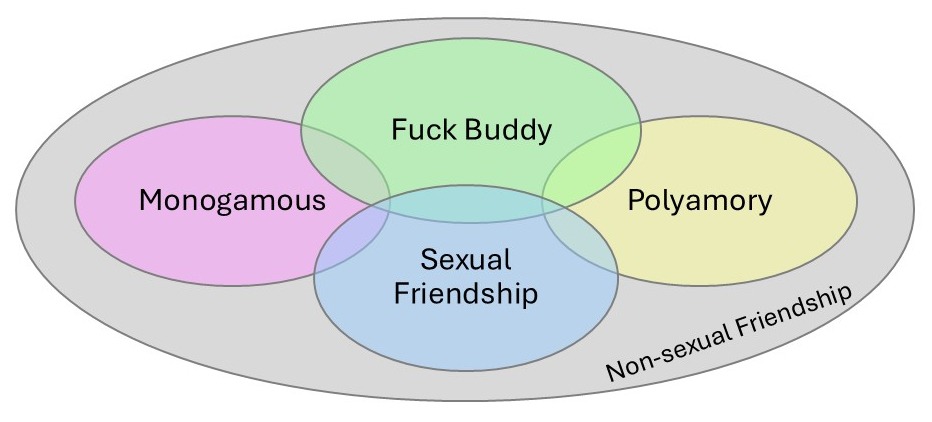
I’ve tried to capture the overlap, as I see it, of various levels of sexual relationship in the following diagram.

Venn diagram
It is important to realise that this is not a hierarchy
and neither are any of the groupings mutually exclusive.

Why should Geoff not be right? I have no experience of polyamory (and anyway every set of relationships will work in their own unique way) but could it be that polyamory sits sexually somewhere “beyond” the apparently more common fuck buddy relationship – which is also distinct from sexual friendship – something deeply and sincerely rooted in the same way monogamy is.

As you might expect from my generally open and liberal views I have no problem with this – although I concede that I might find the actuality difficult, which is doubtless says more about me and social conditioning.

It seems to me that in a world where everyone is really treated equally, regardless of sex (ie. we’ve managed to evict the patriarchy and male chauvinism) we would see an increase in genuine M-F friendships and then we could see a rise in sex (hetero and same sex) as a token of nothing more than friendship. And why shouldn’t we? Indeed it could even be a driving force for the change – a circular feedback loop.

Bring on that change, I say!

Nudity & Society IV: Useful Links

This is the last of four posts addressing nudity and society. The first three in the series will stand alone. These three articles are not fully referenced, hence this fourth and last article contains a selection of useful links supporting aspects of the first three articles. In addition a Google search on “nudity society body acceptance” (or similar) will find many additional articles (academic and otherwise) relevant to the whole series.


Read Article I. Read Article II. Read Article III.


The links below are presented without commentary, in order for readers to make their own judgement of the arguments presented (as is indeed true for the previous three articles). Some of the linked items present academic research; while many are opinion pieces which appear to be grounded in verifiable fact. However, as with all such opinion pieces, caveat emptor applies.


British Naturism, https://www.bn.org.uk

International Naturist Federation (INF), https://inf-fni.org

British Naturism Written Evidence to Parliament, 2020, https://committees.parliament.uk/writtenevidence/16087/pdf/

Why is Nudity Such a Big Deal?, https://kamilamurko.substack.com/p/why-is-nudity-such-a-big-deal

Why has nudity been a strong taboo in most societies for so long?, https://naturistplace.substack.com/p/why-has-nudity-been-a-strong-taboo

Benefits of social nudity: stress reduction, general health, https://naturistphilosopher.wordpress.com/2015/03/12/benefits-of-social-nudity-stress-reduction-general-health/

Beyond Hypocrisy and Fear, https://kamilamurko.substack.com/p/beyond-hypocrisy-and-fear

We Left Shame Behind… and We’re Not Going Back!, https://ournaturistlife.substack.com/p/we-left-shame-behind-and-were-not

The naked truth – research finds nudism makes us happier, https://www.gold.ac.uk/news/naked-and-unashamed/

I Feel Better Naked: Communal Naked Activity Increases Body Appreciation by Reducing Social Physique Anxiety, https://pubmed.ncbi.nlm.nih.gov/32500740/

On Nudity and Naturism, https://zenmischief.com/on-nudity-and-naturism/

Naked and Unashamed: Investigations and Applications of the Effects of Naturist Activities on Body Image, Self-Esteem, and Life Satisfaction, https://link.springer.com/article/10.1007/s10902-017-9846-1

The Naked Truth About the Sauna, https://kamilamurko.substack.com/p/the-naked-truth-about-the-sauna

Hate Your Body? Public Nakedness Might Change That, https://www.psychologytoday.com/gb/blog/all-about-sex/202211/hate-your-body-public-nakedness-might-change

How to Normalize Naturism in Modern Society, https://justnaturism.com/how-to-normalize-naturism-in-modern-society/

The Naked Truth: How Desexualizing Nudity Builds a More Civilized Society, https://medium.com/@LazySith/the-naked-truth-how-desexualizing-nudity-builds-a-more-civilized-society-31ac0c574b64

Naturism, Sex, and All the Messy Bits We’re Not Supposed to Say Out Loud, ttps://ournaturistlife.substack.com/p/naturism-sex-and-all-the-messy-bits

When “Nudity Equals Sex” Stops Working: What Sparks Desire Instead, https://ournaturistlife.substack.com/p/when-nudity-equals-sex-stops-working

How a Lack of Healthy Nudity Exacerbates Body Dysmorphia and the Hypersexulisation of Society, https://www.beaconssaministry.org/musings-of-a-queer-saint/lack-of-healthy-nudity-effects

Desire Isn’t a Committee Decision, https://kamilamurko.substack.com/p/desire-isnt-a-committee-decision

The Difference Between Skin and Performance, https://kamilamurko.substack.com/p/the-difference-between-skin-and-performance

Beyond Hypocrisy and Fear, https://kamilamurko.substack.com/p/beyond-hypocrisy-and-fear

A History of the Nude in 10 Works, https://www.sothebys.com/en/articles/a-history-of-the-nude-in-10-works

BN Children Deserve Better Report 2016, https://www.bn.org.uk/files/file/740-bn-children-deserve-better-report-2016/

Does nudity harm children?, https://www.planetnude.co/p/does-nudity-harm-children

Think of the children!: Relationships between nudity-related experiences in childhood, body image, self-esteem and adjustment, https://onlinelibrary.wiley.com/doi/10.1111/chso.12743

Naturism and religion, https://naturistplace.substack.com/p/naturism-and-religion

Naturism needs YOU to fight groundless nudity taboos, https://naturistplace.substack.com/p/naturism-needs-you-to-fight-groundless

Nudity and Naturism Quotes, https://zenmischief.com/nudity-and-naturism-quotes/

Nudity & Society III: Normalising Nudity in Daily Life

This is the third of four articles addressing nudity and society. Although a series, the first three will stand alone; the fourth article will be a selection of useful supporting links. Consequently there will be overlap of material between the articles. The articles are not fully referenced (hence Article IV), although a Google search on “nudity society body acceptance” (or similar) will find many articles (academic and otherwise) relevant to the whole series, starting perhaps with British Naturism’s 2020 Submission to Parliament.


Read Article I. Read Article II.


Have you ever felt discomfort when discussing nudity? So often shroud of shame descends, dictating how we view our bodies and those around us.

But in a world where we celebrate openness and authenticity in so many areas of life, why not strip away the stigma surrounding our most natural state?

So let’s look at how, and why, normalizing nudity fosters body positivity, enhances personal freedom, and ultimately leads to a more accepting society.

Nudity has long been wrapped in layers of taboo and societal norms, making it a controversial topic. For many, the mere mention of nudity conjures up overly sexualized images or simply uncomfortable ones.

But what if embracing our natural state could instead lead to greater acceptance and understanding?

The idea of normalizing nudity isn’t only about shedding clothes; it’s also shedding the insecurities. Acknowledging – even celebrating – nudity can foster a more open-minded society; a world where nudity is viewed through a lens of body positivity and mental well-being, rather than as something to be idolised or demonised.

nude athletes on a Greek vase

Throughout history, nudity has been perceived differently by different cultures. In Ancient Greece the nude was celebrated as a symbol of beauty and athleticism. Sculptures depicted the human form in its natural state, emphasizing ideals of strength and aesthetics.

Many indigenous cultures accept nudity as part of their daily lives, seeing it as harmony with nature, rather than something to be hidden or shamed.

By contrast, during the Victorian era, society imposed strict clothing norms, associating nudity with shame and immorality – a shift which marked a significant change in how bodies were viewed publicly and privately.

Nevertheless art movements like Impressionism highlighted the naked body without sexualizing it. Artists captured raw human experience through depictions of vulnerability and authenticity.

painting of two naked girls, back to viewer, preparing to bathe in a wooded stream

These varied perspectives show that attitudes toward nudity are not fixed but evolve over time and in different cultural contexts.

Embracing nudity can lead to a real sense of freedom. When we shed clothing, we also cast off society’s expectations, fostering self-acceptance and confidence in our bodies.

Psychologically, nudism encourages body positivity, and breaks down barriers created by unrealistic beauty standards. Nudists regularly report higher levels of happiness and reduced anxiety about their appearance.

Physically, spending time without clothes promotes skin health. Sunlight is beneficial when enjoyed responsibly, providing vitamin D while promoting an appreciation of one’s body. Air and sun help to reduce skin problems such as fungal infections.

Communal nude activities strengthen social connections. Such shared experiences create bonds beyond the superficial judgments which are so often tied to attire or fashion choices.

Many people have fears about nudity which are rooted in misconceptions. One common worry is that being naked equals being sexual, as I discussed in the second post. This belief creates unnecessary shame and discomfort around the human body, as well as promoting indecency or immorality. In reality, the vast majority of nudists embrace their lifestyle for its focus on freedom and self-acceptance – not for any inappropriate reasons.

It is often thought nudity leads to objectification; but the opposite is true. When practiced respectfully, nudity leads to an appreciation of bodies for their diversity rather than being judged.

Worries about vulnerability also surface. But again, embracing nudity empowers individuals to confront insecurities head-on, thus promoting confidence over fear.

Such misunderstandings fuel the taboos surrounding nudity. By addressing these fears we pave the way to healthier attitudes about bodies (ours and others).

Teaching children about body positivity is essential in nurturing their self-esteem. When kids learn to appreciate diverse bodies, they develop a healthier relationship with themselves and others. Research has shown many times that children are noticeably unfazed by nudity until adults teach them otherwise.

Conversations around nudity foster acceptance of all shapes and sizes. Normalizing different body types helps banish the harmful stereotypes that often lead to insecurities.

As an example, in Finland sauna is a way of life, a way of being: families come together; friendships deepen. Nudity isn’t optional; it’s required. Here children learn very early on that nudity isn’t shameful, but natural. People and bodies are respected; not sexualised or judged. It’s all a normal part of being human. Even our scars tell stories.

Encouraging open dialogue creates safe spaces for children to express how they feel about their bodies. This openness builds confidence and resilience against society’s pressures. Moreover, teaching kids the beauty of authenticity fosters kindness towards others. They learn that every body tells a story worth celebrating.

Integration of body-positive messages through books, art, and media is a powerful tool in shaping perceptions. With guidance, children can grow into adults who genuinely embrace diversity, rejecting narrow standards of beauty.

Although embracing nudity can be a liberating experience, it needs to be done with respect and mindfulness.

Start by creating a comfortable environment at home. Maybe designate certain spaces where you feel safe being nude, perhaps your bathroom or bedroom. Incorporate clothing-free practices into your routine: for example skin-friendly yoga in the privacy of your living room, allowing you to connect with your body without distractions.

Another option is joining naturist events or visiting nudist beaches which promote a respectful atmosphere. Such venues provide an opportunity to socialize while embracing nudity in a safe communal setting. Or join art projects that celebrate the human body; drawing or painting nudes helps normalize the beauty of bodies without sexual connotations. Art and nature, as well as everyday life, provide opportunities for nudity without shame.

Conversations about nudity also play a crucial role. Openly discussing our feelings around nudity demystifies it and reduces fear. Encouraging family discussions about body positivity is beneficial. Sharing experiences and feelings about nudity openly (including in an age-appropriate way with children) fosters inclusive attitudes.

Research shows that normalizing nudity can significantly reduce stigma surrounding our bodies. When we embrace nudism, we challenge the unrealistic beauty standards that dominate society. As attitudes shift towards acceptance rather than judgment, people feel less compelled to hide their natural selves. Such cultural transformation builds self-acceptance of our body as well as those of others.

By introducing nudism into daily life – with clothing-optional spaces, family discussions about body positivity, or advocating for less judgment – we pave the way for healthier attitudes towards ourselves and each other. Children who grow up understanding that bodies come in all forms carry this acceptance into adulthood, along with much better body acceptance and openness.

As society evolves, we should promote the idea that our physical selves are not a source of shame, but rather of diversity and individuality. Embracing nudity enables us to appreciate authenticity without necessarily sexualizing it.

Nudity and the philosophy of nudism can transform our relationship with our body, leading to greater happiness and health for all involved. The freedom found in shedding clothes as well as society’s expectations is profound.

As I’ve said before, at the end of the day, we all know what’s under your t-shirt and jeans, my t-shirt and jeans. So why is there a problem?

Nudity & Society II: Nudity and Sex are Not Coincident

This is the second of four articles addressing nudity and society. Although a series, the first three will stand alone; the fourth article will be a selection of useful supporting links. Consequently there will be overlap of material between the articles. The articles are not fully referenced (hence Article IV), although a Google search on “nudity society body acceptance” (or similar) will find many articles (academic and otherwise) relevant to the whole series, starting perhaps with British Naturism’s 2020 Submission to Parliament.


Read Article I.


At the risk of stirring up a hornet’s nest, I want to consider something that gives people pause: nudity and sex.

Almost all societies and cultures have taboos about sex and nudity. These appear largely based around the idea that if someone is nude then sex must be involved – and vice versa. Nudity and sex become inseparable; one cannot exist without the other.

But the liberating truth is:

Nudity does not require sex;
and sex does not require nudity.

Neither needs to be a taboo.

Think about that for a minute …

When we separate nudity and sexuality, we make room for more genuine comfort and body confidence – with ourselves and with others.

Nudity doesn’t have to be sexual. Being nude doesn’t automatically mean being sexual. Sometimes (most times) it just means being comfortable – in your own skin, with no pretence or performance. Think of when nudity is about freedom or expression: sunbathing, painting a self-portrait, breastfeeding, or stepping out of the shower to feel the air on your skin. None of those moments require sexual intent to be meaningful or beautiful.

nude couple, back to us, looking across a sandy beach and sea

Unfortunately though we’ve built a whole culture of taboos around nudity. Most of us have been taught to associate nudity with shame, temptation, or worse – an equation which is at best flawed. Such conditioning makes it hard to see the body as neutral let alone something to be appreciated, rather than judged. When we uncouple nudity from sexuality, we start to see bodies (ours and others) with more compassion and less anxiety.

Sex doesn’t have to be naked. Sexuality is about connection: emotional, physical, spiritual. While we often picture it involving total nakedness, that’s certainly not always the case. People can share deep intimacy while partly or completely clothed. Words, eye contact, emotional vulnerability, can be just as intimate as anything physical – whether clothed or not.

When we realize sex is about energy, communication, and consent – as opposed to what the body looks like – it takes the pressure off; it helps us redefine intimacy in ways that feel authentic rather than performative.

We live in a culture obsessed with, but terrified of, the human body. It seems to me a large part of the problem, and the reason for the taboos, is fear: we’re frightened of nudity because we don’t understand it; we think it (might be) an invitation, a sign of doubtful morals; and we’re petrified of losing control and being unguarded.

Because we see nudity as an invitation the media and marketing droids play on it; constantly trying to sell us a new Utopia in a bottle or a bra. Meanwhile society insists we cover up, hide, or feel guilty about our bodies, our physicality. We must not be seen to give the “wrong” messages.

This kind of mixed messaging makes it hard to know what’s “appropriate” or “normal”. So no wonder we cling to the taboos; they’re the only thing we know which appears safe.

We’re brought up with these mixed messages. But it needn’t be this way. We know kids are oblivious to nudity until we teach them otherwise. Research has also shown that being around nudity does kids no harm; it actually does them good because they develop better body image, and a better ability to see through society’s bullshit. We can do this through teaching kids about consent, boundaries and context so they can see the beauty and vulnerability of the body – and of course intimacy when/where appropriate. Sexuality can, and should, be approached in the same way.

How can we hope to have balanced and open minds when there are important elements of being human we keep closed off?

If we can’t talk about sex, we end up with shame and a lack of education.

If we can’t talk about (or see) nudity, then mental health suffers and we’re constantly fearful and prudish.

Healing this starts with awareness. It’s OK to admire the human body – yours or someone else’s – without turning it into something sexual. Let’s be honest: which of us doesn’t appreciate a pretty girl or a handsome guy (depending on one’s proclivities) whether nude or not. It’s OK to feel comfortable in, appreciate, and admire your skin, your body, without shame; and it’s OK to appreciate others. The body itself isn’t the problem; it’s the meanings – so often creepy or (latently) abusive – we’ve learned to attach to it.

Everyone has different levels of comfort around nudity and sexuality. Some, like me, are completely open and unfazed regardless of circumstance (it’s how I was brought up, enabling me to develop my own beliefs); others the complete opposite; most somewhere in between. What matters is choice and consent. You get to decide what feels right for you; when, where, and with whom. In return, others deserve the same respect.

Not assuming nudity always means sex, and sex always means nudity, gives us permission to create clearer boundaries, deeper trust, and an open mind; and it’s easier to honour what’s truly comfortable, rather than what’s culturally expected.

At the end of the day, your body’s not just something you “have”; it’s an integral part of who you are. It’s not inherently sexual, shameful, or wrong. It’s your home. Learning to inhabit that home with kindness and acceptance can be incredibly healing.

Let’s accept nudity as normal; and let’s see sex the same way. But they’re not ipso facto joined. Why should we not accept nudity as normal, just as we would Fred’s new suit or Suzy’s cocktail dress? We can admire and appreciate them, without seeing them as inherently sexual.

So whether you’re fully clothed, completely nude, or somewhere in between, remember you get to define what intimacy means for you; not anyone else and certainly not society. Which means: nudity doesn’t require sex (unless all those involved consent for it to do so); and sex doesn’t require nudity. But both, when approached with awareness, consent and respect can be deeply human (even transcendental) experiences.