Category Archives: current affairs

No New Town Here

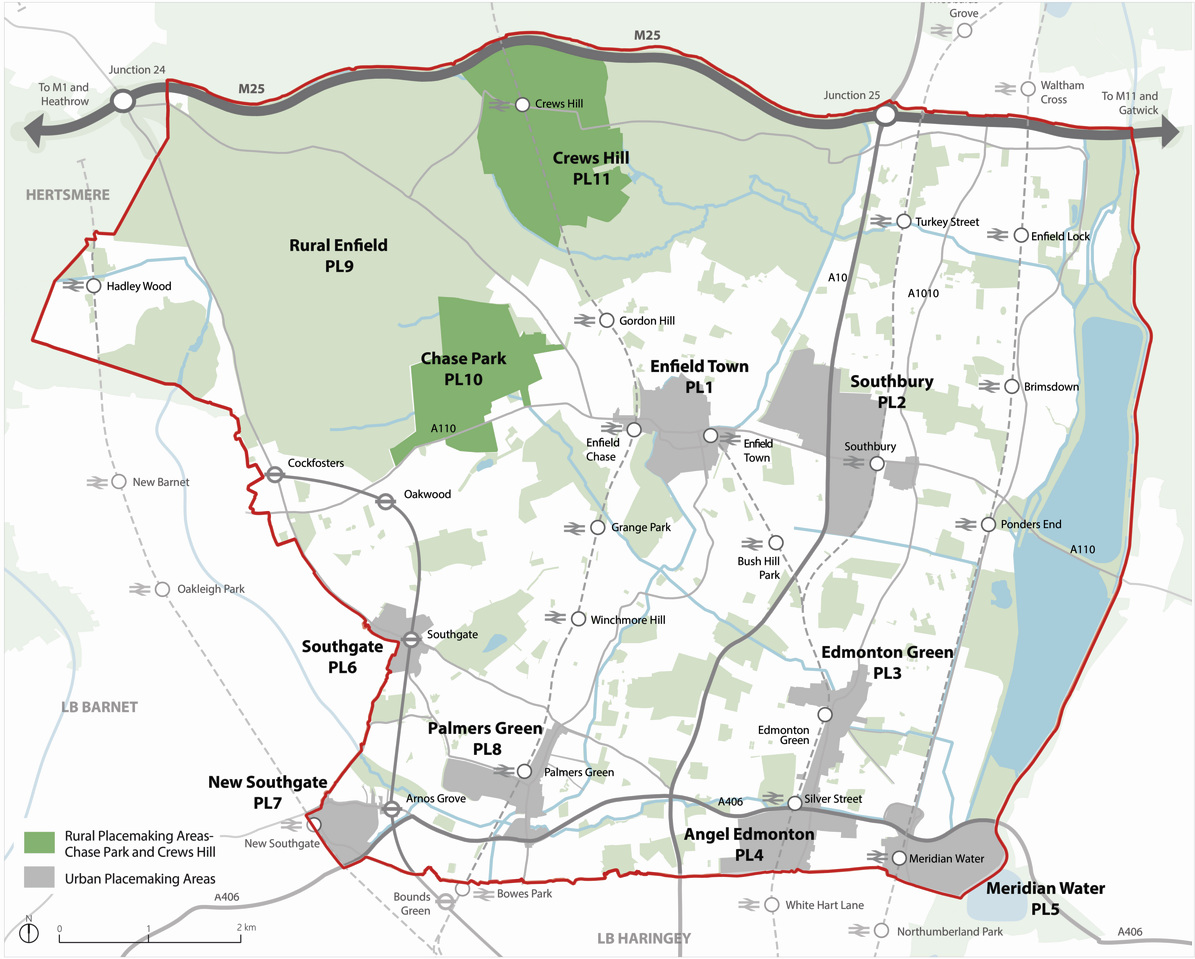
So the London Borough of Enfield – just a couple of boroughs away from me, and close to my home town – has withdrawn from the government’s “new town” programme. Basically the council, which has recently changed from Labour to Conservative run, has told the government there will be no “new town” building on the proposed sites at Crews Hill and Chase Park.

I know the Crews Hill area (although not recently) and it is an open, relatively unbuilt area which is a nationally important horticultural centre, including garden centres and plant nurseries; plus pet shops with reptile and bird specialists; and a popular equestrian centre. Consequently there has been significant local opposition to the government’s plans.

map of London Borough of Enfield
London Borough of Enfield, showing the planned “new town” development areas.
See the Station marked “Grove” at top right: that was where I spent my childhood.
Source: LB Enfield

Most of the two areas is designated Green Belt land, and should therefore be protected from development to ensure a green, environmentally friendly, area around the capital.

country scene
Around Crews Hill Golf Course

The Enfield council now says that the commitment to increase housing (required by the government, and the London Plan) will now concentrate on using brownfield sites and redevelopment of existing facilities.

I strongly believe this is something which needs to be exhausted before there is ever consideration of building on Green Belt or Metropolitan Open Land – which councils are overly prone to chip away at; this little bit won’t matter; and then this bit; and this bit; until the whole is gone, which I’m seeing locally. There seems too little concern for the environment; just more and more development – because it brings in money for the council.

[Aside: I also believe that any building which is less than 50% occupied for, say, three months should be required to be converted into housing. This would not only increase housing but also clamp down on speculative build.]

Enfield’s stance is not (just) a question of NIMBY-ism or party politics, but a strike for common sense, respect for existing communities, and the law.

More power to a council – any council regardless of political persuasion – with the guts to stand up to, and call out, the government. We need more of this if we are to keep the place pleasantly inhabitable and environmentally sound.

There are a number of media reports on the decision, including this from The Guardian.

On the Sexing of Toilets

Unisex toilets? I’m not sure that shouldn’t be uni-gender toilets!

The powers in this country are getting their collective knickers well tangled over the Equality & Human rights Commission (EHRC) guidance on the use of single sex toilets, changing areas, hospital wards etc. which is now before Parliament. This follows on from the April 2025 ruling by the UK Supreme Court that sex in the Equality Act means only biological sex (as defined at birth). This means ipso facto that single-sex toilets etc. end up excluding transgender people. (That in itself seems daft in the extreme, but that’s the law as presently laid down.)

I’m not going to spell out the details, partly because it looks a mess largely created by conflicting self-interest groups. If you want more background then there are countless media reports including from The Guardian and BBC News.

FFS guys, get a life! And grasp the nettle! There’s a very simple solution which I’ve been advocating for years, and which we know works. (See for example the last paragraph of my post from February 2013 and this longer post from May 2018.) What is this solution? …

Make every facility unisex. Yes, toilets, changing rooms, student accommodation etc. At the end of the day, as I’ve said before, where’s the problem: we all know what’s under each other’s t-shirt and jeans. But no, it doesn’t have to be quite that open – and yes, I do understand why some people feel the need for privacy.

My local swimming pool has had one single sex changing room for over 15 years to my knowledge. It is a single space used by men, women and children. For privacy there are lockable cubicles (of varying sizes to accommodate single people, parents with kids etc.) to change in, and lockers (in the open area) for your belongings. That way no-one should be blocking a cubicle for more than a few minutes while changing. So anyone can arrive dressed, choose any free cubicle, get changed and put their stuff in a locker; on return pick any free cubicle etc. etc. There are more lockers than cubicles, and cubicles can’t be locked from the outside, so you can’t block the cubicles.

It works. No-one in my experience even considers walking around the open area clad in anything less than a towel or swimsuit. There’s a choice of showers, either “open” or in cubicles – but all cubicles would be easy. And toilets can be easily arranged with just cubicles. Everything can have floor to ceiling partitioning if felt necessary.

Oh, and by the way, most accessible toilets are already unisex. So you can do it!

The one place it might be difficult is hospital wards; but then there’s a question of medical privacy to consider as well. A mix of alcoves with two to four beds and single rooms would seem doable – and if properly designed probably no less space efficient.

So, guys (of all sexes and genders), stop having conniptions and get a life. The solution is easy and it could/should have been universal decades ago.

HS2

I’m deeply sick of the vanity project called HS2. And today Simon Jenkins has a piece in The Guardian also decrying the project.

I’ve been saying this, or something like it, since the outset. This money could have been (and still could be) much better spent on upgrading the existing rail infrastructure across the whole country and likely at half the cost. Instead we have a Tory party (from recollection it was George Osborne) vanity project, which has conned every successive government, and for which IMO there was never a business case. It’s not too late to pull the plug and avoid an even greater waste of money and environmental destruction for something we don’t need.

Moreover we must be the laughing stock of the world when it takes us 30+ years to build a railway line.

I despair of this country!

On Oil and Ethics

“Europe will suffer jet fuel shortages in just three weeks if the Strait of Hormuz does not reopen”, Airports Council International (ACI) Europe has said, “particularly with the approach of the summer tourism season”.

Oh good!

We have to find a way to stop people, and freight, flying. We’ll never get close to Net Zero if we don’t.

Forget all the hype around Aviation Biofuel; opinion suggests that there will be too limited a supply and it will be too expensive (see here, for example).

Flying people and stuff around the world to the unnecessary extent we do is just not sustainable.

Moreover, although it is slowly being cleaned up, shipping is no better, given the bunker fuel most big ships still run on.

No, I’m not saying we have to stop flying (or shipping) entirely, but we need to be much more circumspect and use it only where really necessary. We need to go back to making and growing as much as we can as locally as we can – accepting that there are some (pseudo-)essentials of modern life that we can’t.

As I’ve asked before … Do you really need to fly to Australia, or USA, just for a 2 hour meeting with a client (which could just as easily be done over a video call), because the client says so? That’s a question of skewed business and management ethics.

Why do we ship, for example, wine, apples and lamb from the Antipodes – or airfreight runner beans from Kenya – to UK when we have lots of these commodities on our doorstep in Europe, if not at home. In reverse why do we fly long-haul for a few days break? These are questions of skewed marketing and consumer ethics.

We need to update our ethics – both personal and societal. Maybe an oil crisis will help the paradigm shift.

On Spiteful Sniping

I’m heartily sick of the media. The entire media. All they appear to do is to snipe spitefully (often without much apparent evidence) at those in power, with the aim only of getting them out of office. There is little or no regard for actual policies or what our leaders are genuinely and reasonably trying to do. Instead it is all about personal smears, and stirring up hatred, to undermine positions.

If the UK media manage to get Kier Starmer – or any member of the government – out of office it will be as a result of a spiteful, vitriolic smear campaign, and not because of the government’s policies and attempts at reform.

By all means criticise the government’s (or indeed anyone’s – it isn’t just government, but anyone with any power/influence) policies and attempts at reform. That’s how democracy should work. Then allow the electorate decide.

Yes, of course people make mistakes and errors of judgement. Find me someone who hasn’t. That is not something which warrants vitriolic, hateful, smear campaigns – nothing justifies such. We must allow people to acknowledge their errors, learn from them, and move on. Doing so will allow people to develop with compassion, and without trauma; we’ll stop wasting time and emotional energy; and we’ll make a lot more progress in a more peaceful, relaxed and thoughtful world.

So stop the spite and the vitriol.

Just shut the fuck up and let people get on with their jobs.

I Blame Harold Wilson

This is an opinion piece (an op-ed if you will) which I’ve been thinking about for a long, long time.

Back in 2014 Roy Hattersley wrote in the Guardian

[In 1964] Harold Wilson was elected prime minister of Great Britain and Northern Ireland. Labour won because its leader caught the mood of the time. Wilson was the politician as technocrat, the man in the Gannex overcoat who complained that, in a world in which “even the MCC has abolished the distinction between amateurs and professionals, in science and industry we are content to remain a nation of Gentlemen in a world of Players”.

Maintaining the technocratic image helped him to keep a fractious party more or less intact. But nobody doubted that the pragmatism about which he boasted was, in truth, guided by a principle which he set out in the language of the time. “The Labour party is a moral crusade or it is nothing.”

Two or three weeks into the new parliament, he invited the dozen or so youngest Labour MPs to Downing Street. The most self-confident […] told him that the government had made a crucial mistake in not devaluing the pound. They were right …

Harold Wilson brought a paradigm shift to government in the UK, and to the functioning of society as it finally surfaced from the deprivations of WW2. Wilson took advantage of the changing mood of the times. As a consequence many attitudes in the UK, and thinking within government – not to say many of the current problems which afflict the country – have their roots in the actions of the Wilson administrations of 1960s and 1970s.

Think about the following …

Comprehensive Schools
Wilson said he wanted everyone to have his grammar school education and in an attempt to achieve this effectively all schools became comprehensive. But the law of unintended consequences meant what happened was that by mixing the bright with the dim, the brightest got dumbed down, given no incentive to work hard and be stretched, while the less bright gained nothing. Actually the less bright also lost out because the previous secondary modern schools had never been properly constituted (with good curricula) and consequently the change of focus meant there was no foundation to fall back on.

Expansion of the Universities
To be fair this was started under Harold Macmillan, but the expansion of the mid-60s was the first step on the slippery slope to the destruction of Technical Colleges, Polytechnics and apprenticeships. This has, in turn, led to a shortage of technical training for plumbers, bricklayers etc. – we didn’t need them: Wilson’s “white heat of technology” would do it all. But we do need them and so we have ended up importing them from places like Eastern Europe.

Another consequence is that we now have too many, low quality, universities running courses of little worth and awarding over-inflated degrees. Why? Because over time everyone has become entitled to a university education – and government wanted to keep the unemployment figures down. Not a direct result of Wilson, but built upon the foundations he laid.

Soundbite Government
Wilson was the first to blatantly use the media as a tool of government and to provide snappy soundbites. Remember “the pound in your pocket”, “the white heat of technology”, and “beer and sandwiches at No.10” to win over stroppy union leaders?

Media Freedom
It isn’t clear which is chicken and which is egg, but with soundbite government the media started to feel they had much more freedom and fewer constraints, and they became more available with the advent of regular TV news bulletins. News became more immediate; and the public started to see, and recognise, politicians when previously they had little inkling of the machinations of government, who those people were, and what they did. This inevitably (over time) led to the broadcasting of Parliament, with politicians being interviewed at every turn – and spinning every story for their benefit.

Government and Industry
The beginning of politicians and government obviously, openly and blatantly in cahoots with industry for their own benefit. Remember Wilson’s Gannex mac? This was doubtless nothing new, but it was now out in the open or at least much more easily probed.

Destruction of British Industry
Wilson’s watch saw the rise of unprecedented union power, which was allowed to cripple manufacturing (think cars, steel, shipbuilding) and which continued until Thatcher broke the miners in the 1980s. That’s not to say unions haven’t been a force for good in improving working conditions etc., but under Wilson they very much had the upper hand (which is now really evident only in the rail unions as most of the rest have been emasculated). This ultimately led to substantial wage rises, high inflation, wage restraint, and high unemployment.

British Rail & Utilities
The actions of Dr Beeching in massacring Britain’s rail network were, admittedly, started under Harold Macmillan, however the pressure was continued under Wilson with BR, and indeed many other public utilities, being subjected to unprecedented attention from government accountants – something which continues to this day – and threats of nationalisation. This was in large part undone by the privatisation policies of Margaret Thatcher’s administration which has left many of our utilities in a position where it would be almost impossible to fully renationalise them.

Financial Crisis
All of this led, inexorably, to a financial and economic crisis, a series of failed economic measures, and the consequent devaluation of the pound by 14% in November 1967. Arguably the economy and the country’s financial situation has never recovered from this.

Social Agenda
Under Wilson’s administration we saw the first Race Relations Act (1965), the Sexual Offences Act (1967) and the abolition of (almost all) capital punishment (1965); followed later by an expansion of the welfare state. Our current social policies (including welfare payments) are very much built upon these foundations and are, in my estimation, a large factor in the current entitlement of much of the population.

Corrupt Patronage
Patronage, and corrupt patronage, has always happened. But because of the greater freedom of the media and its availability to all, Wilson’s patronage of people like Marcia Falkender (his political secretary and alleged mistress) and Lord Kagan (of Gannex macs) became open knowledge, if not actually more blatant.

I’m not saying that all our current ills are directly attributable to Harold Wilson. Nor am I saying that Wilson didn’t do some good things (eg. the welfare state). But much of where the UK is now, at least internally, is built upon the foundations set by his administrations.

That, at least, is my assessment. YMMV.

There’s much, much more about Harold Wilson on Wikipedia.

#MeFirst

I’ve been thinking recently about personal attitudes and the state of society. There has been a marked shift in the willingness of people to be active in the community, for the greater good of the community.

It’s been happening for quite a while, but has got worse since the beginning of the COVID pandemic. We now live in a world which has shifted away from community spirit to an almost ubiquitous focus on personal gain: “what’s in it for me?”.

People get angry about being inconvenienced. Their plans matter more than public safety, or the community. It’s selfish and ultimately destructive.

We’ve lost the civilising philosophy of “Do unto others as you would wish them to do unto you”.

As I say, this was happening before COVID; however the isolation of lockdown, the fear, and in many countries the indifference (or worse) of government have multiplied this “me first” attitude. Everything has become focussed on “how does this affect me?” rather than the broader picture of “how does this protect us?”, “how does this benefit the community?” or even “do I really need this?”.

Freedom has shifted from living peacefully with others in society, within the law, to “I can (and will) be allowed do whatever I want, regardless of anyone else”. That’s not to say that we should all be mindless, conforming drones. There is still, and always must be, a place for free speech, a variety of opinion, demonstration, and challenging the status quo. Nor am I saying that self-care doesn’t matter. But we’ve been brainwashed into a view that everything is a service we pay for (especially when it’s free!) and is therefore a right which must be provided here and now, or else.

This has not been helped by the political modus operandi which has become so polarised that there is no thought of compromise and common ground. Worse, what are people supposed to think when they see the politicians avoid any consequences for their lies, malfeasance and broken promises. The USA is demonstrating this in spades; and they aren’t the only ones. What’s sauce for the goose is sauce for the gander.

We’ve gone from “we, we, me” to “ME, ME, maybe we”.

We’re seeing this in so many areas. One place I see it is as Chairman of my doctor’s patient group: patients are demanding to always have a face-to-face appointment with their GP – today! – rather than trusting the GP to make a decision based on the clinical need. Because if a phone call is sufficient (as it is in a majority of cases) it benefits everyone: it is less disruptive, quicker, and thus better for everyone as the GP can get to treat more patients (who may be at greater need). But no, I must come first; my desires are paramount.

How many these days voluntarily put themselves forward for community roles? For example: as school governors; as charity workers; as interest group newsletter editors. Judging by the number of organisations advertising (internally or externally) for people, the answer is “very few”. I don’t recall this being an issue when I was younger; there was almost always a volunteer willing to step up. And it is all levels of society, top to bottom, regardless of which method you use to slice the “society cake”.

The idea of contributing, even sacrificing, something for the community has pretty much disappeared. When enough people are putting themselves above the group’s wellbeing, things shift, trust turns to suspicion, every obstruction engenders anger; and the community starts to fracture. When “we” becomes “me” the community dies. Just as we’re currently seeing in society – worldwide.

It’s not so much #metoo as #MeFirst.


There’s a fuller exposition of this in the article When “What’s In It for Me?” Kills Community … . Ignore the naturist foundations to the article; it’s just as appropriate for any community, of any size.


June Quiz Answers

Here are the answers to this month’s six quiz questions. If in doubt, all should be able to be easily verified online.

World Affairs

  1. Which political figure became Baroness of Kesteven? Margaret Thatcher
  2. What year was the United Nations established? 1945
  3. Tedros Adhanom Ghebreyesus became the head of which United Nations agency in 2017? WHO (World Health Organisation)
  4. Who was US President in the year 2000? Bill Clinton
  5. What was the name of the treaty signed between the Allies and Germany that officially ended WWI? Treaty of Versailles
  6. The border between North Korea and South Korea is about 257km long and 4km wide. What is this buffer zone known as? Korean Demilitarised Zone (DMZ)

Answers were correct when questions were compiled in late 2024.

June Quiz Questions

Each month we’re posing six pub quiz style questions, with a different subject each month. As always, they’re designed to be difficult, but it is unlikely everyone will know all the answers – so have a bit of fun.

World Affairs

  1. Which political figure became Baroness of Kesteven?
  2. What year was the United Nations established?
  3. Tedros Adhanom Ghebreyesus became the head of which United Nations agency in 2017?
  4. Who was US President in the year 2000?
  5. What was the name of the treaty signed between the Allies and Germany that officially ended WWI?
  6. The border between North Korea and South Korea is about 257km long and 4km wide. What is this buffer zone known as?

Answers will be posted in 2 weeks time.

Monthly Links

Welcome to the first “Monthly Links” of 2025, where we give you links to things you may have missed the first time around. And do we have a bumper crop this month!


Science, Technology, Natural World

Let’s start with a celebration … This month the Universe is 100! [LONG READ]

We do live in a special part of the Universe, don’t we? [££££]

It took Galileo’s new-fangled telescope to find these four objects which you can now see easily with binoculars.

And scientists continue to push the boundaries of the telescope … Hubble Space Telescope wasn’t supposed to ever look at the sun, but they did it anyway. [££££]

Twenty years ago there was a cosmic explosion which rocked Earth. [££££]

Slightly less dramatically, Pluto and Charon may have formed as the as the result of a kiss.

Meanwhile astronomers are hoping for a brief, but spectacular, star which appears only every 80 years. [LONG READ]

Also celebrating its centenary is the Pauli Exclusion Principle which underpins our understanding of subatomic particles.

Let’s get our feet back firmly where we can understand what’s going on … or not so firmly, as here’s a look at the strange fish which has historically struck fear into the hearts of mariners.

Still on oddities, a pair of birders in Michigan have been visited by an extremely rare yellow cardinal bird.

Why in 1926 in the USA was there a plague of mice? [LONG READ]

Going down another level in size, some caterpillars make deadly venoms which can even kill a human.

Even further down is size to our DNA, why are we all riddled with genetic errors? [LONG READ]


Health, Medicine

The series looking at modelling a pandemic has reached Part 4: Asymptomatic Transmission. [LONG READ]

OB/GYN Dr Jen Gunter takes a look at fibroids, one of the scourges if the female reproductive system. [LONG READ]

At the other end of the body, it seems the pupil of the eye can open a surprising window on the mind.

And here’s a real oddity … an 84 year old man in Hong Kong has turned grey due to silver poisoning.


Sexuality

Kate Lister says she spent a year telling men where they were going wrong in bed. [££££]

A sex expert suggests eight questions everyone should ask for better sex. [££££]


Environment

The expansion of London’s Heathrow Airport, indeed all airport expansion and air travel in general, will negate the UK’s attempts to reach net zero.


Social Sciences, Business, Law, Politics

Breaking with my normal position on politics … In what may be my only comment on the state of the USA, Ian Dunt at The I Paper looks at that Elon Musk Nazi salute and what it means for the future of the US. [££££] [These people have to be stopped, but how?]

How can we fix democracy? Ancient Greek philosopher Plato could suggest the answer.

Zoom calls and how to survive them in 2025.


History, Archaeology, Anthropology

A quarry in Oxfordshire has yielded the UK’s (and maybe Europe’s) biggest set of dinosaur tracks. (Aerial view above.)

Archaeologists have discovered that they can extract ancient DNA from dirt, so areas like cave floors are revealing yet more information about, for instance, Stone Age humans. [££££]

Meanwhile investigations are ongoing into how built Europe’s first cities.

In Egypt archaeologists have found the 4,000-year-old tomb of an overachieving magician.

An Iron Age site in Dorset is demonstrating that women were at the centre of some tribal communities, and exploding the earlier misogynistic narratives.

Excavations at Pompeii continue to reveal astonishing details of life there, including unexpected luxury.

Here’s a look at what five gold rings from Norfolk can tell us about the past.

Porch House in Stow-on-the-Wold claims to be Britain’s oldest pub dating from around 947. But is it really?

Leonardo Da Vinci always maintained that there were secret tunnels in Italy’s Sforza Castle. It now turns out he was right.

Excessively pointed shoes were the height of fashion in medieval London


Lifestyle, Personal Development, Beliefs

Meet a sea captain who’s obsessed with icebreaking.

We’re losing the ability to write in cursive, and therefore also read it – and it’s all the fault of computers.

And finally … What do you need to start meditating? Nothing except your own mind.