Category Archives: current affairs

Leadership

James Timpson (Chief Executive of the Timpson Group, Chancellor of Keele University, Chair of Prison Reform Trust) has been appointed Minister for Prisons, Parole and Probation in Sir Kier Starmer’s administration.** It is excellent that the new PM is appointing people who have some knowledge of what their departments are supposed to be about.

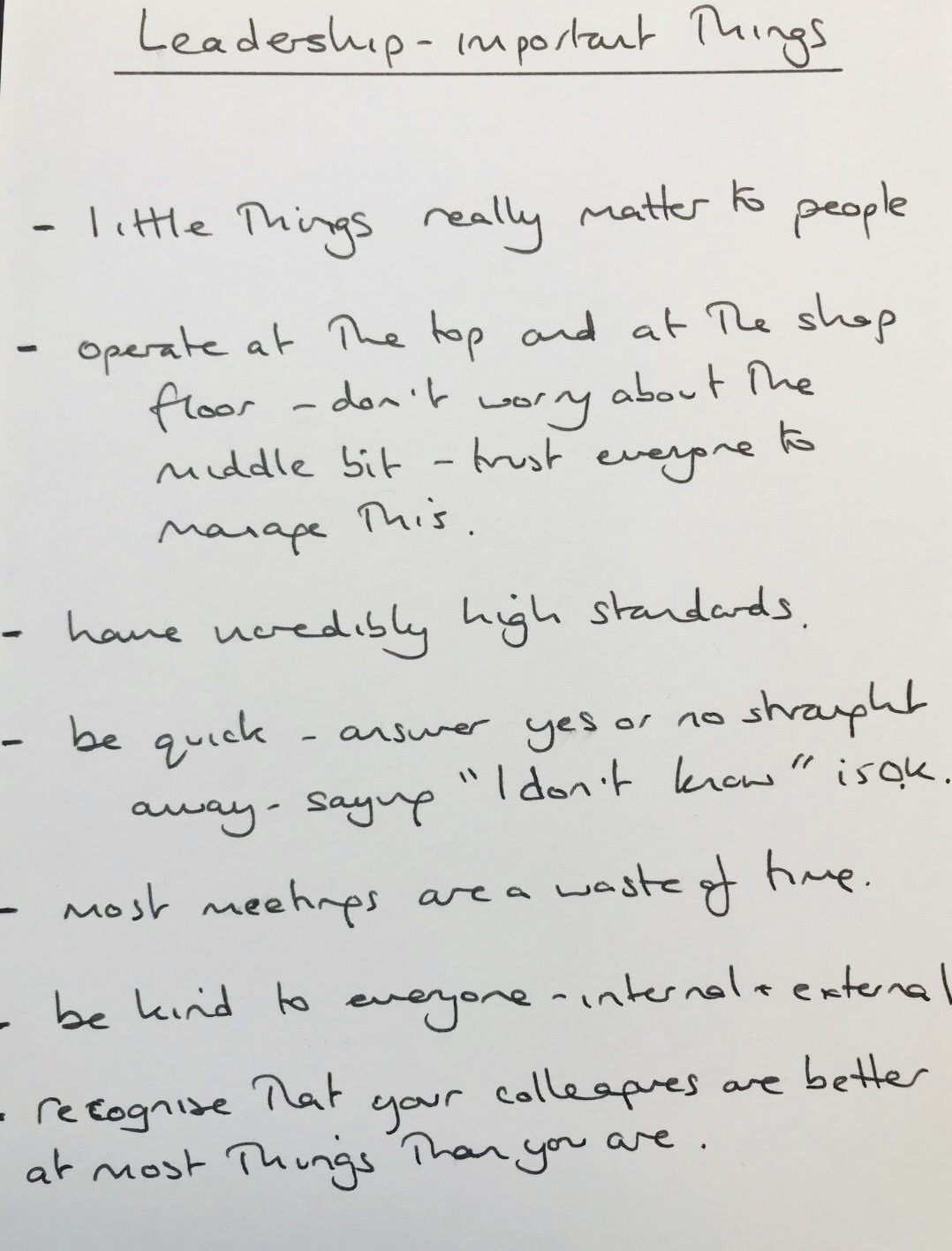
Even better is the fact that Timpson (who, by the way gets a peerage to be able t be a minister) also knows something about leadership and management – a skill which recently appears to have been woefully lacking. A couple of years ago he posted his guiding principles online, and of course the internet has just resurrected them.

handwritten note
Click the image for a larger view

We need a lot more of the appointment of specialists and people who know how to manage. Now let’s have it applied throughout the NHS.


** I was going to say “government” but I was once ticked off by the late Lord Gowrie for this usage. The administration is the monarch’s government, not the Prime Minister’s.


Does the UK need a Monarchy?

The recent death of Queen Elizabeth II and the Coronation of King Charles III has opened debate on whether the UK should have a monarch or an elected president.

This is essentially two questions: do we need a monarchy, and do we want a monarchy? And they are two very different questions. I can’t account for what people think they want – but I can point out some of the arguments.

First of all … Do we need a monarchy? Put simply, no, a monarch as head of state isn’t necessary. Many countries operate quite effectively as republics with an elected President – see France, Germany, Ireland – as head of state. What a country does need is a head of state, who is empowered (within whatever the constitution is) to make final decisions on ministers etc. and to represent the country at the highest level. The buck has to stop somewhere and, for the avoidance of factionalism, that has to reside in a single person be they a president or a monarch.

So should the UK have a monarchy? Well, just because there are more presidential republics in the world than there are monarchies, doesn’t mean they are necessarily better. Let’s look at some of the arguments.

  1. Cost. Monarchs are generally well off; presidents maybe not be so much. But in both cases the state will be paying much of the cost of maintaining the head of state. This will encompass their personal maintenance, the cost of state apartments/palaces, and duties performed as head of state (including transport and security). There are also, of course, state occasions like banquets (usually for other heads of sate) and ceremonial (like regular inaugurations, irregular coronations, opening parliament, state funerals). Whether you have a monarch or a president these costs are going to be much the same. A president will not de facto be cheaper.
    Given sufficient wealth a monarch or president may maintain their own private residence(s), staff, etc.; and this may help constrain the cost to the public purse. Monarchs, likely being wealthier, are perhaps more likely to do this.
    Result: a draw
  2. Appointment. Monarchs are in most cases hereditary, so the succession from one to the next is fairly assured, relatively smooth, relatively infrequent, and relatively low cost. The major cost is just that once in a while state funeral and coronation.
    By contrast presidents have to be elected every few years. Hence there is the cost of the regular elections and regular inaugurations. And the inaugurations may require just as much pomp and pageantry as a coronation. Additionally, past presidents are often paid huge “pensions” for life, and a country could be paying several of these concurrently – as the US currently is.
    Let’s look at this another way. Those regular presidential elections are a recipe for farce, charade, deceit and a completely overwhelming media and political circus. Just think about the US Presidential elections: do we want an unedifying circus, US-style, every four or five years? Because that’s what we would get; we have a track record of picking up bad habits from the US. We already have general elections, local elections, and in many places mayoral elections; aren’t they sufficient circuses?
    Result: win for monarchy
  3. Malfeasance. In general, these days, with constitutional monarchies the monarch doesn’t have their hands on the country’s finances. This is not the case with (a lot of) presidents. In consequence it is much easier for a president to have their hand in the till and to syphon off money etc. into their own pockets. Presidents are much more likely to become newly wealthy at the expense of the country. Another weakness of a republic is that it can afford too easy an inlet for foreign corruption.
    Of course this was not always the case and in times past many monarchs lined their own pockets via all varieties of taxation – but then in those days there was little differentiation between the state’s money and the monarch’s; something which disappeared with the separation of state and monarchy (during the 18th-century in the UK).
    In the UK, the royal family are super-wealthy, and much of that wealth has arisen via their ancestors, and not all acquired honestly. We may decry that, but whether right or wrong by our moral code, such were the “rules” of the day – and good legislation is not retrospective. But not all the royals’ money comes from their ancestors; much comes from business activity – whether that’s things like the Duchy of Cornwall or the late Queen dealing in racehorses.
    So yes, perhaps the royal family should not be so wealthy, but at least these days they have relatively little opportunity to have their hands in the till.
    Result: win for monarchy
  4. Property. Do not run away with the notion that everywhere the UK royals live is theirs. Many (most?) of the properties belong to the state (Buckingham Palace, Windsor Castle, Holyrood House, Kensington Palace), and some belong to the royal dukedoms (eg. Highgrove is owned by the Duchy of Cornwall, and hence is now under Prince William’s control but not ownership). Only a few properties are actually owned by the royal family per se: eg. Sandringham, Balmoral.
    Result: a draw
  5. Popularity. This is where having a president may be preferable. With an unpopular, inept or corrupt monarch it is almost impossible to get rid of them; although most monarchies are constitutional (or parliamentary) and the head of state can do relatively little damage. On the other hand an unpopular president can be removed at the next election; but in the meantime will often have more power to do untold damage – see events of recent years in the US.
    Result: a draw
  6. Tourism. The British Monarchy is well respected abroad, a profitable brand, and our pageantry is second to none. Which all brings in tourists – and hence money – from around the globe. This is much less likely to happen with a president: for instance, boring motorcades are much more likely than horse-drawn gilded coaches.
    Result: win for monarchy
  7. Partisanship. Most monarchs, and the late Queen was an exemplar of this, are above partisanship. Whereas presidents, almost by definition, will always be partisan. Monarchs are not involved in the day-to-day activity of government; by contrast a president is so often the head of government and has day-to-day control – so there is no-one outside government to try to see the bigger picture and provide impartial advice.
    Monarchs generally offer steady, self-effacing leadership, whereas grubby politicians come and go, they cut deals, and win elections by dividing their country.
    Result: win for monarchy

So in my estimation, a monarchy wins 4-0. But as always YMMV.


Sources

On Freedom of Speech

To paraphrase a comment I saw elsewhere …

A freelance sports commentator has been told by a company he works for how he may and may not make comments, unrelated to his work, on his social media; and he is not being contracted until he agrees. This appears to be an outrageous political stitch-up in which the spine-less company has kowtowed to an increasingly Fascist government in an attempt to suppress free speech.

I’m not going into the realms of who is involved (we all know the current brouhaha) nor who said what and to whom.

But we need to get one thing straight …

FREE SPEECH IS SACROSANCT

I am entitled to my opinion, and to express that opinion. If you dislike it, that’s your problem and reflects on you, not me. I am not, and cannot be, responsible for your beliefs, actions, emotions etc. We none of us can control the brains of another.

And vice versa … If you say something I dislike or disagree with, that’s my problem. I can choose to be publicly (or privately) annoyed or I can stop and think. Even if I fundamentally disagree with you, you are entitled to have and express your opinion. And, as I have said on may occasions, I will defend this right to the last.

If I believe, as I do, that the government are a bunch of pathetic, self-serving c*nts I have the right to say so. I don’t expect them to agree with me; that is their problem and their privilege; it does not entitle them (or any third party) to muzzle me.

How about we all just grow up!

London Bridge

London Bridge is Down

Such apparently was the code to be used to announce Queen Elizabeth II’s death to court and government.

The Queen is dead!
God save the King!

OK, I’m not going to rehash any of the general outpouring of grief, reflection and remembrance that appears to be gripping the country – as regular readers know, such is not my style.

My comment is really just that this does feel somewhat surreal.

I’m old enough to have now lived in the reign of three monarchs. I was just a year old when George VI died, so although “I was there” I remember nothing of it. Nor do I remember QEII’s coronation in June 1953, when I would have been 2½ – although I’m told I was taken to a neighbour’s to watch the event on TV.

So effectively I have only ever known Elizabeth II as monarch. She was there; always; “part of the furniture” as it were. And it seemed she always would be there; like the Queen Mother before her she seemed immortal – and then suddenly she wasn’t.

What struck me as odd was how quickly it all happened. OK, so the Queen was frail, but on Tuesday she was meeting the outgoing and incoming Prime Ministers (admittedly at Balmoral, making them travel) and looking frail; and two days later suddenly she’s gone, with effectively no real warning. One had expected that her demise would be drawn out over maybe a week of final illness. So perhaps all was not as good underneath as it seemed, and her “mobility issues” were as much to do with (say) heart or cancer as just worn out joints. No doubt the truth will emerge – eventually.

There will, naturally, be a period of national mourning at least until the state funeral, which is unlikely before Monday 19 September (what a security nightmare that will be). Fortunately there are fairly advanced plans in place which can be rolled out – albeit with many final details to be resolved – the logistics are essentially already in place (this is one role of the Earl-Marshal and the College of Arms, qv. for items on protocol). It is going to be very interesting to see what gets cancelled, postponed or closed over the coming days.

So now we have King Charles III. I admit I thought until a year or so ago that he’d probably duck and we’d go straight to William, although I came to the conclusion that Charles wouldn’t pass. I’ve also come away from the view that Charles might abdicate in favour of William after 5 or 10 years; I now don’t think he will do that either, although he may reassess this if his health deteriorates.

Many thought Charles would not reign as Charles III, given the history of Charles I and Charles II. But I thought it unlikely he’d choose to be known as anything other than Charles (in the way his grandfather, Albert Frederick Arthur George aka. King George VI, had).

And so to a Coronation. It’ll be a few months away, they say. No, it will be many months away. The late Queen’s coronation took almost 18 months to arrange, and I can’t see Charles’s being any easier (if nothing else it will be an even bigger security nightmare). So it is very unlikely before this time next year, and they’d want to avoid the anniversary of the Queen’s death, as well as having left a suitably respectful period. They’ll also want to avoid the winter weather, as any coronation is a big display of pageantry. So my money is on Spring/early Summer 2024. We shall see.

A new monarch will mean a lot of work for quite a few businesses. All the printed copies of the national anthem have to be updated; potentially hymn books and prayer books; all government document formats and websites; all royal warrants; many flags (especially if the Royal Standard is changed). Not to mention commemorative merchandise, especially for a coronation. The list goes on and on and … That could well keep the country out of the otherwise impending recession – let’s not say the Queen didn’t always do her best for us!

And eventually our money and postage stamps will need to be updated. That though will take time; there’s no great rush as the precedent is for existing money to continue to be legal tender for years to come (basically until it has to be withdrawn through wear and tear). Stamps are likely to happen sooner; but again there’s no great rush and existing stocks can probably be used for some while – the challenge will be any upcoming commemoratives, including Christmas stamps.

Meanwhile …

RIP Queen Elizabeth.
God save the King!

We do indeed live in interesting times.

Imperial Measurements Consultation

In a move typical of obfuscatory government everywhere, on Friday 3 June, a public holiday, the UK government slipped out a purported consultation on the suggestion of the UK reverting from metric to Imperial measurements.

I’m not going to rehearse the arguments here – I have better things to do, like cook dinner. However my polite response is basically: If it isn’t broken, don’t fix it.

The current system isn’t broken; it doesn’t need to be changed; although it could be improved by removing the last vestiges of Imperial measurements which remain.

You can find the consultation at https://www.gov.uk/government/consultations/choice-on-units-of-measurement-markings-and-sales. The consultation is open until 26 August (which you also aren’t told except hidden in the documentation).

Anyone may respond: so please do.

H/T Martin McKee, @martinmckee on Twitter.

Monkeypox 6. Quick Updates

This is really going to be just a quick few updates of some of the salient features I spotted in the last few days.

The headline message remains: The risk is low so don’t be concerned, but do be vigilent.


Illness & Precautions

  1. Infection during pregnancy can lead to miscarriage. [1]
  2. A child’s temperature is likely to be higher with monkeypox, and they may complain of backache, lower leg aches, chills, and very tender glands around their neck. The blisters are bigger with monkeypox (cf. chickenpox). [2]
  3. People with monkeypox have been told to avoid contact with their pets for three weeks amid concerns the animals could become infected and pass the virus on to other people. However the risk of someone passing monkeypox to their pet is low and no cases of monkeypox have ever been suspected or reported in pets in the UK. [3]
  4. People who have tested positive for the virus and their close contacts are being told to isolate at home for 21 days. They should avoid contact with other people until all lesions – or blisters – have healed and scabs have dried off. [4]
  5. Anyone testing positive is being told to abstain from sex while they have symptoms, and then use condoms for 8 weeks as a precaution. [4]
  6. Confirmed cases and their close contacts should take extra care if they need to leave the house to see a doctor or other health worker. [4]

Epidemiology

  1. Health officials are reporting that the current monkeypox outbreak is mostly affecting younger men in London. Although anyone can contract the virus, 111 of 183 cases** in England are in men who have sex with men. In England, 86% of those infected live in London and only two are women. Most are aged 20 to 49. [5]
    (** This was a couple of days ago and the numbers have increased since then. The UK government regularly publishes the latest figures etc. [11])
  2. People aged 50 and above are likely to be immune (they’re more likely to have had a smallpox vaccination) but the under-50s are more susceptible. [7]
  3. The recent outbreak of monkeypox is being linked to events taking place in Spain and Belgium, according to a leading advisor to the WHO. And the authorities are investigating possible links between a recent Gay Pride event in the Canary Islands, which drew 80,000 people, and cases at a Madrid sauna. [6]
  4. Experts in Africa have warned that monkeypox could change from a regionally widespread zoonosis to a globally relevant infectious disease. The virus may be filling the ecological and immunological niche once occupied by the smallpox virus now that smallpox vaccination has ceased. [1]
  5. Which means this was an outbreak waiting to happen after the end of global smallpox vaccination more than 40 years ago. [7]
  6. There’s unlikely to be the same “explosive growth” of infections into the general population that was witnessed with Covid. However the outbreak could continue for several months as contact tracing slows but does not stop transmission. [7]
  7. Scientists are working through how the disease came to flare up in so many countries in such a short space of time. Many suspect that monkeypox was circulating at low levels, undetected, in the UK or Europe for several years before it reached the MSM community and flared up. [8]
  8. Genetic studies on monkeypox viruses taken from people in the ongoing outbreak show a close resemblance to the virus that reached the UK, Israel and Singapore from Africa in 2018 and 2019. They all have a common ancestor which probably dates back to 2019. [8]
  9. Data from the Democratic Republic of the Congo in the early-1980s and mid-2010s suggest the effective reproduction numbers at those times were 0.3 and 0.6, respectively – meaning each infected person passed the virus to fewer than one person in those populations, on average. [1]
  10. DNA viruses like these are a lot larger and more complicated than RNA viruses like Coronaviruses. Coronaviruses are among the largest RNA viruses known, at about 30,000 base pairs, but things like monkeypox are up over 200,000 bp. [9]

Zoonotic Concerns

  1. The infection can be spread by animals, and pet owners have been urged to “manage exposed pets and prevent the disease from being transmitted to wildlife”. [10]
  2. The EU has warned that the zoonotic transfer to humans could spill over yet again from humans to other mammals, potentially making monkeypox endemic in Europe. That’s a real concern, since we know the disease can be carried by a variety of small mammals. But what we don’t know is the likelihood of humans passing it on to animals, or the disease getting established among those animal populations in the wild. [9]
  3. Some of our most troublesome infectious disease threats – think Ebola, or Nipah, or coronaviruses, and now monkeypox – are disproportionately zoonotic diseases. [1]

References

[1] https://www.scientificamerican.com/article/what-we-know-about-the-rise-in-monkeypox-cases-worldwide/ [£££]
[2] https://www.thisislocallondon.co.uk/news/national/uk-today/20163472.uk-monkeypox-outbreak-tell-difference-chickenpox-monkeypox/
[3] https://www.theguardian.com/science/2022/may/27/monkeypox-patients-contact-pets-uk
[4] https://www.bbc.co.uk/news/health-61640196
[5] https://www.bbc.co.uk/news/health-61660180
[6] https://www.thisislocallondon.co.uk/news/national/uk-today/20160206.monkeypox-outbreak-sex-raves-spain-belgium-may-blame/
[7] https://www.theguardian.com/world/2022/may/24/monkeypox-outbreak-was-waiting-to-happen-say-scientists
[8] https://www.theguardian.com/world/2022/may/25/monkeypox-may-have-been-circulating-in-uk-for-years-scientists-say
[9] https://www.science.org/content/blog-post/now-monkeypox
[10] https://www.thisislocallondon.co.uk/news/national/uk-today/20162530.monkeypox-pet-owners-urged-manage-exposed-pets-uk-cases-rise/
[11] https://www.gov.uk/government/news/monkeypox-cases-confirmed-in-england-latest-updates

Elections

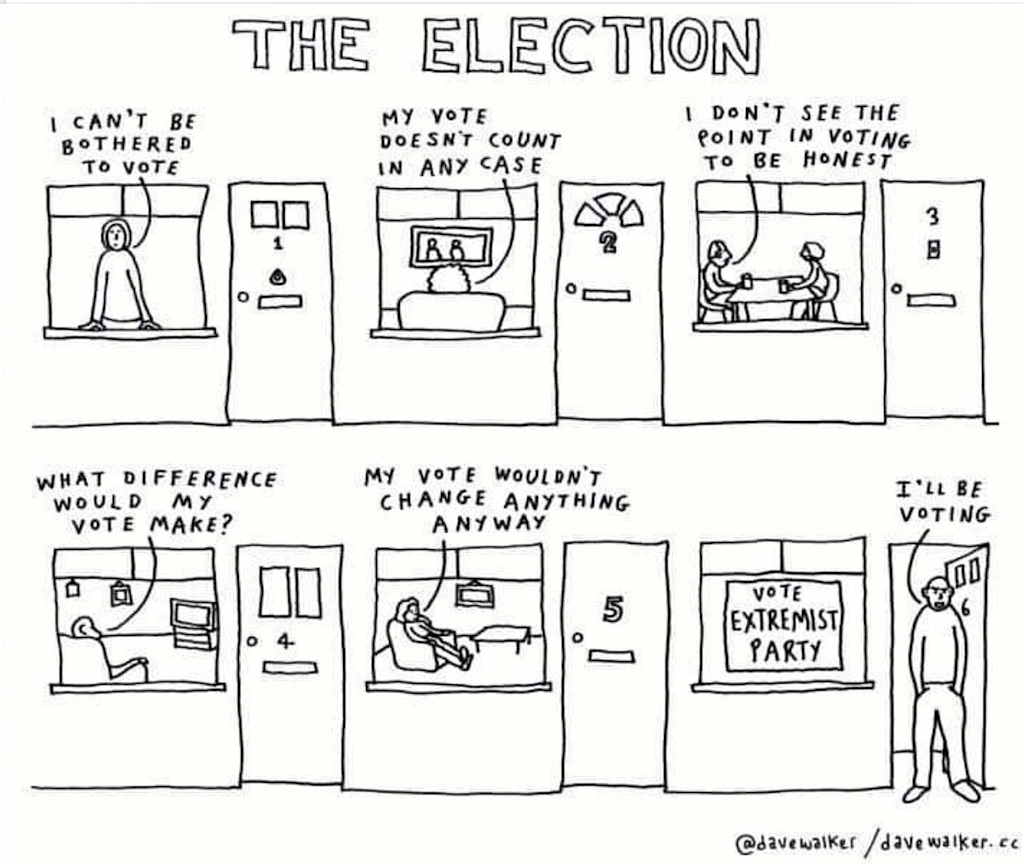
Many parts of the UK have local council elections in a month’s time. Don’t think it matters? Well here’s a quick reminder why it does matter and why you should vote at every given opportunity.

If you fail to vote undesirables (what ever your value of “undesirable”) are more likely to get elected … and of course your voice can’t be heard.

One of My Rare Forays into Current Affairs

OK, so Nazanin Zaghari-Ratcliffe is on her way home to the UK having been released from 6 years detention in Iran. And let’s not forget that Anoosheh Ashoori has also been released and is non this way back to the UK.

Of course this is tremendous news for them and their families, at which we should rejoice.

But as always there is undoubtedly more to the story than we’re being told. So …

Q. Why are they released now?
A. Because the UK finally paid the almost £400M which Iran claimed it was owed.

Q. So why did we pay this money now, when it could have been paid years ago?
A. We now want to have friendly relations with Iran.

Q. But why would we suddenly want to be Iran’s friend?
A. Because the UK wants Western sanctions against them lifted.

Q. Why?
A. Very simply because we want their oil; oil which they currently can’t sell in the West.

You see just as with Kuwait many years ago, it all revolves around oil (and ultimately corporate greed). As Clare Short memorably remarked when Iraq invaded Kuwait many years ago: If the Kuwaitis grew carrots, no-one would care. So with Iran, my friends.

Boris Johnson needs oil (and gas) to keep the country running – to Hell with climate change – now the Russian (and Ukrainian) supply is effectively cut off.

What a cynical move, when we could (and should) have gotten them both freed years ago. Words fail me to describe my contempt for this government and its immediate predecessors.

Why are GPs Leaving the NHS?

Dr Clare GeradaEarlier this week there was a long read article in the Guardian by Dr Clare Gerada, a senior GP and former chair of the Royal College of General Practitioners. In the article Dr Gerada draws on her own experience to show how the GP’s role has changed in the last 30 years. No wonder the NHS is haemorrhaging GPs because it is not a pretty tale.

“In my 30 years as a GP, the profession has been horribly eroded”

We should be very worried, because we are clearly not getting the healthcare most of us would want, or expect.

More Covid Stupidity?

So our pathetic government appear to have decided that all Covid-19 restrictions will be removed in two weeks time, as part of the plan to save Boris’s skin. Basically they seem to be saying that Covid is over, the case numbers are falling rapidly, there’s no longer any need to isolate, and we can all go back to normal. [1,2] Essentially this says “we don’t care; go back to normal; if you get Covid well tough luck, but it is now only a cold so continue going to work and spreading the disease further”.

Let’s look at this.

  1. Of course the government reported case numbers are falling; they’re designed to. People are being urged to go back to work, and testing is not being pushed. There is now no requirement to get a confirmatory PCR test following a positive LFT; and there’s no requirement to log the result of a LFT; so testing has dropped off a cliff – people just aren’t bothering. So as the government reports only confirmed positive tests, of course their numbers are falling.
  2. However this does not accord with data from the Office of National Statistics (ONS; a government body) who do random sampling of the population. Nor does it agree with the data from the Zoe Covid Study, who track reports from their 4 million subscribers. [3,4,5] The Zoe study is showing rates still incredibly high at around 200K/day (as it was at the beginning of January) and the ONS data is tracking this fairly closely. That means around 1 in 25 people currently have Covid [5] and anything up to 10% of those are re-infections [3,5].

But it is worse than this …

  1. Going back to normal, means no testing and no isolation. So people will be walking around with Covid as they think they have a bad cold (or are even asymptomatic), they’ll keep travelling and going to work/school, and spreading infection. Many will be forced back to work as many employers won’t tolerate time off sick with a cold (which is in itself stupid, but part of the “work at all costs” ethic).
  2. More people walking about spreading infection means that the number of cases will rise, as will hospitalisations and deaths. And because there’s no testing the government won’t know, until hospitalisations, deaths or school absences start climbing out of control. But by then it is too late; the genie is out of the bottle. (Remember that hospitalisations and deaths lag behind infection by 2, 4 or even more weeks.)
  3. That in turn puts the vulnerable at even greater risk. And many vulnerable people (like me) are feeling even more that they’re condemned to “house arrest” because they dare not risk going out and getting infected.
  4. It also means more children off school, or having their education impacted because their teachers are sick.
  5. And the higher the rate of infection, the higher the number of cases of Long Covid which will severely impact the patient’s life for … well we don’t know how long!
  6. More infection also means the virus has even greater opportunities to mutate. That’s the way evolution works. These new variants may be less or more infectious, and/or cause more or less severe infection. And again we wouldn’t know, because there’s no testing.
  7. All this is compounded in that immunity wanes. We know that the good immunity provided following two vaccinations was falling off rapidly after 6 months [7]; hence the booster programme. But it does now seem that immunity provided by boosters falls off rapidly too, such that someone like me who had their booster in mid-October (17 weeks ago) now has almost no benefit from it [6]; I’m back where I was last June with a risk of around 4 times the norm [8] (and I’m by no means in the extra-super-mega-vulnerable range). We seem to be needing a new booster every 3 months or so, but there appears to be no plan for this – indeed the current booster programme has effectively stalled [3].
  8. According to the BBC “The law will be replaced with guidance … and for example people will be urged not to go to work if they have Covid” [2]. Frankly the government can provide as much guidance, urging and recommendation as it likes, but people are going to take little notice: they need to work and their employers aren’t going to tolerate high levels of absence.

Is it any wonder the vulnerable and the disabled are worried. They feel that the government doesn’t care about them and wants them out of sight and out of (their) mind. (From a personal perspective, friends are going to increasingly not understand of one’s avoidance of social gatherings etc.)

I have seen a number of respected scientists, including some members of Independent SAGE [9], suggesting that the government’s proposed action is nothing less than “criminal negligence”. We don’t know what is round the corner in terms of new variants, so they could well come back and bite us in the bum at any time. And when it does the consequences are going to be a direct result of yet further government failure.

Whether it is actually “criminally negligent” only a court could decide, but I would certainly class it as totally stupid and intensely unethical.


[1] Guardian; 09/02/2022; https://www.theguardian.com/world/2022/feb/09/covid-rules-axed-england-is-pandemic-end-really-in-sight
[2] BBC News; 09/02/2022; https://www.bbc.co.uk/news/uk-60319947
[3] Independent SAGE; 04/02/2022; https://www.youtube.com/watch?v=21TKKKFfGYo
[4] Zoe Covid Update; 03/02/2022; https://www.youtube.com/watch?v=MUfjJ1z-a6s
[5] Zoe Covid Update; 10/02/2022; https://www.youtube.com/watch?v=Z2Zm9OcULDs
[6] Telegraph; 24/12/2021; https://www.telegraph.co.uk/news/2021/12/24/fourth-jabs-possible-covid-booster-immunity-will-fall-millions/
[7] University of Edinburgh; 21/12/2021; https://www.ed.ac.uk/news/2021/covid-19-vaccine-protection-wanes-three-months
[8] QCovid Risk Calculator; https://qcovid.org/
[9] Independent SAGE; https://www.independentsage.org/