Being my usual round up of things what I done this month but didn’t previously write about.
Tuesday 1
It’s literary society year end. As I do the memberships, I bring in most of the money, so my finances have to be reconciled. And all the subscriptions are due, so there’s a mountain of that to process. It’s going to be manic for the rest of this week, at least.
Thursday 3
N has now been going to the hospital 3 times a week for almost a year, and today was the first time that her hospital transport got royally buggered up. Apparently someone cancelled it; they hadn’t; there was a name confusion. The upshot was that instead of being picked up about 12:00 for a 13:00 clinic, she finally left home just before 15:00. This well screwed everything for both of us.
Friday 4
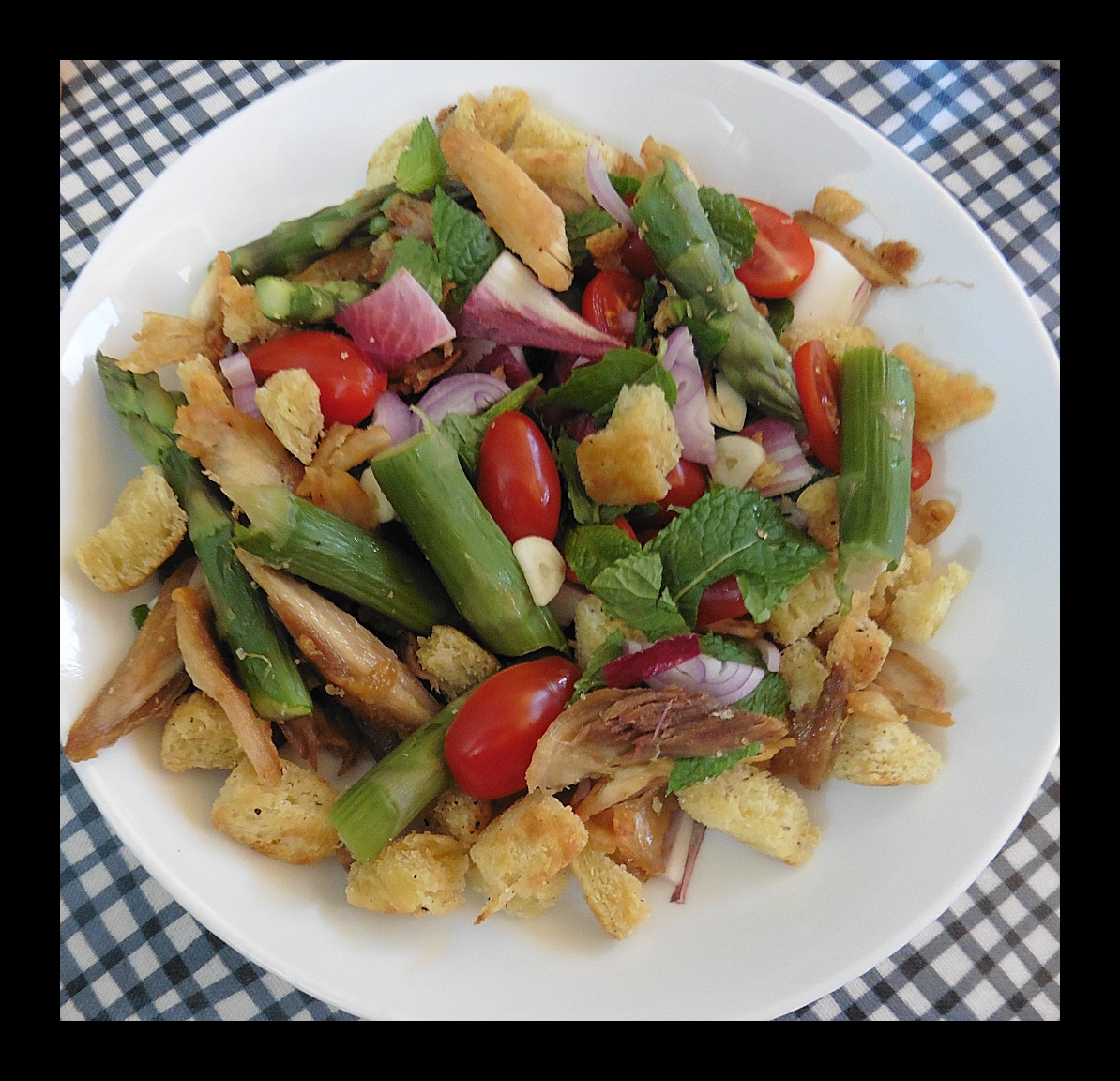
This evening, a variant on our infinitely adaptable “all in one” salad; and even more variable as I did us separate bowls of salad because N is having to be more careful about diet. We had the end of last weekend’s roast chicken: not a lot; and it needed recooking. So I chucked the pieces in a frying pan and sizzled them until crisp. Put together with some steamed early English asparagus, croutons, cherry tomatoes and red chiccory. A tasty quick dinner.
Sunday 6
I don’t believe it! We already have a few flowers on one of our small (eating) apple trees; it shouldn’t really be out for another 3-4 weeks! There’s also flowers on the ornamental crab, but that’s less surprising as it is always early. And the columnar crab isn’t very far behind.
Monday 7
Why are ears such a pain? Not content with having wax in my right ear, I woke this morning with both ears bunged solid and unable to hear anything. It cleared a bit after a hot shower, but it was even so just not worth wearing my hearing aids, partly due to the discomfort and partly as they weren’t going to do a lot of good. And of course, it’s miserable. It’s not as if I don’t put olive oil in my ears regularly to keep the wax soft, as medically advised.
Wednesday 9
It’s all good fun. So they tell me anyway. I finally got fed up with trying to clear my ears and, after much searching, found a sensible place to get them vacuumed. Private, of course; trying to get it done on the NHS with any speed is a lost cause. So I book for tomorrow, although inconvenient. And afterwards find I’ve booked the same young lady that did my ears about 18 months ago, somewhere totally different.
No sooner had I done that than my most nuisanceful crown came off! So I now also have a dentist appointment on Friday morning. If this doesn’t end up with an extraction I’ll be very lucky – we know here’s not a lot of tooth left to fix a crown to. Well that buggered up any plans for the rest of the week. It never rains but there’s a flood.
Thursday 10
Blimey! Talk about efficient. I went for my ear hoovering this morning. 11:30 appointment. I arrived at 11:10. Seen straight away and out in 10 minutes. Job done. Home by midday having waited 20 minutes to be picked up. It isn’t half nice to be able to hear properly again, and not have uncomfortable ears.
And it’s been a lovely sunny day; all the trees are bursting into leaf, so everywhere is splodges of bright green new leaves – and apple blossom.
Friday 11
Trip to the dentist to see about my crown. And exactly as expected, young miss dentist says there’s nothing more she can do with it as there’s not enough tooth left to fix a crown to. So the tooth has to come out. And that means a referral to a specialist as (apart from being an awkward back tooth) it has at least one curved root which could cause problems. That’ll be a lot more ouch of the wallet, unless we can swing it as surgical and claim it on the medical insurance. Fun here, innit!
Saturday 12
And now all our apple trees are in full bloom, all at the same time which is most unusual (but what should happen). However there’s not a pollinator in sight; they should be buzzing with bees, flies, wasps. So it looks like it’s going to be a bad year. It’s not really surprising there are few insects around after last year’s poor summer and a very wet winter.
Sunday 13
During last week the guy next door to me had the fence between us replaced, which is fine as the deeds say it’s his fence. They were said to be putting in concrete posts and gravel-boards and it would take 2½ days. Knowing his propensity for employing cheap cowboy workmen I wasn’t hopeful. They started on Thursday morning and broke the back of the job by mid-afternoon; it was finished before lunch on Friday. They appeared to know what they were doing, and I know my neighbour is as well aware of the law on boundaries as I am. So I decided to leave them alone, not interfere, and trust them. This seems to have paid off. They look to have done a good job and respected the boundary line. Very pleasing.
Tuesday 15
Over the last two days council contractors have been resurfacing our road. So, I’m sure much to the annoyance of our neighbours, the road has been closed during the day. It’s been intermittently noisy, of course. I’m not knowledgeable enough to know how good a job they’ve done, but they do seem to have done the right things. When we were told this was going to happen, I was sceptical. I thought: “the council will do it cheaply and they’ll just have the contractor put 2cm of black-top on what’s already there, despite that the kerbs, manhole covers etc. will need resetting”. But no, they spent all of yesterday taking the top (maybe 4-5cm) layer of old tarmac off; and today they’ve laid the new. I don’t know if they’ve finished it all – apart from they’ll have to come back to replace the speed bumps and road marking. I wonder how long that will take?
Wednesday 16
The surreal sight of a small flatbed truck proceeding up the road with 8 stands of temporary traffic lights (upright) on the back. What a shame they weren’t also working!
Thursday 17
Lo and behold! The guys have finished the road. Bumps and white lines all replaced. Unexpectedly speedy!
Friday 18
As yesterday was Saturday, is today Saturday, Sunday or Noneday?
Wednesday 23
St George’s Day and we should all be out celebrating – not that we English do that. Instead of which it’s wet most of the day, although there were a couple of bits of sunshine. But the good news is that we have our first roses out: on Lady Hillingdon, of course.
Thursday 24
N appears by me this morning and says: “By the way I just found a large dead rat on the hall floor; I put it out by the gate so the fox can retrieve it”. Judging by the size she indicated it was getting on for 20cm in the body; certainly a decent size. Curiously none of the cats confessed to owning said rodent.
Friday 25
Last weekend I got the renewal for the house insurance. Bloody Hell! How can they justify raising the annual premium from £535 to £912? So during the week I’ve had a quick look around and found quotes in the £700 region – but it is impossible to compare like for like as every policy is (not so) subtly different. So I called my current insurers. Yes, says the young lady, the underwriters have increased all the premiums and everyone is complaining! What can we do to reduce the premium? Not a lot except increase the excess we pay if we claim (which to be honest is much lower than I thought it was). We do that and at least get the premium down to £776 – which is better, even if not good. The alternative is to start a new policy, probably with less good terms, and frankly I can’t be bothered to go through all the hassle. So this afternoon I paid up. At least it will get us a good dollop of points on the credit card which will get turned into gift vouchers.
Saturday 26
The Pope died last Monday, and his funeral was this morning. So, as much as any are, he’s an important world leader, but is that really an excuse for showing hours of the funeral live on prime TV? It’s not as if we’re a Catholic country. Will the BBC do the same for the Dalai Lama? I bet they don’t.
Monday 28
Three cats to the V-E-T this morning for their annual check-up and jabs. Luckily our black cabbie friend was available as that’s the easiest way to carry all three cats in their individual carriers; they’ll all stand on the floor – it’s almost impossible in a saloon car. Anyway …
- Boy is good and has put back the weight he lost last year; he’s now back to 5.5kg.
- Rosie is also good but is now 6.2kg and getting decidedly rotund, although the vet is unconcerned. However she does needs her teeth cleaning.
- Tilly has lost weight and is down to 3.9kg from her previous 4.55kg 2 years ago. So the vet took some blood; results this afternoon indicate elevated liver function, so the tests need repeating in a couple of weeks.
All that made a nice big dent in the credit card, with more to come! And we’re totally exhausted!
Tuesday 29
The buggers! Someone has knocked the nestbox out of the oak tree this afternoon; it’s on the garden path. Very annoying as I know the blue tits were using it. It was on the trunk and quite high up, so almost certainly out of the reach of cats. So one suspects either magpie or squirrel; although parakeet is just possible – or I suppose crow (unlikely with the magpies always around in the adjacent silver birch) or woodpecker (even less likely as I rarely see one). Nothing one can do, alas!
Wednesday 30
Yes, confirming that the magpies do have a nest in the silver birch. It is well hidden from our view by all the ivy and rose cambering through the tree. But at lunchtime I saw one go into the nest, and apparently settle down; then a couple of minutes later the second came along. What was interesting is that they have their own private track through the boscage; they both used exactly the same hops from branch to branch over the last metre or so to the nest.