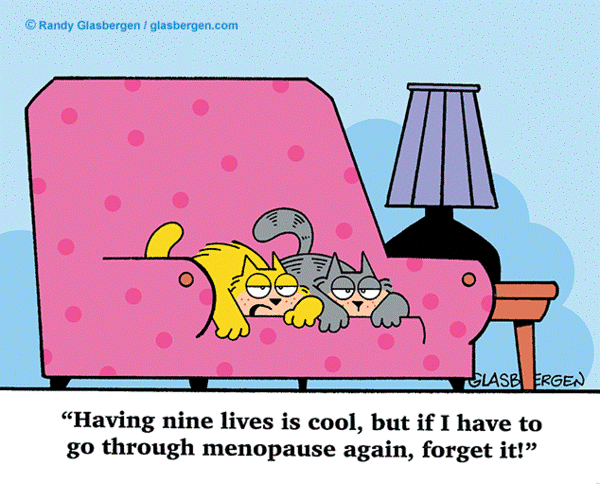
Something for the Weekend
According to researchers, when you remember a past event, you’re actually remembering the last time you remembered it.
When you’ve wrapped your head around that you’ll see that this is why memories fade and distort over time.
For more information see
www.themarysue.com/memory-distortion-in-brain/
and
medicalxpress.com/news/2012-09-memory-gameeach-recall-event-brain.html
I spotted this on the menu of a Taylor Walker pub in central London — Mayfair, forsooth! — on Saturday. It raised quite a giggle amongst the assembled company.

For some time I’ve been collecting fun things one can do which shouldn’t be either especially scary (so no bungee jumping) or outrageously expensive (so no world cruises). I now have a list of 50 which don’t quite form a bucket list for me, although it is interesting to see which ones I’ve done and which I haven’t. When I get round to it I shall put the list on my website, but meanwhile I thought this month we would have a selection, just as a taster.
 Ten Fun Things To Do (which shouldn’t cost a fortune).
Continuing last week’s mobile phone theme …
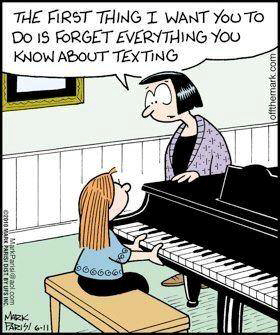
Another selection of amusing or thought-provoking quotes recently encountered. For some reason we seem to have quite a few heavyweights this time. In no particular order …
Follow your bliss and don’t be afraid. Doors will open where you didn’t know they were going to be.
[Joseph Campbell]
Language is the armoury of the human mind; and at once contains the trophies of its past, and the weapons of its future conquests.
[Samuel Taylor Coleridge]
If our minds are ruled by destructive emotions, by self-centredness, with little regard for others, we won’t be happy. As social animals we need to work together. With friends around us, we feel secure, happy and our minds are calm. We’re physically well too. When we’re filled with anger, fear and frustration, our minds are upset and our health declines. Therefore, the ultimate source of happiness is warmheartedness.
[Dalai Lama]
When you talk you are only repeating what you already know. But if you listen you may learn something new.
[Dalai Lama]
Great minds discuss ideas; average minds discuss events; small minds discuss people.
[Eleanor Roosevelt]
So what advice should one give to a young person? By all means, go to college. In fact, approach college in the spirit of craftsmanship, going deep into liberal arts and sciences. In the summers, learn a manual trade. You’re likely to be less damaged, and quite possibly better paid, as an independent tradesman than as a cubicle-dwelling tender of information systems. To heed such advice would require a certain contrarian streak, as it entails rejecting a life course mapped out by others as obligatory and inevitable.
[Matthew B Crawford in his essay “Shop Class as Soulcraft”]
The real voyage of discovery consists not in seeking new landscapes, but in having new eyes.
[Marcel Proust]
The world is full of magic things, patiently waiting for our senses to grow sharper.
[WB Yeats]
The kind of pleasure and understanding that I get from studying natural history has long vanished from most contemporary teaching institutions that have become part of intensive care units, which are supposed to save the residual intellectual machinery of medical students. The teeming mass of hope and pain, technical virtuosity, and depersonalization called a “health center” delivers packets of what is termed “medical care”. The capacity to look remains, but the capacity to see has all but vanished. Teachers and students forget that the ability to palpate is not the same as the ability to feel.
[Prof. William B Bean]
The less you worry about what people think, the less complicated life becomes.
[unknown]
One of the painful things about our time is that those who feel certainty are stupid, and those with any imagination and understanding are filled with doubt and indecision
[Bertrand Russell]
The Foole doth thinke he is wise, but the wiseman knowes himselfe to be a Foole.
[Shakespeare; As You Like It]
Granny grasped her broomstick purposefully. “Million-to-one chances,” she said, “crop up nine times out of ten.”
[Terry Pratchett; Equal Rites]
There goes more to matrimony than four bare legs in bed.
[Ben Jonson]
And finally …
Tip for the Day: Treat every problem as your dog would. If you can’t eat it or fuck it, piss on it and walk away.
[unknown]
Scientific names can be wonderful for many reasons. [There is] a bird whose name has rhythm, a fish with a fascinating etymology, and a butterfly named for a pioneering (and amazing) woman in entomology. Today’s entry is Yi qi, a newly described dinosaur whose name is interesting in origin and sound, and also wonderfully and surprisingly short.
Actually, the dinosaur is pretty wonderful too. Yi qi was a feathered theropod dinosaur … about the size of a large pigeon. In addition to feathers, it has two really odd features: a bony rod extending from each wrist, and sheets of membranous soft tissue that are preserved near the arms [which seem to be] wing membranes …
… two things about Yi qi‘s name.
First: why “Yi qi” (pronounced “ee chee”)? Yi means “wing” and qi means “strange” in Mandarin … So Yi qi is the “strange winged” dinosaur …
Second: what’s up with just four letters? We’re used to scientific names being long … and difficult to spell or pronounce …
So is Yi qi the shortest scientific name? Well, for an animal no shorter name is possible, because according to the International Code for Zoological Nomenclature … genus and species names must have at least two letters each … As it turns out, though, the race for the shortest name is a tie***: the Great Evening Bat is Ia io, also just 4 letters (and the only scientific name I know without consonants). Yi qi and Ia io have a few things in common besides the succinctness of their names: both are from China, both are flying predators, and both fly on membranous stretched from their arms.
*** With honourable mention to the Australian sphecid wasp Aha ha, at 5 letters.
From Wonderful Scientific Names, Part 4: Yi qi
OK, so here’s another round of links to interesting items you may have missed the first time. As always we start with the nasty, hard, scientific stuff and then it’s all downhill.
First here’s a long-ish piece on the fascinating world of chimeras. Although the article concentrates on humans, much the same applies to all animals and there is an interesting paragraph which explains how tortoiseshell cats are always female.
This week’s photograph is one I took on Saturday. It shows the commemorative plaque to General Sikorski who was leader of the exiled Polish forces in WWII. The plaque is on the (astonishingly expensive) Rubens Hotel, right opposite the entrance to Buckingham Palace Mews, which was the Polish forces GHQ for most of the War. This is not just a piece of history for it will resonate with Anthony Powell fans. Powell spent most of his war years as Military Intelligence (Liaison) and for much of that time was the officer responsible for liason with the Polish Allies — so he would have known the Rubens Hotel well.

Updated 17 February 2022; mostly correcting old links
I belong to several Facebook groups about my home town, Waltham Cross and Cheshunt in Hertfordshire. On one of them there was a thread about the park which was less than 10 minutes walk from my house and which I knew well from a very early age. Needless to say someone found and posted a few old photographs and postcards which triggered me to remember what I knew about the park and its surroundings.
Cedars Park covered part of the site of the old Theobalds Palace, which was built around 1560 by William Cecil and where he entertained Queen Elizabeth. The Palace was subsequently “stolen” from Robert Cecil, Lord Burghley, by James I in exchange for Hatfield House. It was here that Prince Charles (later Charles I) spent much of his childhood. James I died and Charles I was proclaimed King here. Although few contemporary images of Theobalds Palace survive, it appears to have been a late Tudor masterpiece. So needless to say it was razed to the ground by Oliver Cromwell’s merry men.
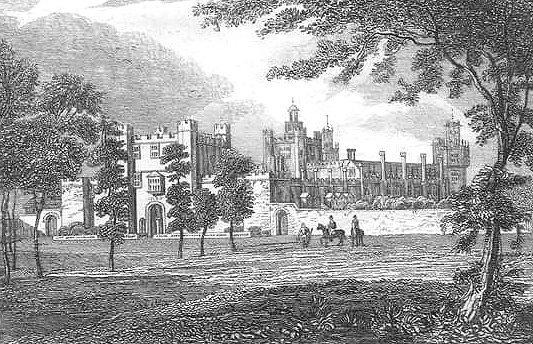
Subsequently the estate — used by James I as a deer park — was split up and an 18th century house built on the site of the palace. Old Palace House, as I knew it, even contained a couple of the original Tudor windows from the palace, but apart from that the exact location of the palace was lost beneath the ground. As befitted a large house of its period, Old Palace House had formal gardens, stables, a kitchen garden and a large orchard. In 1919 the adjoining area was given to the local council as a municipal park: Cedars Park, so named because it contained two enormous Cedars of Lebanon which it is suggested are contemporary with Theobalds Palace. The park also contained two very old Mulberry trees which may also have been contemporary with the Palace.
I knew Cedars Park well in the 1950s and ’60s — basically from the time I could walk, and maybe earlier — less well in the ’70s when I was away at university. Since the ’70s the park has been extensively remodelled and modernised; in the process there has been a great deal of archaeological work done and the ground layout of Theobald’s Palace is now pretty well documented.
The old lady who lived in Old Palace House must have died in the very early ’60s; the house was shut up and ownership passed to the local council. It is at this period, the mid-60s, that I knew Old Palace House and its grounds. The house itself was burned down — as usual in suspicious circumstances — in the early ’70s and it is this which, eventually, started the process of clearing the site and extending the park.
One of the first acts, after making the buildings safe (ie. demolishing most of what was left) was to grub out the orchard, turn it into a field and tack it on to Cedars Park by making an opening in the dividing (ancient) wall.
As you can see there is an awful lot of history here, so if you want to delve deeper you might want to look at:
For more on the history of Theobalds Palace see British History, Hertfordshire Genealogy and Hertfordshire Memories.
For more on the history of Cedar’s Park see Broxbourne Borough Council and Wikipedia; there is also a website for Cedar’s Park.
There is lots of detailed information on the archaeological excavations around Cedars Park, mostly done by Oxford Archaeology, in their site reports here and here.
I also wrote briefly about Old Palace House in a 2009 blog post.
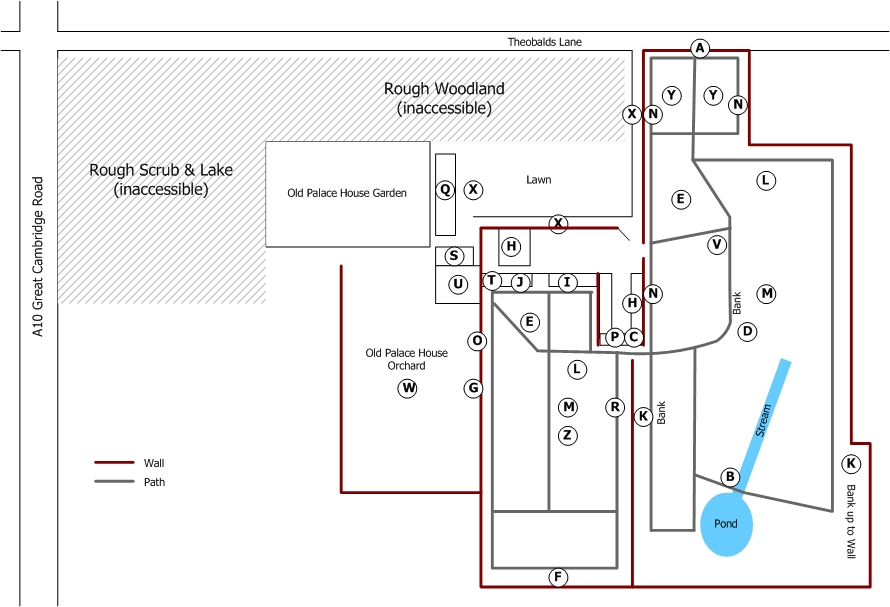
What now follows is my recollection of Cedars Park, and Old Palace House and grounds, as I knew them in the ’50s and ’60s.
First of all an annotated sketch map, then a few more recollections.
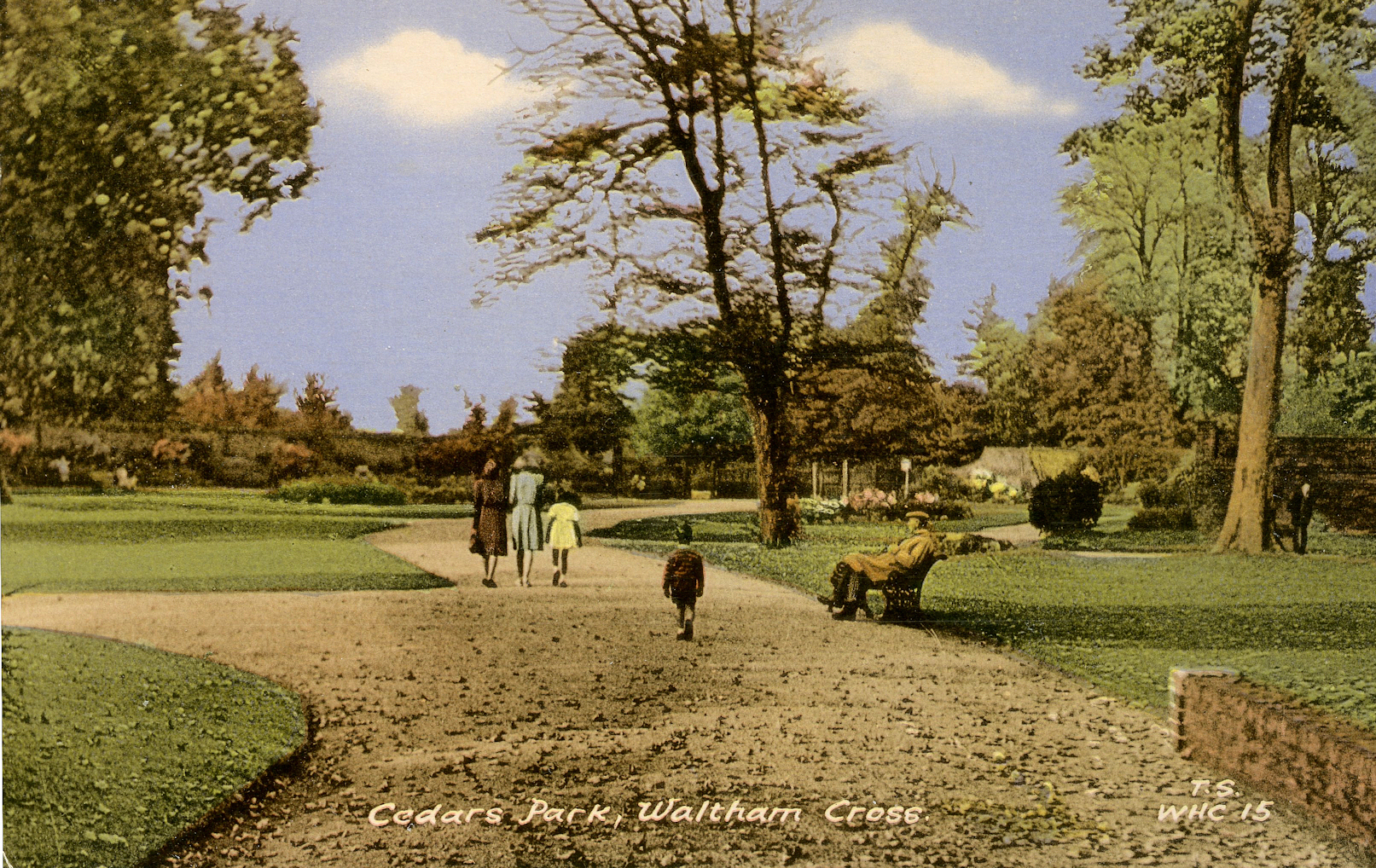
Here are a couple of postcard views of Cedars Park from, I think, the early 1950s.
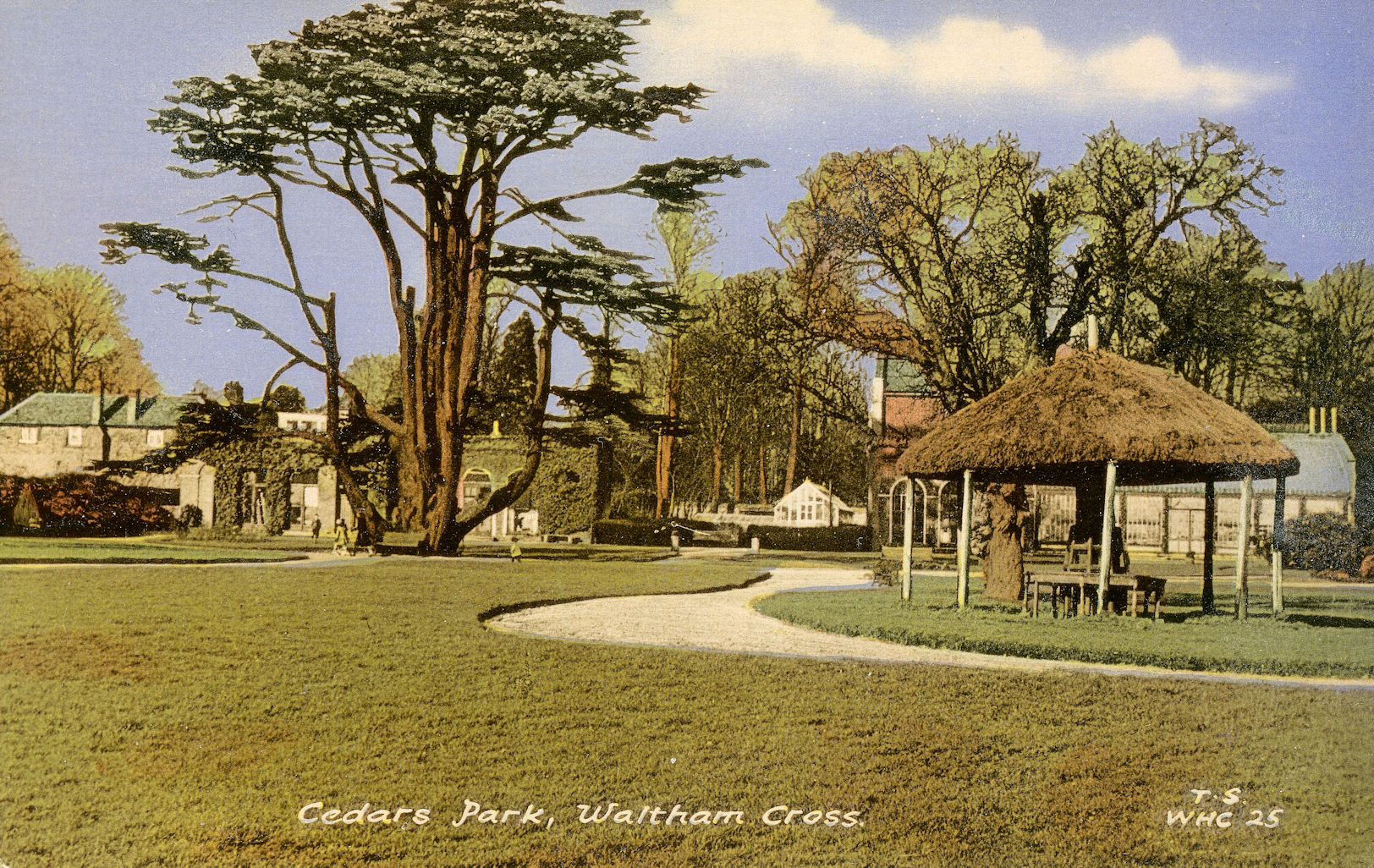
This shows the thatched shelter (Z) with the mulberry tree (M) and cedar tree (E) beyond from in front of the follies (F) on the plan.
By the time I knew them, all the areas of Old Palace House and grounds were pretty well unkempt: lawns not cut; shrubs not pruned; orchard trees not cared for; house shut up and damp. We were occasionally allowed access to the Old Palace House grounds on a Sunday afternoon because we knew one of the park keepers who worked something like one Sunday in three. Once or twice we were taken over the house and stables.
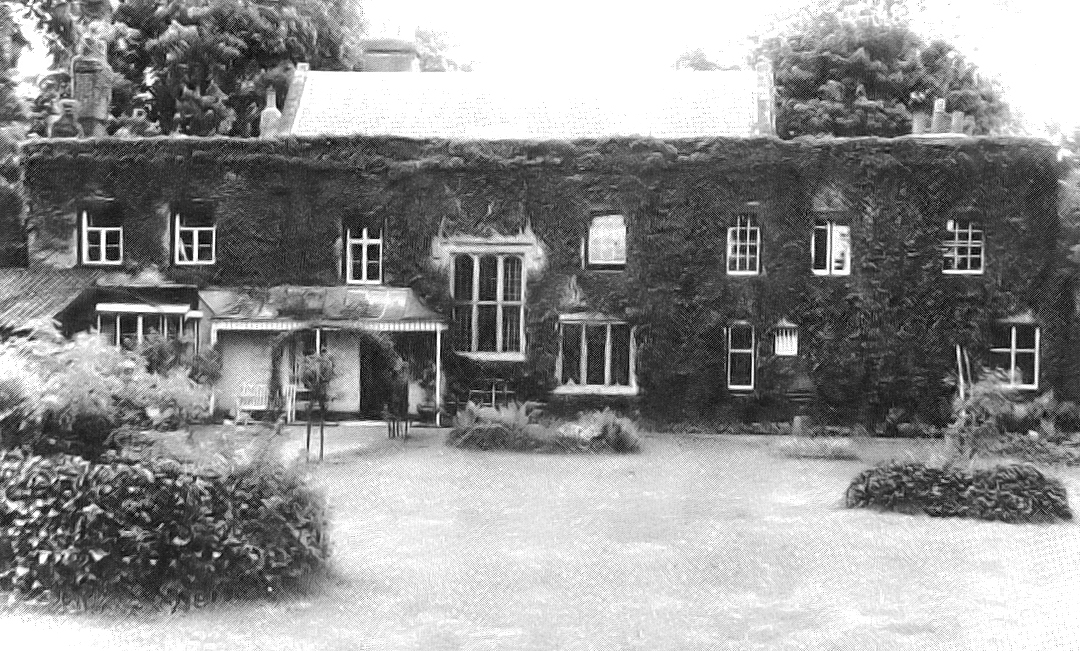 This is the rear of Old Palace House in about 1935. Note the two, possibly three, Tudor window embrasures.
The orchard, full of very old fruit trees, was a delight despite being overgrown with grass and bramble. A handful of times, over a couple of autumns, we were allowed to go in there and help ourselves to whatever fruit we could carry away (usually in rucksacks). The orchard contained just about every imaginable old variety of apple and pear. And the apples were to die for; wonderful varieties that one never sees today, many of which we couldn’t even identify. Obviously there were also things like cherry trees — stripped by the birds early in the season! I think I remember raspberry canes too. And then there was the enormous mature specimen walnut tree (that’s my memory, anyway) which stood in the middle. This walnut tree was the only tree kept when the orchard was grubbed out (in the early 70s?); I have a memory that my mother painted it in wonderful autumn colour, standing majestically alone in what was by then a field belonging to the park. While one deplored the orchard being grubbed out, the trees were so old and neglected that there was realistically little other option.
Also, knowing the park keeper, we sometimes got a look round the hothouses and the conservatory. The latter was always full of colourful plants being grown for civic occasions — calceolarias, coleus and I forget what else. Outside there were cold-frames and I think an area used for bringing on rose bushes, trees etc. Plus the inevitable sheds housing big lawn mowers and other machinery, potting sheds etc. The hothouses were heated by some old coal-fired furnaces, which had to be stoked up last thing at night and would apparently just about last until the morning.
Going back to the park, I loved the Monkey Puzzle Tree, the Cedars, the Mulberry trees; I remember rolling down the bank from the path by the Monkey Puzzle; and with the large number of Horse Chestnut trees it was a great place to hunt for conkers. I never did much like the tigers or the follies. Nevertheless the park was for me a fairly magical place.
As I grew into my teens and beyond I came to much more appreciate the old walls and Old Palace House with its Tudor windows. Indeed I remember drawing the Tudor windows (badly, it has to be said) for Art homework; that would have been 1966 or ’67. And I have the following three, not very good, B&W photographs of Old Palace House from around 1964 (they may have all been taken on the same day) …
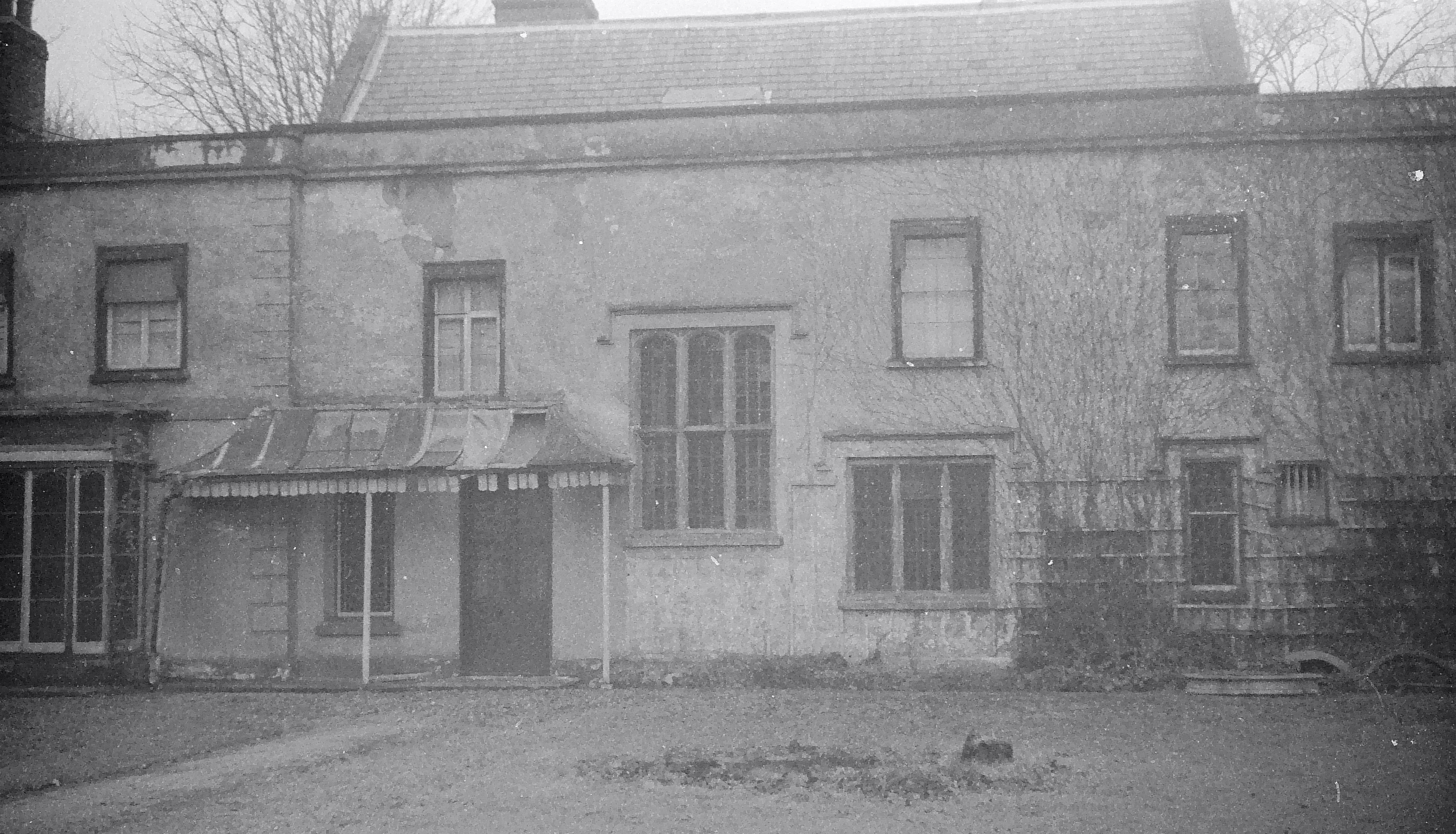
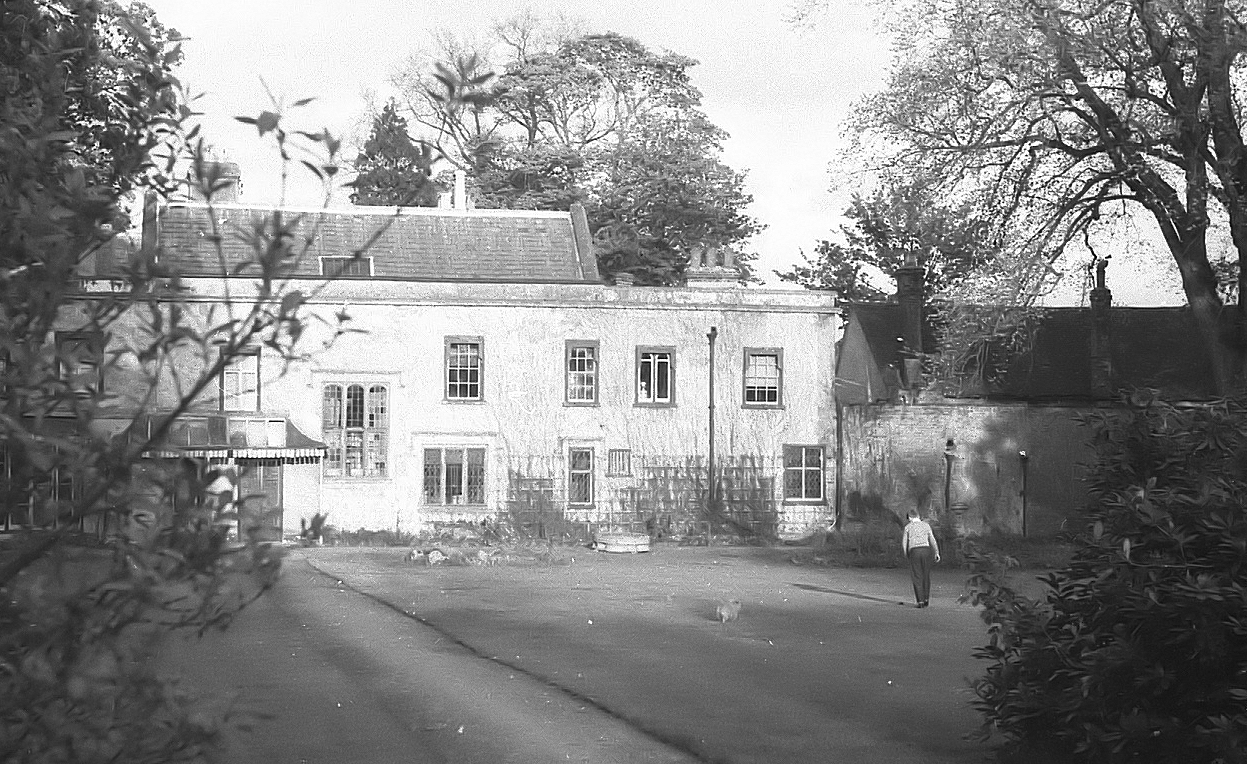
Another image of the rear of Old Palace House with a surprisingly tidy looking lawn. This must have been taken by my father as the young teenager (right middle-ground) is me; note also a small dog.
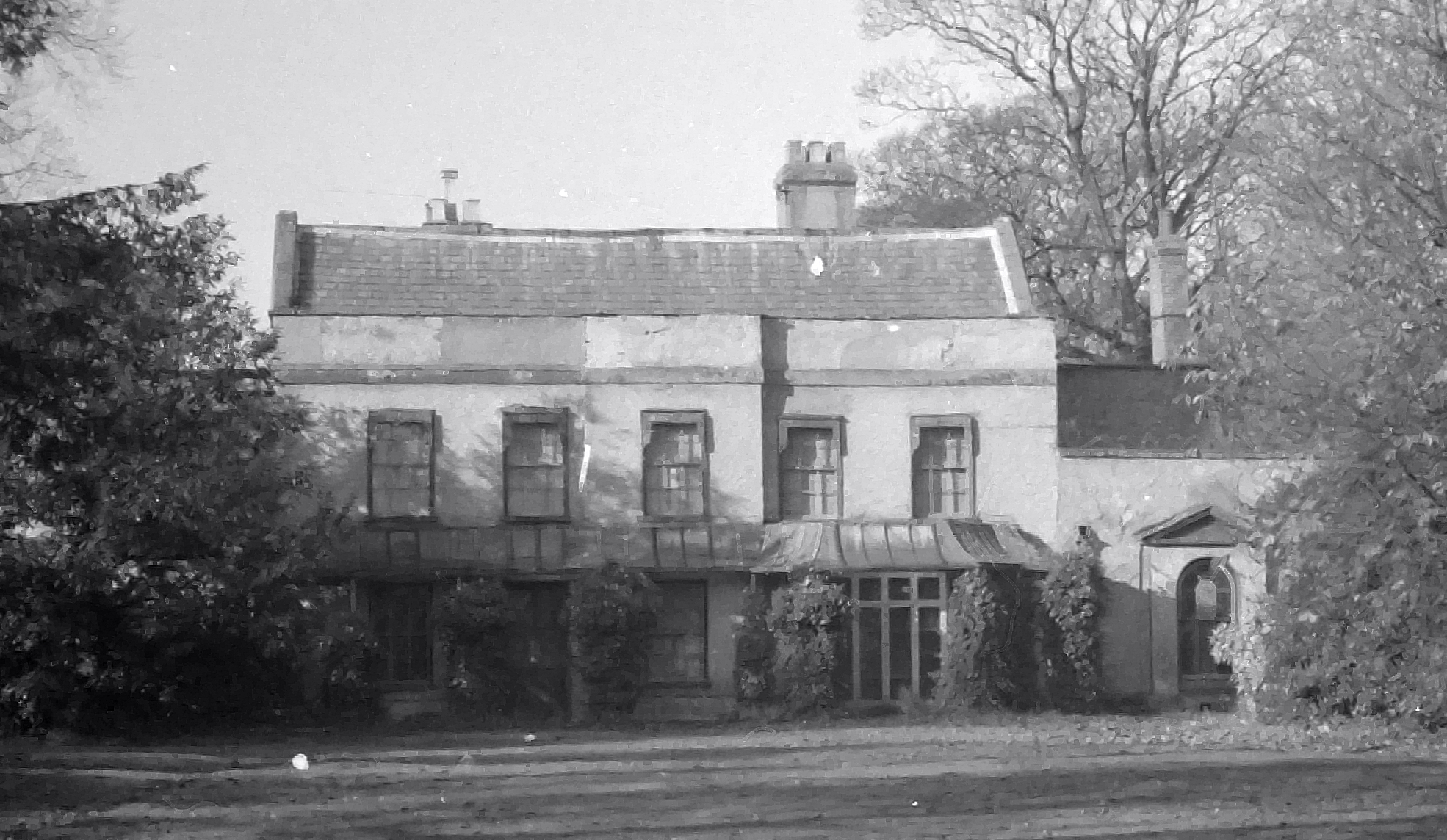
And here is the front of Old Palace House, taken from the front lawn.
I also remember Theobalds Lane, between Cedars Park and Crossbrook Street (so the part off the right of the map) from the mid-1950s; it really was a country lane then. The land to the south was covered in glasshouses, which from memory grew tomatoes and cucumbers — as did a lot of the Lea Valley. The land on the north side had some glasshouses but also a couple of orchards, where I remember my mother buying apples in the autumn — that might even have been before I started school, so 1955 at latest. This was all demolished and grubbed out somewhere in the late ’50s and the housing estate built — and completed long before I went to the Grammar School in 1962 and possibly before Theobalds Grove Station reopened in November(?) 1959.
I’ll write more if I come across any more photographs.