of receiving the generosity we give them.
[Ethan Nichtern]
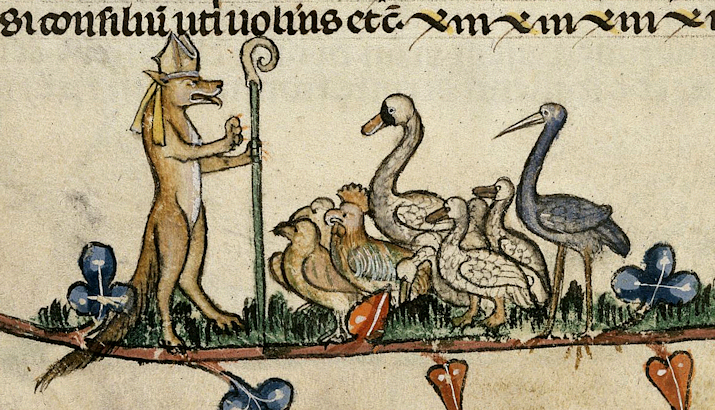
About 30 years ago, the guy I shared an office with commented about “the strange conversations you people have over the dinner table”. This was, as I recall, occasioned by my mentioning that the previous evening Noreen and I had been ruminating upon the origins, and reasons for, the names animals were given in medieval times. You know: Reynard the Fox, Tib the Cat, Broc the Badger, and so forth.
From the French kiosque and Italian chiosco; after the Turkish kiūshk a pavilion; which is from the Persian kūskh, a palace or portico.
Secondarily to this the OED quotes as one of its sources (not the earliest, that’s 1625):
1 April 1717, Lady MW Montagu letter to Mrs Thistlethwayte: “In the public gardens there are public chiosks, where people go and drink their coffee, sherbet, etc.”
I remark on this because the only other time I have come across Thistlethwaite as a name was Prof. Frank Thistlethwaite, Vice-Chancellor of UEA when I was a graduate student there in the early 70s.
But it isn’t just us. A few weeks ago when we met up with our friend Katy (plus under-age hangers on) for lunch the conversation fell to wondering about the origin of hunkey-dorey, meaning OK, good or even excellent. None of us knew, or even wanted to hazard a guess.
But trawling the intertubes it turns out that there is no agreed origin of the expression. The earliest reference seems to be in the US Civil War period collection of songs George Christy’s Essence of Old Kentucky of 1862. Not that this tells us the origin or reason; just when it is first recorded.
Looking further Word Detective turns up another, but suspiciously spurious, possible origin:
Probably the most oft-heard story about “hunky-dory” holds that there was, in the 19th century, a street in Yokohama, Japan, called “Honcho-dori.” It is said that Honcho-dori was the Times Square of Yokohama, and thus a favourite hangout of US sailors on shore leave. So popular did this street become among sailors, it is said, that “Honcho-dori” entered naval slang as “hunky-dory,” a synonym for “Easy Street” or a state of well-being and comfort.
Now, there actually is a “Honcho-dori” in Yokohama. (In fact, there’s one in many Japanese cities, because “Honcho-dori” translates roughly as “Main Street”.) But there are two problems with this story. One is that there is no direct evidence of any connection between the first appearance of “hunky-dory” around 1866 and US sailors in Japan or naval slang in general.
Problem number two is that a connection with “Honcho-dori” is somewhat unnecessary. English already had the archaic American slang word “hunk,” meaning “safe”, from the Dutch word “honk”, meaning goal or home in a game. To achieve “hunk” or “hunky” in a child’s game was to make it “home” and win the game. So “hunky” already meant OK.
But where the dory or dorey came from is, it seems, anyone’s guess. But then maybe it’s just a rhyming duplication like okey-dokey.
Yeah, the strange conversations you people have over dinner!
Bear with me because this is in large part me thinking aloud. And no, I’m not being a male chauvinist dickhead; I’m genuinely trying to understand a (modern?) phenomenon.
Manspreading — when a man sits with his legs wide apart on public transport encroaching on other seats — has recently been added to the Oxford English Dictionary. So this seems a suitable point for some thoughts on the subject, which actually goes wider than public transport.
Men are always being castigated for sitting with their knees apart, taking up too much room and (supposedly) showing off their jewels — or they would be showing them off if they weren’t clad in OMG jeans. I agree this posture is ungainly and unattractive; nevertheless I’m as guilty as the next bloke.
I have a four-pronged theory as to why this is, and why men don’t — indeed can’t, comfortably — sit with their knees together as women (mostly) do. This is at least in part based on personal experience and observation.
So now let the sensible debate begin, and hopefully we’ll have some scientists prove me wrong (or even right).
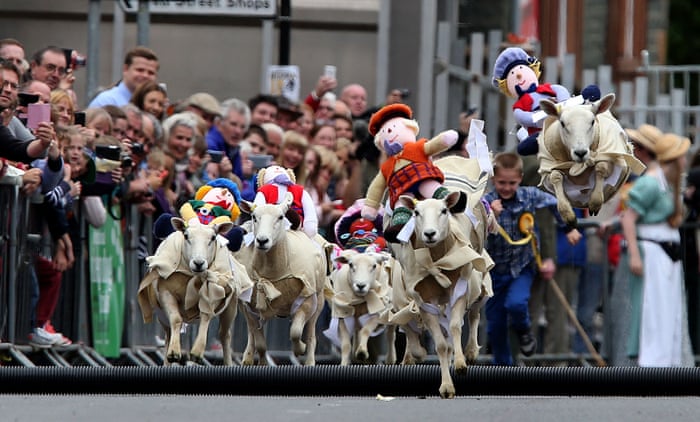
In early August this year crowds flocked to the Dumfriesshire town of Moffat to cheer and place bets on their favourite sheep during the fourth annual Moffat High Street sheep race.
Baa, ewe are ‘aving a giraffe, aren’t ewe?
No, they really do race sheep, complete with knitted jockeys and a boy shepherd. What’s more, the race is over hurdles. See here …
I’ve just realised that I have neglected my duty to post this week’s photograph — basically because I spent most of Monday engrossed in family history and discovering that one of my gg-grandfathers was tried in 1864 for fraud against his employer, the South Eastern Railway. I may write more about this in due course as he then seems to have disappeared from the radar and we’re still searching for the wreckage.
Anyway to this week’s photograph, a very old one from the archives, of the reflections in the Manchester office block where I was running a project.

So here we are again with another round of links to interesting items you might have missed the first time around. Again not too much heavy science but a lot of oddities …
Cats vs Dogs. Who wins? Well from an evolutionary perspective scientists have concluded that cats are better.

Just like every other age the Victorians had a wide variety of slang, much of which has not survived. For example:
Bang up to the Elephant
This phrase originated in London in 1882, and means “perfect, complete, unapproachable”.
Bags o’ Mystery
An 1850 term for sausages, “because no man but the maker knows what is in them”. The ‘bag’ refers to the skin in which the chopped meat is contained.
Mutton Shunter
This 1883 term for a policeman is so much better than “pig”.
Find more at 56 Victorian Slang Terms That We Should Definitely Bring Back.
Laura Dodsworth
Bare Reality: 100 Women, Their Breasts, Their Stories
Pinter & Martin; 2015
 This is a fascinating book in which 100 women share un-photoshopped photographs of their breasts alongside honest, courageous, powerful and sometimes humorous stories about their breasts and their effect on their lives. The women come from all walks of life: from a Buddhist nun to a burlesque dancer; ages ranging from 19 to 101; everything from a 32AAA to a 36K bust; entirely natural through surgically enhanced and surgically reduced to bilateral radical mastectomy.
The cover blurb suggests the book will make you reconsider how you think and feel about your own body as well as those of the women in your life. And yes, it may for those who have not thought about these things before. Has it for me? I don’t think so, but the jury is still out. But these women’s perspectives and experiences are certainly revealing, intimate and at times moving.
The stories recounted cover the whole range:
Probably everyone would agree there are a small number of real stunners (though we probably wouldn’t agree which ones) and there are an even smaller number of horrors (like one spectacularly bad boob job); but the vast majority are just breasts — normal breasts — just like you’d see on any topless beach; nothing to get hung up about.
Which is all very much as one might expect so I can’t say I was struck by anything at all surprising. Sad; pathetic; moving; joyous. Yes all of those. But no moment of “OMG how did I not know/suspect that?!”. And in a way I found that disappointing. I had expected there would be something profound about women and their breasts that had passed me by, but if so it isn’t revealed here.
That having been said I did find the book both interesting and compulsive reading. Whether you are male or female, if you want an insight into how women view their breasts this is a must read. I would commend the book to everyone, but especially to teenagers — of both genders, but boys especially — as an essential part of learning, understanding, cherishing and being completely comfortable with your, and everyone else’s, body. To which end we could now do with the equivalent books of male and female genitalia.
Oh, and do not expect the book to be titillating. It isn’t.
Overall Rating: ★★★★☆