There are no words. Just really there are no words for the mess we’re getting ourselves in.
And really what is this year doing to us?
First, the Great British people vote, in a non-binding referendum, to take the UK out of the EU, and the government treats the result as binding. As someone near me observed the other day, never overestimate the intelligence of the great British public.
Then earlier this week the American people elect Trump — a self-confessed misogynist, racist, bankrupt, megalomaniac bully — to be their next President.
 What is it about people that has caused such apparently idiotic choices?
Well it seems to me that it is partly down to the fact that too many people these days feel deeply pissed off, abused and disenfranchised.
Add to that the fact we are tribal — however much we like to think we aren’t. (I wrote briefly about racism and tribalism a while back in my Five Questions series.)
This means that when people’s backs are against the wall they will default to following their tribal instincts: xenophobia, racism, aggression, bullying. And, as a gross generalisation, the less intelligent people are the easier they find it to slip into tribal mode; those who can (and do) think are more able to rationalise and counteract such tendencies (although, of course, not all do as they may give a higher weighting to protecting their vested interests).
Thus, it seems to me, when people are so deeply pissed off, they will tend to vote for the more right-wing (Fascist) choice. This, they think, will satisfy their emotional and tribal needs. Hence another UK Conservative government, hence Brexit and hence Trump. And that’s despite the fact that such situations are so often the ones which will disenfranchise people further.
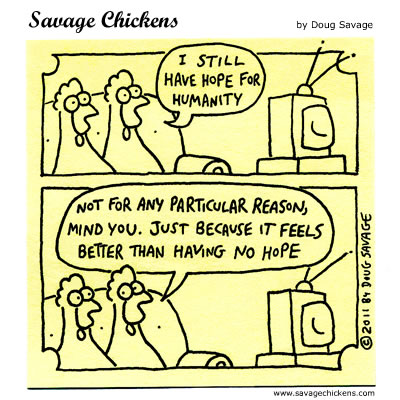
There is another factor at play here too. It’s “we don’t like what we’ve got so we’ll vote for something different”. We’ll have a change — that’s any change! — as it must be better. In an essentially bipartite democracy (UK, USA) that just means whoever isn’t in power. [Although this doesn’t explain the current UK Conservative government.]
So maybe we shouldn’t find the current mess quite so surprising.
So what next?
Well if, as the old wives tale has it, “things come in threes” and the year isn’t over “until the fat lady sings” we have about 7 weeks to survive. We’ve had Brexit (with its fallout), now Trump. What’s going to be the third almighty cock-up we can inflict on ourselves?
Keeley on Facebook has suggested the third cock-up is the Columbians voting down the proposed deal with FARC. I don’t know — I don’t know enough about this to be able to judge — but it could well be a good contender. We shall see.
Meanwhile just hang on in there and push back against racism, abuse, bullying wherever you can; ‘cos 2017 just has to be a better year.
And 2016: May a thousand monkeys dance sideways on your grave!
Something much more mundane for this month’s Ten Things, if only because I have numbness of the brain!
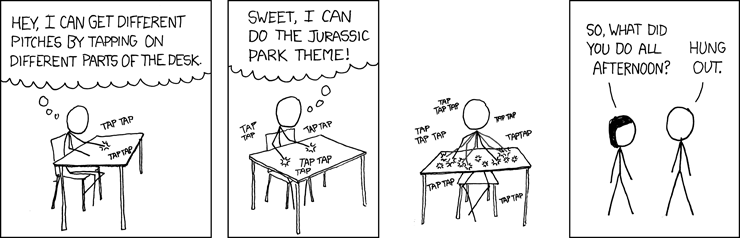
And then of course there is the plethora of computer stuff. But no, no cat — the current set don’t seem to like my desk, but then I don’t have a hot desk lamp these days.
Another in our very occasional series thinking about some of the aspects of the “Brexit mess” the UK is now in.
[Note: What follows are largely my thoughts on the legal landscape as I see it, based on various legal items I have read over recent days and weeks. I am not a lawyer. This is not legal opinion. It is my ramblings.]
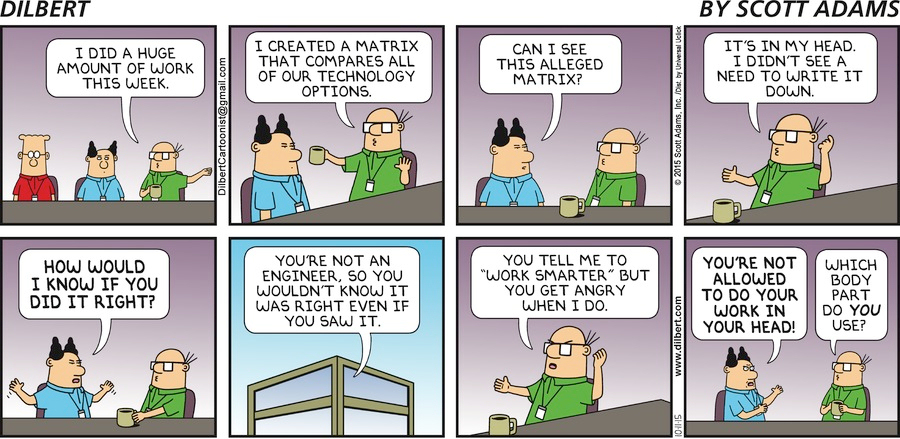
I am heartily sick of all the misinformation and stupid comment which is pervading the media waves at present. So in the wake of yesterday’s court judgement on the constitutional issues surrounding Brexit I thought a few (legal) facts about the mess we’re in were in order. These thoughts will be uncomfortable and unwelcome for the unthinking masses.
Conclusion: What we have in the UK at present is a political crisis, of the Government’s making, and not a constitutional crisis.
Now will everyone STFU and act their age not their shoe size. Yes, Daily Mail, Daily Telegraph and others, I’m looking at you.
We’ve not had any amusement recently from the catalogues of our local auction house. This is mainly because they have recently been relatively dull. But it’s time to catch up, so here are the highlights from the last two or three auctions, and as always it is not just the stuff that people sell but what gets lumped together to make a lot and sometimes the somewhat erratic descriptions. Presumably someone must buy this stuff or they wouldn’t sell it! Anyway, here goes (any emphasis is mine) …
A Venner time switch, a Metropolitan taxi meter, and a speed and power playback reel to reel tape deck
A treacle glazed pottery Toby jug, a dinosaur teapot plus three erotic netsuke in china and wood
 A pair of cream ground elephant seats, a quantity of DVDs including Sex and The City, photo albums, a figurine of a rabbit, two modern dishes, wine bottle opener, and a coffee table
An antique native primitive bow of natural branch form with gut bow-string, and two quivers, one in bamboo with plain leather binding, the other in decorated leather, each containing bamboo arrows with barbed iron heads
A good collection of garden ornaments, incl. a dog holding a basket, a planter upon a cherub, vintage chimney marked Doulton & Co., Lambeth, and various cherub wall plaques and decoration, two male busts, mirrors, and a marble-topped table on metal base
A Suzuki MG25 marching Glockenspiel
[That’s worthy of Terry Pratchett; it must be a cousin of “The Luggage”!]
A charming Edwardian pram with Greek fabric detailing on inside of hood, a weatherproof covering for doll, and what appears to be a leather head support strap across the top of buggy, four spoked wheels on metal frame, a doll (one leg missing) with serial code AM Germany351/41/2 K on neck and rolling blue eyes, eyelash detailing, open mouth and in knitted blue dress and cardigan
[GOK why you would want a one-legged doll (though I guess it is politically correct); and are the spoked wheels part of the pram or separate items?]
A collapsible child’s micro scooter, also dumbbells, and a chest expander
 A figure of Christ crucified
[Why?]
A pair of framed watercolours of birds, a set of old golf clubs, some hickory-shafted, vintage movie cameras, a Windsor model 71 voltometer, a collection of cameras incl. Kodak Brownie 127, a metal safety box, stoneware bottles, spirit levels, and a pair of aluminium ladders
2 hand-painted decorative saws depicting village scenes, a vintage lawn mower, a spade and a shovel
[Clearly an ancient art-form which has passed me by]
A pets bed styled as a miniature sofa in buttoned velvet, raised on shell carved cabriole legs
A bronze figure, Ancient Egyptian or later, on a stone base
[Basically it could be any date, but it looks Egyptian]
A Victorian stag hoof converted as an inkwell
A fine Victorian Indian ivory page turner carved with a pierced handle surrounding a maiden
An interesting lot of small items including an enamel-lidded glass jar, other jars, old buttons in a box, 2 old watches, miniature enamelled vases, a naval whistle, lizard claw, etc., all in a brass-faced box
An album of black and white adult photographs
A Lachenal & Co concertina, early 20th century, no. 160071, with 33 buttons to the pierced nickel-plated ends, wooden rests stamped with trade mark etc. and ‘steel reeds’, in ebonised wood box
[AKA a button accordion]
A one-string fiddle, home-made, with brass horn, and a violin bow
 An impressive ceramic Quartz clock decorated with shell decoration and two handled on top
[A two handed what? Included also as it is so stunningly … impressive]
A leather Doctors bag and contents, plus a further leather Doctors bag complete with instruments, a Policeman’s helmet, and a Kodak Instant camera
[There’s a theme here, but I’m not at all sure what it is; maybe Agatha Christie?]
[And of course there had to be a collection of things stuffed. What is it about taxidermy?]
A taxidermy kestrel on rocky base enclosed in glazed wooden display case
A taxidermy kestrel on a mossy base in a glazed wooden cabinet
A taxidermy barn owl on rocky base enclosed in glazed wooden display case
A large quantity of china to include 19th century part tea services, a small collection of Wade figures including a lady and a blow up Dalmatian, further decorative wall plates, meat plates, ornaments, animal figurines, etc.
A Life Guard Trooper’s helmet, presumed circa 1900
 A modern bronze group of two conjoined torsos
[Scrap metal?]
A wooden cased table organ with nine pull-outs and three and a half quavers, in aluminium carry case
[I suggest they mean 3½ octaves]
Three Union Jacks last displayed on VE day
[We know this?]
A cow skin, probably Charolais
A Laura Ashley red velvet quite with beaded trim edge, a Greek fabric national doll and a Spanish flamenco doll
Two 19th century powder-coated cartwheels
[Oh, really?]
Five vintage petrol cans …
More anon.
Science & Medicine
The medical profession has come to the conclusion that there are at least 40 common treatments which are not necessary (or don’t do any good).
In an interesting study, researchers conclude that there might be a relationship between migraines and gut bacterial species.
AIDS was brought to the USA by one promiscuous homosexual in 1980-81, right? Wrong; it had been there undetected for years!
So that’s how thy mummified the Egyptians.


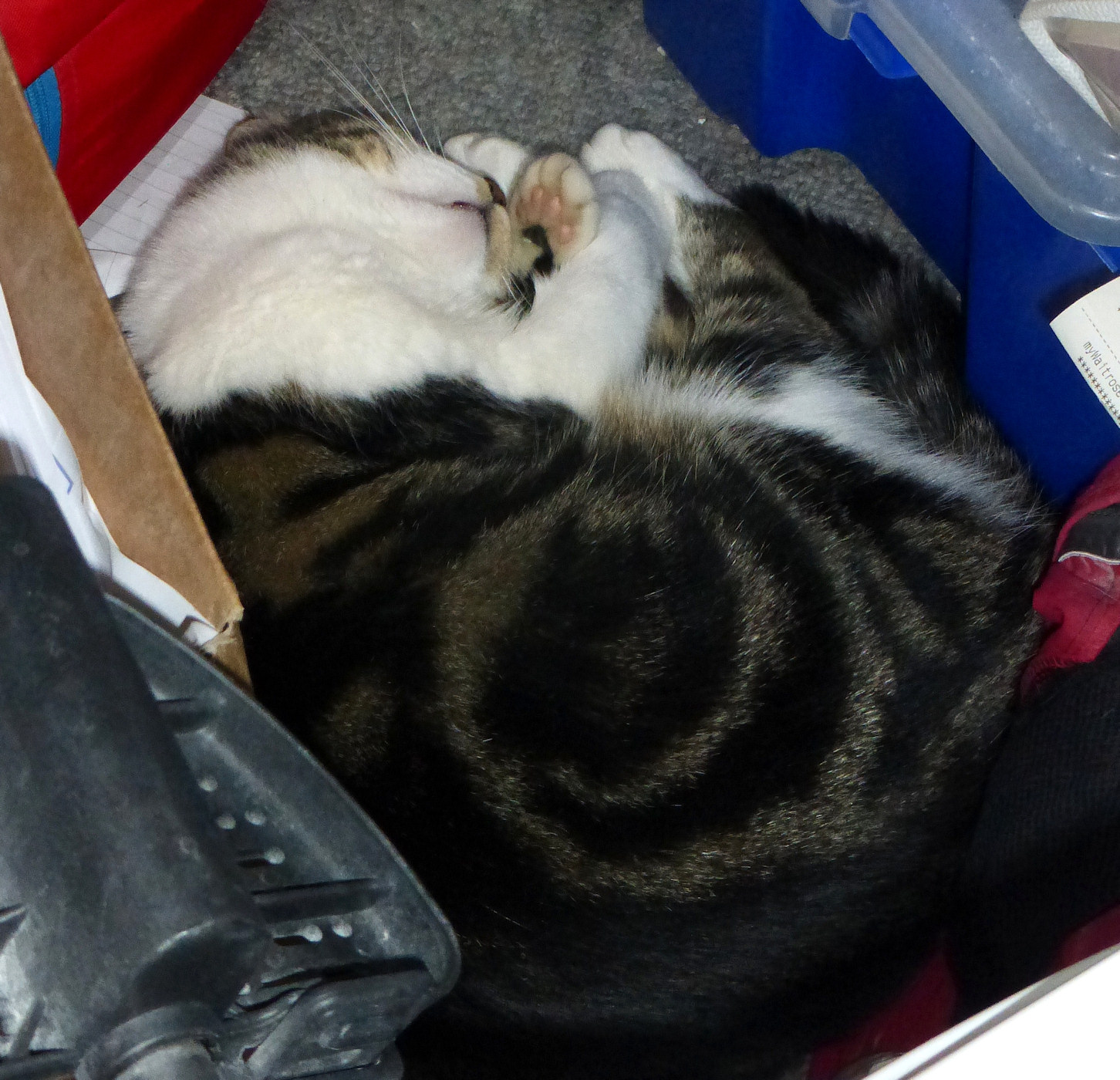
Winter is coming, the cats are getting keener to be in rather than out — not that this stops them going out for a little light mouse-foraging! All afternoon I’ve had two of our three cats with me in the study, very asleep and both determinedly trying to make it rain.
Wiz has found the warm spot in front of the airing cupboard …