Monthly Links

Apologies that due to an incursion of lurgy this month’s collection of links is somewhat late. Anyway here goes …
Science & Medicine
Unlike most other animals, roughly 90% of humans are right-handed. But why?
Another peculiarity of humans is that we are one of only a handful of species which has an appendix. Again, why?
Evidence is emerging that women with severe PMS, called premenstrual dysphoric disorder (PMDD), really do have an aberrant cellular response to their hormones.
How do doctors measure pain? Answer: inconsistently. And they’re trying to understand this better. [Long read]


I suspect most people don’t notice the pigeons around them, but there are three which are common in the UK: the feral pigeon (rock dove), wood pigeon, and collared dove. The first two are genuine natives, but the collard dove is a recent arrival from Asia which set out to conquer Europe.
Sexuality
Ten things you probably didn’t know about the clitoris.
­
The here and there of (female) pubic hair through the ages.
On attitudes to masturbation in a relationship.
The BFI now has an archive of erotic films covering the late nineteenth century to around 1960s.
History

And bridging seamlessly into the really historical, it seems the Ancient Chinese were into sex toys, just as much as modern generations.
Researchers are getting really quite good at dating ancient objects and events. An ancient volcanic eruption has now been firmly dated using fossilised tree rings.
The myth of Medieval Small Beer — no, everyone didn’t drink beer, rather than water, in olden days.
Someone has found what is alleged to be the long-lost skirt from one of Queen Elizabeth I’s dresses being used as a church alter cloth.
A research student has been able to uncover the movements and exploits of a Renaissance spy, who successfully masqueraded as a garden designer to the rich and powerful.
London
Each year IanVisits provides a calendar of the gun salutes in London for the year.
­
Crossrail have unearthed yet more archaeology in an unexpected place: jammed and pickled under the old Astoria nightclub.
There’s a section of tunnel under the Thames on the Northern line tube which was bombed and flooded in 1940. And it is still sealed shut.
To go with the previous item, here are a few vintage pictures of London tube stations.
And, just in time for your next pub quiz, here are a few things you may not know about London buses.
Lifestyle
Some thoughts on how to talk meaningfully with children. And not just children, I suggest.
Even the most macho bloke has his bit of feminine. Here are some on the feminine things men would do if they thought they wouldn’t be judged for it.

Unless you’re doing a really dirty job (like down a coal mine) it’s likely you’re showering much too often for the good of your skin.
And finally … Just what did those prudish Victorians have to hide?
More next month.
Storm in a Coffee Cup

So the FSA think we should give up toast and roast potatoes because there is a cancer risk from the acrylamide they contain.
As so often this is, at best, misleading science and quite probably total bollocks. Moreover the FSA is going beyond it’s brief in warning us about something which is basically an assumption based on evidence that’s struggling even to be flimsy.
Yes, acrylamide can cause cancer. This has only been conclusively demonstrated in laboratory rats fed thousands of times the dose we would consume. There is no real evidence of normal doses causing any problem for humans. Like all these things the dose is important and the evidence has to be taken in a sensible context.
There is apparently more acrylamide in coffee than toast or roast potatoes, and most people consume far more coffee at breakfast than they do burnt toast. Yet we aren’t being told to stop drinking coffee because of the acrylamide.
And how many women crave burnt toast when they’re pregnant? Anecdotally quite a lot. Are we really going to add toast to the ever growing list of things pregnant women aren’t allowed to even see? If so, we have to ask how we all managed to get here in the first place.
No. I for one shall be treating this advice with the contempt it deserves. Yet again the FSA is bringing itself, and by association all dietary advice, into disrepute.
For more background see:
Is acrylamide in your toast really going to give you cancer?
Why you don’t need to worry about eating brown toast
‘Alternative facts’ are now threatening our roast potatoes. Enough!
And remember: Research causes cancer in rats.

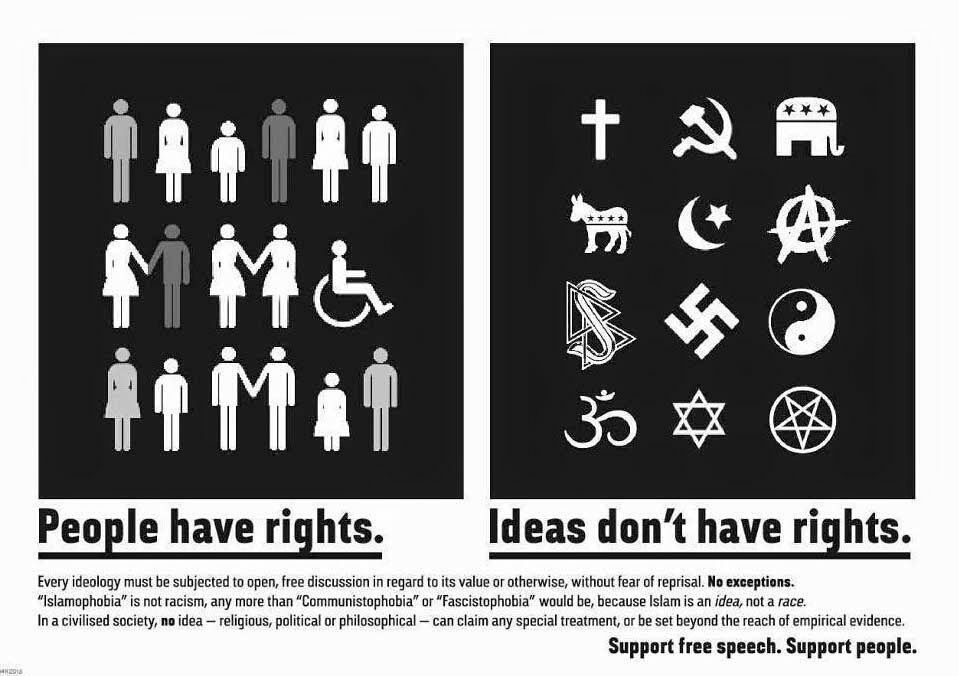
Idea Rights

I’ve just come across this on Twitter …


Click the image for a larger view

It’s clear, concise and correct.
Although as a couple of people have pointed out in the comments
people have the right to ideas, thoughts, according to UN Declaration of Human Rights

and
people actually have the Human Right to think what they want

Which is right — the abstract (ideas) and the non-living (eg. rocks, buildings, cars) cannot have rights per se although in some circumstances the living might be said to have rights on their behalf (think, burial of the dead). It is people — in fact arguably all living things (people, cats, cockroaches, trees) — which have rights.

Taboo Vocabulary

I’ve been going on, for a long time, about how we need to normalise nudity and sexuality, and become much more familiar and at ease with our bodies and bodily functions.
Apropos this I recently caught up with a July 2016 press release from The Eve Appeal, who are a charity devoted to fighting women’s cancers.
The press release reports on research they conducted into women’s, specifically young women’s, knowledge of their sexual anatomy, language and attitudes. The results are quite worrying.
Almost two-thirds of young women have problems using words such as “vagina” and “vulva” and only half of 26-35 year-olds are able to locate the vagina (compared with 80% of 66-75 years-olds).
But it gets worse …

It’s not just a knowledge gap … the data also showed a distinct difference in attitudes towards talking about gynaecological health issues … more than one in ten of 16-35 year olds said they found it very hard to talk to their GPs about gynaecological health concerns, and nearly a third admitted that they had avoided going to the doctors altogether with gynaecological issues due to embarrassment …
These findings are in direct contrast with the popular misconception that society is more open these days, making it much easier for women of younger generations to talk about gynaecological health.

I find this very worrying. It means there is a huge section of the population who are at much higher risk than need be of serious gynaecological health issues.
And according to Men’s Health Forum, men are no better about knowledge of, and attitudes to, their genital equipment. So don’t go getting all smug, guys!
I dread to think how bad is the knowledge of the other sex’s anatomy and the naming of parts. Or of normal bodily functions like menstruation.
We just have to change this! We have to get everyone much more familiar with their bodies — with bodies of all sizes, shapes and genders. We have to teach people the correct, as well as the incorrect and slang, names for body parts. We have to overcome the embarrassment and the knowledge gap.
There is really no reason for us to be embarrassed, because medical professionals aren’t — they’ve seen it all before. When I was in hospital recently for my knee operation I had a conversation with one of the (more mature) nurses, who remarked that they all, very early on in their careers, stop seeing genitals in any sexual way; they just become another piece of body no different from a finger or toe. And that is how it should be; just another part of a body. Until one gets into a specifically intimate and sexual situation.
It is also important that we teach when it’s appropriate to use various terms. While “penis”, “vulva”, “testicles”, “anus” are appropriate for a medical context, “prick”, “cunt”, “balls” and “arse” (although perfectly good Anglo-Saxon words) are much better kept for more intimate, private or jocular occasions. And even greater circumlocutory euphemisms are best abandoned completely.
Moreover, if we were all more attuned to, and comfortable with, our intimate anatomy how much more difficult it would become (and we would make it) for sexual predators/abusers. It would be much easier for (potential) victims to speak up, either at the time or afterwards. How much easier would it be for us to fight against female (and indeed male) genital mutilation and to reduce STIs.
I don’t know how we do this piece of public education, especially when we are starting from a base of such poor knowledge and attitudes. What I do know is that the responsibility has to lie with both parents and teachers. Actually it lies with all of us … we all need to use the correct words and not be frightened to do so.
If we can achieve this I feel sure it will result in much better health for all of us, because there will be no stigma in discussing “sensitive” subjects with medical professionals, or indeed with each other, just as we are all comfortable talking about ears, eyes, knees and backache.
It beats me why we can’t just do this.

Monthly Quotes

Here’s this month’s collection of quotes various for your edification and/or amusement …
When deaths occur in industries other than prostitution, the usual response is to ask how working conditions can be made more secure, not whether the industry should be scrapped.
[Frankie Mullin; http://www.newstatesman.com/politics/feminism/2016/12/can-we-end-violence-against-sex-workers]
Trollope’s mass is greater, of course, but as in Dance individual novels can be read as single coherent volumes but are strengthened and deepened by their part in a wider sequence, in which everyday life engages with and is counterpointed by the public world of affairs.
[Prof. John Bowen]
Along the walls frescoes tinted in pastel shades, executed with infinite feebleness of design, appealed to Heaven knows what nadir of aesthetic degradation.
[Anthony Powell; Casanova’s Chinese Restaurant]
Let’s not kid ourselves: everything we think we know now is just an approximation to something we haven’t yet found out. That is the frustrating, exhilarating lesson history teaches us about fundamental theories of nature.
[Richard Webb; New Scientist; 19 November 2016]
If you only read the books that everyone else is reading, you can only think what everyone else is thinking.
[Haruki Murakami]
The first people a dictator puts in jail after a coup are the writers, the teachers, the librarians — because these people are dangerous. They have enough vocabulary to recognize injustice and to speak out loudly about it. Let us have the courage to go on being dangerous people.
[Madeleine L’Engle]
An ambassador is an honest gentleman sent to lie abroad for the good of his country.
[Sir Henry Wotton; 1604]
Sex at age 90 is like trying to shoot pool with a rope.
[George Burns; 1896-1996]
Theresa May announces Quantum Brexit
Turns out the reason Theresa couldn’t be more specific when she kept saying “Brexit means Brexit” is because she was working on a highly complex plan with Britain’s top quantum scientists, which she had placed inside a secure box. Under this plan, the UK is to remain both inside and outside the single market and both maintain free movement and abandon it at the same time … as long as no one ever opens the box. However, if we open the box, May warns, all Britain gets is a cat.

Quit blaming your parents for everything wrong in your life. Be grateful they saw you through your teenage years and didn’t kill you.
Hating the haters is still hate. Being intolerant to those who are intolerant is still intolerance. Being bigoted against bigots is still bigotry. Bullying the bullies is still bullying. Lying about the liars is still lying.
[Brad Warner; http://hardcorezen.info/my-epic-battle-against-intolerable-evil/5090]
My prick no more to bald cunts shall resort;
Merkins rub off and often spoil the sport.

[John Wilmot, Earl of Rochester; 1647-1680]
The government was not claiming power to repeal or amend or in any other way to alter Acts of Parliament. No power to alter the law of the land was being claimed.  However, a power to notify (under Art. 50) was being claimed notwithstanding that it will result in changes to domestic law.
[Law & Lawyers Blog; http://obiterj.blogspot.co.uk/2017/01/brexit-litigation-in-supreme-court.html]
It is a poor family that hath neither a whore nor a thief in it.
[Old English Proverb]
Government is instituted for the common good; for the protection, safety, prosperity, and happiness of the people; and not for profit honour, or private interest of any one man, family or class of men.
[John Adams; 1735–1826; 2nd President of USA]
Progress in science depends on new techniques, new discoveries, and new ideas, probably in that order.
[Sydney Brenner]

Talking Therapy

Over the years I’ve tried talking therapies, of various sorts, on a number of occasions and each time I have found they don’t work even if one persists with them for a protracted period.
In fact it is my contention that they don’t really work for anyone, although some may be able to delude themselves and reach a cosmetic resolution — which I guess is working of a sort.


Last evening I was reading a blog post by our favourite zen master, Brad Warner under the banner I Hate Myself. Brad points out that the root of the problem is that the “I” and the “Self” are one and the same, so trying to fix one to fix the other is as useful as trying to argue your way out of a paper bag — pointless and productive of very little. And because we become aware of our failure it often makes the situation worse, rather than better.
Indeed it seems to me this is what talking therapies are trying to do: to fix (your variant of) “I Hate Myself” by getting you to separate the “I” and the “Self” when this is neither possible nor sensible.
And this is why talking therapies don’t generally work: they’re based on the false premise that “I” and “Self” are different and can be separated.
In the words of the exam paper: Discuss.

Word: Cunctation

Cunctation
Procrastination; the action of delaying; tardy action.
The word is derived from the Latin cunctātiōn-em, noun of action; cunctārī to hesitate or delay.
The OED records the first English use as being in 1585.