The trouble with fiction is that it makes too much sense. Reality never makes sense.
Monthly Quotes
This month’s selection of recently encountered quotes …
As someone who escaped the lurid treadmill of life in a circus family I have always had the most disagreeable fear that one day the exploding clown car would come back to haunt me.
[Sir John Major]
Anglo-Saxon words
Refuted by my scrabble app:
Cunt. Quim. (Frig’s OK.)
[@19syllables; https://twitter.com/19syllables/status/1176959628925636608]
Magnus nodded sagely. “The more you see of the world, Alva, the more you will find the line blurred between right and wrong. People move about, taking with them their beliefs, their customs, their language. They blend and meld with the places they settle until it is difficult to determine Viking from Anglo-Saxon, pagan from Christian. We are all growing and changing with every passing moment. And I am by your side. We will be changed by this together.”
[God] just seems very man-made to me. There are so many theories, and not everyone can be right. It’s human nature to need a religious crutch, and I don’t begrudge anyone that. I just don’t need one.
[Janeane Garofalo; Showbiz; 1995]
The one who follows the crowd will usually get no further than the crowd … The one who walks alone is likely to find herself in places no one has ever been.
Freddie experienced the sort of abysmal soul-sadness which afflicts one of Tolstoy’s Russian peasants when, after putting in a heavy day’s work strangling his father, beating his wife, and dropping the baby into the city’s reservoir, he turns to the cupboards, only to find the vodka bottle empty.
[PG Wodehouse; The Best of Wodehouse: An Anthology]
Don’t worry … we will be what we need for each other. We will become who we need to be to give each other light.
[Gesshin Claire Greenwood; https://medium.com/@clairegesshin/facing-the-end-of-everything-c3056f44e836]
Life is filled with suffering, but it is also filled with many wonders, like the blue sky, the sunshine, and the eyes of a baby … life is both dreadful and wonderful. To practice meditation is to be in touch with both aspects.
[Thich Nhat Hanh; Being Peace]
If you want to find the secrets of the universe, think in terms of energy, frequency and vibration.
[Nikola Tesla]
Whether the weather be hot,
Or whether the weather be not,
We’ll weather the weather
Whatever the weather
Whether we like it or not!
[unknown]
The standard business model for corporations is to lie, confuse and deny anything that may threaten their profitability.
[Steven Magee]
Ninety percent of what’s wrong with you
could be cured with a hot bath,
says God through the manhole covers,
but we want magic, to win
the lottery we never bought a ticket for.
(Tenderly, the monks chant,
embrace the suffering.) The voice never
panders, offers no five-year plan,
no long-term solution, no edicts from a cloudy
white beard hooked over ears.
It is small and fond and local. Don’t look for
your initials in the geese honking
overhead or to see through the glass even
darkly. It says the most obvious shit,
ie. Put down that gun, you need a sandwich.
[Mary Kerr; VI. Wisdom: The Voice of God]
When small men begin to cast big shadows, it means that the sun is about to set.
[Lin Yutang]
Eleanor Crosses
Serious historians amongst you will remember that on 28 November 1290 Edward I’s wife, Eleanor of Castile, died at Harby, Nottinghamshire, and Edward decreed that she should be buried in Westminster Abbey, almost 200 miles away.
Eleanor’s body was first moved to Lincoln, about 7 miles away, where she was apparently embalmed. Having buried her viscera (minus her heart) in Lincoln Cathedral on 3 December, Edward and a huge entourage escorted the body to Westminster – a journey which took around 12 days. Eleanor was buried on 17 December.
Just think about that for a minute. The cortège covered some 180+ miles, in early December, on foot and horseback, on almost non-existent roads. They covered about 15-20 miles a day, stopping overnight at major religious houses, where Eleanor’s body could lie with monks or nuns to keep vigil, and where the King could be accommodated. That, plus one suspects the suitability of the roads, determined the non-obvious (to us) route: Lincoln – Grantham – Stamford – Geddington – Hardingstone – Stony Stratford – Woburn – Dunstable – St Albans – Waltham – Westcheap (now Cheapside) – Charing.

Historians will also know that Edward I decreed that a memorial cross be erected at each of the stopping points – 12 in all. And in true medieval, grieving King style, we’re talking about a substantial memorial 30-40 feet high, richly carved and decorated. These 12 crosses were erected between 1291 and 1295 by established master masons. Records survive of the accounts for many of the crosses and we know that some cost £100 or more each – a vast sum in the 1290s. We also know they were completed before the financial crash of 1297!
Of the original 12 crosses only three now remain; at Geddington, Hardingstone and Waltham. The rest appear to have fallen victim to Oliver Cromwell’s merry men, or just the ravages of time.
[Who said “What about Charing Cross?”. Yes indeed there is an Eleanor Cross outside London’s Charing Cross Station. However: (a) it is a Victorian pastiche, (b) it is fairly well accepted that it is unlikely to be much like the original, (c) the original is known to have been destroyed by Parliamentary forces in 1647 at the height of the Civil War, and (d) it’s in the wrong place.]
Now the awake amongst our long-term readers will recall that I was brought up at Waltham Cross, site of the last of those three surviving crosses. In fact Eleanor’s body lay at the abbey in Waltham, which was in those days a major and influential monastery, (re)founded by King Harold Godwinson (1022-1066) – yes, he who got an arrow in the eye at Hastings. That place is now called Waltham Abbey. But the cross is about 2 miles west at what is now known as Waltham Cross. But why?
There are probably two (maybe more) reasons. Firstly Edward I wanted the memorials to be visible and public, so it didn’t make sense to put them at isolated monasteries. So the cross at Waltham was placed on the nearest “major road” at the junction with the causeway across the marshes to the abbey. Secondly, the abbey at Waltham was indeed rather isolated and in the middle of this swampy piece of marshland at the bottom of the Lea Valley; so the cross had to be built on the nearest sensible piece of stable ground.
Unfortunately I’ve never managed to photograph the cross at Waltham; in my days there it was encumbered by traffic, street furniture, traffic lights, trolleybus wires etc. But here is a recent image with the area round the monument now pedestrianised, and a scan of a glass negative I recently acquired.

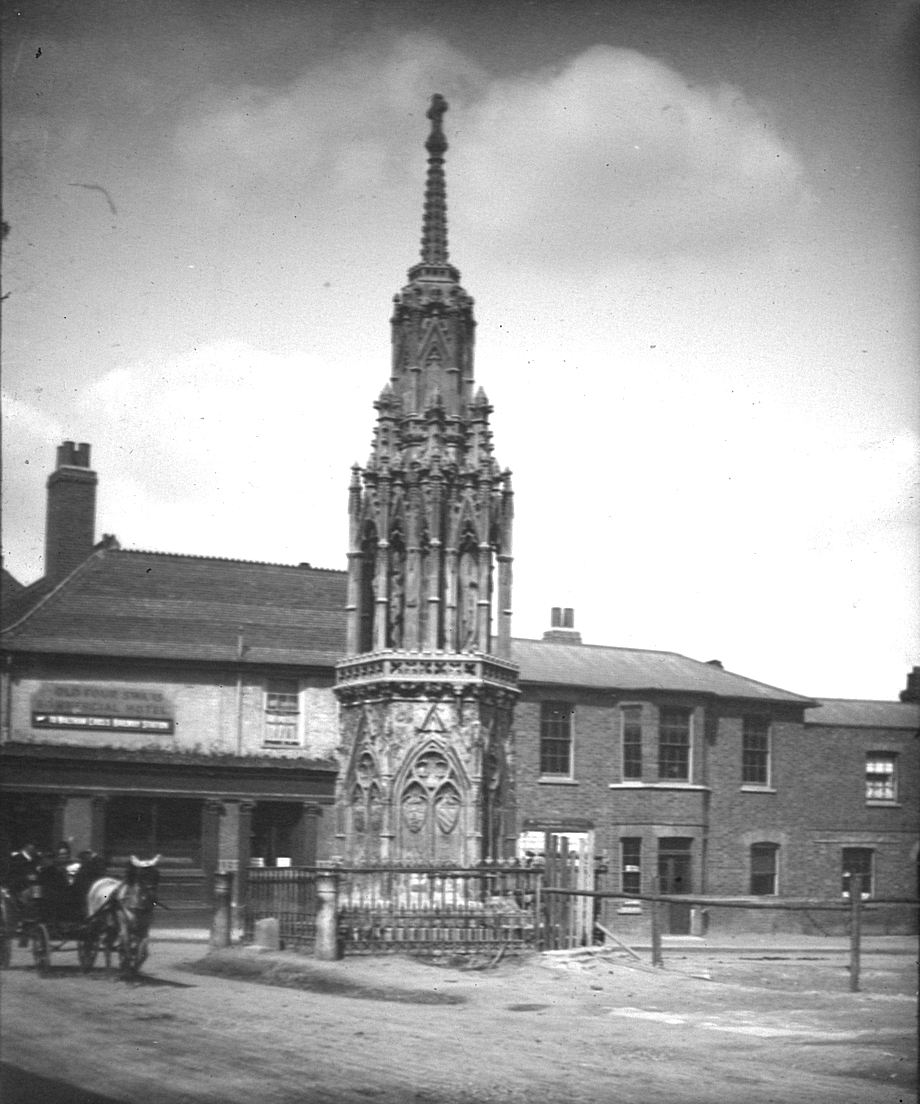
and in an old glass negative of c.1910 (R)
[Left image: Wikimedia]
Until this week I’d never seen the other two original crosses at Hardingstone (just outside Northampton) and Geddington (about 20 miles NE of Northampton). But a few days ago we had the opportunity to go to Northampton. Noreen was meeting her best friend from university, so I had some hours to kill.
On the way into Northampton we stopped at Hardingstone. Unfortunately the cross there is currently shrouded in scaffolding etc. as it is undergoing yet another round of belated restoration.
But why a cross at Hardingstone? Because Eleanor’s body lay overnight on the journey at Delapré Abbey, just a stone’s throw from the cross (which is on the main road) – the old abbey wall runs just beside the cross (just off to the right of my photograph (below). Here the nuns could keep vigil during the night. Meanwhile King Edward lodged at nearby Northampton Castle. So this was an obvious overnight resting place.
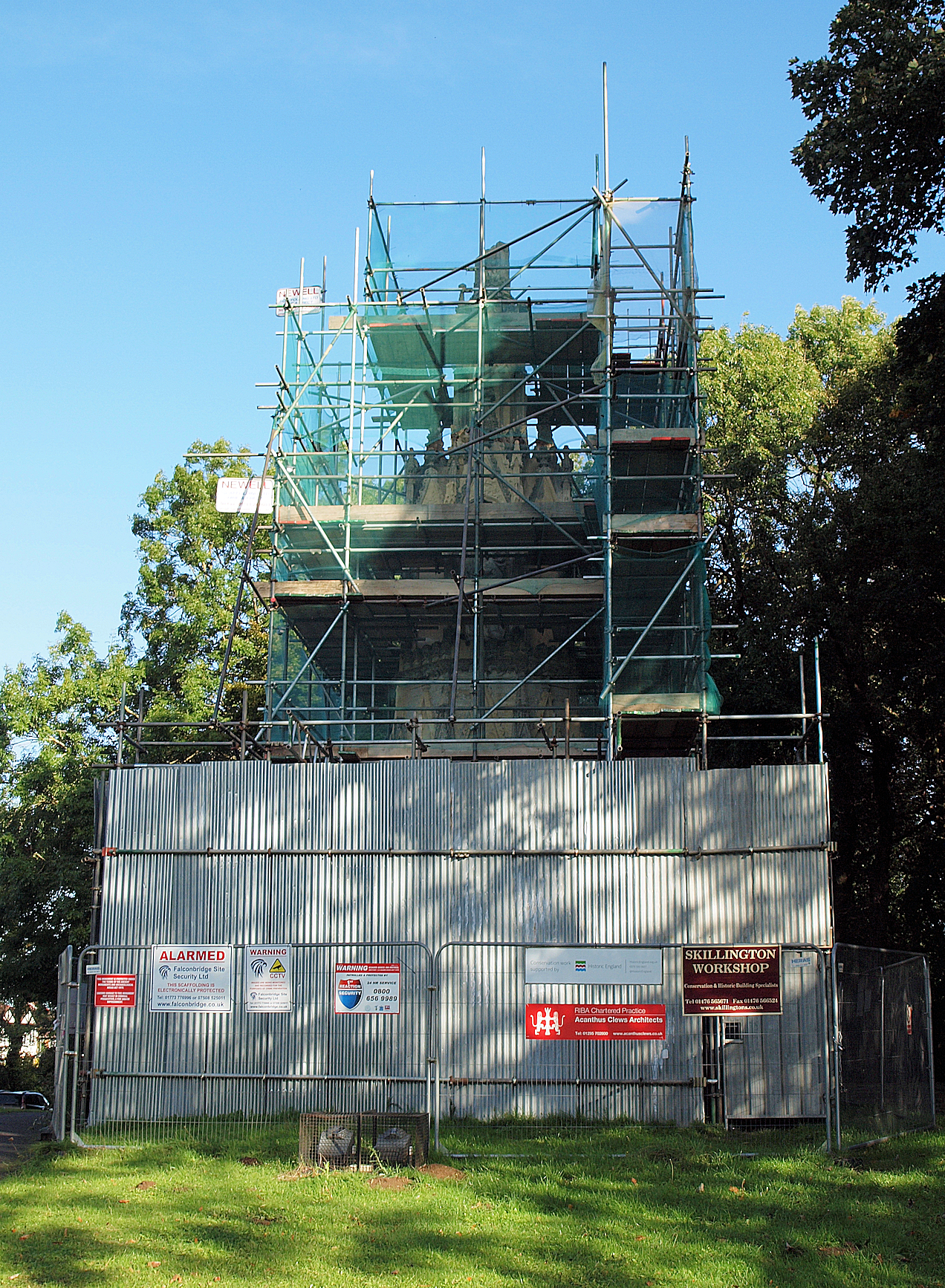

[Images: KCM (L); Wikimedia (R)]
Having dropped Noreen off we went on to Geddington. This is perhaps the best preserved (and least restored?) of the three crosses. Geddington is a tiny village of pretty stone houses and the cross stands in a triangle in the village centre right by the church. (The church itself is interesting as it retains a large element of the Saxon original.) As you can see from the photographs the Geddington cross is very different in style from either Waltham or Hardingstone – much more graceful and fragile in appearance, but just as decorated.
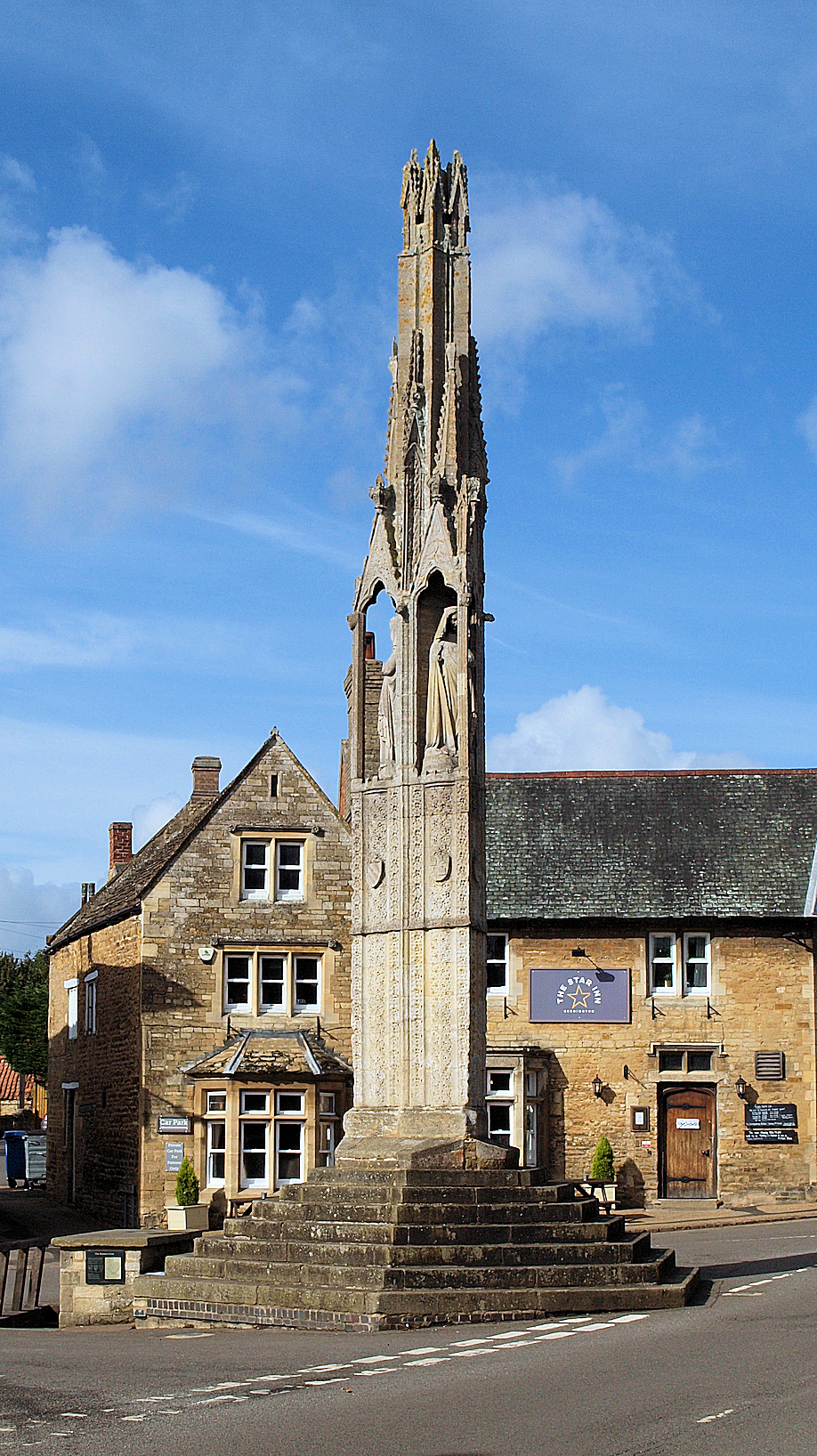
[Image: KCM]
I had puzzled over why there was a cross at Geddington as there was no obvious monastery here. But it turns out there was a royal palace (well at least a hunting lodge; depends who you believe) here, so an easy place for an overnight or two.
Having had a splendid lunch in The Star (also right next to the cross; it’s the building behind the cross in my photo) and looked at the church, we meandered our way back to Northampton; but not without another of Geddington’s delights: the ford, which is right next to the medieval packhorse bridge (now closed to traffic).

[Image: Wikimedia]
The meander took us via Earl’s Barton for a quick look at the church. This is notable for its stunning Saxon tower. The body of the church, and the battlements on the tower, are medieval additions. But that tower is quite something, although as time was ticking on I couldn’t dwell long enough to take much in the way of photos.
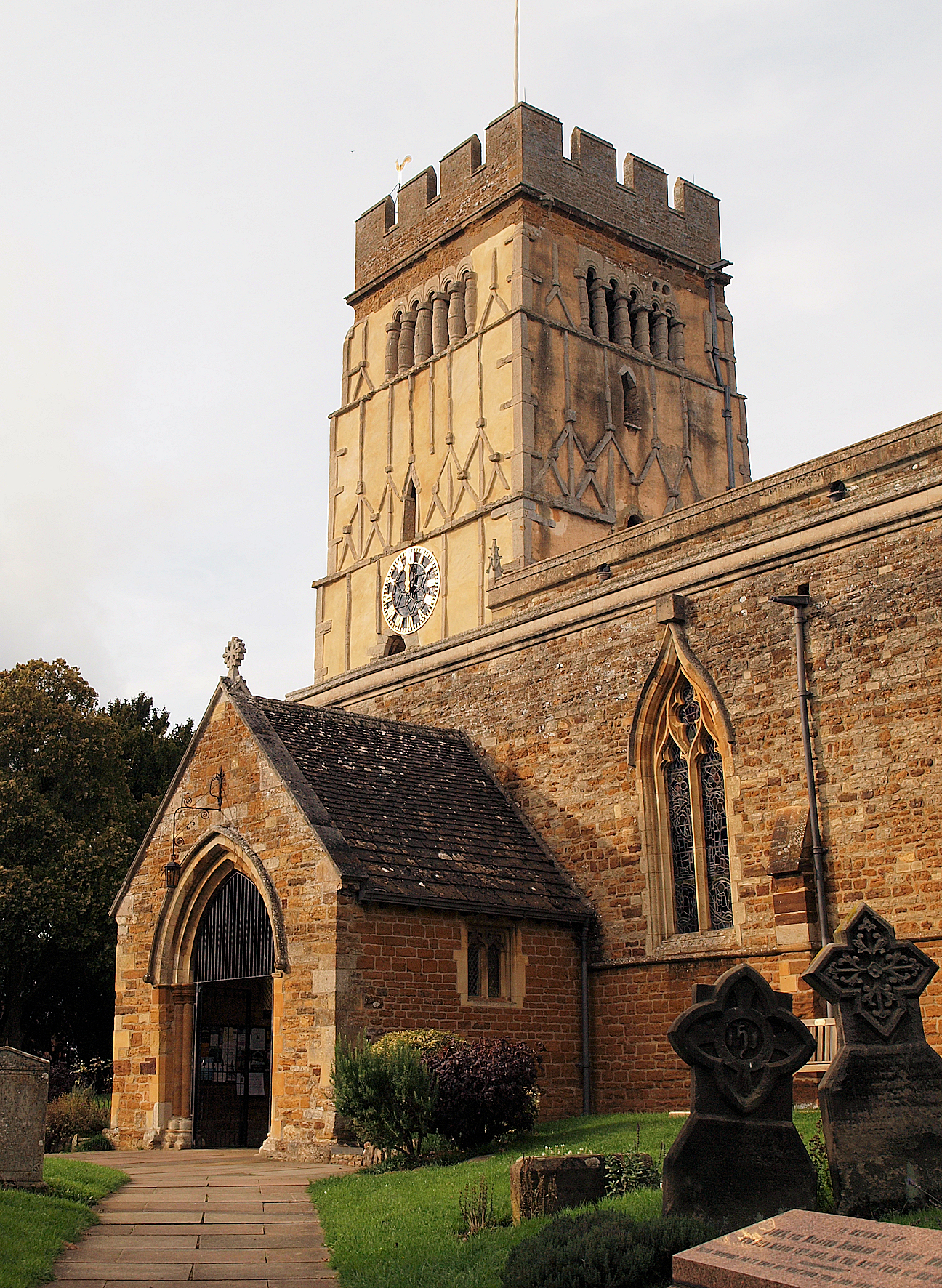
[Image: KCM]
Having collected Noreen and after a stop for much needed coffee and cake, we made our way back to London, by a different route. It was a long day, and we packed a lot in. But if possible it’s a trip we’ll be doing again, hopefully when the Hardingstone Cross is once more unwrapped.
100 Days of Haiku, Episode the Last
This is the final episode, covering the last couple of days, of my 100 Days of Haiku challenge. And not soon enough, they all say! Anyway here’s the final round-up.
Monday 7 October
Nudity and sex
need openness, not taboo.
Healthy benefits.
Nudity and sex
need openness, not taboo.
Healthy benefits.
Tuesday 8 October
Silent summer night
and a fox trots up the street,
snack sensor a-twitch.
Bonus
Turkish delight, such
subtly flavoured sweetmeat.
Seraglio’s best.
Here’s the tally of progress by week:
| Week | Haiku Written |
| 1 | 16 |
| 2 | 28 |
| 3 | 33 |
| 4 | 26 |
| 5 | 26 |
| 6 | 27 |
| 7 | 28 |
| 8 | 24 |
| Week | Haiku Written |
| 9 | 28 |
| 10 | 18 |
| 11 | 26 |
| 12 | 22 |
| 13 | 27 |
| 14 | 23 |
| 15 | 13 |
| Total | 365 |
So what now? Well … First of all I might put together a “Best of …” my 100 Days Haiku. The 365 written contain a lot of dross, and a few good ones that haven’t made the cut here. I shall see if I find any point doing this and then if I get to do it. Secondly, I have another 100 Day challenge lined up; I may delay strating it until the start of next month. So watch this space.
Meanwhile I hope this series provided some amusement – in whatever way!
Ten Things, October
This year our Ten Things series is focusing on each month in turn. The Ten Things may include facts about the month, momentous events that happened, personal things, and any other idiocy I feel like – just because I can. So here are …
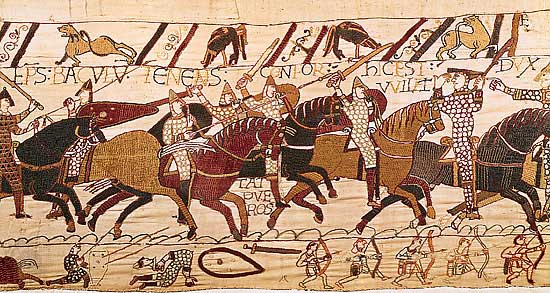
Ten Things about October
- Noreen’s birthday
- My late Mother’s birthday
- Birthstone: Opal
- Halloween
- End of summertime on last Sunday
- Eighth month of Roman year
- St Luke’s Day
- English Pudding Season starts
- Greenwich Mean Time introduced 1884
- Battle of Hastings 1066 (above)
100 Days of Haiku, Episode 14
So here we are at the penultimate instalment of our 100 Days of Haiku challenge. The 100th day is Tuesday 8 October and I’ll post the final results in the middle of next week. Meanwhile here is this week’s offering.
Monday 30 September
Felines emitting
zonkons. No wonder I sleep
all the afternoon.
Felines emitting
zonkons. No wonder I sleep
all the afternoon.
Tuesday 1 October
Autumn eastern sky;
only two stars, just visible.
Too much urban light.
Wednesday 2 October
Life is suffering
but filled with such wonders:
blue sky and lightning.
Thursday 3 October
Sink and ye shall find,
the tap it is a-dripping.
Plumber required.
Friday 4 October
2AM. She sleeps.
I enjoy a quiet wank.
Ah! So much better.
Saturday 5 October
Three eager felines
awaiting their bowls of cod.
No need to wash up.
Sunday 6 October
October tolls the knell
of distant summer days, and
winter soon to come.
Here’s the tally of progress by week:
| Week | Haiku Written |
| 1 | 16 |
| 2 | 28 |
| 3 | 33 |
| 4 | 26 |
| 5 | 26 |
| 6 | 27 |
| 7 | 28 |
| 8 | 24 |
| Week | Haiku Written |
| 9 | 28 |
| 10 | 18 |
| 11 | 26 |
| 12 | 22 |
| 13 | 27 |
| 14 | 23 |
| 15 | |
| Total | 352 |
Final instalment in a few days.
Counters
Each month this year we’re bringing you a post under the general title “Things that Count in [Number]” where [Number] will be the month. And naturally each month’s post will contain the [Number] of items (so just one for January, up to 12 for December).
For our purposes the definition of counting includes things which either come in groups of [Number] (eg. four suits in a pack of playing cards) or things which count in [Number] (eg. decimal coinage counting in tens).

Things which Count in Ten …
- Green bottles
- Anything metric
- Commandments
- Lords a-leaping
- Bowling pins
- Provinces of Canada
- Legs on a crab
- Countdown to launch
- Plagues of Egypt
- Grave precepts of Zen Buddhism
Monthly Links
Here goes then with this month’s selection of links to items you may have missed the first time round, and probably shouldn’t have done!
Science, Technology & Natural World
Cheeky monkeys! Apparently squirrels eavesdrop on birds’ chatter to find out if there’s a security alert.
After which it isn’t surprising that squirrels’ cousins, the rats, love games, giggle and jump for joy.
Insects deserve much more respect than they get; without them we’d not be here! [LONG READ]
One insect group deserving of greater respect, and admiration, are the wasps. Not just the annoying “yellow jackets”, there’s a whole diversity of species and they’re brilliant predators.
On the other hand we all like butterflies, and this has been an especially good year, especially for Painted Ladies.
Health & Medicine
Research has shown definitively that babies born by Caesarean have different gut bacteria compared with vaginal births. Why does this surprise anyone?
Statistical analysis shows that 26 September is the busiest day for births (at least in the UK) at about 10% above the average. Yes, you guessed it: it’s all down to Christmas and New Year shagging.
Sexuality
The world’s first Vagina Museum opens in November at London’s Camden Lock. Aim: to educate and raise awareness of vaginal and vulval health and fight stigmas.
Environment
Apparently the fish stock calculations were way off and North Sea cod should not have been labelled as sustainable.
What practical things can you do to combat climate change? One thing we seldom consider is to plant your own trees.
Art & Literature
After 119 years the Wallace Collection in London is to start lending out its artworks. Under the terms by which they were established they thought they couldn’t do this, but now they think they can.

History, Archaeology & Anthropology
Archaeologists have uncovered over 250 Neanderthal footprints, many of children, in northern France. They promise to throw some light on Neanderthal lifestyle.
Again, I’m not sure why this is surprising, but there is now evidence to suggest that the first people in the Americas came by sea.
Archaeologists are also now suggesting that prehistoric babies were fed animal milk from pottery bottles.
Coming more up to date, English Heritage are concerned that damp is putting many ancient murals, especially church wall paintings, at risk.
A piece of what is thought to be Elizabeth I’s lost dress is to go on display at Hampton Court.
In Scotland there is a plan to establish a national witches’ memorial.
London
While Britain’s parliamentarians are letting off quantities of hot air, the Houses of Parliament are threatening to collapse on their heads. [LONG READ]
One of our favourite London bloggers, Diamond Geezer, takes a random walk from Oxford Circus.
Food & Drink
No part of the pig is ever wasted. Now chefs are beginning to sign up to fin-to-gill eating – cooking fish without discarding anything.
Lifestyle & Personal Development
A pair of (American) researchers are suggesting every couple should have eight intense discussions to cement and develop their relationship. When you read their book, although they are deep discussions, it is the usual structured common sense – but something many will not easily do without a prompt.
It has apparently now been confirmed that there are benefits to being left-handed.
Shock, Horror, Humour
And finally, it’s time for this year’s Ig Nobel prizes. Amongst this year’s winners is a study of French postmen’s testicles.
More next month.
100 Days of Haiku, Episode 13
Now for the next instalment of our 100 Days of Haiku challenge.
Monday 23 September
Product of the cow
set between slices of bread.
Steak sandwich heaven.
Product of the cow
set between slices of bread.
Steak sandwich heaven.
Tuesday 24 September
Lazing along day.
No hurry, no rush, no stress.
Yet all is complete.
Wednesday 25 September
Gaze on a blank screen;
myriads of unborn words
at my fingertips.
Thursday 26 September
Pretty hairy pubes
wafting aroma aloft:
enticement to fuck.
Friday 27 September
Out of their depth the
bullies bully more, louder.
Government crisis.
Saturday 28 September
A painted lady:
pretty summer butterfly
or a pretty tart?
Sunday 29 September
Meaty piggy ribs:
marinade, oven barbecue.
Much yummy, Mummy.
Here’s the tally of progress by week:
| Week | Haiku Written |
| 1 | 16 |
| 2 | 28 |
| 3 | 33 |
| 4 | 26 |
| 5 | 26 |
| 6 | 27 |
| 7 | 28 |
| 8 | 24 |
| Week | Haiku Written |
| 9 | 28 |
| 10 | 18 |
| 11 | 26 |
| 12 | 22 |
| 13 | 27 |
| 14 | |
| 15 | |
| Total | 302 |
Next instalment, next Sunday.
Quote: Nasty People
Don’t make excuses for nasty people. You can’t put a flower in an arsehole and call it a vase.