![[47/52] Another Era Warps into View ...](https://farm8.staticflickr.com/7018/6405617805_32a5e63122.jpg)
Week 47 entry for 52 weeks challenge.
Another take on the vintage cars in London on 5 November in preparation for the London to Brighton run.

Week 47 entry for 52 weeks challenge.
Another take on the vintage cars in London on 5 November in preparation for the London to Brighton run.
This week’s catch-up on things you may have missed, and which I missed writing about. This week: Sex and Science.
 Now I know all maps are a 2D projection of a 3D surface, but I’d never realised before quite how many different ways there were of doing the map projections.
Does bestiality increase your risk of penile cancer? Why would anyone even think to want to find out?
First there was the Human Development Index — a sort of generalised national “happiness rating”. Then someone decided to add some greenness and turned the whole thing upside down.
Lots of interesting, quick and easy video explanations of physics at Minute Physics. Worth a look — and not just for geeks.
Vulvanomics — on female genital cosmetic surgery. Why would anyone? But then as a fully paid up mail I will never understand.
Antibiotics with a side of steak. Worrying commentary on agribusiness.
And finally …
Some lucky women are having orgasms in an MRI scanner. Now how cool is that?
But they’re doing it to show that only Epilepsy brings more activity to women’s brains than does “self-stimulation” to orgasm.
We live in a strange world!
I’ve not written recently about the nuclear disaster in Japan following March’s earthquake and tsunami. This is largely because there has been little in the way of new news. However a few days ago an IEEE Spectrum report was released which looks at the first 24 hours at the nuclear facility following the earthquake and highlights some of the design and procedural errors which exacerbated the disaster.

Although the situation in the reactors was clearly far worse than we had been led to believe, I’ll not extract the report here: you can read a summary on-line. And it is worth reading: it’s clear, lucid, gives a flavour of just how complex these situations really are, how much wasn’t know (or wasn’t told) and how people react under extreme pressure.

What I will do is mention the six major lessons which have been highlighted by the report, with the inevitable handful of comments. This should be sufficient to show where there were errors in the design of plant and procedure. Before that there’s one important thing to note:
[The] report is based on interviews with officials from the Tokyo Electric Power Co. (TEPCO), Japan’s Nuclear and Industrial Safety Agency, the U.S. Nuclear Regulatory Commission, the International Atomic Energy Agency, local governments, and with other experts in nuclear engineering, as well as a review of hundreds of pages of official reports.
So it isn’t just make-believe; it should be good stuff. Anyway here are those lessons:
Lesson 1. Emergency generators should be installed at high elevations or in watertight chambers.
Sounds obvious, doesn’t it. But it all comes down to good risk analysis. If you aren’t expecting significant flooding it makes great sense to put plant, especially emergency generators etc., on the ground: they’re excessively heavy and when operating generate huge amounts of noise and vibration.
LESSON 2. If a cooling system is intended to operate without power, make sure all of its parts can be manipulated without power.
Again sounds obvious when stated like that, but far too easy to overlook, although good design reviews should have picked this up.
LESSON 3. Keep power trucks [mobile emergency generators] on or very close to the power plant site.
Why would we do that? Isn’t a central facility more cost effective? In this case no, it may not be!
LESSON 4. Install independent and secure battery systems to power crucial instruments during emergencies.
Same comment as for Lesson 2.
LESSON 5. Ensure that catalytic hydrogen recombiners (power-free devices that turn dangerous hydrogen gas back into steam) are positioned at the tops of reactor buildings where gas would most likely collect.
You’re never going to get a big build-up of hydrogen inside a containment building are you. Wait: isn’t that what a containment building is for? But be honest, how many of us would have thought of this?
LESSON 6. Install power-free filters on vent lines to remove radio-active materials and allow for venting that won’t harm nearby residents.
Again, see Lesson 2.
What remains clear to me is that the plant, the systems and the procedures worked correctly, and were implemented correctly, as they were designed. What failed is the 40-year-old design and the procedures which didn’t go far enough in their disaster scenario planning.
We would (and do) do much better now and will do even better as a result of this disaster. Because of its safety critical nature, the nuclear industry is like the aviation industry: every accident (and near-accident) is analysed for the underlying root cause(s) and there is a culture of incremental improvements and (where necessary/possible) of retro-fitting improvements. Notwithstanding the fact that Fukushima was (and is) a disaster, exacerbated by continuing failures in transparency and communication, I see this as a positive experience which should make nuclear power safer and more acceptable — not the reverse.
The biggest disaster is the effect on the displaced and frightened people which is largely psychological and social rather than medical; and that’s in large part down to the obfuscation and half-truths of the TEPCO and Japanese government communications. One day governments will learn that total transparency is the only safe course of action.
![[44/52] Vintage Speed](https://farm7.static.flickr.com/6223/6315943884_b6dbb9b54f.jpg)
Week 44 entry for 52 weeks challenge.
There were a a few vintage cars wandering around the Mayfair/Bayswater area of London this afternoon, presumably having been on display/parade in Regent Street ahead of tomorrow’s London to Brighton run. They’re a real challenge to photograph in amongst all the other traffic especially as many are so small they tend to hide. In the end I managed to take this from the passenger seat of our car as we overtook one on the Bayswater Road near Lancaster Gate tube station.
Here’s this week’s selection of interesting articles you may have missed. And what a selection it is!
Turning the lights off won’t save oil, says Melissa C Lott in the Scientific American blog. Maybe not, but it will save coal and gas, reduce emissions and stop wasting our (increasingly expensive) electricity.
“Put that fly down! You don’t know where it’s been.” But Rob Dunn does. Again in the Scientific American blog.
The Divided Brain is an 11 minute video in which Psychiatrist Iain McGilchrist describes the real differences between the left and right halves of the human brain. It’s not simply “emotion on the right, reason on the left” but something far more complex and interesting. Love the cartoons!
Max Davidson in the Daily Telegraph defends old-fashioned words against the influx of new text-speak.
And here’s yet another from the Sci Am blog … Ingrid Wickelgren goes looking for the secrets to a happy marriage. And finds some unexpected answers.
The right to keep your pubes. A feminist perspective on shaving for childbirth. I dunno what’s so feminist about it; seems like a basic right to me.
And lastly, if I hadn’t read this here, I wouldn’t believe it. Londoners are being told to stop shagging for a bit, ‘cos the Mayor doesn’t want girlies dropping bairns in the streets during the sacred cow Olympics. Maybe Boris needs to make sure we keep the lights on!

Quite a while back Katyboo resurrected the “Ten Things” meme. Although I’m doing a monthly sequence of ten things, I thought I’d join the overladen tumbrils and bandwagons rolling down the cobbled streets. So leaving out the inevitable choices of food, wine, cake, coffee, my wife, the cats, blah, blah, blah, here’s my slightly more unusual, and possibly controversial, version.

 Wearing Glasses. This is something else I’ve done since I was young — like about 14. I’m basically short-sighted, so I’m pretty blind without my glasses. Which is why I’m not a natural ball-player, despite my love of cricket and hockey. Contact lenses weren’t around when I started wearing glasses, so there was no choice: wear glasses or not read the blackboard at school. I hated glasses at first, largely because I had horrible frames. But once I was allowed to choose my own metal frames (like when I could pay for them myself) and have plastic lenses I got to like glasses. They don’t worry me. Most of the time I don’t know I’m wearing them. Yes, keeping them clean is a pain. But for me lenses would probably be worse; I’m not sure if I could adjust to them and this would be harder given my hayfever etc. — all the lens wearers I know seem to have continual trouble with them.
In Iron Age England, it was believed that the cock served as a defence against thunderstorms; that is why cocks are still to be found on church steeples. They became known as weathercocks.
[Peter Acroyd, The History of England, Volume 1: Foundation]
There seems to have been a lot going on this week which drew my attention but which I didn’t get to write about here. So here’s a summary (in no particular order) …
First an interesting item on how belief can kill. It’s a curious phenomenon but even so I can’t bring myself to read the book. See The Dark Side of the Placebo Effect: When Intense Belief Kills.
Much more interesting and useful is a long article on the National Geographic site about the workings of Teenage Brains and how this should be seen as a sensible evolutionary trait. It might also help all of us understand and relate with teenagers. It certainly seems to explain quite a lot.
Next an investigative journalism piece about the Fukishima Disaster and especially the long-term effects on the Japanese population. The suggestion is that the effects of stress etc. will be far more significant than the actual radiation doses (I guess excluding the immediately affected workers). For my money the article still doesn’t delve deep enough — but the journo writing it probably couldn’t get access to do so.
Law and Lawyers has written several pieces about the worrying machinations of the Metropolitan Police in attempting to get The Guardian to reveal some of its sources. First they were going to use the Official Secrets Act, then PACE 1984. For now though it seems the dogs of war remain caged.
Also this week Obiterj at Law and Lawyers has pointed out that the Fixed Term Parliaments Act 2011 comes into force. This means the next General Election will be on 7 May 2015 — unless both Houses of Parliament decide otherwise by a two-thirds majority.
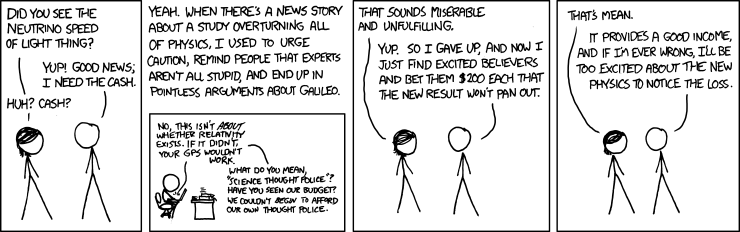
Which for a scientist somewhat pales into insignificance beside the apparent result from a team at CERN that they have detected neutrinos doing the impossible and travelling faster than light. But hold on guys, they don’t quite relieve it either and they’re asking the scientific community for help to test their results. Good scientific commentary by Adrian Cho at Wired and Phil Plait of Bad Astronomy.
Finally back to earth. There’s been lots of twittering in the dovecotes about female orgasm, how it relates to evolutionary pressures and to male orgasm. Also some good demonstrations on how to demolish a (supposedly) scientific study. The best of the critiques I’ve seen is from Scicurious. Maybe you girls should just be allowed to enjoy it?
Have an orgasmic weekend!

The magnitude 9 earthquake that struck Japan on 11 March was one of the five most powerful shocks recorded; so powerful that it lowered the coastline by a metre and nudged Japan two metres closer to the United States.
[Jonathan Watts, “Fukushima disaster: it’s not over yet”, Guardian, 9 September 2011, online here]
Week 37 entry for 52 weeks challenge.
As Noreen has reported on her weblog, yesterday we went to Chipping Norton in Oxfordshire in search of some of her ancestors — and just to walk the streets they walked. The Meades line was an unexpected find for Noreen, both in that they come from somewhere way away from Lowestoft but also because they are a family of stonemasons.

This is the gravestone of Noreen’s great-great-great-great-grandfather, Richard Meades, in the churchyard at Chipping Norton. He was the stonemason responsible for the work to rebuild the church tower in the 1820s. It is Richard’s stone, William MeEades who eventualy moved to Lowestoft.
Chipping Norton (or “Chippy” as the locals know it) itself is a delightful small Cotswold town built out of the local golden stone and on the side of quite a wicked hill — hardly surprising as it is supposedly the highest town on Oxfordshire. And the fact that it is on the side of hill has resulted in something quite unusual: the parish church (St Mary’s) is in fact lower down the hill than most of the rest of the old town — the main street is at about the same level as the top of the church tower.
More photos of Chipping Norton over on my Flickr photostream.