Category Archives: ramblings

Pornography vs Obscenity

I’ve just finished reading Brooke Magnanti’s The Sex Myth: Why Everything We’re Told is Wrong (review later) and she makes a useful point about pornography and obscenity.

The word ‘pornography’ comes from Greek roots: porno-, related to prostitution; graphos, to write. Stories about hookers, in other words … People in the nineteenth century became more worried about drawing a line between what was art and what was obscene. Those worries helped shape the view of what today is labelled ‘pornography’ versus what is labelled ‘erotica’ – even though few people, if any, can give a clear idea of the difference.
‘Obscenity’, meanwhile, comes from the Latin obscenus, meaning repulsive or detestable. Something obscene is something that is offensive to the morality of the time, something taboo. The definition of obscenity is different in different cultures, and even people in the same culture can disagree about what is obscene. Many laws have tried to define obscenity. While erotic imagery can be defined as obscene, it isn’t always considered so, and some laws recognise this

To which I would like to add the word ‘prostitute’: one who engages in sexual activity in exchange for money (payment).
Put that lot together and it means my world view goes something like this …
Technically pornography is stories about those who engage in sex for money. To me this means that any video (or other medium) which portrays a sexual act, where one can reasonably expect that (some of) the participants have been paid is pornography and (depending on one’s predilections) may also be erotic. Mere photographs of vulvas or penises may also be erotic, but are not a sexual act so are not (at least in my world view) pornographic; they aren’t ipso facto a sex act.
Whether one defines the pornographic, or the erotic, as obscene depends very much on one’s personal morality. We each have our own moral code, which may or may not align with that of society at large, and an act (image, description) doesn’t become obscene until it offends our morals and transgresses the line into being taboo. And that act doesn’t have to be sexual.
To use my own views as an example, I have no problem with the depiction of sexual acts, let alone the depiction of breasts, vulvas or penises. Pornography (as defined above) for me only becomes obscene when it crosses the boundary into being violent, non-consensual or involving minors or animals. There are sexual acts I greatly dislike (eg. male homosexuality), but that doesn’t per se make them obscene. But I do find many other things in this world obscene, amongst them the gratuitous killing of people and animals, blatant disregard for human rights, FGM, rape (of people and the environment), corporate greed and bankers mega-bonuses. YMMV.
So pornography is essentially, technically, amenable to definition. Obscenity is not readily definable so easily in anything other that one’s personal world view. Pornography is (should be) a largely objective measure. Obscenity can only ever be subjective. Which, of course, doesn’t mean that legislation cannot prohibit certain acts because the moral view of the majority of the legislature is that they are obscene for them – that’s how our collective, social, morality works and it is only by iconoclasts like me pushing the boundaries that such collective views are shifted.

How to be Green

Noreen and I have always maintained that we’ve done two of the most important things one ever can in terms of being green and preventing global warming. We don’t have children and we don’t run a car.
It turns out that we’re right, as this article outlines.

Any of [the top] lifestyle changes drastically reduces carbon emissions compared to more common practices like recycling, using energy-efficient light bulbs and line-drying clothes.

  • having one fewer child (an average for developed countries of 58.6 metric ton CO2-equivalent (tCO2e) emission reductions per year;
  • living car-free (2.4 tCO2e saved per year);
  • avoiding airplane travel (1.6 tCO2e saved per round trip trans-Atlantic flight);
  • eating a plant-based diet (0.8 tCO2e saved per year).

In fact, according to this list, we should also count the third item.
As always though there is a “but” …
Yes we’ve chosen not to have children. So far, really good. However we are not totally car-free. It’s true that neither of us drives and we’ve never owned a car, but we do use taxis a fair amount. I calculated many years ago that, when one looks at the total (money) cost of ownership, using taxis was much cheaper than running a car. Nevertheless, using taxis can’t count as totally car-free, although I’d maintain it is pretty damn good: on the 2-3 times a week we need car transport, by using a taxi for maybe 20 minutes, we share that car with tens of other people that day. And having to get a cab, makes us think about what we’re doing and where we’re going, as we can’t just jump in the car at any slight provocation, several times a day.
In addition we avoid air travel wherever possible. We’ve only ever done one long-haul trip (Washington DC) and even then we made a special effort to offset the carbon emissions. I don’t see us doing long-haul again; but one never knows. Although over the years I did a couple of dozen internal or European flights for work, we’ve only ever done a handful of short-haul flights for leisure purposes – and again I don’t see that changing significantly. Yes, of course we would love to go and see all these fancy places – but we don’t need to, it’s expensive (in so many ways) and we can live without it.
So while we may not be able to count a full 3 out of the 4, I reckon we’re entitled to 2½. Which is probably 2 more than the average person. No reason to gloat, but a reason to be sad that others are perhaps less compassionate, and a reason for some small contentment.
Ultimately it is all down to one’s ethical compass, how one views the world, and making lifestyle choices.
How well do you do?

Extra Cat

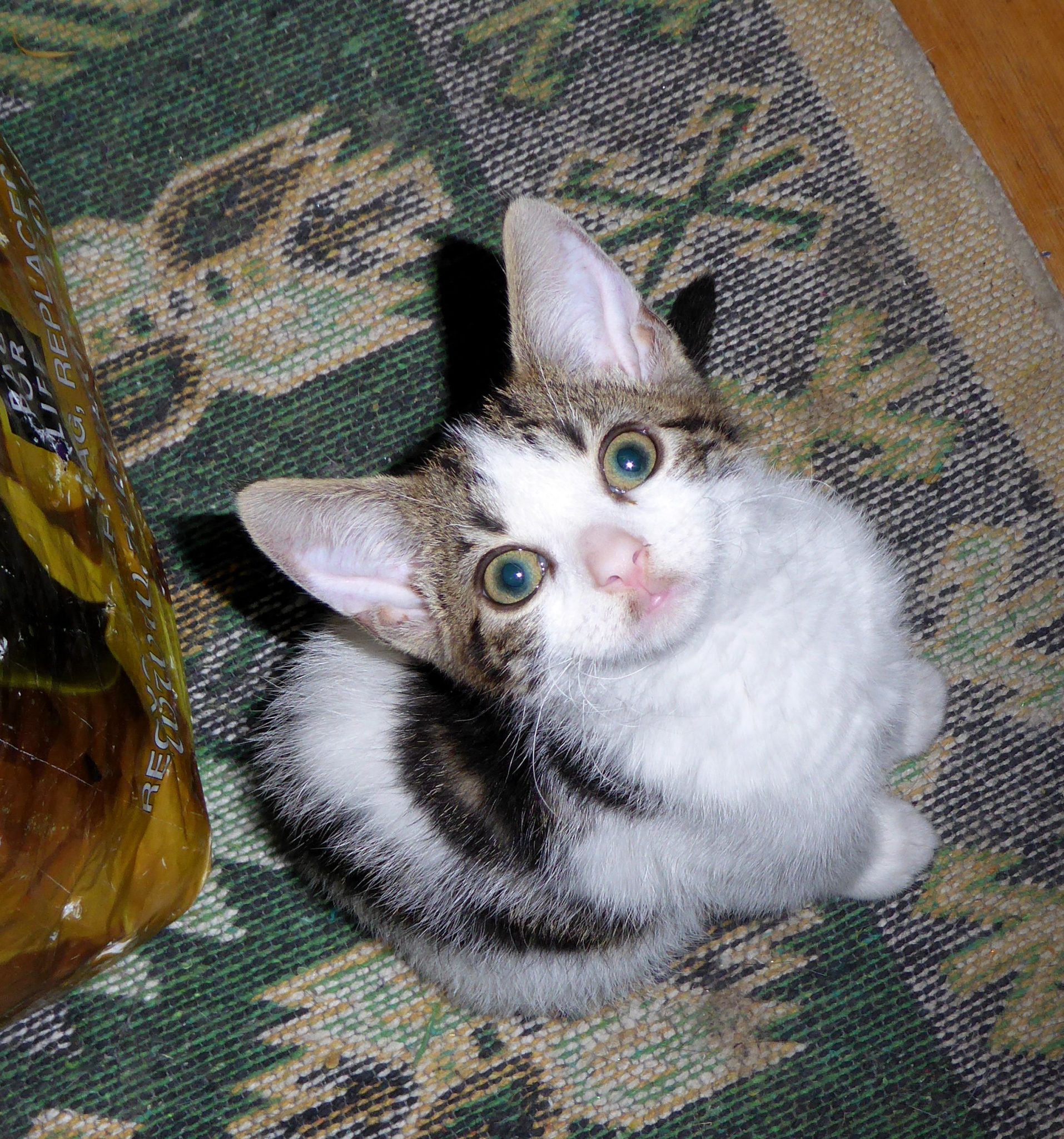
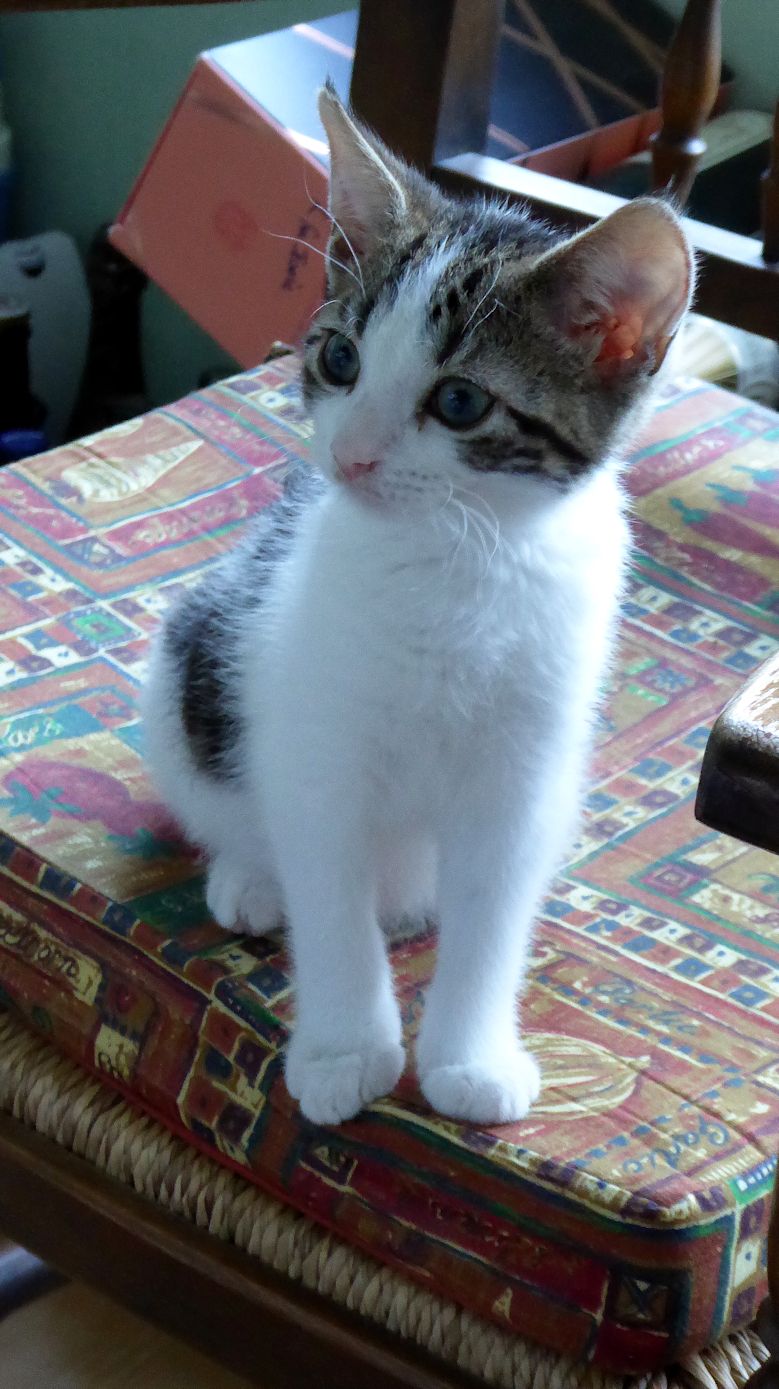
Yesterday we acquired another kitten – a boy kitten. Well we can’t have a household of just two girlie cats! Again he came from our local animal rescue charity Guardian Angels and was being fostered by the lovely Kat in Isleworth. Kat said she hadn’t named him but was referring to him as “Boy”. By the time we got him home, it had stuck. He’s about 9 weeks old, mostly white with some tabby splotches. He’s also got noticeably, and strikingly, curly whiskers, a very triangular head and big ears – which makes us wonder if he doesn’t have some Devon Rex (or similar) in his make up; maybe a Devon Rex grandfather?
So here are the first couple of decent photos, taken at lunchtime yesterday, within an hour or so of him arriving. In the first he is offering to help with lunch. Well what self-respecting cat wouldn’t when there’s cold roast salmon on offer?


Like all kittens he’s slightly scruffy, but that never stops them looking cute …

He’s still quite phased by everything. He was the last of the litter to find a home, so he’s been without his brothers’ company for a while. He hated the car journey home. And everything here is different, new and scary especially with two big cats around. But he’ll be fine. I’m confident they’ll all adjust.
If nothing else Boy will eat for England. He clearly wasn’t starving when we brought him home. Nevertheless between about 1pm and midnight yesterday he demolished two complete sachets of kitten food, several teaspoons worth of cold salmon, a piece of raw steak the size of a large almond, and several similar pieces of cooked steak. Oh and the piece of pasta I dropped on the floor. By the evening he was very round and drum-like in the middle; he looked as if he’d swallowed a basketball and was about to split a seam. But then it is every kitten’s ambition to be like that: most cat’s run by the motto “Eat now, lest hungry later”. As Garfield always said: “Eat and sleep. Eat and Sleep. There must be more to life but I do hope not!”
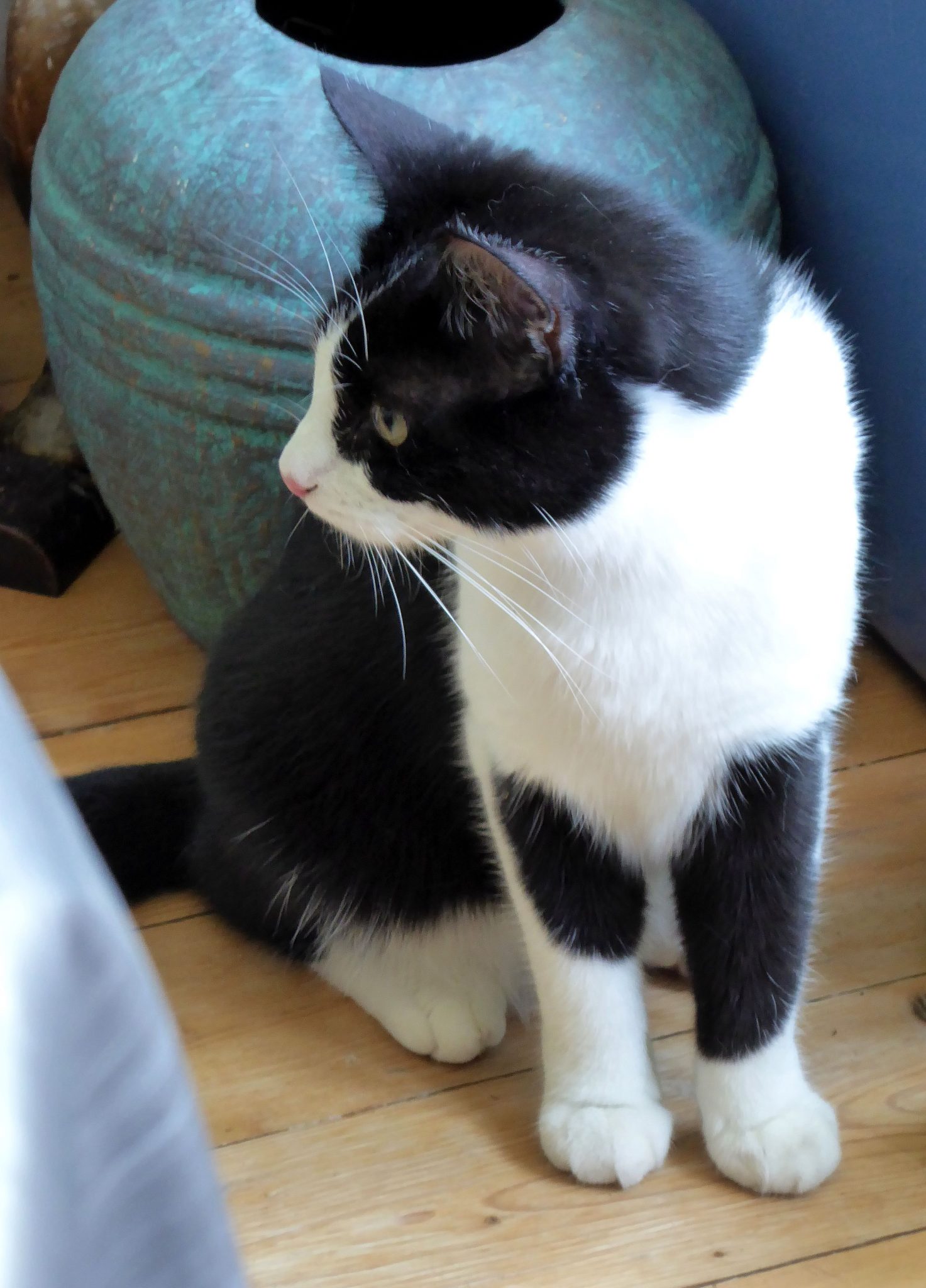
Meanwhile WPC Primrose sat and watched, ready to intervene in any indecorous behaviour:

Actually, apart from spending time out, and being pissed off because our bedroom is out of bounds at present, both Tilly and Rosie are being quite good.

Ten Things

Summer is here. Well at least we’ve had a few glimpses of it. So Ten Things this month has a summery theme.
Ten Summer Things To Do

  1. Eat ice-cream
  2. Watch a cricket match (in person not on TV)
  3. Eat strawberries (and cream, of course)
  4. Sit in the garden (or on the beach) drinking wine
  5. Swim nude
  6. Paddle in the sea
  7. Go to a garden and enjoy the roses
  8. Sit by the river and watch nature and the world go by
  9. Spend a day in the nude – in your garden or on the beach – and enjoy the feel of sun and breeze on your skin
  10. Visit a farm to pick your own strawberries, asparagus etc.

Of course, doing these things is not necessarily restricted to summer, but they’re all better in nice weather. So now we just need the sunshine!

Shoes and Ships, but no Sealing Wax

The last couple of evenings I’ve been reading a small volume produced in 1965 by the Sussex Record Society. It’s by Richard F Dell and titled Rye Port Books; it documents shipping in and out of Rye in East Sussex between 1566 and 1590, ie. a large part of the reign of Elizabeth I. Rye, at this date, had a large harbour which irrevocably silted up around 1600.
While this might sound somewhat dull, they were interesting times (to say the least) when there was essentially a “cold war” between Protestant England and Catholic Europe. Understandably no-one was permitted to leave (or enter) the country without government permission, although many did and not a few were either Catholics fleeing to France or Italy or they were spies for one side or the other (or indeed both).
Rye at that time was one of the major ports for both passengers and freight between England and France and the Low Countries. Regrettably there is little detail of people movements in these records, apart from the occasional note of a boat carrying “20 passengers”. This is a shame because even at this date there were immigration officers stationed at every port such as Rye. Their job, as today, was to interrogate and determine the bona fides of all travellers and naturally to detain any they thought might be Catholic insurgents or spies. From reading elsewhere about the spy rings of Elizabethan England (masterminded by Lord Burghley and Sir Francis Walsingham) it is clear there was also a large amount of mail travelling back and forth, mostly being hand-carried by couriers. [For more on this see Stephen Alford, The Watchers: A Secret History of the Reign of Elizabeth I. Review when I’ve finished reading it.]


This book is more about the trade which was happening. Although there are several vessels logged which seem to do nothing but ply back and forth between Rye and Dieppe (the preferred route to France) carrying what today would be called “stuff”, there is also a large amount of goods travelling round the coast of the country, especially between Rye and London, but also as far afield as Newcastle, Spain and Portugal. Remember these are times when the roads were poor, if they existed at all, and a journey from Rye to London by cart carrying goods would take a week or more whereas in good weather a boat could sail between Rye and London in a couple of days. None of the ships involved are of any size; the largest I saw mentioned was 70 tons and they go down to tiny boats of 10 tons; the average is probably around 25-30 tons. These really are tiny boats; the Mary Rose by contrast was rated at 500 tons.

A large section of the book is a line by line summary of every ship which enters or departs Rye over this 35 year period (give or take a few gaps), all constructed from the surviving Elizabethan records in the Sussex County Archive, the National Archives and the Rye Town Records.
Most of the cargo was quite mundane, and perhaps what one might expect: grain of various sorts, wood (ship upon ship full of wood), coal, wool, cloth of various types, wine; and there were many loads which are just recorded as “mixed” so who knows what they contained. Iron appears fairly regularly, and in significant quantities too (the Sussex Downs were an iron smelting centre at this date) and there are several shipments of ordnance including the occasional iron cannon.
But there are some surprising (at least to me) things, such as: lupins, vinegar, apples (from France), oranges and lemons (yes even so; they come in from Spain and Portugal), hops (being traded in both directions), horses (strangely mostly out-bound), cony skins, wolf skins, bricks (being imported from the Low Countries; a single 40 ton ship can carry at least 10,000). And it goes on with nuts, spices, lead, paper, hosiery, cochineal, woad (presumably for use as a dyestuff), herrings (red and white), codfish, quails and scrap brass. Another ship brings in “6 asses”. All of this is, of course, taxed.
But there were several entries which really caught my eye. One cargo is documented as “Mixed inc. tennys bawles”; another contains “French playing cards”. Then there’s a mixed shipment which includes hawks (“6 Tassell hawks, 7 Falcon hawks, 3 Martin hawks, imported by Walter Libon, alien”). Lastlly, there are several shipments of old shoes to London! One can only guess that scrap leather had a value, but for what?
We think we live in interesting times, ship strange goods around in containers, using humongous amounts of oil. But all this was being done by the power of man, horse, tide and wind.
Who said history is dull!

On Manners, Expectations and Love

Is there a relationship between manners, our expectations of others and love?
Weaving together three articles from several years ago, I think there may be. This post is really me trying to see if this works. So you may disagree and I’m open to discussion.
First of all let’s think briefly about manners: those actions we try to instil into our children to help them survive in polite society.
According to an article in New Scientist in September 2013, “Manners maketh man: how disgust shaped human evolution” by Valerie Curtis [paywall] …

We need to better understand manners for two reasons: first, because they are a principal weapon in the war on disease, and second, because manners underpin our ability to function as a cooperative species … [M]anners are so important that they should be up there with fire and the invention of language as a prime candidate for what makes us human.
The first, and most ancient, function of manners is to solve the problem of how to be social without getting sick.

Those who master manners are set to reap the many benefits that come from living in a highly cooperative ultra-society. Manners are therefore a sort of proto-morality, a set of behaviours that we make “second nature” early in life so that we can avoid disgusting others with our parasites and our antisocial behaviour.

It’s the “cooperative society” part which interests me here as this seems to mesh with the idea (Business Insider; 25 March 2013) that

What one person expects of another can come to serve as a self-fulfilling prophesy.

This was tested on teachers and children. Teachers were told (randomly) a child was a star or a dunce; the children didn’t know how they’d been allocated. A while later when the child’s subsequent achievement was independently tested the stars had done significantly better than the dunces.
Thus we have a situation which reflects what I always say:

If you treat people as you would like them to be, you give then the space and incentive to grow and develop. If you treat them as they are, then they stay as they are.

If you expect manners, you’ll (hopefully) get manners; if you expect no manners, you’ll get no manners. And like it or not, manners oil the wheels of society.
So where does love come into all this?
Reflect on this comment from Candice Chung in an article “Why Chinese parents don’t say I love you” from the Sydney Morning Herald in July 2016.

From a sociological perspective, studies have also found that the phrase ‘I love you’ tends to be used less in a high context culture [eg. Asia] where “expectations are high and well documented”. While in the West (low context society), relationships are often managed with ‘I love you reminders’ to reassure someone of their importance [whereas], in high context culture, “intensely personal and intimate declarations can seem out of place and overly forceful”.

What this is saying seems to be that the Asian way, covert love, is thought to be less intense than the Western, more overt, way. In fact it seems to me the opposite is true and that the Asian way puts far more pressure on families and relationships than we do in the West. There seem to be far greater expectations of family connection, responsibility, loyalty etc. amongst Asians than amongst Westerners, and that the Western way appears to me to be more balanced and permissive of personal freedom.
And that amounts to essentially a difference of manners and expectations between cultures, so it is no real wonder that the cultures work differently.

Ten Things

It’s just over 500 years since Sir Thomas More first described what he called Utopia in 1516. So this month’s Ten Things celebrates More’s fabled island nation.
Ten Essential Elements of My Utopia

  1. Always a perfectly sunny warm early summer weather
  2. No death or life-threatening illness; all illness cured by love
  3. A perfect ethical code that everyone follows, hence a world without greed, hunger, thirst, violence or war
  4. No rat race and no oppressive employment
  5. No fossil fuels and hence no polluting transport or power generation
  6. Magic carpets for transport
  7. Good, free education for all; higher education which everyone wants to attend for the sake of learning
  8. No religion or politics; no political parties
  9. A universal respect for Nature and the environment, hence a green and pleasant land
  10. Everyone is open-minded with a universal acceptance of nudity, sex & sexuality, freedom of speech.

Unfortunately we all know that Utopia is, by definition, unattainable, for if we ever got there there’d be another Utopia just beyond reach. The grass is always greener, and all that!

Bidet

Michele Hanson in yesterday’s Guardian bemoans the fact that “prudish Brits” don’t have a bidet in their bathroom, and most (especially the blokes) wouldn’t know what to do with one if they did.
I agree. We don’t have bidets. And most Brits wouldn’t be seen dead using one. Why not?
I’ll tell Hanson why not. Because most of us have pathetically small bathrooms that you struggle to get a bath, loo and handbasin in. That’s why.
When we had our bathroom rebuilt a few years ago we struggled for a long time with how best to use the tiny space. Out went the bath and in went a shower cubicle. The handbasin was moved and a towel rail installed. Loo and radiator stayed in position. This made a tiny extra amount of space, but not enough room for a bidet. Despite trying hard there just is no way, short of removing a wall, to accommodate a bidet. And there is still almost no room as the space is about half the size of the average box room – cats cannot be swung.
To the majority of Brits, a bidet is like Europe: it’s either for the poncey well-to-do or its foreign. And God forfend we have either of those! Thank you, we’ll remain insular and isolated in out tiny little island/bathroom space.


The solution? Maybe these all-singing-all-washing-all-drying Japanese-style toilets are the way to go, but at the moment they’re way, way too expensive.
But that raises the question of whether a quick wash and dry is more environmentally friendly than 8-10-12 sheets of bog paper. Interesting one that.

Taxing Meat

Could a tax on meat help us save the planet?
That’s the interesting question posed by Simon Fairlie in a Guardian article a few days ago.
It is, I think, now becoming widely accepted that fattening livestock for human consumption is a very inefficient use of feed and water – and thus environmentally unsound. One way to reduce consumption of meat would be to tax it, perhaps treating it as a luxury item.
As usual here’s the tl;dr summary of quotes from the article.

Feeding cereals and beans to animals is an inefficient and extravagant way to produce human food … there is a limited amount of grazing land … the world will be hard-pressed to supply a predicted population of 9 billion people with a diet as rich in meat as the industrialised world currently enjoys, and … it’s not a very healthy diet anyway. [Additionally] … livestock [generate] 14.5% of all manmade greenhouse gas emissions.
… … …
Meat taxes have been proposed … the ideal solution might be not to tax meat itself, but to tax fossil fuels … meat production would decline as a consequence – partly because nitrogen fertilisers … for growing animal feed would become more expensive, and partly because there would be increased competition for grazing land.
… … …
Most proposals [for meat taxes] foresee different rates of tax applied to different animals … a pig fed on food waste and crop residues has a tiny fraction of the environmental impact of a pig fed on soya and grains.

If we were to have a meat tax, it would … be simpler to have a flat rate for all meat; and in the UK and the rest of the EU there is an oven-ready way of doing that … VAT … It is hard to think of a more seamless way of introducing consumers to the concept that meat … is a luxury item they will have to pay more for.
… … …
[Another] aspect of applying VAT to meat [is that] small livestock farms with an annual turnover of less than the £85,000 threshold could be exempt. They would benefit from an advantage of up to 20% over supermarkets for any meat they sell direct to consumers … [this] might help reverse the drastic decline in the number of small family farms, and give a boost to new entrants into farming. It would also provide a fillip to local economies, with farmers’ markets, community-supported agriculture schemes, urban food co-ops, small farms in the green belt, conservation graziers … likely to benefit.

It’s an intriguing idea, but one which I don’t see happening. The consumer in the developed world is far too wedded to meat as a staple food to accept what will be seen as an arbitrary price hike for no gain. But then again why not scrap income tax and charge VAT (or equivalent) on everything?

The Ancestors' Commandments

I came across these a few days ago in a family history society magazine. I’ve tidied them up a bit.
The Ancestors’ Commandments

  1. Thou shalt use the same forenames for at least one person for every generation, preferably at least once in every family, just to cause confusion.
  2. Thou shalt wait the maximum amount of time before registering births and deaths, or better still somehow forget to get them registered at all.
  3. Thou shalt have two forenames, and use them both separately on official documents, but never together.
  4. Thou shalt change your forename at least once during your lifetime.
  5. Thou shalt use every conceivable spelling for your surname, and make up a few others as well.
  6. Thou shalt never use the same year of birth or birth date and always vary it adding a couple of years here and taking away a couple of years there.
  7. Thou shalt use the house name and country as your place of birth and not the village or town.
  8. Thou shalt completely disappear without trace for at least 15 years of your life and suddenly turn up again.
  9. Thou shalt use at least two different versions of your father’s name.
  10. Thou shalt not use family members as witnesses at your wedding(s).
  11. Thou shalt get married somewhere where neither of you live.
  12. Thou shalt not have all of your children baptised and shalt not always use the same church.
  13. Thou shalt move between counties at least once every ten years.
  14. Thou shalt move hundreds of miles from your home at least once.

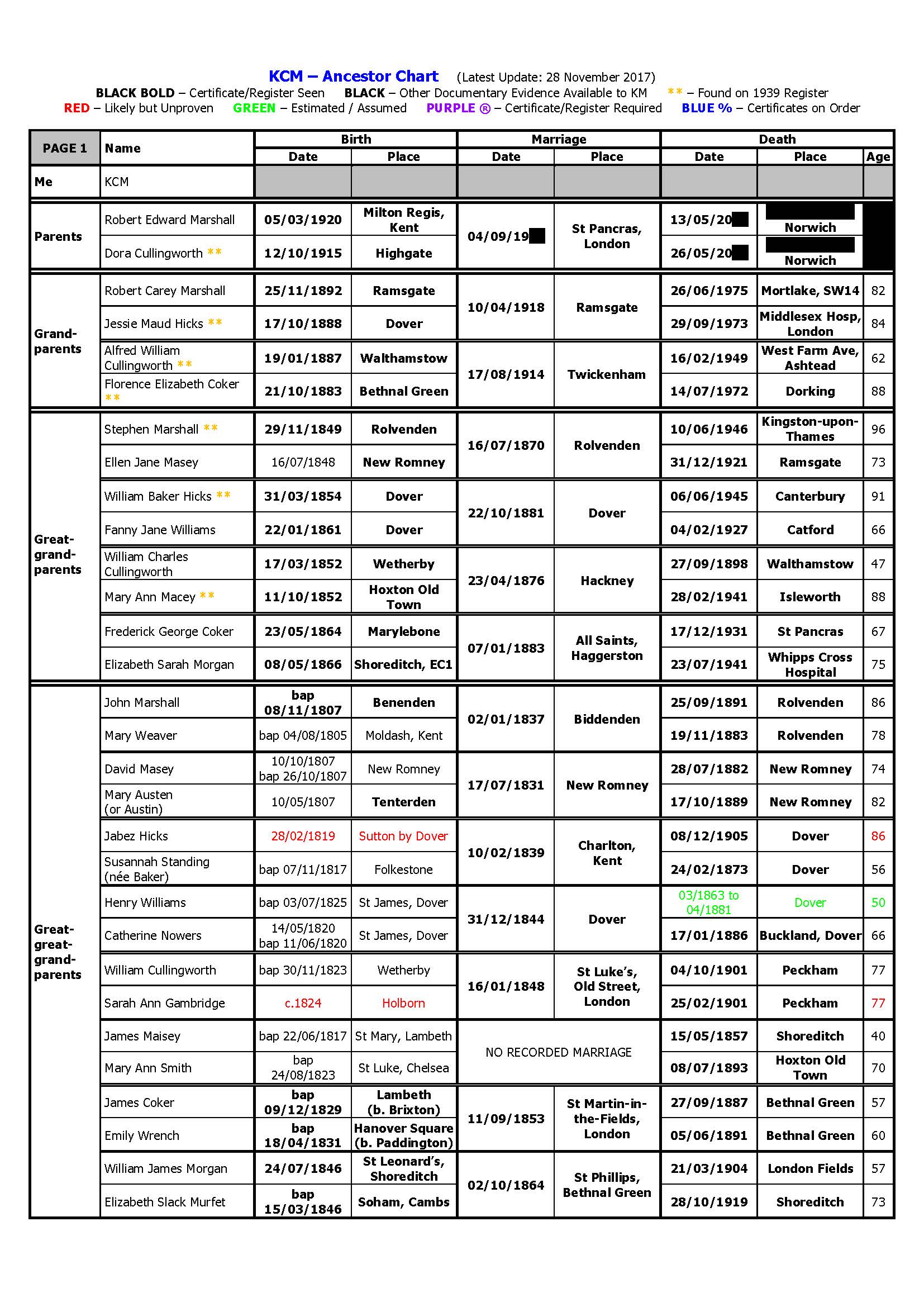
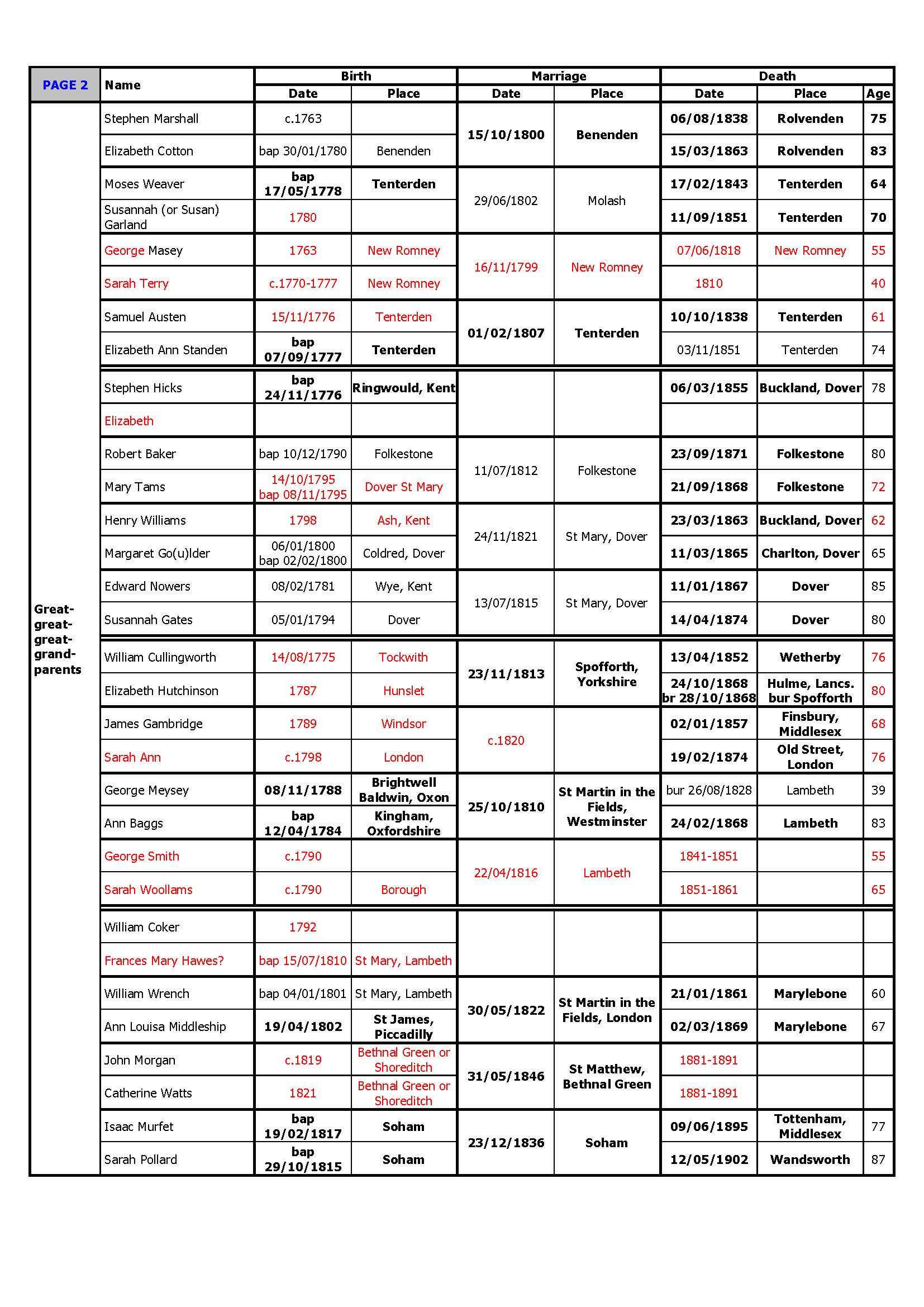
Brilliant, aren’t they. And so, so true. I think Noreen and I each have a full house in our family trees.