Category Archives: natural history

Skills I Do Not Have, No. 253 of 44975

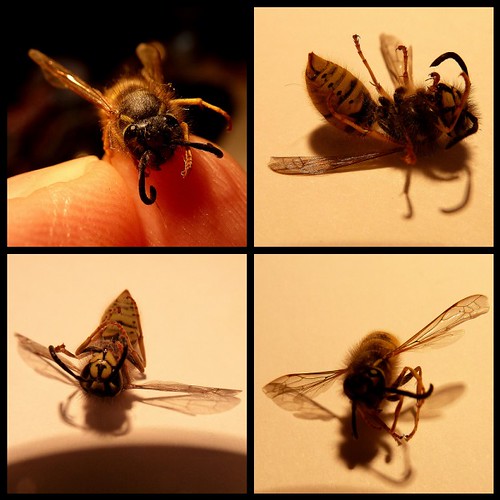
Common Wasp, Vespula vulgaris by kcm76
Common Wasp, Vespula vulgaris, a photo by kcm76 on Flickr.

I present you with the Common Wasp, Vespula vulgaris.

I found this critter dead on the bedroom floor this morning and in picking it up for recycling I realised just what stunning creatures wasps are. We so often think of them a nuisanceful pests whereas they’re amazingly engineered and even in death almost beautiful. So I had to photograph it – click the links below for larger views.

Image 1 (top left) shows just how hairy they are when we think of them as bald. And you can just see the tiny, shiny bulge of the top of the wasp’s compound eye.
Image 2 (top right) shows some of the mazing engineering: just look at the hooks and barbs on the legs – just what is needed for gripping caterpillar/insect prey and crawling over plants.
Image 3 (bottom left) shows the face and jaws which are the characteristics that identify this as Vespula vulgaris rather than any of the other UK species.
Image 4 shows something I’d never realised before (although my book shows it clearly) and that’s that wasps have two pairs of wings: look carefully and you can see in front of the large main wing a smaller wing. No wonder they’re such skilled flyers.

These are tiny, amazingly delicate yet robust insects. This individual, a worker, is just 12mm long with a wingspan of about 22mm. In her lifetime she may well have “salvaged” numerous flies, caterpillars etc. as food for the next generation of grubs – without wasps we would be knee deep in creepy crawlies.

This was taken under my desk lamp (hence the slight colour cast) with my point-an-shoot Lumic TZ8 – which is amazing for macros like this as it will focus down to just a couple of centimetres (much better than my dSLR)!

And as I was taking these I thought: how the hell do you go about dissecting something this small? Clearly scientists have done so, but it’s a skill I don’t have and I’m not dexterous enough to ever conceive how to do it! Amazing insects and amazing scientific work to dissect one!

Montage created with fd’s Flickr Toys

Word of the Week

As my purpose in being here is as a catalyst is to educate all you barbarians bring you new and interesting insights and ways of looking at the world, I’ve decide that we’ll have a new regular series: Word of the Week. Yes, it will appear weekly — well most weeks anyway; no guarantee I won’t miss, or move, some! And as this is the first in the series, and it’s Wednesday, the series will appear regularly on a Monday.

OK, so here’s this week’s word, with it’s definition from the OED …

zygodactylous. Having the toes ‘yoked’ or arranged in pairs, ie. two before and two behind, as the feet of a scansorial bird. [As in the feet of most woodpeckers.]

Oh bugger. That means we’ll have to have a second word. So here’s your week 1 bonus …

scansorial. Used for climbing. Of or pertaining to climbing; specifically of the feet of birds and animals, adapted for climbing.

Foxy Magnetism

As one of those filial duties I pay for my mother’s subscription to BBC Wildlife magazine, and once she’s read it my mother passes the copies to me. So it was that last evening I was reading the May 2011 issue and came across this amazing report of foxes using the earth’s magnetic field. I hope I might be forgiven for reproducing the short news item here as it doesn’t otherwise appear to be online.

Magnetic foxes

Scientists reveal the otherworldly talents of red foxes.

The hunting skills of the red fox Vulpes vulpes are out of this world — literally. According to new work, this hunter taps into the cosmos to pinpoint prey.

The fox feeds mostly on small mammals such as mice and voles, and has a clever way of going about it. It often performs what is called mousing — leaping high into the air in an arc and landing on unsuspecting prey from above. Remarkably, it can pull this off in 1m-high grass (or, in winter, snow of that depth). It’s assumed that, under these conditions, the fox relies solely on hearing to locate its quarry.

But when a team led by Hynek Burda, from the University of Duisburg-Essen, Germany, scrutinised the hunting habits of wild foxes at various locations in the Czech Republic, they noted a peculiar trend: hunters tended to catch dinner most often when they were facing north. This was especially true if their prey was snuggled under vegetation or snow – the foxes then had a 75 per cent hit rate with north-facing strikes. Attacks in all other directions were mostly futile.

What’s so special about looking north? The researchers believe that the foxes use the Earth’s magnetic field to home in on prey.

Some other mammals, and also birds, are known to sense magnetic north — and some are thought to actually see it, when looking northward, as a bright (or dark) patch in their field of vision — a little like a sunspot in a camera lens — due to special receptors in their eyes. If foxes have this ability, they could use its fixed position to gauge their distance to prey.

Think of it as a circle of light from a headlamp aimed, say, 1m in front of your feet. No matter where you go, the circle is always 1m ahead. Thus, a northward-facing fox that has located prey with its hearing needs only to creep forward until that location is within the circle of light. At that point, it knows it’s exactly 1m away. All that’s left to do is pounce.

It’s the first evidence of an animal using the Earth’s magnetic field as a hunting tool.

Animal Magnetism
» This is the first case of an animal using the Earth’s magnetic field to judge distance rather than direction.
» Except for jump direction, no other factor — from an animal’s age/sex to the season, wind direction or time of day — affected the observed pattern.
» Animals that sense magnetic north probably also sense magnetic south to a degree. Indeed, 60 per cent of fruitful attacks that were not northward faced due south. Overall, 90 per cent were along the north-south axis.
» Cattle and deer tend to line up along the north-south axis – except near high-voltage power lines that disrupt the field.
» When foxes could see their prey they had success in all directions.
Quotes of the Week

This week’s collection …

Never put off until tomorrow what you can do the day after tomorrow.
[Mark Twain]

Now I know foreigners do things strangely but …

The 31-year-old king of the tiny Himalayan country of Bhutan announces his intention to marry this October.
[BBC News report]

Oh, that’s alright then. As long as he’s not marrying last October. That would be necrophilia.

I masturbate because it makes me feel warm, embodied, juicy, alert, calm, self-possessed, and fulfilled. I masturbate to celebrate my body and my sovereignty. I masturbate and am not ashamed to do so. There are other things I do when I’m alone that are far more embarrassing.
[Allison at http://thesexpositivephotoproject.blogspot.com]

One really shouldn’t laugh at other misfortune, especially in wartime …

9 May 1941 … We’d just got down to the Victoria in Turners Hill when there was a whoosh and a bang as a [250kg high explosive] bomb fell where the Fire Station is now – it was old Bertie Simpkins’ junk yard then. Mrs Whiddon who lived opposite had an old lavatory pan come in through her front bedroom window!
[Peter Rooke, Cheshunt at War 1939-1945]

Flowers always make people better, happier and more helpful; they are sunshine, food and medicine to the soul.
[Luther Burbank]

Photography takes an instant out of time, altering life by holding it still.
[Dorothea Lang]

Are you suggesting coconuts migrate?
[Monty Python and the Holy Grail]

Quotes of the Week

A rather more eclectic mix than usual this week. I just love some of the names in this first quote …


Transport on Water: Barge Driving Race – Saturday 18 June 2011
Race Start 1200

A number of Thames barges will be raced, under oars, from Greenwich to Westminster Bridge on Saturday 18th June 2011. The race will start at Greenwich at 1200 from 3 start lines for the different classes of barge, off Greenwich Pier, off Trafalgar Tavern (lower end of Scrap Iron Park) and off Tunnel Glucose Wharf. Each start line will be marked by 2 pellet buoys, one on each side of the river.

[Port of London – River Thames, Notice to Mariners, M34 of 2011]

Scrap Iron Park indeed!

Cease to inquire what the future has in store, and take as a gift whatever the day brings forth.
[Horace]

I’m not a beatnik, I’m a Catholic.
[Jack Kerouac]

Which reminds me that in response to some god-botherer’s query “are you saved?” a friend once responded “Good God no, I’m a Roman Catholic”.

You kill ’em. We grill ’em.
[Bart Simpson, aka Matt Groening]

That sums up the feelings of last couple of days quite well!

To us, the moment 8:17 AM means something – something very important, if it happens to be the starting time of our daily train. To our ancestors, such an odd eccentric instant was without significance – did not even exist. In inventing the locomotive, Watt and Stevenson were part inventors of time.
[Aldous Huxley]

Time can’t be measured in days the way money is measured in pesos and centavos, because all pesos are equal, while every day, perhaps every hour, is different.
[Jorge Luis Borges]

Earth laughs in flowers.
[Ralph Waldo Emerson]

If so then our garden is rolling on the floor peeing it’s pants ‘cos we have an absolute riot of roses at the moment. Our large apricot-coloured climber Lady Hillingdon currently has more flowers than leaves – it really is just one mass of flowers like never before.

Ten Things – May

Number 5 in my monthly series of “Ten Things” for 2011. Each month I list one thing from each of ten categories which will remain the same for each month of 2011. So at the end of the year you have ten lists of twelve things about me.

  1. Something I Like: Nudity
  2. Something I Won’t Do: Wear a DJ/Tuxedo
  3. Something I Want To Do: Have Acupuncture
  4. A Blog I Like: Whoopee
  5. A Book I Like: Brown, Ferguson, Lawrence & Lees; Tracks & Signs of the Birds of Britain & Europe
  6. Some Music I Like: Caravan, In the Land of Grey and Pink
  7. A Food I Like: Whitebait
  8. A Food or Drink I Dislike: Sheep’s Eyes
  9. A Word I Like: Amniomancy
  10. A Quote I Like: I like small furry animals – as long as they’re tasty. [Lisa Jardine]