
Sarcophagus
 1. A kind of stone which the Greeks supposed had the property of consuming the flesh of dead bodies deposited in it, and which was consequently used for coffins.
2. A stone coffin, especially one embellished with sculptures or bearing inscriptions, etc.
3. A wine-cooler.
The word comes into English, via Latin, from the Greek σαρκοϕάγος (sarkophagos) = σαρκο- (sarko-), σάρξ (sarx) flesh + -ϕάγος (-phagos) eating.
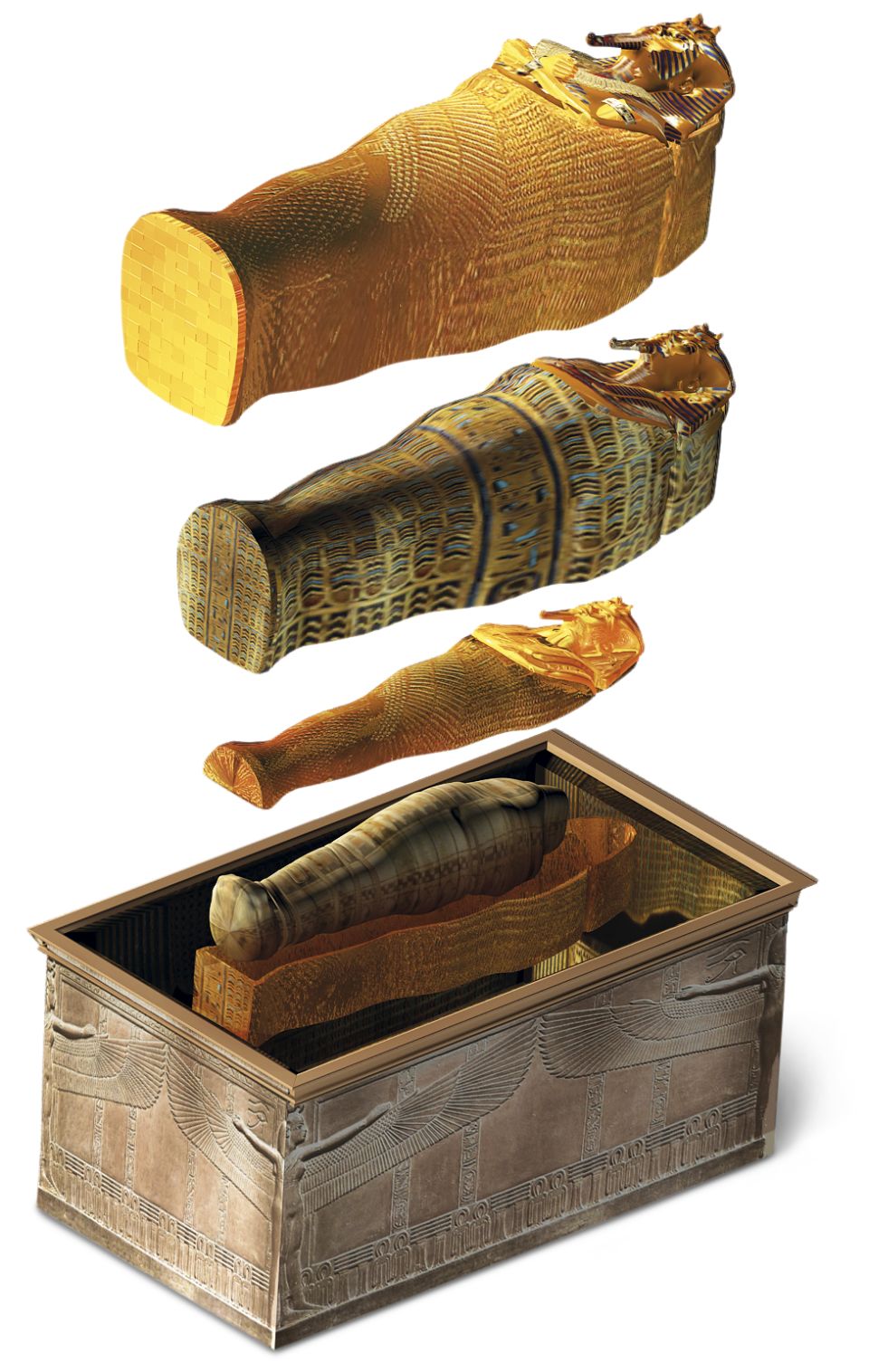
The OED records the first use with meaning 1 in 1601 and with meaning 2 in 1705. Perhaps the most famous Sarcophagus is that of the Egyptian Pharaoh Tutankhamun, although the highly decorated coffin we think of is actually the second of a layer of three which were then placed in the stone sarcophagus.
Category Archives: history
Your Interesting Links
Science & Medicine
The medical profession has come to the conclusion that there are at least 40 common treatments which are not necessary (or don’t do any good).
In an interesting study, researchers conclude that there might be a relationship between migraines and gut bacterial species.
AIDS was brought to the USA by one promiscuous homosexual in 1980-81, right? Wrong; it had been there undetected for years!
So that’s how thy mummified the Egyptians.

Yes, cats obviously do get high on catnip, but not for long.
When is a monkey like a human? When it make stone tools. Yes, monkeys have been discovered making sharp stone tools, but do they know what they’re doing?
Lads, eat your heart out! This newly discovered millipede has four penises — but also 414 legs to get in the way.
OK, so from the animal to the mineral … Scientists have accidentally discovered how to turn CO2 into fuel.
As if we hadn’t guessed it, an ancient book confirms that the whole of the Himalayas is an earthquake zone.
Environment
The River Severn looks set to see Henry III’s favourite fish, the Shad, return after a project to install fish passes at a number of weirs gets funding.
History
A Stone Age dog’s tooth provides evidence of the UK’s earliest known journey.
The Museum of London has acquired a rare and unusual document: verbatim minutes of a report to Parliament on the Great Fire of 1666.
William Hogarth, entrepreneurial Londoner.
It seems no-one knew there were some huge holes underneath the Clifton Suspension Bridge.
London
What Is London’s Oldest Church? Define “oldest”. Define “church” even.
It seems that procrastination and fudge are not the preserve of modern major civil engineering wroks. Here’s a brief history of the Regent’s Canal.
And the same again for the Underground’s Northern Line.
London has a new museum. It’s out at Pinner and celebrates the illustrator William Heath Robinson. Diamond Geezer when to investigate. [PS. The chiropractor mentioned is my osteopath.]

A Heath Robinson landscape painting
Westminster Bridge holds some secrets; here are 11 of them.
And another well kept secret is St Paul Cathedral’s triforium. Yet again, IanVisits went to see.
There are many facts about London, and indeed many about the Underground. Here are some Underground facts that aren’t.
Somewhere near Perivale there’s a fighter plane on a rooftop. except tat it isn’t always there.
Finally for this section, a happy 10th birthday to one of our favourite London blogs, IanVisits.
Lifestyle
How to confuse yourself about nothing and also about emptiness. Well that’s Zen for you!
Food & Drink
You mean you didn’t know that you shouldn’t put tomatoes in the fridge? Tut, tut!
Shock, Horror, Humour
Following on from our first item, here are 40 worthless everyday things you can stop doing right now.
More next month.
Book Review: Bomb Damage Maps
Laurence Ward
The London County Council Bomb Damage Maps, 1939-1945
Thames & Hudson, 2015
 During WWII the Architects Department of the London County Council (the LCC; then the local authority for what are now the central London boroughs) set about documenting the cumulative bomb damage in the capital city. This was an area from Woolwich in the east to Hammersmith in the west, and from Crystal Palace in the south to Highgate in the north. Detailed maps were produced showing every property, from the smallest cottage to the large factories. Teams of surveyors soured the area to assess any bomb damage to properties. The damage was graded from “total destruction” down to “minor blast damage” and areas marked for clearance. The sites of V1 flying bomb and V2 rocket impacts were also marked.
The task required 110 maps at a scale of 1:2500 (that’s 25 inches to the mile), and each measuring roughly 75x106cm; these were based on the 1916 Ordnance Survey maps, updated to 1940. And they were hand-coloured according to the level of destruction found. Each of the maps is reproduced here at roughly 1/3 size. And boy do they give a vivid picture of the destruction wrought by the Luftwaffe. Every map contains something interesting — just look at the map for the area of the City around Farringdon and Holborn: it is one big swathe of purple, meaning “Damaged beyond Repair”, from the river to Hoxton and from Bank to the west of Blackfriars Bridge. Overall, getting on for 50% of the Square Mile must have been demolished!

This is just a part of the destruction in the City of London.
The map is centred on St Paul’s Cathedral.
The maps are part of the LCC archives, now held by the London Metropolitan Archives. They were first compiled into this book back in 2005 by the LMS in conjunction with the London Topographical Society. And now they’ve been published for everyone.
Given the number of maps, it is no great surprise that this is an enormous tome measuring 37x27x3cm and weighing in at only just under 3kg! Despite the size, it is definitely not a coffee table book; nor is it a book to read front to back, or even back to front. It is a reference for anyone interested in the history and topography of London, and that will include family historians who may wish to research where their ancestors lived. As I say, every map contains something of interest.
In addition there are 30 or more pages of introductory material, documenting the maps, the surveyors and rescue teams, and a detailed listing of all the Luftwaffe raids; and another almost 50 pages of photographs documenting the destruction.
All in all this is an absolutely stunning collection for those interested in London or WWII. Just don’t try reading it in bed!
Overall Rating: ★★★★★
Ten Things
This month’s Ten Things is for those, like me, who were children in the 50s and 60s. It is a little nostalgia about radio programmes, in the days before everyone had television and before there were hundreds of radio channels — ie. when there was BBC Radio or nothing; the days of the Home Service, the Light Programme and the Third Programme.
So here are Ten Radio Programmes I Remember from My Childhood:
- Listen with Mother
- Mrs Dale’s Diary
- The Archers (and OMG it’s still going! Why?)
- Round the Horne (Kenneth Horne, Kenneth Williams and Hugh Paddick)
- The Navy Lark (Leslie Phillips and Bill Pertwee
- Music While You Work
- Down Your Way (with Wilfred Pickles)
- Children’s Favourites (introduced by Uncle Mac, aka. Derek McCulloch)
- Does the Team Think?
- Palm Court Orchestra
Missing Links
Here’s our monthly round-up of items you may have missed previously. Slightly late again — apologies! There’s a lot here, this month too!
Science & Medicine
Research is showing that magpies possess self-awareness to rival that of primates, dolphins and elephants.
Humans are practically bald and are one of the very few (almost) hairless mammals which may be why we thrived as a species.
Now here is something which looks odd … it seems that women who have had their appendix removed are more fertile. Ditto for tonsillectomy.
So, the age old question … do women’s periods really synchronise when they live together? Spoiler: no.
A pain in the guts? Research is suggesting that the range and quantity of microbes in our guts may have a powerful effect on conditions like depression, MS and obesity.
However eating yoghurt is not enough to keep those gut living microbes in balance. [Long read]
Just like I’ve always known, travel sickness is a glitch between the brain, the ear, the eye and the stomach.
Now here’s one for the lads out there … just how big is a fart? Answer: somewhere between a bottle of nail polish and a can of drink. Maggie Koerth-Baker has the low down.
Your dentist knows — but likely won’t admit — what you have suspected: flossing is a waste of time.
IFLscience looks at the theories as to why time seems to pass more quickly as we get older.
Sexuality
The French (only the French?) have created a 3D model of the clitoris as an aid to their schoolchildren’s sex education.
Environment
So what is it really like to drive a Eurostar train? Andrew English in the Daily Telegraph finds it’s more complex than one might imagine.
Social Sciences & Business
So here’s something else we’ve always known: people who don’t have children benefit our environment more than any campaign. And that should be valued.
Noreen and I have done jury service three times between us. What are your chances of being called more than once.
Here’s our favourite zen master, Brad Warner, on whether “White Buddhism” is cultural appropriation.
History
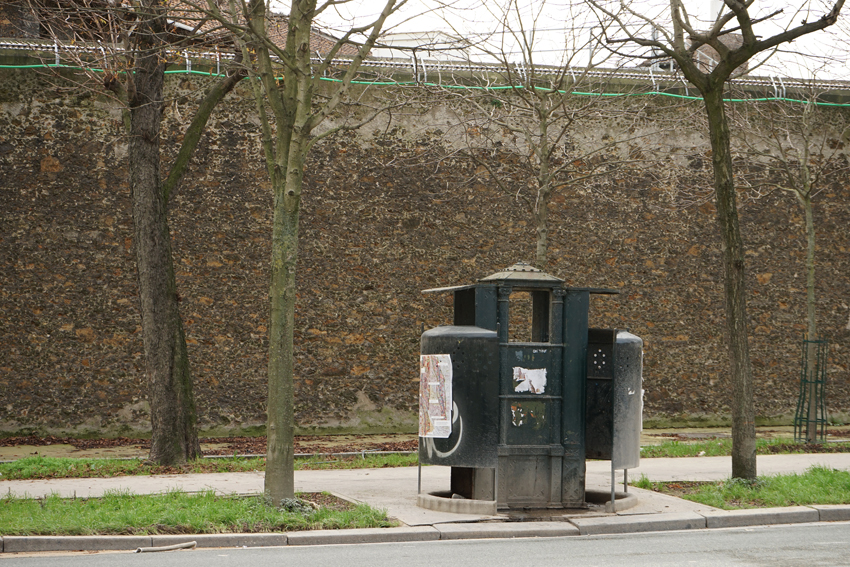
There is something special on the Parisian road outside La Santé prison … the city’s last vespasienne urinal (below).
When the US Army took control of Japan after WWII they confiscated thousands of secret Japanese military maps, covering much of Asia, shipped them back to the US and dispersed them to libraries across the country for safekeeping. Now they are being brought back together and their historical interest realised.
London
In this new section, we look at items about my home city.
Once upon a time there was a plan to build a ginormous “Pyramid of Death” in London. Luckily it never happened.
Time Out looks at the complete history of Paddington Station.
Meanwhile Londonist takes a look at the history of floods on the Underground.
In another item from IanVisits he looks at the old North London Line which ran from Broad Street to Richmond, and is now part of the Overground.
It always surprises me what people can find by way of historic artefacts washed up on the Thames foreshore.
Londonist (again) looks at the top 10 of London’s “spy sites”.
And finally for London, here are nine places that apparently Londoners never go.
Shock, Horror, Humour
The Atlantic brings us the unbelievable, mysterious and Byzantine story of Jesus’s wife. [Very long read]
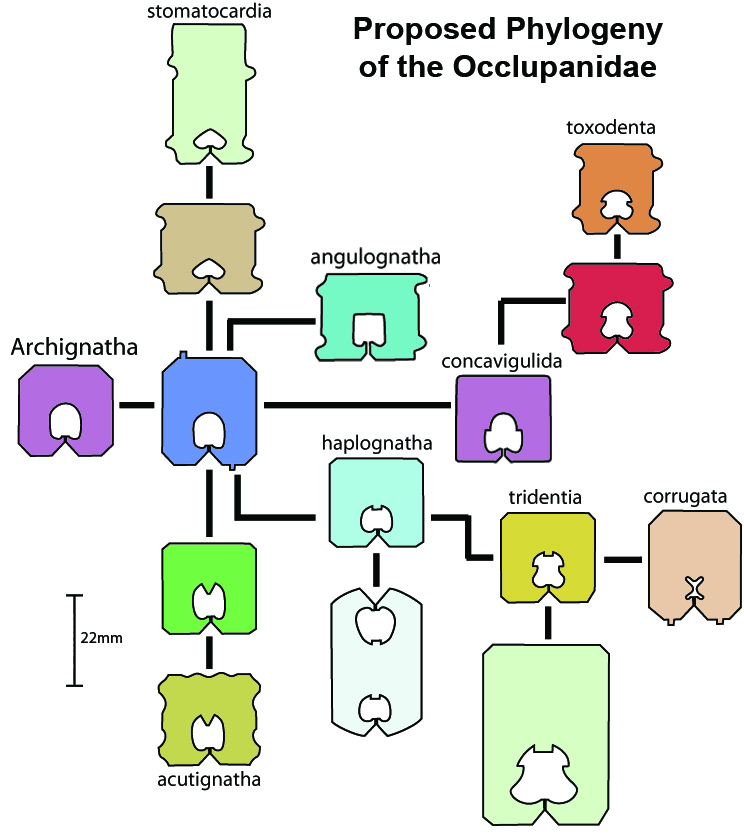
I often think that academics and medics, more than most of us, get up to some exceedingly strange things. One Dr Bruce Ragsdale has developed a taxonomy of the Occlupanida — this little plastic clips that are used to close plastic bread wrappers etc. Very odd.
And finally, thanks to the Guardian, Yes Minister explains everything about Brexit.
Phew! More next month …
The Oldest Profession
Despite its reviled status today prostitution has a long and honourable tradition in many countries. From the Ancient Near East to the Incas and Aztecs. In India and Japan; Ancient Greece and Ancient Rome. To the Middles Ages and modern Europe. And a history in which is has more often been legal, and encouraged, than illegal — contrary to our modern western (largely Christian) expectations.

So I was interested to find this in the description of the above miniature in Flavio Febbraro’s How to Read Erotic Art which I reviewed yesterday:
In the late Middle Ages, so-called stuphae — baths or saunas — were present in almost every city across Central and North Europe. In addition to offering hot baths, they provided premises for sexual encounters with obliging women. On the other hand, prostitution — despite the Church’s official intransigence in regard to sexual activity — was tolerated, if not encouraged, by the civil and ecclesiastical authorities. It was seen as a lesser evil that served to channel masculine aggression and ensure public order. Consequently there were authorized ‘brothels’, managed according to standards defined by the municipal authorities, that enlisted women mainly from the countryside. These women enjoyed the acceptance of the community in which they lived. Houses of tolerance and stuphae were located in the centre of town, often in respectable buildings, demonstrating that, his activity took place openly, with no particular negative judgement attached to those who frequented them.
So why the problem now?
It makes no sense to me.
Your Interesting Links
Slightly later than planned, and hence slightly longer than usual, here is my monthly list of articles you might have missed before …
Science & Medicine
Kazakhstan is a treasure trove of naturally wild and flavourful apple varieties.
Welcome the tiny ingestible origami robot which can be used for repairing wounds.
Ocean scientists have been using message in a bottle techniques for over 100 years, and they still are.
One mouse, two mouse, three mouse … Can cats count mice?
And still on felines … can a cat have an existential crisis? Spoiler: yes. [Long read]
Ear wax is very strange and mysterious stuff. [Long read]
Sexuality
OK, girls, so does the ‘G-Spot’ actually exist?
Do humans actually send out airborne aphrodisiac pheromones to attract potential mates? Erm … dunno.
Social Sciences & Business
On the social and design engineering of high heels. [Long read]
How many friends do you have? Are they really your friends?
Alain de Botton on why you will marry the wrong person. And there’s not much you can do about it!
Language
What’s it like learning to talk all over again? Learning Chinese as an adult.
Art & Literature
From mega-libraries down to nano-libraries … here’s the story of London’s smallest library.

Wow! The whole of Samuel Pepys’ Diary is now online.
History
It seems that Ice Age Europe wasn’t populated by who we thought.
The Fitzwilliam Museum in Cambridge have discovered that one of their Ancient Egyptian coffins holds them youngest known mummified foetus.
Ancient toilets can tell us a lot about the lifestyle of their users, and it seems the flush toilet goes further back than we thought. [Long read]
The colour of monastic habits was much more fraught with controversy than one might suspect.
A plague on all your houses. New research suggests that the Black Death was even more devastating than we thought.
Ianvisits reviews the exhibition of the lost library of the Tudor magician John Dee.
Slowly coming more up to date, here’s a look at the background and organisation of the Gunpowder Plot.
An unsuspected mass grave in Durham is though to hold the remains of prisoners from the Battle of Dunbar.
Investigations into a 1661 document awarding £20 to Major Smith.
Lady Antonia Fraser on the sexy and scandalous truth about Versailles and the new BBC series about the same.
How old is that London house? Is it Georgian Or Victorian?
London was devastated during World War 2. The recently published LCC bomb damage maps reveal all. It’s a magnificent volume!
There have been lots of weird and wonderful proposals for building in London which have come to naught. Here are some, arranged by Underground station.
Food & Drink
How to tell real Parmigiano Reggiano from imposters. Science now has a way.
People
So here are two pieces about the forensic mysteries of identifying unknown bodies.
First the mystery of Saddleworth Moor: who was the man they’ve nicknamed Neil Dovestone?
And in the US, just as here in the UK, the identification of nameless bodies can take years before the mysteries are solved.
Shock, Horror, Humour
So here’s a little quiz to end with … What is London’s longest tunnel? It’s OK, I got it wrong too.
More next month.
Oddity of the Week: Train Stations
It is well known, at least around here, that Britain has more than its fair share of eccentrics. And we have had for a very long time. Think back to John Aubrey, John Evelyn and even Samuel Pepys. Then there are the eccentric Victorian clergyman, with too much time on their hands, who investigated everything from stone circles to the propagation of primulas and photography.

Dolau station in Wales (photo: David Brewer)
Should we therefore be surprised that, even today, the eccentrics are still amongst us? And the latest example: David Brewer, from Chorley in Lancashire, who has spent the last 8 or 9 years photographing every single railway station in mainland Britain. Why? Because they’re there.
Your Interesting Links
Lots of science-y bits again in this months offering …
Science & Medicine
I wonder when humans first started pondering about aliens? Well certainly they were in medieval times.
On the discovery of dinosaurs among us.
So what would you guess is the world’s deadliest poison? Well here are five of the top contenders.
Clean water. We all depend on it, but do you know what happens to it between its source and your tap? Simple explainer from Compound Interest.
Hugs generally feel good. Now researchers are beginning to understand why.
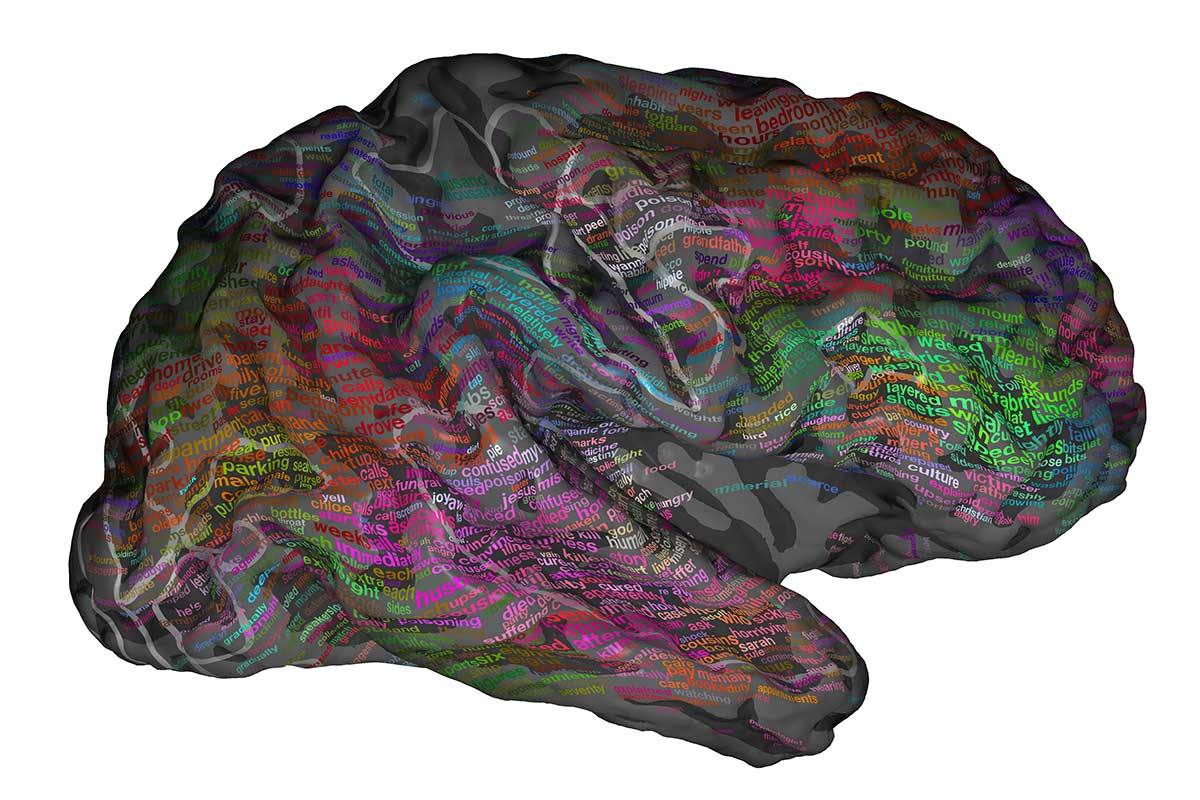
Wow! In what looks a stunning piece of work some neuroscientists have been able to create an atlas showing how words are organised in the brain. The implications could be worrying though.
Next up another stunning piece of research and development … A biotech company has developed a DNA sequencer that fits in a pocket and will go literally anywhere. Of course it is still expensive, but that should change. [Long read]
More new work shows that women get healthier after their husbands die. It must be finally having been able to stop doing childcare.
So really how do female astronauts cope with menstruation? Seems it is currently most down to persona choice.
Sexuality
So here are some of those sex myths debunked.
Here’s the story of a childless young lady who chose to be sterilised in her 20s and 40 years later she hasn’t regretted it, despite the harassment.
Social Sciences & Business
Bodyhackers: people who ave stuff implanted in them, like the microchips we put in our cats and dogs. They’re all around us. And most of them are women.
Language
Speed-reading. Too good to be true? Well that’s what the latest research is telling us.
History
Here’s an interesting piece on the early history of London’s St Paul’s Cathedral.
Archaeological divers found a 400-year-old dress in a shipwreck off the Netherlands. And it seems it sheds light on plot to pawn crown jewels.
The oddities of maritime history … the SS Baychimo, one of the strangest ghost ships on record sailing unmanned for 38 years.
Food & Drink
Well the French may call them pissenlit, but the humble dandelion is an interesting and useful herb. I remember when I was a kid we made both dandelion wine (lots of flowers) and dandelion coffee (from the roots). Love the illustrations too.
Out there are some amazing heirloom breeds: from woolly pigs to deodorant squash. And they’re vanishing, which is a shame as we’re losing some rich variety.
Shock, Horror, Humour
And finally … If you live near the sea what do you do with all the flotsam you find? If you’re artist Stuart Haygarth you sort it all to make interesting collections of weirdness.
More at the end of the month.
Oddity of the Week: Curly Pigs
The Mangalica (or Mangalitsa) is a Hungarian breed of domestic pig. It was developed in the mid-19th century by cross-breeding Hungarian breeds from Szalonta and Bakony with the Serbian Šumadija breed.
The Mangalica pig grows a thick, woolly coat similar to that of a sheep. It is a quick-growing, “fat-type” hog which does not require any special care, hence its popularity in Hungary.
The only other pig breed noted for having a long coat is the extinct English breed the Lincolnshire Curly Coat.
Lots more on Wikipedia.