
Category Archives: environment

It's Been a Busy Week!

There seems to have been a lot going on this week which drew my attention but which I didn’t get to write about here. So here’s a summary (in no particular order) …

First an interesting item on how belief can kill. It’s a curious phenomenon but even so I can’t bring myself to read the book. See The Dark Side of the Placebo Effect: When Intense Belief Kills.

Much more interesting and useful is a long article on the National Geographic site about the workings of Teenage Brains and how this should be seen as a sensible evolutionary trait. It might also help all of us understand and relate with teenagers. It certainly seems to explain quite a lot.

Next an investigative journalism piece about the Fukishima Disaster and especially the long-term effects on the Japanese population. The suggestion is that the effects of stress etc. will be far more significant than the actual radiation doses (I guess excluding the immediately affected workers). For my money the article still doesn’t delve deep enough — but the journo writing it probably couldn’t get access to do so.

Law and Lawyers has written several pieces about the worrying machinations of the Metropolitan Police in attempting to get The Guardian to reveal some of its sources. First they were going to use the Official Secrets Act, then PACE 1984. For now though it seems the dogs of war remain caged.

Also this week Obiterj at Law and Lawyers has pointed out that the Fixed Term Parliaments Act 2011 comes into force. This means the next General Election will be on 7 May 2015 — unless both Houses of Parliament decide otherwise by a two-thirds majority.

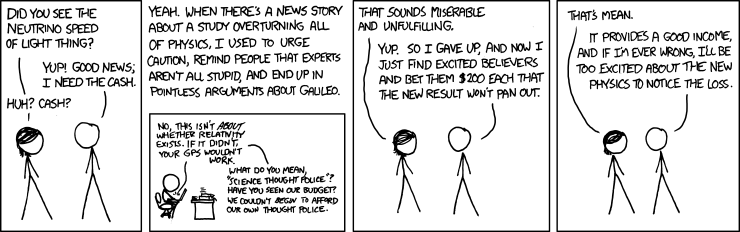
Which for a scientist somewhat pales into insignificance beside the apparent result from a team at CERN that they have detected neutrinos doing the impossible and travelling faster than light. But hold on guys, they don’t quite relieve it either and they’re asking the scientific community for help to test their results. Good scientific commentary by Adrian Cho at Wired and Phil Plait of Bad Astronomy.
Finally back to earth. There’s been lots of twittering in the dovecotes about female orgasm, how it relates to evolutionary pressures and to male orgasm. Also some good demonstrations on how to demolish a (supposedly) scientific study. The best of the critiques I’ve seen is from Scicurious. Maybe you girls should just be allowed to enjoy it?

Have an orgasmic weekend!

Fact of the Week


The magnitude 9 earthquake that struck Japan on 11 March was one of the five most powerful shocks recorded; so powerful that it lowered the coastline by a metre and nudged Japan two metres closer to the United States.

[Jonathan Watts, “Fukushima disaster: it’s not over yet”, Guardian, 9 September 2011, online here]

Oceanic Truths

A short but very sharp posting from Sheril Kirshenbaum on Wired today points out what many of us already know …

Oceans are Totally F*cked


So what can we do about it? Well you’ll point out that what I do as an individual isn’t going to make a whole bunch of difference. Which is true if I’m the only one taking action. But if we all make changes then it will help bring pressure to bear where it hurts: big business!

So what do we do? It’s a complex problem and there is no simple answer. However the more of the following as you can do the better:

  1. Reduce your dependence on oil. Walk, don’t take the car. Don’t jet around the world on holiday, especially long haul. Fight against excess, especially plastic, packaging. Buy locally grown produce wherever you can to reduce food miles. You already know all these things make sense. And they all help the oceans.
    The less oil we use, the less is transported around the world in mega-tankers, which run on … yes … oil (often horrible crude bunker oil, at that). And the fewer environmentally damaging oil spills there are. And the less off-shore drilling there is. (Yes, that may mean nuclear power; but that’s an argument for another day.)
  2. Buy only fish which is farmed or sustainably caught and which is as locally produced as possible. We have to stop over-fishing. As well as reducing food miles.
  3. Reduce your garbage output. A vast amount of our garbage gets dumped at sea!
  4. Reduce your wastewater output; and clean up wastewater as much as possible. Yes, that means sewage, amongst other things. As with garbage it is scandalous the amount of dirty/polluted wastewater that gets dumped in the oceans.
  5. We also need to reduce agricultural run-off. That means reducing pesticide, herbicide and fertiliser use, and also preventing animal slurry getting into waterways. Which in turn means more sustainable land management. Going organic isn’t necessarily the whole, or even the right, answer; but it should help.
  6. If you’re an aquarist, don’t keep marine fish which haven’t been captive bred. Catching marine fish from the wild is extremely poorly regulated (unlike the trade in wild-caught freshwater Amazonian fishes). Fishing (for the aquatics trade and for food) does enormous damage to tropical reef environments because of the methods used.
  7. And anything else you can do to improve air quality and reduce climate change will help too. A large part of the problems the oceans face is from acidification, which is caused by pollutants and increased carbon dioxide levels. And if we can slow down climate warming, we’ll likely slow down the rate at which the polar ice caps are receding too.
  8. And finally, support marine nature reserves, conservation areas and scientific efforts to better understand the oceans and their biodiversity.

Notice, however I am not saying be totally organic, don’t eat fish, stop using a car or an aeroplane, and grow all your own food. Yes, it would be great (for the environment anyway) if we could do all these things. But let’s be realistic, it isn’t practical and it won’t happen. But we do have to reduce all the harmful things we do and the more you can do the better.

Some of you won’t think about any of this, and won’t bother with any of it, which morally I find inexcusable. But it’s your karma. Many will already be doing something. But which of us couldn’t do a bit more. It all helps. I at least would like there still to be an inhabitable world for your grandchildren. And I think I have a moral obligation to do something the help ensure there is.

Weekly Interesting Links

OK guys & gals, so here’s another weekly, but doubtless occasional, new series — links to interesting sites I’ve come across during the week but which haven’t made it into a full posting.

An article by my friend Potter-san on the Soul of Okinawan Music. The music of Okinawa (the southern-most tropical islands of Japan) is a fun eclectic mix of their native music and just about anything they can import. Try it! I was surprised how much of it I liked.

Also advance information on the London Okinawa Day 2011 on Saturday 25 June. I’ve never managed to get to this annual event but it sounds like it should be a fun day. Anyone want to get together a party of us?

On a totally different subject, a thought-provoking item Should Young Teens be Prescribed Hormonal Contraception? by Prof. Kate Clancy. All the more powerful because Clancy is American and her stance is totally contrary to the prevailing American ethic of total teenage abstinence.

If you are interested in your family history and have forebears who worked on the railway you might be interested in the Railway Ancestors FHS.

In view of the week’s biggest event (at least here in the UK) history buffs may be interested in Medieval Weddings.

One of the most misunderstood areas of the law as it affects anyone involved in literary or artistic ventures is copyright. Fortunately the British Library describe the duration of UK copyright in one easy flowchart. But I suspect I shall have to continue to explain intellectual property law even to our literary society trustees. 🙁

And finally, here’s a super eco-idea: use cardboard packaging impregnated with seeds to rejuvenate the environment. No sorry you can’t have the idea, it’s already been done by Life Box.

Ancient Awesome

No, not me! Only one of those adjectives applies to me. It is ancient peoples who continue to surprise us by their abilities and their foresight.

A couple of weeks ago I came across this on Good and its progenitor article at The Canadian Press.

As we know, Japan has recently suffered a huge earthquake and subsequent tsunami. Construction codes for major buildings in Japan mean new build is relatively earthquake safe, but older domestic buildings in remote areas don’t have this advantage. Japan is used to earthquakes and the population are well drilled for them.

Japan also should be used to tsunami as they often follow (the right type of) earthquakes. And yet there is no civil planning for tsunami. But once upon a time there was tsunami planning!

Sometimes hidden, more often ignored, there are hundreds of stone tablets along the coast of Japan warning people about tsunami. Many of these tablets are 600 or more years old and carry inscriptions such as

If an earthquake comes, beware of tsunamis

and tellingly

High dwellings are the peace and harmony of our descendants. Remember the calamity of the great tsunamis. Do not build any homes below this point.

This later is on a tablet (pictured above) in Aneyoshi which this year saved the lives of the village’s inhabitants — all of Aneyoshi’s houses are built on higher ground. As one 12-year-old said:

Everybody here knows about the markers. We studied them in school. When the tsunami came, my mom got me from school and then the whole village climbed to higher ground.

Sadly this was not the case in many other towns and villages along Japan’s NE coast, even where there are ancient warning tablets. After the earthquake many people went back to their homes to get their valuables, including children, only to be caught by the tsunami.

So how is it we forget the wisdom of the ancients? Apparently it takes three generations for memories of disasters to fade. Disaster survivors pass on the memories to their children and grandchildren, but after that the knowledge isn’t maintained. Clearly the ancients knew this and erected warning tablets to remind their descendants. We, of course, ignore them; there hasn’t been such a disaster in living memory, so we think we know better.

Maybe we ought to take more notice of the wisdom of the ancients? Maybe it really is time we started learning practical things from history?

Facts of the Week

This is the first in what will probably be an occasional series highlighting unexpected, unusual or just amazing facts I come across. It is really for curiosity value rather than a resource of those who take part in pub quizzes. Wherever possible I will, as always, provide a source for the information. So here is the first selection of factlets …

Each year, an estimated 10,000 shipping containers fall off container ships at sea.
Between five and six million containers are in transit at any given moment.

[]

The Sendai earthquake shifted the earth’s figure axis by about 17 cm and moved the main island of Japan [Honshu] around 2.4 metres.
[US Geological Survey]

The Sendai earthquake also shortened our day by about 1.8 milliseconds (thousands of a second).
[NASA Jet Propulsion Laboratory]

The original Polynesian and South Pacific origin of the word ‘tabu’ actually refers to that which is sacred: the application of a taboo actually designating that which is holy.
[OED]

More Thoughts on Japan

I continue to watch the news coming out of Japan, especially that about the disaster at the Fukushima Daiichi neuclear plant.

I’m astounded at the lack of assistance the nuclear plant authorities are getting. They have now been struggling with (and losing) the battle to stabilise their reactors after the tsunami took out their backup cooling system on Friday.

I have to wonder (a) why they didn’t shout for outside back-up much earlier on Friday, (b) where the Japanese military are and (c) what priority is being given to getting grid power restored to the Fukushima plant. Why have the Japanese government not flooded the power plant with regiments of Engineers and Logistics experts. And why haven’t they deployed every available military pumping unit and bowser to the site, to help shift water (if only seawater).

Before anyone says it, I know they’ll need bowsers to deliver water to refugees, but I would have thought the nuclear plant needs to take priority, and their water companies should have bowsers too. Moreover the military will have bowsers which may be usable (for seawater) but not for drinking water. And pumping units are, I would have thought, not going to achieve a lot at present in the disaster area (there’s much else to do without worrying about pumping water away) and in any event, again, I would think the nuclear plant should take priority. Clearly too they would need a secure supply of fuel and other supplies – but that’s what logistics is all about.

Yes, I know the military won’t be skilled at managing and operating a nuclear plant. No-one would expect them to be. But their equipment, logistics skills and manpower should be invaluable. We proved in this country how valuable military logistics skills are during the foot-and-mouth epidemic in 2001, where the military were eventually called in and sorted out the problem very quickly. Good senior officers cut through obstructions and get things done quickly and efficiently; they’re trained to do just this; trained in logistics; and trained to deal with horrors like this in warfare.

Should we be exposing soldiers to such an undoubtedly dangerous environment? It’s a tricky ethical problem. But at times of national emergency such as this I would tend to the view that this is part of the military’s role; and indeed the military would expect such a role. After all we expect soldiers to go into battle, kill people, possibly get killed themselves and be exposed to depleted Uranium shells and worse. And they will have NBC suits; although they are by no means a comfortable environment to work in they’re available.

Would any of this have averted where we are now? We can never know. But it seems to me that it probably should have been given a shot. Maybe it has been and we just haven’t been told. We just don’t know.

All we can do is watch, hope and pray.

Japan Nuclear Update

Referring to my Sunday post about the events in Japan, a friend in the US has asked me “Are you still this non-apocalyptic after the latest explosion?”. And given what has been reported about the situation at the Fukushima reactors since Sunday I feel I should update my opinions.

So where are we? Well it’s really difficult to tell. There have now been three explosions, and a further significant release of radioactivity. Albeit the radioactivity appears to be relatively short-lived nucleotides. But we now really don’t know enough about what is actually happening in Fukushima. In fact nobody knows exactly what’s happening apart from the engineers on the ground. All we are getting is the third- or fourth-hand account which the Japanese government are putting out and which is then being spun every which way by the media.

Do I trust what we’re being told? Again it is hard to say. All nuclear authorities (and governments) have a poor track record of owning up to bad news; the Japanese are no better or worse that anyone else. That means I am very skeptical about what’s being admitted to. What is being said may be true, but it may not be the whole truth and nothing but the truth. But as I say, we really don’t know, and cannot know.

However as I understand it, and despite the latest reports, the worst case scenario still cannot be as bad as Chernobyl due to the design of the reactors. Of course that doesn’t mean it couldn’t still be really very nasty. Remember that these nuclear plants have three or four levels of containment between the fuel rods and the open air. A full meltdown and fire, as happened at Chernobyl, would require all the levels of containment to be breached, all the cooling to have failed and at least some of the control rods to not be in place between the fuel rods. Given that we are told the reactors shutdown correctly, all the control rods should be inserted amongst the fuel rods which, if I have understood correctly, makes the worst case Chernobyl scenario highly unlikely.

Let’s also be clear. This situation has not obviously been caused by the earthquake – the facility appears to have withstood a quake some 5 times more severe than its design limit. (I have read that the design limit was to withstand a quake of magnitude 8.2, so this 9.0 quake is way above that design threshold; remember the Richter Scale is logarithmic.) It was the subsequent tsunami taking out the nuclear plant’s backup power generators which triggered the problems, and that clearly was not designed for. One has to question the wisdom of building nuclear facilities so close to such an active geological fault, especially one know to trigger tsunamis.

It’s undoubtedly a nasty situation, and extremely scary for the local population. But as far as one can tell the Japanese authorities are probably handling this as well as anyone could. We just have to hope that the authorities and the engineers are doing enough.

But we just don’t know (and may never know) enough about what’s really happening inside those reactors – no-one does except the engineers on site.

if you want to know more technical details there are good posts here, here and here, and regular technical updates here.

Japan Disaster Appeal

A friend in London with many Japanese contacts and a Japanese friend in Tokyo have suggested that if anyone wishes to assist the Japanese people at this difficult time then donations to the Red Cross Appeal are possibly the best way to do so. Readers in the UK can donate online to the Japan Tsunami Appeal or by calling 08450 535 353.