Category Archives: current affairs

On Vaccine Logistics

Let’s think first about flu vaccination – not the vaccine itself but the logistics involved to get a needle stuck in my arm.

It is very tempting to ridicule the NHS and the UK government for failures to supply sufficient vaccines – especially flu vaccine – in sufficient quantity, and on time, when the requirements are apparently well understood. And indeed there have been supply failures in recent years. However it is salutary to consider the complexities of the logistics involved.

Somewhere around 30 million doses of vaccine have to be manufactured, packaged and shipped. Those 30 million are split between six different vaccines, made by five different companies. And there are tens of thousands of shipping endpoints (almost 10,000 GP practices in England alone, plus pharmacies, hospitals, …), all with differing requirements.

30 million doses can’t be manufactured, packed and shipped in the twinkling of a politician’s brain. It takes time, and the NHS isn’t the only customer of the manufacturers. So the supply from manufacturer to NHS warehouse will be phased; so the final shipping to the endpoint will also likely be phased. Which means at any time a given vaccine may not be available at every outlet, even if they did get their requirements correct the first time.

Keep in mind too that these vaccines are temperature sensitive and must be held in refrigerated storage at all times. That too complicates the distribution.

All of that is before one even thinks about the GP identifying, and calling those eligible for vaccination, and making enough clinic time (space, appointments, clinicians) available to actually stick needles in arms. Oh and chasing up those who don’t respond.

I know from experience of logistics at a much simpler level it is almost impossible to get this 100% correct every single time — hard though one might try! It’s almost inevitable that on this scale things will go wrong; and the further back in the chain the problem occurs the bigger the knock on effect out at the clinic.

(Incidentally it’s the same with supermarkets and getting things like loo roll on the shelves. Don’t just blame people for panic buying – although, yes, they do – but think about the logistics and supply chain involved.)

Amazingly this works the vast majority of times in developed countries. For instance, the UK currently has among the highest national coverage of flu vaccine in the world, vaccinating around 75% of the over-65s against flu every year; most countries either do worse or have no vaccination programmes for older people. But in places where the infrastructure and healthcare systems are more fragile, things break down quite quickly.

Now let’s extend this to vaccine(s) for Covid-19.

First of all let’s say that all of the above logistics still apply, but things get worse …

We don’t yet have a vaccine (or vaccines), so as yet we have no clue how many of what we are trying to deploy, or where, or how.

We don’t know if the vaccine(s) will require refrigerated storage, or actual cold storage. If cold storage (ie. freezer temperatures) is required – and this seems likely for many of the vaccines currently being trialled – this hugely complicates the distribution chain (and makes it pretty much impossible in developing countries).

How many shots of vaccine are required to provide immunity? Will just a single shot be enough? Or will patients need a booster (or two, or three, …). Again it looks as is many of the potential vaccines will need a booster shot after a few weeks. That doesn’t just double the amount of vaccine required; it doubles everything right down to ensuring patients get their booster.

And who is eligible for the vaccine? And when? Government is likely to plan on getting the vaccine to the most important people (eg. healthcare workers, food supply people) first, followed by vulnerable groups, and then everyone else. Ultimately they will want to catch everyone (barring the small number of nay-sayers): that’s 60+ million in England alone, with potentially two shots of vaccine – so four or five times the flu programme.

That’s a potential 120+ million doses of vaccine for England alone together with a huge amount of distribution and a great deal of clinical effort. That deployment will take time; maybe as much as an elapsed year! By which time the first recipients may need repeat vaccination if the immunity decays, as it well may.

All of that is before we even think about … How effective the vaccine(s) are (no vaccine is 100% effective). How many vaccines are available. Are particular vaccines (in)appropriate for particular groups of patients. How do we handle the case where the first vaccine available is followed up by one which is much more effective? – Do we revaccinate the first recipients now, or later, or not at all? What advertising campaign, or other incentives (maybe even legislation?), do we need to ensure the vast majority of people get vaccinated?

Of course, we don’t yet have a vaccine to deploy. The front runners are all still in Phase III trials which are unlikely to complete until at least the end of this year. Even if one (or more) of the candidate vaccines looks really good, it is very unlikely we’ll see an emergency approval much before next Spring. And then there may be the question of how that affects other ongoing trials.

Now you can be pretty sure that there will be people in the Department of Health and the NHS sweating blood to try to work all this out, now, even before we have a vaccine. And however well they do their job you can be sure they will get some of it wrong – because the problem is just too complex and contains too many risks and pitfalls. It isn’t at all easy, and it’s human nature to complain when things don’t work perfectly, but it helps to try to see the bigger picture.

So … (a) cut the healthcare system some slack when things don’t work 100% every time, but (b) do call the government to account if it’s their policies which cause the failures, and (c) don’t pin all your hopes on a Covid-19 vaccine being available to everyone (anyone?) real soon.


Further Reading

  1. Derek Lowe; “The Vaccine Tightrope”; Science Translational Medicine; 21 October 2020; https://blogs.sciencemag.org/pipeline/archives/2020/10/21/the-vaccine-tightrope
  2. David Salisbury; “If you’re pinning your hopes on a Covid vaccine, here’s a dose of realism”; Guardian; 21 October 2020; https://www.theguardian.com/commentisfree/2020/oct/21/covid-vaccine-immunisation-protection
  3. Jeremy Farrar; “Let’s get real. No vaccine will work as if by magic, returning us to ‘normal’”; Guardian; 6 September 2020; https://www.theguardian.com/commentisfree/2020/sep/06/lets-get-real-no-vaccine-will-work-as-if-by-magic-returning-us-to-normal
  4. Derek Lowe; “Cold Chain (And Colder Chain) Distribution”; Science Translational Medicine; 31 August 2020; https://blogs.sciencemag.org/pipeline/archives/2020/08/31/cold-chain-and-colder-chain-distribution
  5. Derek Lowe; “Preparing For the Vaccine Results”; Science Translational Medicine; 25 August 2020; https://blogs.sciencemag.org/pipeline/archives/2020/08/25/preparing-for-the-vaccine-results
  6. Megan Scudellari; “How the pandemic might play out in 2021 and beyond”; Nature; 5 August 2020; https://www.nature.com/articles/d41586-020-02278-5

Horrible Times 12: Business doesn’t Matter

I’m thinking, again, about Covid-19 and the overall scheme of things.

What I suspected long long ago is still true.

No-one gets it! Not just the government, but YOU, out there 🠞 🠟 🠜 🠝 🠞

In the overall scheme of things, BUSINESS DOESN’T MATTER!

Yes, that’s right: protecting business, in these troubled times, is NOT the first, or even a high, priority.

What has to be done is to protect, and look after, the people. Get the people through this pandemic. And do that at the expense of almost anything else!

Yes, that’s a draconian – and no doubt unpopular – view. And I make no pretence it will be easy or comfortable.

But look at it this way … Businesses are expendable. It doesn’t matter if they fail. Businesses can be rebuilt, started afresh, etc. but only if there are people there to do it. There is no point in having a business if there is no-one there to run it or buy from it. And if the people are there then at least a core of businesses will survive. And when all this is over those surviving businesses can grow to fill the new demand, along with new start-ups and resurrections.

Business is secondary to people. No people = No business.

Yes, OK, there are a core of businesses which are essential: specifically utilities (water, electricity, gas, sewerage, rubbish collection), food supply (farm to shop), healthcare (drugs, doctors, hospitals), and transport (haulage, some public transport, fuel).

Beyond that it isn’t important if pubs, restaurants, car manufacture, garden centres, tailors, fashion houses, gunsmiths, jewellers, publishing, and so on, cease. It doesn’t matter if I can’t buy Epsom salt, a mousetrap, or a new camera. All these can, and will, be rebuilt to the extent that the post-pandemic world, and it’s population, needs them and there are people to work them. If there aren’t the people (either as employees or customers) then the business isn’t viable.

Even education (all of it from kindergarten to university) isn’t essential. Yes, we need educated people, because educated people feed business. But missing a year or two won’t be a tragedy, as many who’ve been long-term sick demonstrate. You can catch up on education later. Although again it may not be easy or pretty.

People’s ability to survive has to be supported and protected, first and foremost.

So wake up governments. People first. Then education. And business later.

Reforming Society

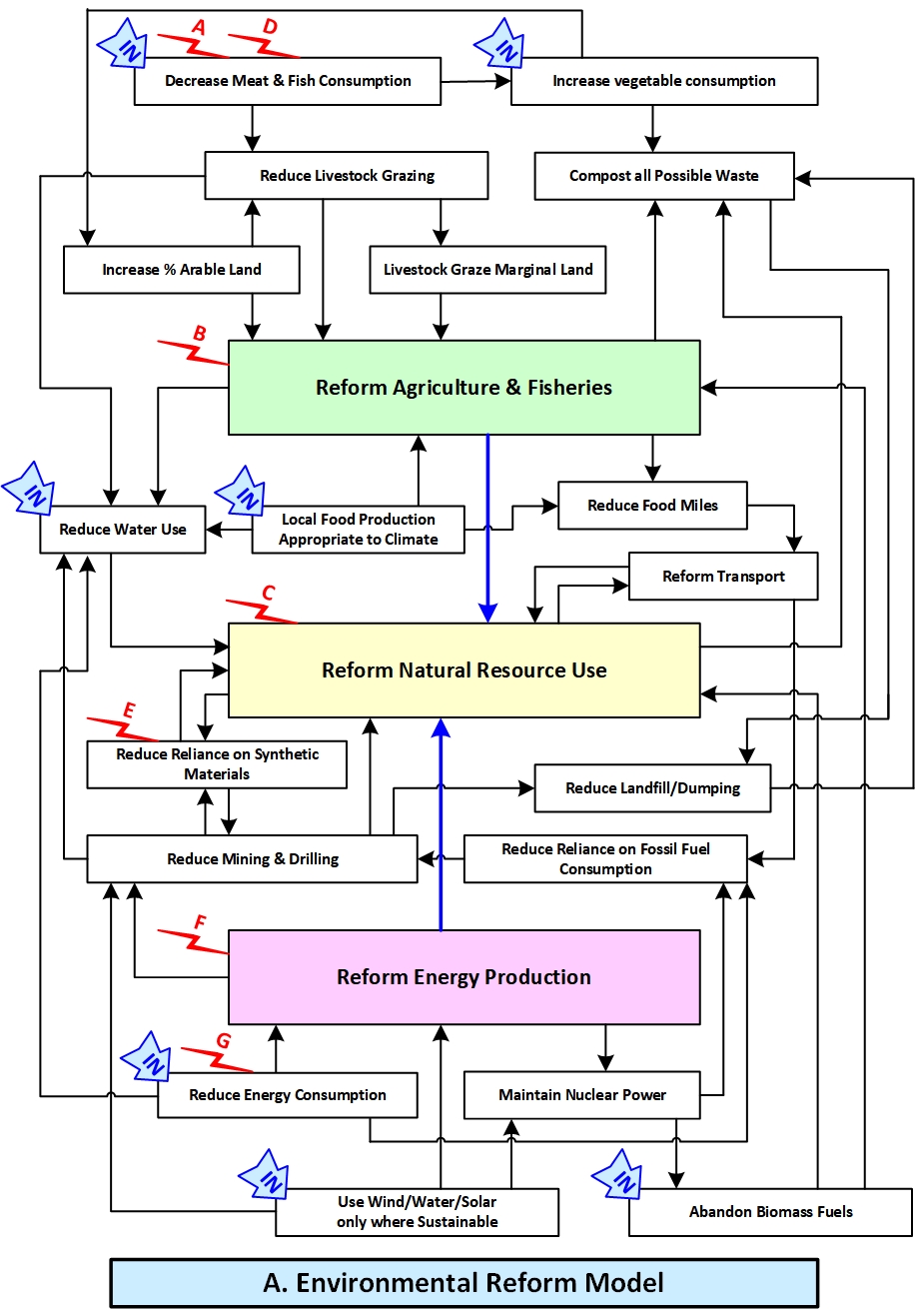
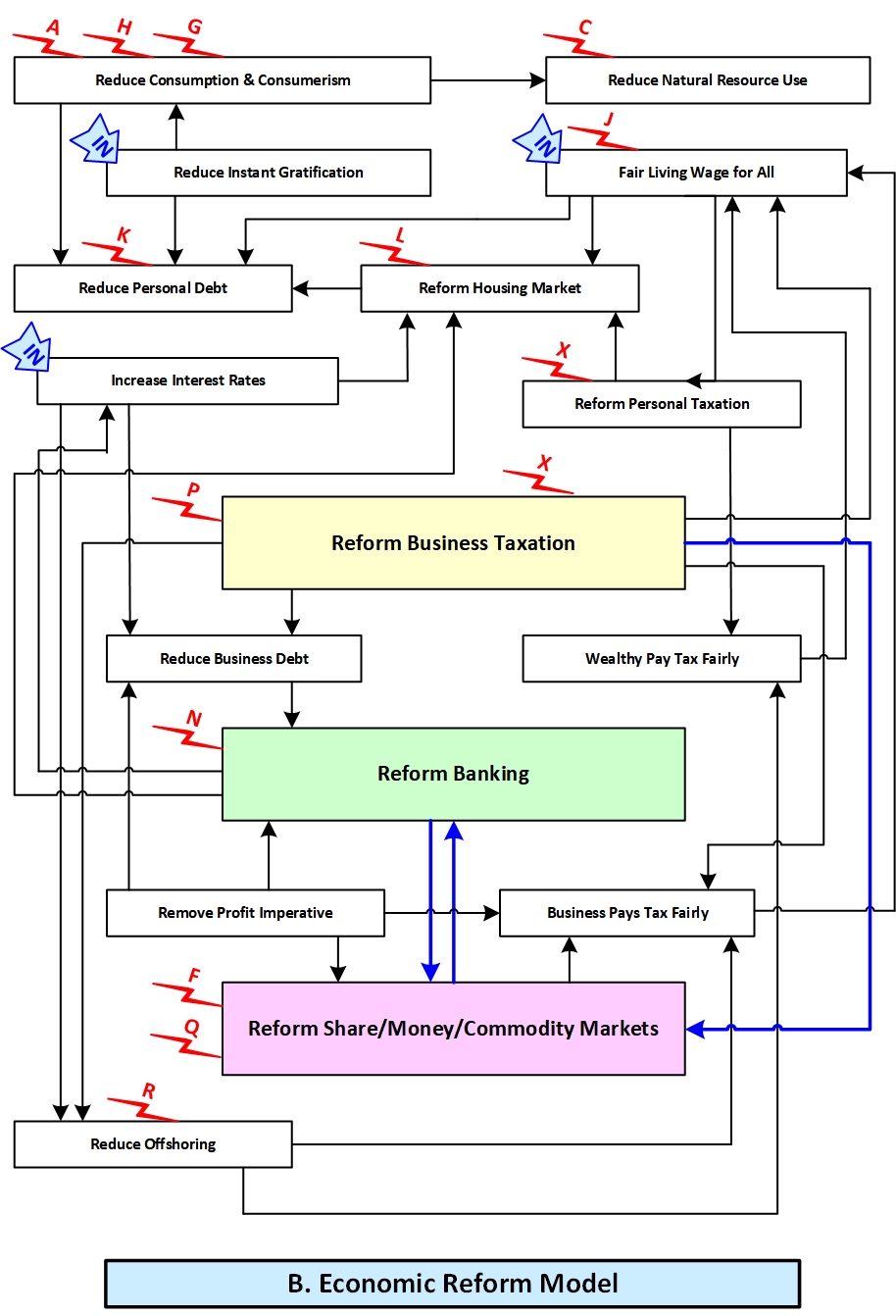
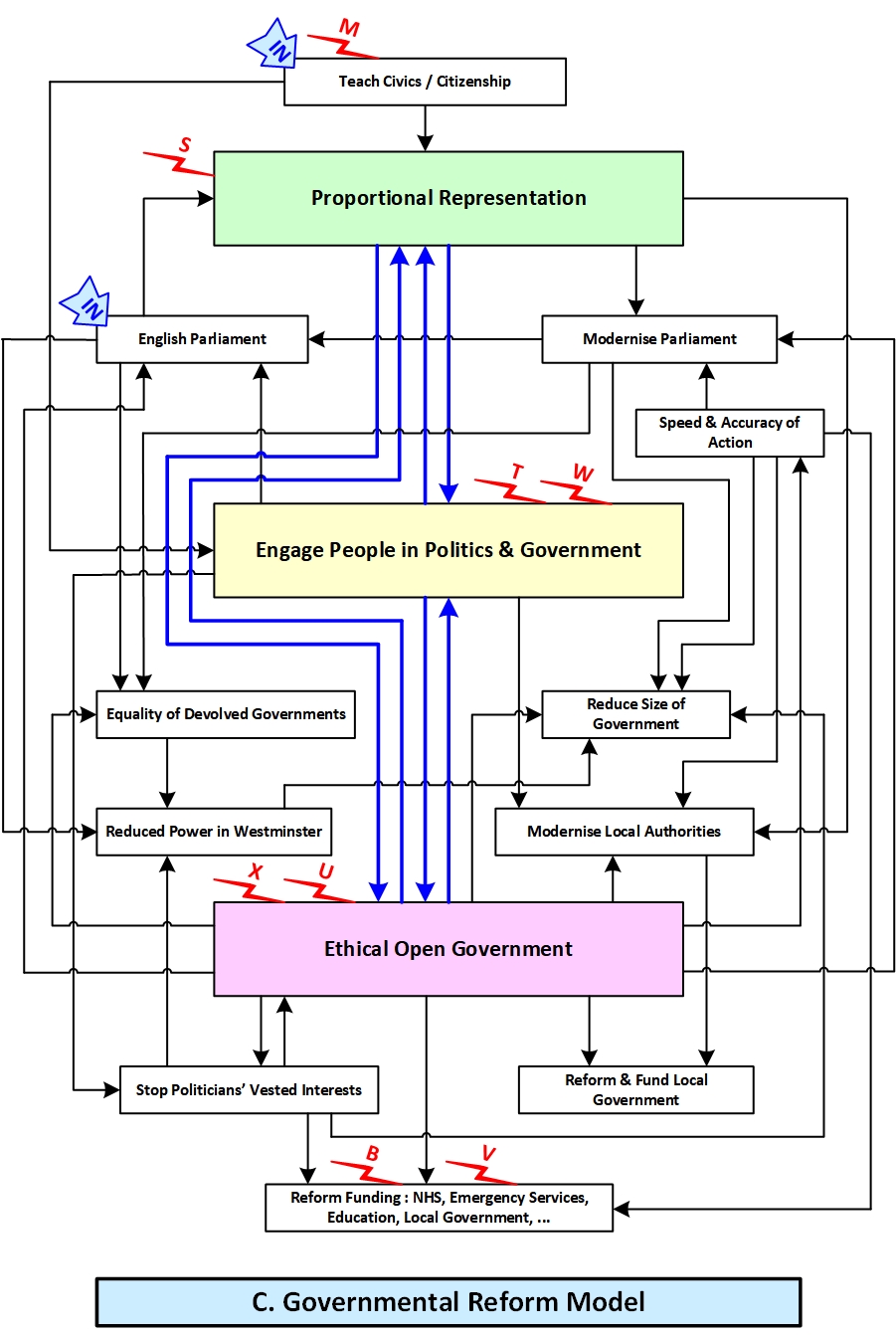
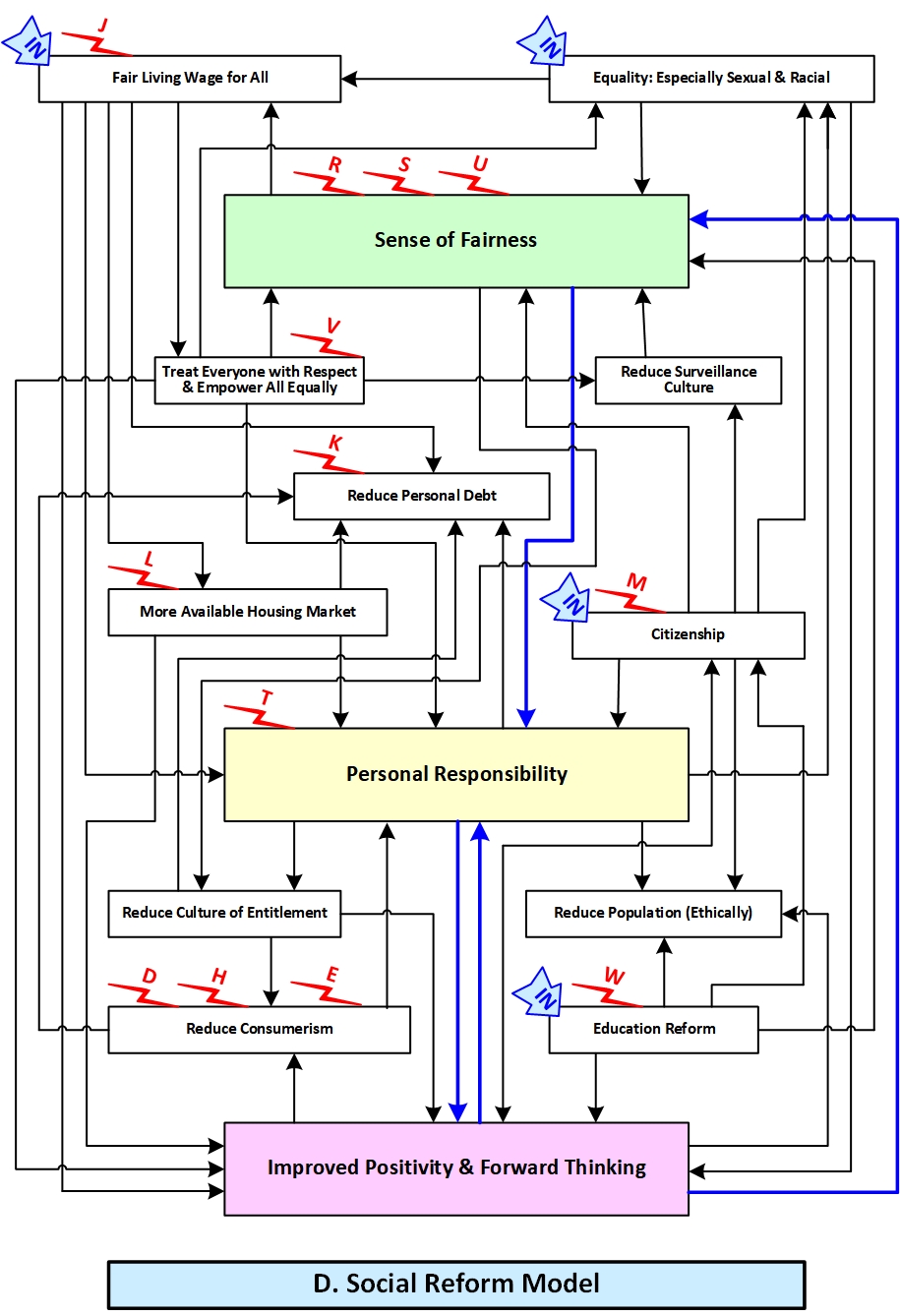
Following on from my post of some weeks back where I looked at a model for Environmental Reform, I’ve now had a go at writing flows for the other areas which need to be reformed together if we are to truly change the way our society works – and thus save ourselves and the planet.

As I see it, the four main arenas for reform are:

  1. Environmental
  2. Economic
  3. Political
  4. Social

They are, of course, highly interdependent.

The diagrams below are my attempt to capture and codify what needs doing.
You’ll see that I have marked with “IN” arrows those places which it seems to me are the simplest and most obvious starting points. Linkages between the areas are shown with lettered lightning flashes.

Click the images for larger views
Environmental Reform

Economic Reform

Political Reform

Social Reform

Yes, it’s very complex; and I don’t pretend I’ve yet got my head round it, nor that the models are necessarily complete. Others may very well disagree with me, be able to add key areas for attention, or linkages between items.

None of this is going to be easy. In fact even the “input points” are going to be fought over. There are too many vested interests amongst the “not-so-great and not-so-good” who hold all the wealth and power worldwide. But also because those of us in the western world have been (relatively) comfortable until now and embarking on this will both threaten that comfort and involve major change – neither of which mankind, as a species, is instinctively equipped to handle as over the aeons it would have been an evolutionary disadvantage. [See, inter alia, Ryback, Lee and Pianka.]

Well perhaps the Coronavirus pandemic can give us a kick start in helping us overcome our (now dangerous) instincts by showing at least the western (developed) world:

  • We can significantly reduce travel, especially air travel, for both business and leisure: business doesn’t need to do it and it will likely be neither affordable nor attractive for leisure.
  • We don’t all need to commute for 2+ hours a day to pile into an office. Sure, many jobs (eg. shops, manufacturing, farming) have to be done from your employer’s premises, but by far from all do.
  • We don’t need to consume stuff at the greedy rate we do (that too is no longer an evolutionary necessity); we can manage with less. Much (especially personal) technology is not essential, merely nice to have. We need to go back to “make do and mend” rather than “throw it away and buy a new one”. Most consumption (beyond the basics) is no more than “cake and circuses” which enriches the already wealthy.
  • There is more to life than earning ever more money; by working longer and longer hours; to show you think you’re two steps better than the guy next door; striving to continually climb the greasy pole; and kidding yourself you’re important. [See Hutnik.]
  • But perhaps most critically, we might come to understand how important it is to have open and ethical government – and that this is possible, though not inevitable. [See Mair.]

Will any of that happen? I hope it will. But I fear it won’t. I suspect this current panic hasn’t hit nearly hard enough, so not enough people are sufficiently shit-scared (or dead), and so the will (or necessity) for change won’t be there. Even the Great Plague and Great Fire of London (1665 & 1666 respectively) didn’t really hit very hard (they were too localised); the two World Wars came somewhat closer; but only the real devastation of losing 30-50% of the population in the Black Death (1348-50) really caused major reform. And who remembers back 670 years?

The will for change may be there amongst (some of) those of us who think and care. However I suspect that after this current Coronavirus panic is over “the people” will go back to their old ways, rejoicing at having escaped the demon bug (‘cos it never happens to them!), demanding what they had before, and being as selfish as ever.

Judging by recent behaviour, the signs are not good.

Horrible Times 8

The more I see, the angrier and more despairing I become – despite the fact that I know it isn’t good for my blood pressure.

Just what do these self-important, selfish, stuffed shirted twats think they’re on?

Almost every major sport is trying to (re)start their season. Football, rugby, cricket, tennis, Formula 1 … and on and on. Top flight football in the UK is intending to restart in mid-June. They aren’t alone.

Why? Selfish vested interests and money.

All they are going to do is to add fuel to the flames of a second spike of Covid-19. Why can these guys not understand this? Why are they (and their sport) so much more important than people’s health? How do we restructure their brains?

Sport is a recreation. Unfortunately it has become big business made up of prima donnas and stuffed shirts. (In fairness the stuffed shirts were always there, at every level.) Sport is not essential; it is recreation, fun. At the end of the day it is dispensable and one of the last things which should be (re)starting once all else is running and things are stable again.

The politicians are not helping. In England from next week up to six people may meet, in the open air (public or private) as long as they observe 2 metre social distancing. They can even have make burnt offerings, aka. barbecues.

Just like the government did too little, too late at the start of this, they’re now doing too much, too soon and risking the gains we’ve managed to salvage from their incompetence. Do they seriously think that Joe “Dumbo” Public is going to manage to observe (or care about) 2 metre social distancing in his garden, with his and his mates kids running around killing each other, while the adults swig larger and smoke “substances”? And how is this going to be policed? An unenforceable law is worse than no law.

It was my friend Katy, over on Facebook, who pointed out:

Juvenal [in The Satires] coined the phrase “Bread and Circuses”. It was about the fact that the Roman senators created a grain dole for the poor in order to buy their votes and keep the peace in a time of increasing unrest and hardship.

And the fact that the Emperor Domitian who was a right bugger, used to create big celebrations to take people’s mind off whatever the Roman version of Stalinist purges and gulags were. Massacred three thousand peasants? Chuck them a circus and some balloons on a stick and we’re laughing.

I’m not sure what the bread in our current case is – maybe Brexit? But the return of non-essential sport, and allowing people to effectively have parties at this time, certainly look a lot like a circus to me.

Just watch the upturn in Covid-19 cases by the end of June.

Gawdelpus with this set of clowns in charge.

Horrible Times 6

I’ve now been in lockdown since midday on 12 March, when I got home from my annual diabetic eye check (which I was surprised wasn’t cancelled). That’s 24 days and counting. I thought I’d just make a few brief notes about the good and the not so good recent happenings.

Not So Good

  1. Being in a higher risk category, which brings on fearfulness and self-isolation.
  2. Being unable to do a supermarket shop, because our decent supermarkets are either a bus ride or a taxi ride away (‘cos we don’t drive), and that feels too risky for either of us.
  3. The total inability to book a supermarket delivery, any supermarket delivery. And when you do, 50% of what you order isn’t available.
  4. The almost total absence of some commodities like bread flour and long-life milk.
  5. An inability to sign up for a “veg box” delivery.
  6. The nice sunny weather means I shall have to do some gardening, as much as my back will allow …
  7. … because the garden is untidy and is threatening to get away from us while we can’t get anyone to work on it.
  8. Two (Arab-looking) guys wandering down the road this morning shoulder to shoulder, the younger wearing a mask and talking to his mobile. Totally oblivious to what 6 feet is.
  9. The government’s pathetic response to the crisis: too little, too late; inadequate support for healthcare workers; delayed lockdown; stupidity of expecting herd immunity; inadequate self-isolation advice for the infected; almost complete absence of testing, so they’ve no clue what is actually happening … it goes on …
  10. All of that covered by wall-to-wall rolling TV news (which I’m mostly ignoring).
  11. I’m missing my fortnightly massage: it does keep my damaged back working but it is also enjoyable socially too.
  12. I know I’m not someone who is always out and about, but even so being forced to stay grounded is somewhat wearing.
  13. The inability to rise above (or kill off) all the stupid things I (feel I) have to do so I can sit and relax and read.
  14. A feeling of vulnerability and impending doom. Suddenly one realises one is all too mortal. And I’m unable to get my head round what it’ll be like not to be here, and not to be able to do the things I am doing.
  15. And then one feels like a helpless mesmerised rabbit in the headlights due to the stress and anxiety which feed the depression – rinse and repeat.

Good

  1. All the valiant and heroic NHS people, transport workers, and food supply-chain workers who are putting themselves at risk to help people and keep things moving.
  2. There’s certainly a sense of history: that we’re living through an historic period much like the Black Death (1349) or the Great Plague of London (1665) and beginning (but only beginning) to understand what it must have been like then. Yes that’s macabre, but also interesting and in a way rather fun.
  3. The quiet! It is just so quiet: no traffic noise, no planes in/out of Heathrow, not even many screaming kids. If you added back in a few mooing cows and whinnying horses this must be much like it was 600 years ago.
  4. Add to that the light and air quality. The lack of traffic, planes etc. has really reduced the pollution. The air is fresh, clear and not smelling of diesel and kerosene. And the light is bright, almost with that special clear quality one is used to seeing in East Anglia.
  5. The friend, who despite being an NHS worker with an elderly mum, is helping us by getting the odd few provisions and a bunch of flowers.
  6. One of the supermarkets (which I won’t name) seem to have decided (how?) that I’m on the vulnerable list for deliveries. This could be useful.
  7. Meanwhile Noreen has been able to get to the (pretty rubbish) local shops for the odd essentials.
  8. At the beginning of all this I had managed to book several Waitrose deliveries and have struck lucky with the odd slot ere and there – so we’re doing OK for food.
  9. It’s a lovely warm sunny Spring day today (Sunday) and the week promises to be largely the same. That means the garden is getting green and the apple blossom is coming out.
  10. As of writing this we’re both still healthy.

Horrible Times 4

Riddle me this …

If, as the government says, there is plenty of food in the supermarkets …
… how is it that today’s supermarket grocery delivery had half the items unavailable and most of the other half substituted?

We got no tomatoes, peppers, cauliflower, greens, potatoes, aubergine, fennel, parsley, onions. And that’s just the salad/veg.

Then there’s no bread, bread flour, baked beans, tinned kidney beans, milk, eggs.

But we did get chicken, duck, steak, sausages, smoked salmon, ham, butter, cheese and ice cream.

We’ll not starve, but so much for 5-a-day and a balanced diet!

Horrible Times 3

At least some elements of the Labour Party are saying we need to have a National Income Guarantee Scheme, to ensure everyone continues to have the money to live. This is, in my view, the correct humanitarian response. But also one which should force the wholesale rationalisation and simplification of the benefits system.

People’s ability to survive has to be supported and protected, and not just by protecting them from the disease. This protection has to come ahead of bailing out business. If people survive, business will survive. Without people there is no business.

If people have secure income, companies are expendable. If businesses don’t survive, they can be rebuilt as long as there are people who survive to do it. Hence people must come first.

No, I don’t care if every (passenger) airline goes out of business. Or every manufacturer of TVs. Or every theatre and pub. They can be rebuilt later. But we do still need to be producing food and medicine – and moving it around.

Ultimately that is where the effort has to be: protect the people and the food supply chain.

Along with this I have seen it suggested that there should be a 0% interest rate on all personal/household debt. My guess is that this would need to last at least a year. I can see the logic behind this, although it would no doubt also mean 0% interest for savers. A reduction in debt interest would not affect us (our only debt is a relatively small amount on credit cards); but no interest on savings would hit us – although not hard because heaven knows we already get little enough interest on our savings.

This is all very fine, but one has to ask where the government finds the money for this. The government doesn’t have a money-tree. The only money they have is what they collect in tax or what they can borrow. They have already borrowed more than it is going to be comfortable to ever repay. Where does the tax come from? Your and my pockets: either directly (income tax, national insurance) or indirectly (VAT, excise duty, corporation tax). If we don’t have any money, the government collects no tax. Without tax income there can be no income guarantee scheme, no bailouts, and no NHS. This is the economics of the capitalist system we live in. Chicken meet egg.

Horrible Times 2

OK, so were some days into … well what? … variable amounts of everything and nothing; huge amounts of existential worry and threat.

We’re effectively being told to stay at home permanently (almost under house arrest) although the supermarkets are open – with special hours for geriatrics and the invalid, which are reportedly more crowded than normal and seem a good way to kill off the unwanted. But if we do stay at home we could starve as supermarket deliveries are booked up weeks in advance.

Everything is feeling very fragile, demoralising and really frightening. It’s very much how the Black Death must have been back in 1349: one never knows where it’s going to hit next, if I’m going to succumb, or where one’s next meal is coming from. And, yes, we could get there! If we go into full lockdown, then there could well be issues with the food supply chain and access to supermarkets – on top of what we’re seeing now. Remember, with schools closed from tomorrow, there could well be people who can’t go to work because they can’t find alternative childcare, and that could hit all sorts of hands-on businesses which includes the whole of the food supply chain.

Am I being extraordinarily pessimistic? Well maybe, or then again maybe not. I know I always say “don’t worry about things you can’t control”, and we can’t control a lot of this. But when it comes to having food and drink one is threatening the very substance of existence, and reactions become especially visceral. Recall Maslow’s Hierarchy of Needs:

At least in western society we’re all used to working near the apex of the pyramid; certainly in the top two layers. But what’s happening now is sending us rapidly down a helter-skelter. The middle “love and belonging” layer is currently coming into it’s own. But some are already going to be down in the “safety & security” layer and any disruption to the food supply chain could leave people with a great deal of uncertainty about their very ability to survive. And once one gets down nearer to the bottom two levels people feel increasingly threatened and start to get nasty as they try to protect their existence – just as any animal will.

I have no idea what is going to happen, but I fear the worst; I’m pretty sure it’s going to get a lot worse before it gets better. And it looks like being a long haul: if we get away with anything much under two years I’ll be highly delighted.

Two years! Yes, because although we have protective restrictions now, once the infection rate drops and the restrictions are lifted it is highly likely the virus will rebound and we could go through a (say) six-monthly cycle several times before things settle out fully.

[Incidentally there is some good modelling of a number of possible interventions from the highly-regarded team at Imperial College, London; and it is this which appears to be influencing the UK’s current thinking. The paper is actually quite readable.]

None of this is at all good for those of us who already suffer with depression, or any other mental health issue. I, like I suspect many other people, feel totally disconnected from everything; completely isolated, both socially and physically; and scared about my ability to come out the other side of this.

But all we can do is to try to keep going as best we can.

Coronavirus: Attitudes to Panic

This post has originated in all the fuss surrounding the Coronavirus situation. In it I’m not interested in the science of how the Coronavirus works, or how it is being treated. I’m more interested in our reactions and the way we (individually and collectively) are approaching the problem.

The post is constructed around quotes from four comment articles [1-4] (referenced below) which have appeared in the last few days.

What’s interesting to me, from a rational standpoint, is the psychology and attitudes behind what is happening.

In the new coronavirus, we see a world that is more connected than ever by international travel, but that has also succumbed to growing isolationism and xenophobia. We see a time when scientific research and the demand for news, the spread of misinformation and the spread of a virus, all happen at a relentless, blistering pace. [4]

For example: The number of people travelling by plane every year has more than doubled since SARS first emerged, in 2003 [4] and we now have 24 hour rolling news both online and on TV.

On top of that

People are often optimistic about risks [called] “optimism bias”; people may think they can control their own exposure to diseases, that they don’t need a vaccine because they aren’t susceptible to flu, or that they won’t transmit their cold to others. [1]

It’s entirely normal that there are still many uncertainties [4]. We don’t yet know enough to be completely certain about the risks of COVID-19 … no one really knows how bad COVID-19 is, and how much damage it could eventually lead to [3].

For instance: How transmissible is the virus? Once infected, how much time passes before people show symptoms, and how likely are they to die? Which people are most at risk? [4].

It appears that on average, infected people spread the virus to two or three others [4]. This the Basic Reproduction Number (what epidemiologists call R0). It is about the same as that for flu, but way lower than for measles which has an R0 of 12-18 [5].

Current data suggests that COVID-19 kills around 2% (the Case Fatality Rate) of those infected [3] (although expect this number to change). However flu with a Case Fatality Rate of 0.1% kills more people [3] (presumably because although it is more widespread, we have a vaccine).

Even the normally cautious epidemiologists don’t know the answers. Harvard epidemiology professor Marc Lipsitch [says] “I think the likely outcome is that it will ultimately not be containable” [2].

In fact

Lipsitch predicts that within the coming year, some 40 to 70 percent of people around the world will be infected with the virus that causes COVID-19. But … this does not mean that all will have severe illnesses. “It’s likely that many will have mild disease, or may be asymptomatic”. [2]

That doesn’t sound good, so no wonder the uncertainties that academics are used to dealing with, about fatality rates or transmissibility, are stoking fear [4] because when we’re uncertain about something, we often rely upon our feelings and prior experiences in place of information. Surgical face masks offer the sense, however illusory, of protection [1].

Indeed

According to experts, the value of surgical masks depends entirely on the context in which they’re used: a surgical mask won’t work unless it’s worn consistently and properly. If worn incorrectly, their utility quickly plummets … Though face masks may provide the feeling of security, masks are most valuable in situations where they are necessary – such as among front-line health workers … We touch our faces, noses and eyes many times a day, making it difficult to completely avoid contact with infection. [1]

[If you want more on face-mask efficacy, see my post “Coronavirus and Face Masks” of a few days ago.]

While

researchers can share data and refine ideas faster than ever … they’re doing so in full view of a concerned citizenry … [and] … preliminary data that might once have run the gantlet of peer review before being published can now be downloaded by anyone, sparking misinterpretations and conspiracy theories. [4]

A climate of uncertainty can cause misinformation to flourish [1] and create fertile ground for mixed messages and inconsistency, which in itself can breed mistrust and fear [3]. And as we all know false reports readily cascade through channels that amplify extreme messages over accurate ones … Hoaxes and half-truths are huge problems during epidemics [4].

But of course we’re often required to make decisions based on having incomplete information [3]. I would actually go further: we never have all the information we need to make the decision; all we can do is to make the best decision we can at the time with the (limited) information we have.

This is why clear messaging from trusted sources, and guidance on what to do and how to do it, is essential during a pandemic [1]. Especially communicate often, communicate what is and isn’t known clearly, and provide simple action items for individuals to take … like hand-washing [and] acknowledge that [all of this] may change quickly [3].

However with public health that’s not easy. The risks of sending the “wrong” message can have devastating consequences – unnecessary anxiety on the one hand … and thousands of unnecessary deaths on the other [3]. And confused citizens might forgo sensible measures such as hand washing in favour of inefficient ones like panicked mask buying [4].

What’s perhaps worse is that border screenings and travel bans have historically proved ineffective and inefficient at controlling diseases. If anything, they can make matters worse. People will find a way to get where they want to go [4]. For example, although the Iran/Afghanistan border has been closed, some 3000 people cross that border illegally every day [6].

What’s more

bans can also break the fragile bonds of international trust … If countries know that they’ll be cut off during an epidemic … they may be less likely to report future outbreaks, leading to costly delays. [4]
Waiting too long to sound the alarm can be disastrous. [3]

As with many things this leaves us with a spectrum of possible reaction and attitude.

On the rational end, we must ask ourselves about … the effectiveness of [any] solution … [and how individuals can use that] solution effectively. On the emotional end, we ask ourselves about … how severe might it be if we … were infected [and] how likely we might contract it. [3]

A lot of the expert discussion (or at least discussion quoting experts) in the media has been at the rational end about the effectiveness of various actions, while I suspect a majority of individuals are inclined to work more towards the emotional end of the spectrum – often because they’re not presented with clear, concise, factual information; whether deliberately by the less reputable press and politicians, by omission, or because it is just packaged in a way they can’t understand.

At the end of the day we probably have to move individuals quite a long way (probably further than is possible) towards the rational side, while at the same time ensuring that the experts are doing as much as possible to make the right solutions effective and have some understanding to allow them to meet the individuals part way. That’s probably a circle that can never be made fully square. Nevertheless the experts have to work their socks off to square the circle as best they can, and take the people with them in supporting their solutions. And that ain’t ever going to be easy.


[1] “When it comes to coronavirus, we shouldn’t let our feelings trump the facts”; 26 February 2020; https://www.theguardian.com/commentisfree/2020/feb/26/coronavirus-feelings-facts-face-masks-covid-19

[2] “You’re Likely to Get the Coronavirus”; 24 February 2020; https://www.theatlantic.com/health/archive/2020/02/covid-vaccine/607000/

[3] “Uncertainty in a Time of Coronavirus”; 26 February 2020; https://blogs.scientificamerican.com/observations/uncertainty-in-a-time-of-coronavirus/

[4] “The New Coronavirus Is a Truly Modern Epidemic” 3 February 2020; https://www.theatlantic.com/science/archive/2020/02/coronavirus-very-2020-epidemic/605941/

[5] “Basic reproduction number”; 27 February 2020; https://en.wikipedia.org/wiki/Basic_reproduction_number

[6] “Coronavirus in a war zone: Afghanistan braces for outbreak after first case”; 26 February 2020; https://www.theguardian.com/global-development/2020/feb/26/coronavirus-in-a-war-zone-afghanistan-braces-for-outbreak-after-first-case

Welcome!

Welcome everyone in the UK to the world’s newest third world country

So you think Britain isn’t a third world country?
Outside the EU it will be about as important as Tristan da Cunha.

Gawdelpus!