This month’s large collection of articles encountered which you maybe didn’t want to have missed.
Science & Natural World
First off we must pay our respects to this year’s IgNobel award winners amongst whose investigations were solid and liquid cats, didgeridoos and cheese disgust.
Budburst on many trees is temperature dependent and March temperatures seem to be the key for many. And they’re getting slowly warmer, so budburst is getting earlier.
[Disclosure: I’ve been submitting records to UK phenology research for many years; many more years that the 17 covered by this research. It takes little time and is valuable “citizen science”.]

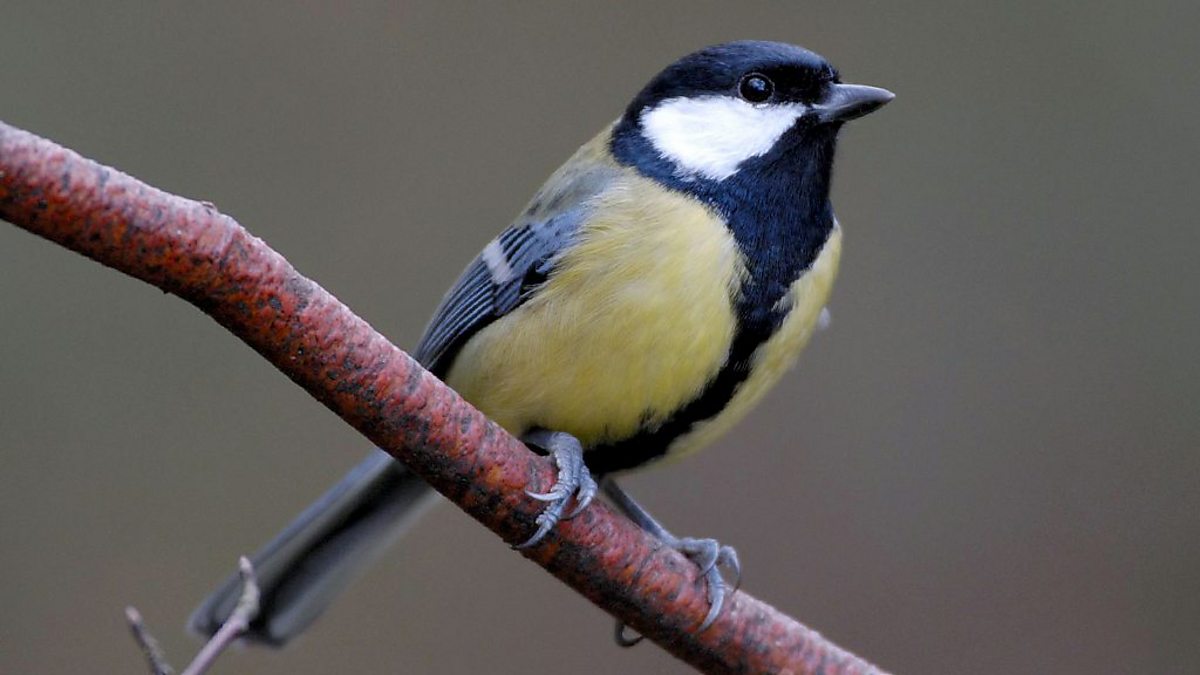
Another curiosity of British wildlife is that some birds (notably Great Tits, above) are evolving longer beaks as this gives them an advantage at garden bird feeders. Here are two complementary reports, one from the
Guardian, the other from the
BBC.
Now to chemistry … A look at how poisoners could use
clothing as a murder weapon.
The aliens are coming! Well maybe not quite, but there is a
mysterious object speeding past the sun which could be visitor from another star system.
Health & Medicine
For those who want a little more of a challenge than normal (it contains some relatively simple maths), here’s a very good article on why
vaccination is important in preventing epidemics.
Sepsis is a hidden killer, and one which most people know nothing about because it has so successfully continued flying under our radar.
There’s a small study which suggests that the psychoactive drugs in
magic mushrooms “reset” the brains of depressed people. [Do NOT try this at home! The study used very controlled doses in a medical environment.]
And now to some curiosities … First off, and not for the squeamish, an historical report of a
man with two penises and two bladders.
Synaesthesia is mind-boggling. The first of our two mentions this month is of a woman who lost her sight due to illness and in regaining it had some terrifying sounding
synaesthetic effects.
And to boggle the mind even further, this young lady has a
range of different types of synaesthesia (compared with the normal one). I just cannot imagine what this is like!
Sexuality
Two different aspects of a relationship without sex. First there are people who are genuinely
asexual: they may have romantic partnerships but have no interest or desire to have sex.
At almost the other extreme there are couples who, while still happy together, just
stop having sex.
Social Sciences, Business, Law
Forensic science is coming under increasing scrutiny. Not only has fingerprinting never been scientifically evaluated for its reliability, but
DNA is accused of frequent flawed techniques, which can have devastating effects.
Language
Philip Pullman is under fire because his
children’s book La Belle Sauvage is littered with swearwords. Emma Byrne in the
Guardian suggests this is actually a good thing: most children already know the words and isn’t it better that they learn in a controlled way when they are and are not acceptable?
History, Archaeology & Anthropology
Uncovering the menus for
Neolithic man’s feasts: pork and cheese.
The
Incas were far better astronomers than previously thought.
The
shipwreck which produced the Antikythera mechanism is still turning up interesting artefacts like the bronze arm which suggests there may be a haul of statues waiting to be found – and what may be another piece of the Antikythera mechanism itself.
Why do a number of Scandinavian Viking graves contain
burial clothing embroidered with the work “Allah”
But worse is yet to come, for the
Vikings may have brought leprosy to this country via their trade in red squirrels.
Coming much more up to date, both sides are now telling the story of the capture and
boarding of the German U-boat U-559, which changed WWII by giving the Allies the Germans’ Enigma codes.
So how about a list of the
ten best railway stations in Britain, at least according to Simon Jenkins in the
Guardian.
London
IanVisits is writing an occasional series on “Unbuilt London”. In an old post he looks at the 1960s plan to
replace buses with monorail network. I have a vague memory of this hare-brained scheme.
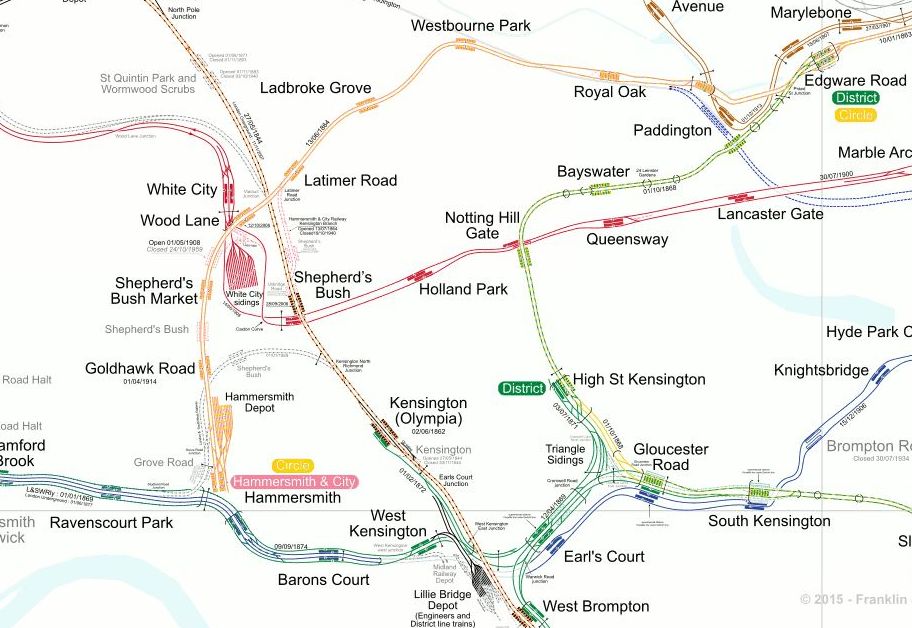
And here is a really fascinating and
detailed map of the London Underground, Overground, DLR, Tramlink & National Rail (small section below). But why does this have to be published by a French company?
Lifestyle & Personal Development
Our favourite Soto Zen master, Brad Warner, reflects on
“The Center of All That” the implications of being you, here.
We’re losing our skills. The
skills to do everyday chores our parents took for granted, like washing up by hand, changing a mains fuse or sewing on a button.
A brief look at some of what happens
behind the doors of a London crematorium.
I wasn’t sure whether to put this next item here or under medicine. According to sleep scientists we are chronically
underslept and sleepwalking our way through life. That is a real threat to our health, and it isn’t fixed by a couple of good lie-ins. So what to do about it?
Apparently our culture says that emotional friendships are a female thing and that
boys cannot have emotional friendships with their own sex and are discouraged from doing so by the time they hit puberty. And this is forcing a large number of men into loneliness despite the outward appearances. [OK, it’s American, but is UK culture so different?]
People
Back in August Geoff Marshall (no relation)and Vicki Pipe completed their challenge to
visit all 2,563 National Rail stations in Great Britain. Here they talk about the experience for the National Railway Museum’s blog.
That’s all folks! Another instalment next month.