Monthly Links

Welcome to this month’s well packed selection of links to items you may have missed.


Science, Technology, Natural World

An evolutionary biologist explains what we already know: cats are perfect. [££££]

Nevertheless we’re still trying to fully understand how cats purr.

A Pacific Footballfish (yes, really; they’re a type of anglerfish) has washed up on the Californian coast; only about 30 known specimens have ever been collected.

And now for something completely different … how many tectonic plates does Earth have?

Scientists are saying the Moon is 40 million years older than we thought. Well unless there’s a lot we’re not being told, I don’t find it totally convincing.

Meanwhile way, way out in space the two 50-year-old Voyager probes, now out beyond the solar system, are being given code updates to prolong their mission even more.

So you think quantum physics is weird? Well it isn’t; its weirder! [££££]


Health, Medicine

They’ve tested it, and it turns out the ancient honey-and-vinegar mix is a really effective wound treatment. But then so is superglue. [££££]

It’s long been received wisdom, but does chicken soup really help when you’re sick?

On which note, how many microbes does it take to make you ill? [LONG READ]

Another piece of long-held wisdom is that young, health adults were more vulnerable to the 1918 flu virus. Examination of some skeletons suggests this wasn’t so.

It may sound morbid or traumatising, but researchers are still trying to understand what really happens during a near-death experience. [LONG READ]


Environment

Many of the UK’s big wine retailers have joined forces on the Bottle Weight Accord aimed at globally reducing the weight of glass bottles.


Art, Literature, Language, Music

Aboriginal Australian languages have finally helped linguistics researchers show that a language’s grammar affects how the speaker sees. [££££] [LONG READ]

Many people have assumed the worst, but it is doubtful Lewis Carroll was actually a paedophile?


History, Archaeology, Anthropology

There’s this theory that men evolved to hunt and women evolved to gather (wrapped around childcare etc.). But the thing is, it’s wrong. [££££] [LONG READ]

There are some footprints in New Mexico which if correctly dated mean humans were in the Americas much earlier than thought. It also seems that the first American settlers weren’t who we thought [LONG READ] they were.

In Spain archaeologists have discovered 9500-year-old baskets and 6200-year-old shoes in a bat cave.

Did Stone Age peoples have toilets? It looks like at least some did. [LONG READ]

There’s one small glimmer of light amongst the climate change which is melting all the ice … some interesting ancient artefacts are coming to the surface from their alpine deep freeze. [LONG READ]

At the other end of the scale, scientists in Israel are having some success growing date palms from 2000-year-old seeds found at sites in the Jordanian desert.
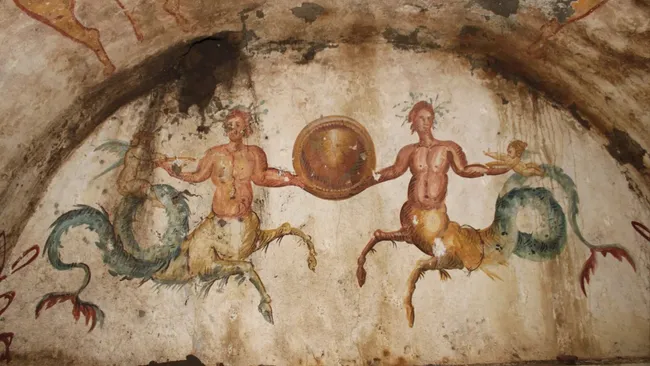
Staying in Europe … in Italy a 2200-year-old tomb has been discovered – and it’s decorated with a mythical hellhound and sea-centaurs.

Declassified satellite images of Syria and Iraq from 1960s and 70s are revealing a large number of Roman forts in the area; far more than were expected.

Never let it be said that Romans didn’t have all mod cons, because it appears that at least some had their own wine fridge.

Also dating from the Roman period, an 1800-year-old sarcophagus, which held a woman of “special status” has been unearthed in NE France.

Let’s skip quickly over to the Americas again … the Mayan reservoirs relied on aquatic plants to help provide clean water.

And we’re back in Europe and with that melting ice … a rare, well preserved and possibly Viking, horse bridle has emerged from melting ice in Norway.

It seems that the Vikings had windows as fragments of Viking-Age window glass have been found in Denmark and Sweden.

Our favourite medievalist has written a short explication of the Holy Roman Empire. [LONG READ]

Medieval manors were actually important employers; here’s a look at some of the jobs.

Meanwhile medieval people got murdered, and some academics have put together murder maps for three cities.

Agrippa’s De occulta philosophia (1533), a manual of learned magic, explicated the ways in which magicians systematically understood and manipulated the cosmos. [LONG READ]

Now coming almost up to date … 19th-century Britain had this aversion to allowing women to practice medicine.


Food, Drink

Researchers have finally revealed the true origins of grapes and wine. [££££] [LONG READ]

So just why are 1 in 7 of us addicted to ultra-processed foods? [LONG READ]


Lifestyle, Personal Development, Beliefs

It that time of year, but Katherine May suggests ways in which the can lighten these dark months.

Here are ten questions to help start an important conversation with a teenager (well anyone really).

A professional architectural photographer talks about the magic of photographing the Romney Marsh Churches. [LONG READ]

Still down in Kent, my friend Katy Wheatley got to see round the late Derek Jarman’s Prospect Cottage which is in one of my favourite places, the desolation of Dungeness.


Shock, Horror, Humour, Wow!

Finally … the heroic and amazing exploits of animals working for us including ferret electricians and land-mine clearing rats. [LONG READ]



Culinary Adventures #104: Apples in Nightgowns

This is an old recipe, but one I’ve not tried before. I’m not a fan of the simple baked apple, but I’ve had Apples in Nightgowns in the past (thanks Robert & Theo, wherever you are now) I know how good they can be. So having plenty of apples, a block of pastry and the end of a jar of mincemeat I figured I’d make up my own version.

To get us started, here’s a traditional German recipe. But like most things around here it’s almost infinitely flexible.

Apples in Nightgowns
[Image from the recipe linked above]

Apples in Nightgowns

Serves: 4
Preparation: 20 minutes
Cooking: 40 minutes

Ingredients

  • 4 good sized eating apples
  • 500g block of puff pastry
  • about a tbsp mincemeat for each apple
  • 2 tsp granulated sugar for dusting
  • 2 tsp icing sugar for dusting (optional)
  • flour for rolling
  • milk (or beaten egg) for glazing

What to do …

  1. Pre-heat the oven to whatever temperature the pastry needs, and prepare a baking sheet lined with baking parchment.
  2. Peel and core the apples being sure to keep them whole. If you wish dip the apples in a drop of lemon juice or water to prevent them browning.
  3. Roll out the pastry; it needs to be very thin to be large enough for four apples. Cut the sheet of pastry into four squares.
  4. Place an apple on each square of pastry and fill the core hole with mincemeat; pack the mincemeat in well with the end of a wooden spoon (or similar pusher); it doesn’t matter if it overflows the top.
  5. Wash the pastry with milk (or egg) and wrap it neatly over the apple to enclose it.
  6. Place the enveloped apples on the baking tray; glaze with milk (or egg); and sprinkle with a little granulated sugar.
  7. Bake for 10 minutes at the pastry temperature; then turn the oven down 20°C and bake for a further 20-30 minutes until golden brown and the apple has had time to cook through.
  8. Dust with icing sugar and serve hot or cold with, for preference, double cream.

Notes

  1. As the original recipe implies, you can stuff the apples with almost anything of your choice: fruit & nuts, marmalade, jam, mincemeat …
  2. I used puff pastry because I happened to have some; shortcrust should work just as well.
  3. Traditionally this is made with cooking apples, but they’ll likely need a bit more sweetening than I’ve used here (although the mincemeat was pretty sweet).

Monthly Quotes

It’s time for this month’s (short) collection of quotes …


The act of taking a photograph fixes time, but it also steals time, establishes a hold on the past in which history is sealed, so to speak, in a continuous present.
[Graham Clarke; The Photograph]


Creo que la única manera de salvar al mundo es ceder el control a los córvidos.
[I think the only way to save the world is to give control to the corvids.]

[@Morvven]


No more apologies for a bleeding heart when the opposite is no heart at all. Danger of losing our humanity must be met with more humanity.
[Toni Morrison]


You will never get the truth out of a Narcissist. The closest you will ever come is a story that either makes them the victim or the hero, but never the villain.
[Shannon L Alder]


If art is how we decorate space, music is how we decorate time.


Once more, let me remind you what fascism is. I need not wear a brown shirt or a green shirt. Fascism begins the moment a ruling class, fearing the people may use their political democracy to gain economic democracy, begins to destroy political democracy in order to retain Its power of exploitation and special privilege.
[Tommy Douglas]


It helps if you imagine autocorrect as a tiny little elf in your phone who’s trying so hard to be helpful, but is in fact quite drunk.


Education is the most powerful weapon we can use to change the world.
[Nelson Mandela]


All war is a symptom of man’s failure as a thinking animal.
[John Steinbeck]


Man is the most insane species. He worships an invisible God and destroys a visible Nature, unaware that this Nature he’s destroying is this God he’s worshiping.
[Hubert Reeves, Canadian-French astrophysicist]


Fediverse Test

I’m testing a way to add this blog to the fediverse, so it becomes visible to services like Mastodon, and can be followed by users from their fediverse server.

If you see this post on a fediverse server, and wish to follow this Zen Mischief blog, then search for @zenmischief.com (to pick up all new posts and pages) or @kcm (to pick up only those posts/pages I create – which is likely to be all of them).

This post is to check if this works; there is no significant content beyond the above.

Here’s an image to see how that works.

test image of a scented geranium

That’s all.

October Quiz Answers

Here are the answers to this month’s five quiz questions. If in doubt, all should be able to be easily verified online.

October Quiz Questions: Biological Science

  1. How many hearts does an octopus have? Three
  2. What is the name of the bumps on a raspberry? Drupelets. The raspberry is not a berry but an aggregate fruit of numerous drupelets around a central core.
  3. The Kakapo is a flightless bird native to New Zealand. What type of bird is it? Parrot
  4. Ants and bees evolved from which other insect species. Wasps
  5. According to researchers there are thought to be over a billion individuals of only four bird species. Name two of them.
    House Sparrow, European Starling, Ring-Billed Gull, Barn Swallow.

Answers were correct when questions were compiled in late 2022.

Ten Things: October

This year our Ten Things column each month is concentrating on science and scientists.

Where a group is described as “great” or “important” this is not intended to imply these necessarily the greatest or most important, but only that they are up there amongst the top flight.

Great Biologists

  1. William Harvey
  2. Charles Darwin
  3. Aristotle
  4. Antonie van Leeuwenhoek
  5. Carl Linnaeus
  6. Alexander Fleming
  7. Edward Jenner
  8. Robert Hooke
  9. Hippocrates
  10. Gregor Mendel