
 Micturition
The desire to urinate. A morbid frequency in the voiding of urine.
Micturition is often incorrectly used for the act of urination, which is correctly miction.
Derived from the Latin, the OED gives the first recorded usage in 1725.
Weekly Photograph
This week’s photo is another I took last October when Noreen and I travelled on the paddle-steamer Waverley from London (Tower Pier) to Southend. This shot of the Canary Wharf development was taken in the twilight on the way back to Tower Pier; I like city lights at night and the movement of the boat produces some interesting, almost other-worldly, effects.

Dusk over Canary Wharf
London; October 2013
Your Interesting Links
More links to articles you may have missed.
Apparently odd numbers are dodgy — except for 7 — but even numbers are good.
So just what is the evolutionary or biological purpose of menstruation? Even you girlies might be surprised at the (details of) the answer.
While we’re on girlie bits, here’s probably more than you wanted to know about having a tit reduction.
Most of my friends will have managed to navigate this OK, but just in case you needed to know, here’s how to care for your changeling.
On the stress of trying to cope with a life-threatening nut allergy.
For all those of you who sleep together, apparently the way you sleep says volumes about your relationship, unless you sleep on your back. Not sure how Noreen and I have survived all these years then.
Research tells us that in the UK we start kids on formal learning much too young. As so often Europe gets it right and we get it wrong.

And now for something more light-hearted. Here’s a medieval image of John Lennon. Love the specs!
While on the old, here’s more on the riddle of the Voynich Manuscript. The article is suggesting it is a forgery — I agree this seems likely.
Back about 1750, long before Cleopatra’s Needle, Canaletto painted a large obelisk on the north bank of the Thames in London. IanVisits investigates.
For once a sensible and accurate article about the Japanese, sub-tropical paradise of Okinawa and Okinawan music in the UK press. And it quotes my friend John Potter.
How the coming of the railways changed elopement.

Meanwhile in Paris the new-fangled police force were spying on the mistresses of the well-to-do for no apparent reason.
And in modern Munich nudity is perfectly OK.
Apparently 2014 has been designated the Year of the Bush. And not before time, say I.
Finally … So you’re worried that your naked body isn’t perfect. Don’t be. A masseuse reassures us that we’re all the same — beautifully imperfect!
Ennismore Terrine
Yesterday we enacted what is for us an occasional bank holiday weekend ritual: the making of terrine — something I’ve written about before, for example here and here. As always it is at least partly made up as we go along, but always a variant of a basic recipe. So yesterday’s was a terrine which includes spinach. Yes, spinach! I don’t recall exactly where I got the original idea for this, some 25-ish years ago, but I think it may have been Elizabeth David. Anyway it works very well. In fact the first time we did this it worked so well that our then two cats found the result addictive!
Anyway this is (roughly) how yesterday’s terrine was concocted. It takes time, but it is worth it.
Ennismore Terrine
This makes enough to all but fill a 24cm round Le Creuset casserole; a large cake tin would work too.
Ingredients
6-8 rashers streaky bacon or equivalent in bacon offcuts
About 800 gm pork
About 800 gm chicken livers
About 400 gm plain pork sausages, skinned; or equivalent amount of sausage meat
About 300 gm bread without crusts
About 500 gm spinach
1 large onion, finely chopped
3 or 4 cloves of garlic, peeled
Wineglass of calvados, brandy or whisky
Half a glass of white wine
2 tablespoons garlic purée
3-4 tablespoons tomato paste
Handful of juniper berries
1 large egg
Pinch of salt and a generous grind of black pepper
2 tablespoons chopped fresh herbs of choice
1 tablespoon Worcs. sauce
Olive oil
A little butter
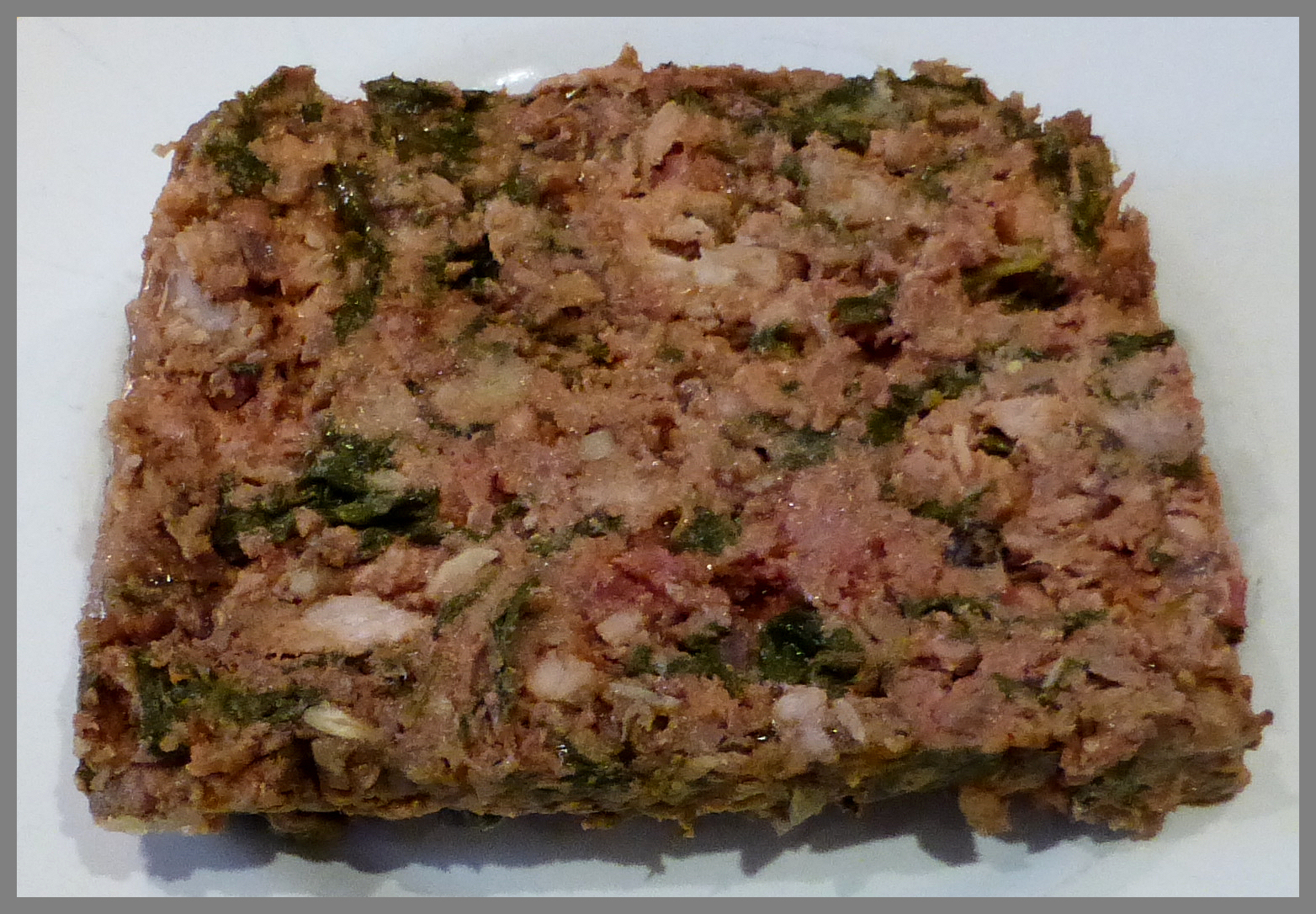
The finished result
Method
- Chop the bacon into 1cm pieces.
- Cut the pork into 1cm cubes, removing the skin, bone and any excess fat.
- Put the bread, herbs, salt and pepper, garlic cloves, juniper berries in a food processor and whizz to a crumb.
- Add the sausage meat, half a glass of the calvados, Worcs. sauce and the egg to the food processor and whizz again to a smooth paste. Transfer this to a large mixing bowl.
- Heat a drizzle of olive oil in a frying pan and lightly cook the spinach. Drain well and add to the meat mix.
- With a bit more olive oil fry the onion until translucent. Tip this out into the food processor with the garlic purée and tomato paste.
- With a little more oil if needed fry the bacon until the outside is seared and browning but still undercooked inside. Add this to the food processor and whizz lightly; do not purée.
- Now fry the chicken livers for a few minutes again until the outside is beginning to brown but not cooked through. (As the livers aren’t fully cooked don’t go tasting the cake mix!) Add this to the food processor and whizz; it will make a slurry. Add this to the meat mix.
- Finally fry the pork until lightly browned but also not cooked through and put this in the food processor.
- Deglaze the pan with the rest of the calvados and the white wine. Add this to the food processor and whizz to a rough paste; don’t worry if it looks grainy. Add this to the meat mix.
- Mix the meats together thoroughly; don’t be afraid to use your hands.
- Butter the casserole generously or, if using a cake tin, line it with baking parchment.
- Pour the meat mix into the casserole/tin and firm it down well. Cover with foil or a tight fitting lid.
- Cook in the oven at 170°C for about 1½ hours. It is done when a knife stuck in the terrine for a few seconds comes out very hot (or a meat thermometer at 80°C).
- Remove from the oven and if possible weight the terrine to press it. (Something flat with tins of beans or a brick on it works; heavier is better.)
- Allow to cool for a couple of hours and then put in the fridge for at least 2 hours more, but preferably overnight, still with the weight.
- If you made the terrine in a tin you can now turn it out. If you used a casserole you’ll need to serve it from the dish.
- Serve with crusty bread and/or salad.
Notes
- This is very forgiving. You can use any mix of meats you like but it does need a little fat. And you can vary the proportions according to taste. It is OK to use belly pork if you’re fine with the fat, otherwise use something like leg steaks and don’t skimp on the sausage meat.
- If using a cake tin, some people like to line it with streaky bacon. This holds the terrine together better when it is turned out as a loaf. Personally I can’t be bothered, but then I usually make it in a casserole anyway.
- You can also add any odd ends of leftover veg (mushroom, tomato, potato are especially good) but this is entirely optional. If you do, either finely chop them or whizz them together with the breadcrumbs.
- The mix should be a paste but not sloppy. If you find it is too wet then add some extra breadcrumbs or some stuffing mix.
- Technically the terrine should be cooked in a Bain Marie, but I never bother.
- You can get away without pressing the terrine but the result will be more friable and crumbly, and won’t turn out of a tin so well.
We’ve just devoured some for lunch with home-made seedy bread, and it was good.
Something for the Weekend
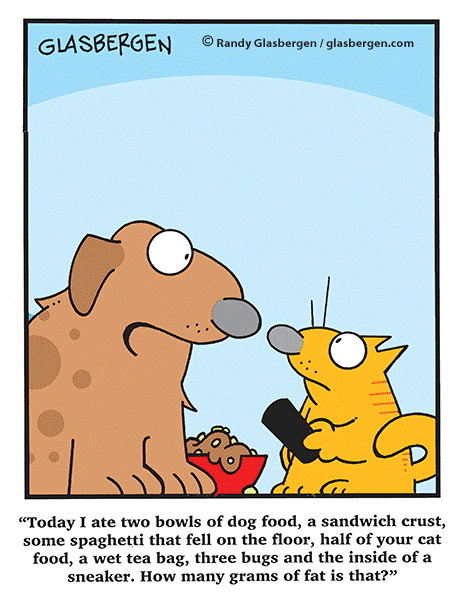
What, not two eggshells and something I found on the drive as well?
Oddity of the Week: Typewriter
After seeing a demonstration of a typewriter in 1874, and despite a worldwide economic depression, Twain ran right out and bought one for the outrageous price of $125 [around $2,500 today]. Within a week, he was writing letters on it (in all capitals; it had no lowercase) about how he looked forward to giving it away: “IT is MOST TOO TEARING ON THE MIND,” he lamented. It’s sometimes hard to separate Twain’s real complaints from his curmudgeonly persona, so maybe he was exaggerating. But by 1875, he had given away his typewriter and decided instead to endorse new “fountain” pens for two companies …
Still, Twain did more than anyone to ensure the eventual triumph of typewriters over high-end pens. He submitted the first typewritten manuscript to a publisher, Life on the Mississippi, in 1883. (It was dictated to a secretary, not typed by Twain.) And when the Remington typewriter company asked him to endorse its machines … he declined with a crusty letter—which Remington turned around and printed anyway. Even the acknowledgement that Twain, probably the most popular person in America, owned one was endorsement enough.
From: Sam Kean; The Disappearing Spoon
Word: Xenodochium
Xenodochium
A house of reception for strangers and pilgrims; a hostel, guest-house, especially in a monastery.
From the Greek ξένος a stranger + δέχεσθαι to receive.
First recorded by the OED a in use as late as 1612.
Weekly Photograph
This week it has to be time for some more pussy porn. So here’s one from earlier this month of Tilly the now-not-so-kitten (she’s coming up for a year old) sleeping on my desk. She’s a bit out of focus, apart from those paws, but this only adds to the pussyness!

Office Varmint, Resting
Greenford, April 2014
£50m? That Goes Nowhere!
In a widely reported impending announcement David Cameron is allegedly to pledge £50m to fund 1000 GP surgeries (roughly 1 in 8) to open 0800-2000, 7 days a week. See for instance here.
Yes, these extended GP hours are something we, the patients, are asking for. And there is a need because currently there are people (just how many is really debatable) who can’t (for lots of reasons) go a GP appointment but unnecessarily clog up A&E.
But yet again the UK government has proved it doesn’t have a clue about how to actually run the NHS. Cameron doesn’t stand a hope in hell of achieving what he’s pledging, because $50m by my reckoning will pay for a quarter of that for just one year.
Here’s why …
Opening 8-20, 7 days will mean around an extra 34-40 hours a week to be covered. (It’s 34 hours if the practice is currently open 0800-1800, 5 days a week; and many aren’t.)
This means every GP practice which is going to extend their hours, as demanded will need to employ at least one extra full time equivalent GP.
And to cover the extra hours they will also need at least one full time extra member of reception/office staff.
Leaving aside where they are going to find all the suitable, spare GPs, let’s look at the cost. Here’s a very broad brush, back-of-envelope, estimate:
Assume that a GP costs the NHS £150K pa (that’s salary plus pension contributions, plus employers NI contributions, plus other benefits like holiday etc.).
Assume similarly that a full time trained receptionist costs £30K pa (again salary plus benefits package). (Yes you do need trained receptionists; medical work is not something anyone off the street can do, and certainly not safely.)
And then remember that the extra hours will also incur costs for heat, light, hot water and other services — let’s assume that’s £25 per week per practice.
Which means each practice would need funding of around £181K a year.
Dividing that into £50M would provide enough funding for around 275 practices, or about a quarter of what is proposed. And 275 practices is little more than 1 for each NHS area (CCG) in the country (by my count there are 211 of them in England).
So even if the “reorganisation” also provides 100% efficiency savings (which would be a world first!) that still means we’ll achieve only 50% of Cameron’s pledge.
So not only will Joe/Josette Public not realise that this may mean his/her GP isn’t open (and they have to go several miles across the borough to find the practice which is open — on a Sunday when there are no buses), but it is going to go nowhere near meeting Cameron’s pledge.
And that’s without all the fancy gizmos, like Skype video consultations, which are being promised. They have to be paid for too!
Oh and if you read the articles don’t be deceived by all the twaddle about the over 75s. That’s been in the plan for a long time; it isn’t new. Just as I suspect the £50m isn’t new money either.
How do we get these people to understand that healthcare is expensive, that the available funds are being misallocated and mismanaged, and that GP services are hugely underfunded compared with 10 years ago? Because they really don’t have a clue how to fix things.
Ay to Zee
I’ve decided that we’ll have another irregular series, an A to Z. Unlike 10 things this won’t be a regular monthly feature — I considered it and thought that one such a month was enough and I’d do an A-Z when the whim takes me. I also decided that we’ll start with …
An A-Z of Me
A — Age: 63 on the calendar. Mentally it varies from 21 to 91. Physically it feels more like 163.
B — Blood Type: Not a clue; I’ve never been told.
C — Chore You Hate: All of them, especially housework.
D — Dogs or Cats: Definitely cats. I don’t dislike dogs but I don’t have the affinity with them I do with cats.
E — Expletive Deleted: Usually f**k or c**t.
F — Fun Thing: The London Eye.
G — Greatest Accomplishment: Survival.
H — Haircut: Yes, I finally managed to get to the barber last week; only 6 weeks late!
I — I’d Like To Be: Thinner, fitter and richer.
J — Japan or China: Japan. I’d like to see both although Japan would win, except that I disapprove of their stance on whaling and I don’t much fancy a 12+ hour flight.
K — Kids: No, thank goodness. Two cats is enough, thank you!
L — Luxury: A warm, sunny, sandy beach and an endless supply of cool beer.
M — Married: Yes for half a lifetime.
N — Nude or Clothed: Nude when possible, clothed when necessary. In that order.
O — Operation: Yes, I’ve had several but nothing major: appendix, sinuses, knees.
P — Piercings: Yes one, somewhere you probably don’t want to know about.
Q — Quirky Possession: A Tibetan singing bowl and two Bhutanese Thanka.
R — Random Fact: I’ve never eaten a hamster or a goldfish, either alive or dead.
S — Siblings: No, and I cannot imagine what it must be like to have brothers and sisters.
T — Tattoos: Not yet.
U — Underwear: Only when I have to.
V — Vanilla or Chocolate: Vanilla. While I don’t mind real chocolate I dislike chocolate flavouring. Though I had some mango sorbet the other day which was out of this world!
W — Waiting for: A big lottery win.
X — X-Rays: Had a few of these over the years and always found the images fascinating.
Y — Yummy Food: Curry.
Z — Zoo Animal Favourite: Meercats and the aquarium.
What about you? Either leave your answers in the comments or on your blog with a link in the comments.
And another A-Z when the mood takes me.