I’m spending this week home alone as Noreen is doing a week’s consultancy work in Derbyshire. I was originally going to go with her, just to get a week away, but it was decided — for all sorts of reasons — it would make more sense for me to stay here.
We are not impressed. We aren’t used to having to “do for ourselves” these days; we expect our slaves to be there on demand.
As a very minimum we need intravenous tea.
And I keep having to ask questions like “What’s a dishwasher?” and “How do I get into this tin?”.
Well, no, not really. But you get the point.
On the other hand it is sufficiently quiet that I’m also getting quite a bit done, which was part of the intention because, as always, I have mountains of work to do for both the Anthony Powell Society and the two Patient Participation Groups I chair. I managed to kill off lots of jobs yesterday, but there’s still a lot to do.
I’m not doing so well today, though. Firstly I got a phone call this morning summoning me to go to see my doctor as she wants to change my medication. And I also have our friend Tom here replacing some corkboard for us — he’s currently scraping away at the other side of the wall from where I’m sitting.
And while Noreen’s away I’m taking the opportunity to give her laptop the once over — no she decided she wasn’t going to need it so left it behind. (No, I don’t understand how you can survive for a week away without your laptop, either!) Said laptop needs a good clean — both physically and virtually — as well as it needs various updates and changes doing; so this is a good chance. Luckily much of what’s needed can be done between other jobs, otherwise you just end up watching the proverbial paint dry.
What has really surprised me, though, is how quiet the house is. It isn’t as if Noreen is noisy — if anything I’m the noisy one! But without a second person in the house it is just so quiet — I noticed it as soon as Noreen went out the front door before daybreak yesterday morning. You could almost hear a pin drop. Suddenly the house was quiet and different, even before I got out of bed, as if it knows it is alone.
Needless to say the cat is confused too. But then she’s not a creature of routine and often lays low for hours at a stretch — especially with Tom in the house as he’s the bringer of noise and pusser-eating machines.
It all just feels weird.
But, barring intervention by The Kindly Ones, it’s only until Friday evening.
Weekly Photograph
This week’s photograph is another from the archives, and something slightly different. This wonderful Victorian pillar box is in Eton High Street. It is one the earliest designs, dating from 1856, and is said to be one of only 10 remaining in the UK. Needless to say it is Grade II listed by English Heritage, and thus protected. My original photograph has been translated into 1960s colour.

Victorian Postbox
Eton High Street; September 2011
Click the image for larger views on Flickr
Your Interesting Links
Our (now monthly) round-up of links to items you may have missed the first time.
Science & Medicine
First off, Compound Interest gives us the low-down on the complexity of the drug discovery business, and why drug research is so expensive.
We’re the only animals with chins. Yes really! And it seems nobody really knows why.
There’s a guy here who hasn’t had a shower for 12 years. And he still appears to have friends.
Conversations. They’re complex but there are almost universal cultural rules we obey.
What’s that strange thing floating in my vision? We all get UFOs (aka floaters) in our eyes. Here’s something about them.
Just as I suspected, cognitive behavioural therapy (CBT) is maybe not the wonder therapy everyone (except me) thought. Trouble is it means Freud might have been right all along.
OMG, there’s been so much hoo-ha about the governments new alcohol guidelines. Mainly because they are based on misinterpretations of totally false science (see for instance here and the subsequent posts). But Simon Jenkins writing in the Guardian goes further telling the government to butt out of people’s drinking habits. And quite right too.
Sexuality
For once a good news story: masturbation actually has health benefits.
Emer O’Toole on body hair and the art of being naked.
Social Sciences & Business
Now, think very carefully before answering this. When do you really become an adult? No, not easy is it!?
Language
And now here’s something which those of us who think at all about our language already know: English is not normal. In fact it’s much odder than most languages.
So what in the world is the plural of emoji? There should be a right answer, but no-one has agreed on it yet. Personally I favour emoji.
History (mostly London-centric)
Headless Romans in London? Solving an ancient mystery.
But then again what did the Romans ever do for us? Oh, yes, they brought fleas, lice and bacterial infections with them. How kind.
Only briefly in vogue, the codpiece has left a rich legacy in art and literature. Here’s a brief history of the codpiece.
A history of the grimness and gruesomeness of pubic shaming in London; in two parts: Part 1 and Part 2.
Meanwhile there was the development of Soho into a nice little suburb.
The bra, as we know it, is a late 19th century invention. So what did women do in the 17th century?
The Blessing of the Thames — a modern revival based on an ancient custom.
Hundreds of old photographs of London pubs have been saved, having been rescued from a skip.
Finally in this section, IanVisits gives us a calendar of gun salutes in London during 2016. One day I will get to photograph one.
Food & Drink
So there’s more hoo-ha going on about diets, so we bring you a few myth-busters and the like …
I’ve never been a great breakfast eater and it seems I may have been vindicated as there is now a suggestion that breakfast may be a waste of time.
And here’s an article which claims to bust eight food myths. Who believes all these things anyway?
Next up we have a look at the science behind a number food trends.
Beware the chia seeds, my friends, just as you would the Ides of March. Cosmopolitan brings us a cynical look at seven natural foods that can totally fuck you up.
Now some fairly sensible food safety advice, and myths busted, from a scientist who should know.
Novelist and restaurant critic Jay Rayner, in the Guardian, has 12 things he really wants restaurants to stop doing this year. Me? I’ll just settle for having food on a plate, not on a piece of slate, or floorboard, or in a tin bucket.
And now here’s Rebecca Rupp, in National Geographic, on the wonders of chicken soup.
Finally in this section one for the all cookie baking linguists: cuneiform cookies.

People
On the wonder of cats and our relationships with them.
Shock, Horror, Humour
Emer O’Toole again, this time taking a (sideways?) look at how to be moderately successful. Top tip: follow the “Ah, fuck it” rule!

And finally the present for that friend who has everything: a dick in a box.
Word: Spandrel
Spandrel
.png) The triangular space between the outer curve of an arch and the rectangle formed by the mouldings enclosing it, frequently filled in with ornamental work.
The triangular space between the outer curve of an arch and the rectangle formed by the mouldings enclosing it, frequently filled in with ornamental work.
Any similar space between an arch and a straight-sided figure bounding it.
The space included between the shoulders of two contiguous arches and the moulding or string-course above them.
And hence by association:
 The support of a set of steps; the material with which the space between a stair and the floor is filled in.
On oriental patterned rugs or carpets: one of the spaces between the central field and the border, or between an arch motif and its frame.
By extension spandrel is sometimes used to refer to any ornamental bracket.
Additionally in evolutionary biology, a spandrel is a characteristic that is a by-product of the evolution of some other characteristic, rather than a direct product of adaptive selection. In other words, an evolutionary bracket or ornament.
The OED records the earliest use as being in 1477-8 and the word is thought to derive from a diminutive of the Ancient French spaundre, which is itself of doubtful origin.
Something for the Weekend
I never understood this, but then I wouldn’t, would I? …
Book Review: London
Julia Skinner (ed)
Did You Know? London: A Miscellany
Francis Frith Collection, 2014
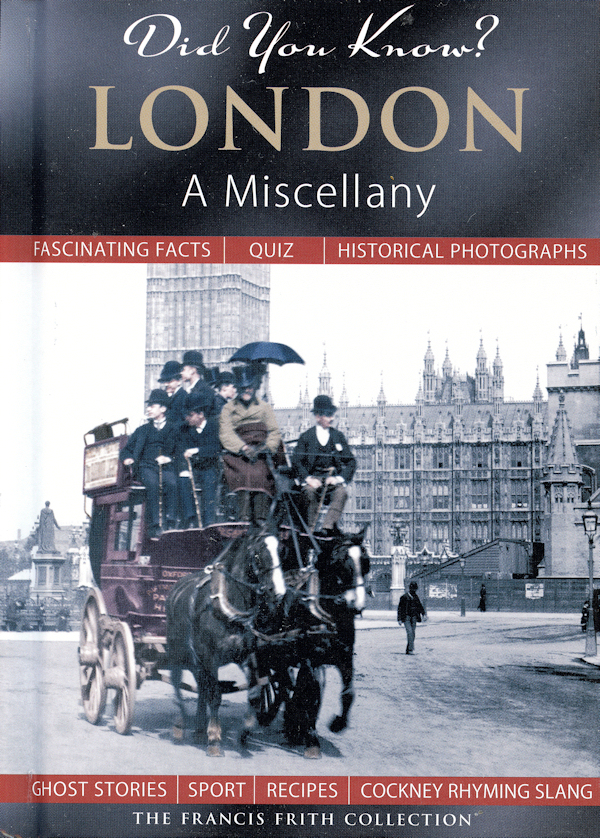 This is a very small book of just 60 pages and under A5 in size, but it is nicely produced in a good hard cover. It is text heavy, which is good, with about 30 B&W photographs of London nearly all from the period 1875 to 1915. It essentially covers “central London”, being the Cities of London and Westminster, although there are mentions of some areas a little outside like Southwark and the docks.
While I found some of the photographs interesting, the text was dull. The writing hurries along, with fact hard upon fact, quite relentlessly and with little change of pace, tone or style — which makes for difficult reading. I wasn’t helped by already knowing most of the contents — but then I’m not the book’s core audience.
Some of the facts are things which many people wouldn’t know. For example, the Eleanor Cross in front of Charing Cross Station is a Victorian replica of the original which stood on the site at the top of Whitehall/south of Trafalgar Square where there is now an equestrian statue of Charles I (but that is a book all on its own).
Near the back of the book is a short quiz of London trivia (most Londoners should get at least 8 out of 10) and a bit about Francis Frith, the “pioneer Victorian photographer” who started the picture archive which still bears his name and who published this book.
Apart from not engaging me, my main gripe would be the lack of a map to show how all the areas discussed fit together. I would have liked this and I feel sure it would be invaluable to anyone using the book as (part of) a tourist guide.
Overall the book contains lots of factlets about London and some fascinating images, so that if you don’t know London (or don’t know its history well) then this would be a good and interesting introduction. It just didn’t really do it for me.
Overall Rating: ★★★☆☆
Oddity of the Week: Crazy Inventions
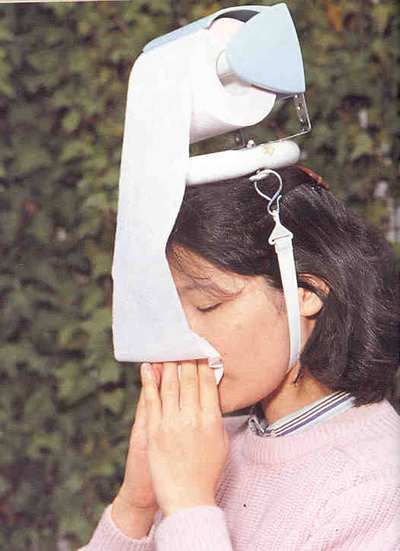
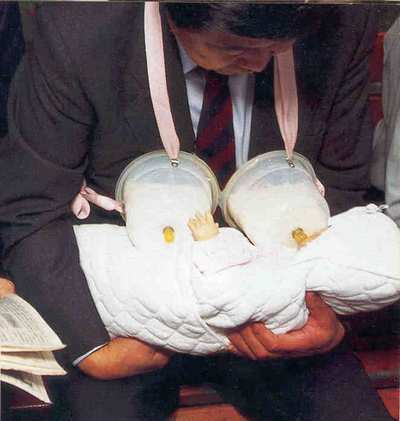
The Japanese are famous for their crazy inventions. Here are a couple I especially like (ie. they’re sufficiently crazy that their whackiness is excellent).
First we have the portable nose-wipe supply for when you have that streaming cold:
And then there’s this for you guys who are just too shagged out to be able to stand up to pee:

Finally girls, you can get your own back on us men over breastfeeding in public:
There are lots more on the internet, start at http://nuffy.net/cool/articles/totally-crazy-japanese-inventions.html or http://justsomething.co/23-craziest-japanese-inventions-you-never-knew-existed/.
The Oddness of Me
Yesterday my friend Katy posted on her blog about feeling slightly strange.
Once I’d recovered from my initial reaction of “well, yeah, I wouldn’t expect anything less from you!” I realised that it wasn’t just Katy. Because I feel a bit the same. Which is odd.
This year started with me struggling as I had done most of last year. Struggling to do anything other than want to sleep. Which is partly down to the depression and partly a reaction to being overloaded with things to be done — which are actually much the same thing in my brain.
And then about 10 days ago I had a filthy cold. And my lower back was giving the hell, despite having been to the osteopath and had a massage a couple of days before. In fact my back was so bad it was giving me awful guts ache.
Then something odd happened. The cold gradually wore off during last week so that by about Thursday I was feeling human again (well, as human as you would expect me to be!).
But it was more than this. The cold was gone. I had managed to make myself some relief from the never-ending demands of too much to do — it was all still there, and all still needing to be done, but it felt easier; less overwhelming. My head was clearer and everything was brighter. And my back was much more at ease — not right, it never will be, but much easier.
I like this. This is how I should feel. I’m managing to get things done. Probably not much more than I was forcing myself to do before, but there’s a lot less effort involved.
I seem to be sleeping better, which is being helped by being able to wake up naturally most days. That’s generally between 8 and 9 o’clock; and not the struggle for consciousness at 11 as it was before.
I would love this feeling to continue; but, ever the realist, I’m not holding my breath. I’m just enjoying the few days while it’s here and hoping it decides to stay.
And all this despite some unwelcome medical stuff on the horizon, starting today with, I expect, a difficult discussion with my GP about my diabetes — which because I’m relatively relaxed and prepared seems a lot less worrying than it probably should.
As Katy comments (of herself): I think I am experiencing a form of self care. It’s not something I do very often, not properly. I’m not talking all that take a bath in expensive bath oil and light candles bollocks. I’m talking about proper, solid self care.
If that’s what it is, I have no clue where I caught it; it certainly wasn’t conscious. I don’t know how to feed it properly so it wants to stay. But stay it certainly may.
Please!
Weekly Photograph
This week let’s have something cheering and summery from the archive. This was taken on a scorching hot day in Beer, Devon almost 10 years ago.

Flowery Front
Beer, Devon; July 2006
Click the image for larger views on Flickr
Something for the Weekend