Something for the Weekend
As of about 3 o’clock this afternoon, Noreen and I have been married for 37 years! Eeeeekk!
That’s 10 years more than we haven’t been married!
I can’t decide whether if feels like forever or feels like for never. It just is; it’s like an old shoe that is so comfortable you don’t know you’re wearing it. Although like all shoes you get a stone in it occasionally — indeed, contrary to the usual tenet, marriage is a bed of roses: it looks pretty but has thorns too!
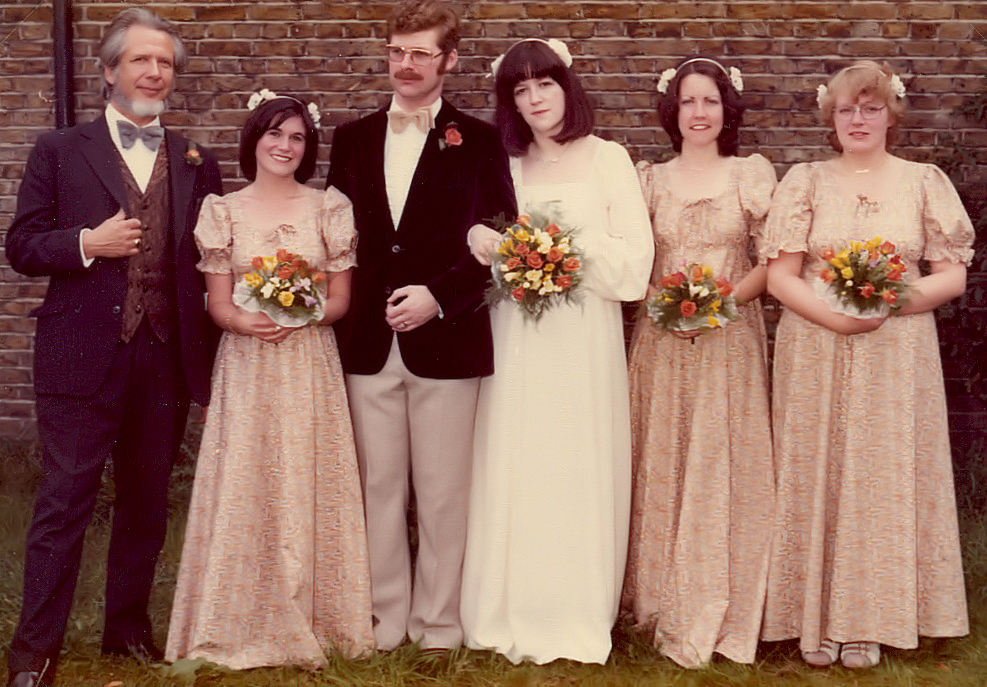
Back in 1979 we were still coming out of the hippie-ness of the 60s and 70s, and we were still students at heart — we still are! So we did the wedding our way, slightly eccentrically. There wasn’t a lot of money around — the country was crawling its way out of recession, we didn’t have any spare money, neither did Noreen’s mother, nor my parents. So we did it all ourselves, made it all up as we went along, did our own thing, very simply, and still had a good time.
We were married at St Peter’s, Acton Green; at the north end of Chiswick where it merges into Acton. We had been living there for about 4 months, and going to church, so it seemed sensible to get married there. St Peter’s was Anglo-Catholic, and sufficiently high church that it even satisfied our RC friends.
We lived just 400 yards from the church, so we walked to church, from our flat. No, cars; what’s the point when it is less than a 5 minute walk? My best man was my friend Victor, from my post-grad days, who was old enough to be my father. Noreen had three “maids of honour” all her own age — friends from school and university — and all four had made their own frocks. Noreen was given away by another university friend, her mother did the flowers and one of my aunts made a cake.
Here’s our monthly round-up of items you may have missed previously. Slightly late again — apologies! There’s a lot here, this month too!
Science & Medicine
Research is showing that magpies possess self-awareness to rival that of primates, dolphins and elephants.
Let’s catch up on a couple of recent (like this week) photographs. Specifically we’ve had two common, but quite interesting, moths in the house in the last few days. First of all we had this …


So a couple of weeks ago the Bank of England reduced interest rates lower than ever to 0.25%.
They hope this is going to stimulate the economy. It isn’t. At least, as Mary Dejevsky pointed out in the Guardian a couple of weeks ago ever-lower interest rates have failed; so why should they work now?
Anyone with a mortgage has never had it so good. They are paying peanuts in interest. Meanwhile those of us who paid off our mortgagees years ago and are now the much vilified savers are being shafted — savings interest is struggling to match inflation.
The banks seem to have forgotten that people like me, the savers, are an essential part of their business. Without our money coming in, they don’t have money to lend. They need us, just as they need the pension funds etc.
But all the banks have ever done is shaft my generation. When we started our mortgage in 1981 we were paying 14.5% interest on it; within six months that was 17.5%. And we were being encouraged to save for our retirement — which we did as much as we could. That was barely sustainable; and totally unsustainable compared with today’s rates. We were being priced out. No wonder the bubble burst and people ended up in negative equity and the banking sector with a merry-go-round of toxic debt.
Having saved, against the odds, we are now being shafted for having done so by not getting a decent return on our investments. We’d almost be as well off with our investments in the Bank of Mattress. And we’re supposed to feel happy about this; go out and spend our money; make the economy grow and recover.
Sorry but why the f*** should I? That money you want me to spend has to support me for maybe another 20 (or more) years. If you aren’t going to give me a decent return on investing it, then I’m going to hold onto it for dear life and milk as much as I can from all of it.
On the same day as Mary Dejevsky’s piece, Simon Jenkins wrote (also in the Guardian):
Want to avoid recession? Then shower UK households with cash.
Just give people the money. Give them cash, dole it out, increase benefits, slash VAT, hand it to those most likely to spend it: the poor. Put £1,000 into every debit account. Whatever you do, don’t give it to banks. They will just hoard it or use it to boost house prices.
Britain is suffering from a classic liquidity trap. There is insufficient demand. Yet all the Bank of England [has done is] wring its hands, blame Brexit and go on digging the same old holes.
They are labelled lower interest rates, quantitative easing and more cash for banks. Those policies have been in place for some seven years. They have failed … Not one commentator … thought cutting interest rates to 0.25% would make any difference to the threat of recession.
And again …
In the present climate, there is not the slightest risk of inflation — the traditional hazard of monetary expansion: £1,000 “printed” and moved from the Bank into every household account would still cost less (at £30bn) than Hinkley Point or HS2 … There could be vouchers, scrappage schemes, Christmas bonuses and, horror of horrors, cash for the undeserving poor. Why not try it? All else has failed.
Yes, and out of the change from cancelling HS2 you could probably give every university student a decent maintenance grant and/or scrap student fees!
It’s a novel idea. Raising saving rates would be another. For indeed all else has failed.
It’s time for a new and different approach.
It might even be a vote-catcher!
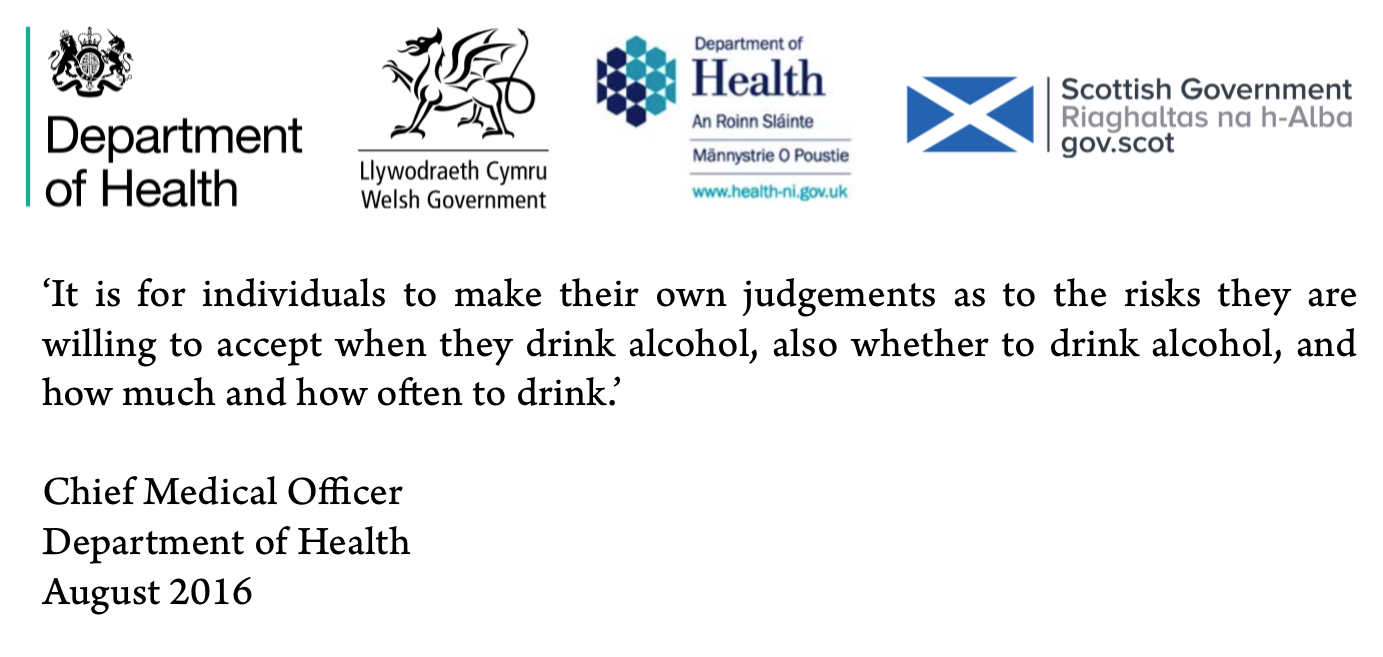
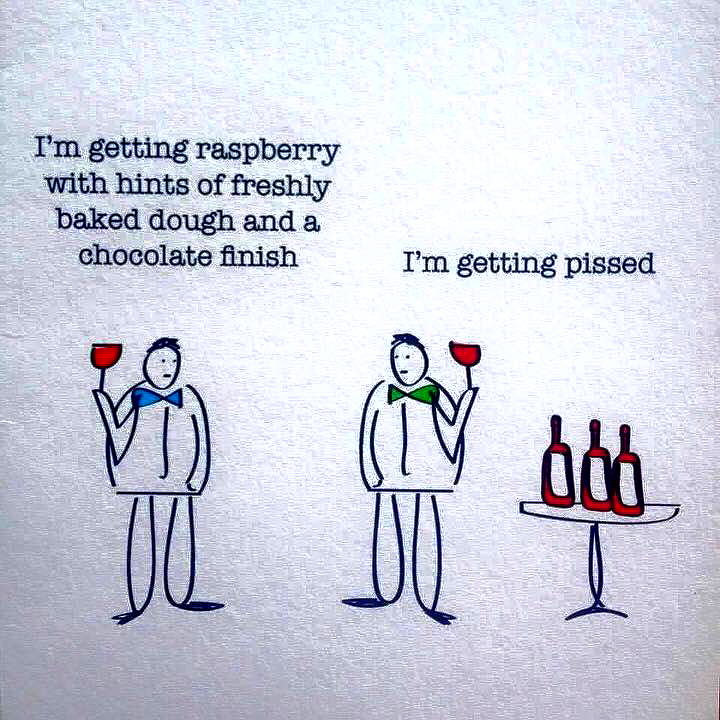
Ah! At last! Some sensible guidance on the consumption of alcohol.
Here’s another selection of interesting, thought-provoking and amusing quotes encountered in the last few weeks.
Nothing is stronger or better than this, that a man and his wife live together, sharing one heart and one mind, a great grief to their enemies and a joy to their friends; but best of all they know it themselves.
[Homer, The Odyssey]
When a German dives into a sentence, you won’t see him again until he emerges at the other end with the verb between his teeth.
[Mark Twain]
If you have a garden and a library you have everything you need.
[Cicero]
To succeed in life, you need two things: ignorance and confidence.
[Mark Twain]
The strategy relied on forlorn hopes that the “confidence fairy” would lift Greece out of this policy-induced nose-dive.
[Ambrose Evans-Pritchard in a Daily Telegraph article, 29 July 2016, on how the IMF has screwed up Greece; http://www.telegraph.co.uk/business/2016/07/28/imf-admits-disastrous-love-affair-with-euro-apologises-for-the-i/]
All you really need to know for the moment is that the universe is a lot more complicated than you might think, even if you start from a position of thinking it’s pretty damn complicated in the first place.
[Douglas Adams]
Gossip is charming! History is merely gossip. But scandal is gossip made tedious by morality.
[Oscar Wilde; Lady Windermere’s Fan]
Nature does not hurry, yet everything is accomplished.
[Lao Tzu, Tao Te Ching]
Usually when people predict an end to religion, what they’re hoping will take its place is a world of pure scientific rationality based on a strictly materialistic view of the universe. I think Richard Dawkins and his followers would like to see that.
The problem with that is, pure materialism has failed us just as badly as pure spirituality. The pure spirituality of the Middle Ages provided a lot of uplifting fantasies, but left most people living in filth and squalor. The pure materialism that took hold in the 19th century, and continues to dominate us today, provided flush toilets, the Internet and a generally higher standard of living. But it left people feeling empty inside while runaway technology and the waste it produces threatens us with extinction.
[Brad Warner at http://hardcorezen.info/the-age-of-reality/4716]
As soon as dogs realise we have bones hidden under our skin all hell is going to break loose.
[unknown]
If we want things to stay as they are, things will have to change.
[Giuseppe Tomasi di Lampedusa, The Leopard]
Yoni
According to the OED the word first appears in English in 1799 and is derived from the Sanskrit yonih, womb, abode, source.
Lingam
Again, the word is from the Sanskrit liṅga, liṅgam, mark, penis. It is first recorded in English in 1719.