
Cunctation
Procrastination; the action of delaying; tardy action.
The word is derived from the Latin cunctātiōn-em, noun of action; cunctārī to hesitate or delay.
The OED records the first English use as being in 1585.
Weekly Amusement
Book Review: Field Guide to Moths
Paul Waring & Martin Townsend
Field Guide to the Moths of Great Britain and Ireland
2nd edition; Bloomsbury; 2009
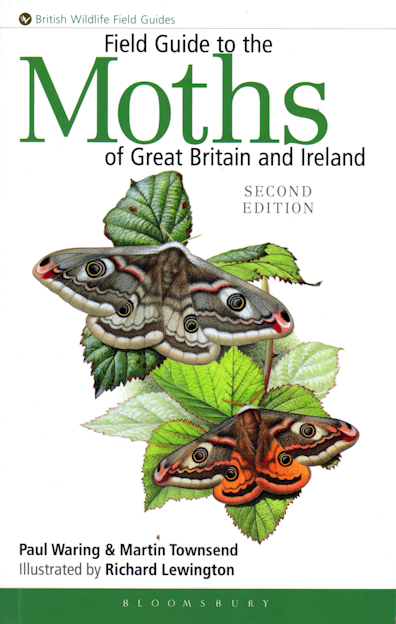 This is a magnificent tome, but not what I would define as a “field guide”: for an octavo paperback of almost 450 pages, on glossy paper and weighing almost 900 gm you would need a poacher’s pocket or a JCB to carry it around. It is a reference book — and a brilliant one at that — but as such it is not something to be read from cover to cover but explored when needed. It is an essential on the shelves of anyone with an interest in the huge diversity of the insect world, especially, obviously, moths.
Having said that, it doesn’t cover all moths but just the “macro-moths” (essentially anything with a forewing length over about 1 cm); micro-moths are covered elsewhere.
I’ve long wanted such a book (why didn’t I get this before?) as there was for many, many years a huge hole in the field guide coverage of British moths; I remember my mother complaining at least 40 years ago that there was no good, available, guide to moths — how she would have loved this book!
The book does what it sets out to do: describe for the naturalist (both professional and amateur) every known species of moth in the British Isles. The descriptions are organised by genus, with each species getting an entry of a third to half a page in quite small type. The descriptions cover mostly the adult moth, its habitat, lifecycle and distribution.
Strangely all the illustrations of adult moths occupy the central 20% of the book. This is not obvious from the colour-coding of the pages and I’ve found the only way to know quickly where the illustrations start is with a bookmark. Having said that, the illustrations (by Richard Lewington) are magnificent — much the best I’ve encountered — and they show the wonderful diversity and beauty of these important but much disliked insects. Moreover the illustrations show the adult moths in their normal sitting pose, unlike many guides which show the wings displayed as they would be in a museum case (something that’s not helpful to the non-specialist).
There is, however, one significant thing I don’t like about this book. In general it does not illustrate the larvae (caterpillars) of each species. Some (maybe 15%) of species have a photograph of the caterpillar along with the description (not with the illustrations). This I find curious. I know that many caterpillars look very similar (even more than adult moths) but why not illustrate them and have a complete section of the illustrations — separate from the adult moths would be OK — as an aid to identification. For me, this stops the book getting a top 5-star rating.
My only other gripe is the cost; at around £30 for the paperback this is beyond the reach of many.
Nevertheless this is a reference book which will live on the shelf over my desk and quite likely become well used.
Overall Rating: ★★★★☆
Knees Up
[Skip this if you don’t like things medical.]
For anyone who wants to know what a total knee replacement looks like 2 weeks post-op, here’s mine today just after having removed the dressing. Slightly longer scar than I had been led to expect, but no stiches/clips but glue. Still swollen and uncomfortable, but definitely on the mend.
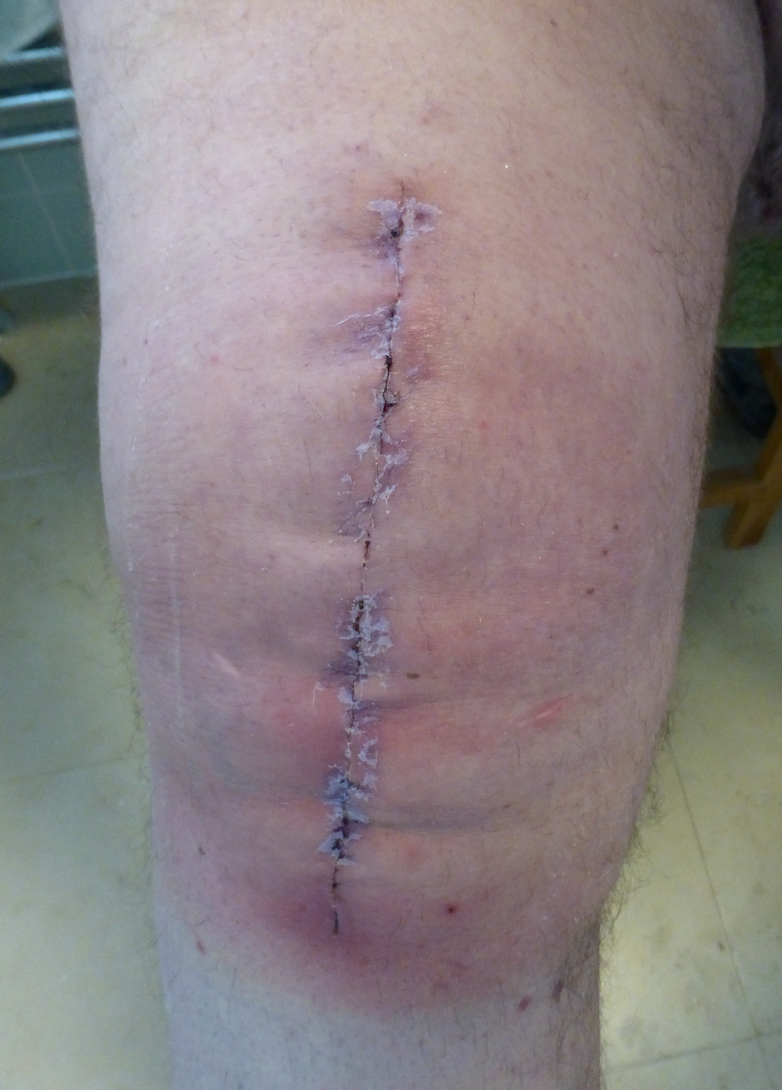
Click the image for a larger view, if you dare
Notice about 2/3rds the way down the incision, a small scar on each side where I had arthroscopy some 10 or more years ago.
Birthday Meme
Just for a bit of fun, I thought I’d make up my own birthday meme. Hopefully it doesn’t give too much away!
- Do you share your birthday with anyone well known? Yes, former miners’ leader Arthur Scargill (b.1938), golfer Ben Crenshaw (b.1952) and England footballer Bryan Robson (b.1957).
- Do you share your birthday with anyone you know? Yes, JP.
- Do you share your birthday with an historical figure? Yes, most notable Harry Gordon Selfridge (b.1858), founder of the eponymous London department store; also James Paget (b.1814, English surgeon and pathologist) and Ezra Cornell (b.1807, founder of Western Union and Cornell University).
- Do you share your birthday with an important historical event? Again yes, the first recorded lottery in England in 1569.
- Where were you born? University College Hospital, London.
- What time of day were you born? Just in time for lunch! [No change there then!]
- How much did you weigh? Something over 8lb.
- Who are you named after? No-one to my knowledge, although I do have my mother’s family name embedded.
- Zodiac sign? Capricorn.
- Chinese zodiac sign? Metal Tiger.
- Innie or Outie? Innie.
- Do you wear glasses or contact lenses? Glasses since I was about 14.
- What have you had pierced or tattooed? No tattoos, and you really do not want to know where my piercing is.
- Do you still have your tonsils? Yes, I still have my tonsils, but I’ve been robbed of my appendix, a deformed fingernail and my right knee joint.
- At what age did you become aware of pornography? I think probably at about 13.
- What is your best attribute? An analytical brain.
- What is the thing you least like about yourself? An ability to be tactlessly outspoken.
- With who do you feel most comfortable talking to about anything? Noreen, Katy.
- The last time you felt broken? Today — it’s a knee thing.
- Do you consider yourself an introvert or an extrovert? Introvert.
- Have you ever taken drugs; if so what? Only the West’s drugs of choice: alcohol and tobacco.
- Who amongst your current friends (not family) have you known the longest? Ken King; we were at primary school together 50+ years ago and have recently make contact again.
- Is there anyone on your friends list you would ever consider having sex with? Yes; but no I’m not going to tell you who!
- Are you cool with talking about sex? Yes.
- Who did you lose your virginity to? Faith.
- Has reading a book ever changed your life? Yes, see this from my Zen Mischief weblog.
- What were you doing when you last lost track of the time? Being wheeled into the operating theatre.
- What can you do today that you couldn’t do a year ago? Use crutches properly.
- Do you think you’ll change in the next 3 months? Yes, of course; we all change all the time.
- What will you be able to do at this time next year that you can’t now? With luck I’ll be able to walk properly.
- If you had to be executed but could choose the method, what method would you choose? Instantaneous poison.
- What will people say at your funeral? “Phew! There goes that PITA at last.”
So you’re all now challenged to complete this on (or even not on) your birthday each year. The only rule is that you must add or change at least one question each year. Have fun!
Ten Things
This month, as it is the beginning of the year, we’ll have a double serving of Ten Things.
First here are Ten Things I’d like to do in 2017 but probably won’t:
- Get a new body and a new head
- Have a nudist holiday
- Have acupuncture
- Get a tattoo
- Go for a nude swim
- Travel (across Europe) on the Orient Express
- Win £1M+ on the lottery (or equivalent)
- See the aurora borealis
- See the Severn Bore
- Prove my family history back to Tudor times
While, with the exception of #1, all the above are possible, if I achieve any of them it will be a bonus.
So here is the official, achievable, list of Ten Things I’m definitely trying to do in 2017:
- Keep breathing
- Do something I’ve not done before
- Go somewhere I’ve not been before
- Be drawn/painted/photographed nude (again)
- Walk across London’s Millennium Bridge
- Complete my AP’s London Photography project
- Do more photography
- Have a day out every month
- Visit Horniman Museum
- Make some significant progress on my family history
[And yes, I know the second list has a large degree of overlap with last year’s list; some of that is deliberate and some just reflects how badly I did in 2016.]
I’ll report back this time next year, DV.
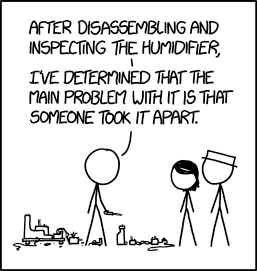
Weekly Amusement
This from XKCD earlier in the week …
2017 Predictions
 As I promised a few days ago I’ve again dusted off my crystal ball to see what this year could bring. After all it can’t be a lot worse than 2016 — or can it?
What follows is my best interpretation the misty images in the aforesaid crystal ball. I remind you that they are just my ideas of what could happen; they’re based solely on hunches and gut feel; I have no inside knowledge and I haven’t been studying the form — so if you base any decision on any of this I will take no responsibility for your for your wanton act of idiocy.
As before, I’ve divided the predictions into three sections: UK, Worldwide and Personal — the latter are documented but currently redacted.
UK
- Brexit. The Supreme Court overturns the High Court judgement that Royal Prerogative cannot be used to trigger Article 50.
- Brexit. Article 50 will be triggered in the last week of March by government without the agreement of parliament.
- Brexit. It becomes apparent that no deal is possible with the EU and that the notification under Article 50 cannot be withdrawn.
- As a consequence, Theresa May resigns and asks Parliament to grant a General Election.
- Boris Johnson is sacked as Foreign Secretary and relegated to the back benches.
- The new Foreign Secretary is one of David Davies, Liam Fox, Michael Gove.
- Inflation will hit 2.5% by year-end.
- The Bank of England Base Rate will be reduced to 0%.
- The Pound falls by 20% (cf. 1 January) against the US Dollar and the Euro.
- FT100 falls by at least 10% compared with the start of the year.
- Unemployment rises by 10% compared with December 2016.
- GDP falls by at least 2% year-on-year; the UK is in recession by the end of the year.
- The Government will introduce legislation to implement Nordic model of prostitution.
- The Government also implements alcohol minimum pricing.
- There is at least one major incident (plane crash, train crash, terrorist attack, industrial accident etc.) with over 50 fatalities.
- At least one high street name goes out of business with over 500 job losses.
- At least 2 major hospitals are forced to close due to finance problems, with loss of jobs and healthcare; there is no allowance for anyone to pick up the slack.
- Two horses die in the Grand National, which is then permanently scrapped.
- There’s significant flooding somewhere in the UK in March, May and October.
- A meteor strike destroys two houses, but there are no fatalities.
- There is finally proof that there are non-native big cats living wild in the UK; there are enough to maintain a small breeding population.
- The Queen dies unexpectedly followed within 3 months by Prince Philip.
- Prince Charles ducks becoming King thus allowing William to take to the throne.
- Other Deaths: Paul McCartney, Bruce Forsythe, Bob Geldof, Michael Parkinson.
World
- Donald Trump is inaugurated as US President amid strident protests, possible rioting and several fatalities.
- During the year there are moves to impeach Trump which may succeed.
- Obama care is scrapped.
- NASA’s budget is halved.
- An accident (maybe a debris strike?) destroys the ISS with loss of the crew.
- Consequent on the above NASA abandons manned space flight for the foreseeable future.
- Trump visits Russia; Putin visits the US.
- US imposes severe restrictions on immigration.
- Against all the odds the USA abolishes the death penalty.
- Major banking collapse somewhere in the developed world, possibly Italy, USA or UK.
- Major cyber attack brings down power/utility infrastructure affecting hundreds of thousands, probably in USA but maybe Western Europe.
- Marine Le Pen is elected French President precipitating an existential crisis in the EU.
- Turmoil in South Africa after the arrest of a top politician.
- President Mugabe of Zimbabwe dies.
- Consequently the regime in Zimbabwe becomes even more repressive, in an attempt to prevent a civil war; this triggers a mass exodus of blacks to neighbouring countries.
- At least one major earthquake (magnitude 7.5+) with over 200 fatalities in Asia and another in South America.
- Scientists in Tasmania discover a small breeding population of Thylacine.
- At least two major civilian plane crashes each with over 100 fatalities.
- There is a significant downturn in air travel which causes at least one major carrier to fail.
- At least one conspiracy theory of 2012-16 turns out to be true.
- There’s a major epidemic of a new infectious disease across a whole continent (or more).
- IBM is bought by/merged with another large US corporation (possible contenders: Microsoft, Apple, Google).
- Other deaths: Rupert Murdoch, the Dalai Lama, Jimmy Carter, George HW Bush.
Personal
Personal predictions have been documented but are redacted to protect both the innocent and the guilty.
- Knee Surgery 1. [[REDACTED]]
- Knee Surgery 2. [[REDACTED]]
- Pension. [[REDACTED]]
- Deaths amongst Family & Friends. [[REDACTED]], [[REDACTED]], [[REDACTED]], [[REDACTED]]
- Anthony Powell Society. [[REDACTED]]
I wonder if I can do any better than my pathetic 32% score for 2016 — but I wouldn’t advise anyone to put any money on it!
And if you have any good predictions please do share them.
[Updated 7 January 2017]
2016 Predictions, the Results
A year ago I dusted off my crystal ball and made a few predictions about what would happen in 2016. Now the results are in. So how did I do?
UK
- David Cameron will not succeed in negotiating any meaningful changes to UK’s membership of the EU. MAYBE; it all depends on your interpretation of “meaningful changes” but I suggest what was agreed amounted to little more than a few ribbons and bows
- Nevertheless Cameron declares a triumph & campaigns for the UK to stay in the EU. CORRECT
- However the UK electorate will vote narrowly to leave the EU. CORRECT; although a slightly larger margin than I expected
- This could lead to the downfall of the current government and a General Election. CORRECT in that the government changed; WRONG in that there was no General Election
- Labour’s Sadiq Khan wins the London mayoral election. CORRECT
- Boris Johnson is appointed to the cabinet in a summer reshuffle. CORRECT
- At least one very well-known UK company (or charity) goes into liquidation unexpectedly with 500+ job losses. CORRECT; BHS (11,000 job losses), Austin Reed (1000 jobs) just for starters
- The government will go ahead with a third runway at Heathrow despite adverse environmental evaluations. CORRECT; runway approved by the government although some form of consultation is suggested
- Consequently the value of property within 10 miles of the Heathrow flightpath falls by 20%. NOT PROVEN, too early to say
- Work starts on HS2 and Crossrail 2 despite the lack of available funding. CORRECT in that some enabling work has started for HS2; WRONG for Crossrail 2 as far as I’m aware
- Construction work starts on London’s “garden bridge”, also despite a funding shortfall; the project will never be completed. WRONG, as far as I know there has so far been no construction work although it was planned
- Inflation remains at about 1%. CORRECT
- Interest rates rise to 1% by YE. WRONG, they fell to 0.25%
- The FTSE 100 closes 2016 down 10% on the 2015 close. WRONG, FT100 closed up 900 (over 14%)
- At least one major “accident” (transport? industrial? terrorist?) with 50+ fatalities — and there’s a good chance it will be in London. WRONG
- Death of a senior member of the royal family. WRONG
- Prince Harry comes out as gay (or at least bi). WRONG
- Artist Banksy is finally unmasked; he turns out to be someone already well known. MAYBE; back in March the most likely candidate was identified by “geographic profiling” but not confirmed
- Bruce Forsythe and David Attenborough die. WRONG
- Arsenal win Premier League. WRONG, they came second to Leicester City
- Another warm, wet winter followed by a cold wet summer. CORRECT for the Winter; WRONG for Summer which was wetter than average for most of the UK but also marginally warmer
World
- Donald Trump will not win the Republican nomination in the US Presidential election. WRONG
- Hilary Clinton wins the US Presidential election by the tiniest of majorities. WRONG
- Relations between Turkey and Russia deteriorate further. MAYBE; this appears to have been true early in the year although they do seem to have improved latterly
- Fighting in Ukraine flares up again. WRONG, it doesn’t seem to have done — or has it just dropped off the news?
- North Korean leader Kim Jong-un dies unexpectedly, plunging the country into chaos and resulting in annexation by China. WRONG
- Dalai Lama dies, precipitating a diplomatic crisis with China. WRONG
- Major violence erupts in Egypt further damaging their tourist industry especially in the Nile Valley. WRONG, despite terrorist attacks on Egyptian airline flights
- Assad remains in power in Syria, possibly in a strengthened position as the West comes to see him as the least worst option. CORRECT
- Greece will have further financial troubles and will again come close to leaving the EU — and they may even be forced to leave. CORRECT that Greece is still in financial trouble and has had bailout loans delayed; WRONG that they’ve not been forced out of the EU
- Cyprus reaches some form of vague reunification agreement. WRONG, certainly I’ve not seen this announced anywhere
- The EU has to formally suspend Schengen Agreement. WRONG
- A further downturn in Chinese economy causes worldwide downturn. WRONG
- Oil prices remain low but fuel and domestic energy prices rise compared with the start of the year. MAYBE; Snapshot data: Brent Crude up from $35.75 to $57.19/barrel; Unleaded (UK avg) up from 103.1 to 116.87; Diesel (UK avg) up from 106.38 to 119.08
- At least two major airline, train, cruise liner or ferry accidents with 200+ fatalities (in total). CORRECT; major civilian plane crashes at Rostov-on-Don (Russia, 62 lost), EgyptAir (downed over Mediterranean, 66 lost), Chapecoense football team (in Columbia, 75 lost), PIA flight lost near Islamabad (48 lost) at the top four
- A naval vessel (Australian? Russian?) finds the wreckage of MH370, by luck as it is outside the search zone; it is too deep to be safely recovered. WRONG
Personal
Six personal predictions were documented and can now be revealed:
- I will finally be put on insulin, or an insulin mimetic. CORRECT
- All clear from AAA screening. CORRECT
- Colonoscopy finds more polyps, but they’re benign. WRONG, got an all clear
- Aunt Jessie, Uncle Cyril, cousin Anne and Auntie Olive all die. WRONG, all family members still present and correct as far as I know
- We will finally lose Harry the Cat, probably in February. CORRECT although it happened in January
- AP Conference will make a loss of around £2K (after subsidies) due to unforeseen costs and/or low take up – possibly the Americans don’t come because of a perceived terror threat. MAYBE; the Americans didn’t come and take-up was below plan, but the unplanned losses were only about £900
At first sight it looks as if I did a little better than for 2015; 30% hit rate this year compared with just 25% last year. But then as last year sometimes being wrong is actually good.
I’ll bring you my predictions for 2017 in a few days time.
My 2016 in Summary
As for the last few years here’s a summary of my achievements and engagement (or, if fact the total lack of same) in 2016.
It’s been a funny year. On one side, my depression has been worse than usual, although I’ve been functioning most of the time; on the other I’ve had some good pieces of health news. I seem to have been doing even yet more voluntary work than ever, despite scaling back on some of th4e things I do, and having some work taken off me. And I don’t feel I’ve achieved anything although one or two things have been knocked off the bucket list. So here goes …
At the beginning of the year I posted 10 Things I’m Going to Try to Do in 2016. The results are in and I think it fair to say I lost badly — again!
1. Keep breathing — WIN
2. Go somewhere/do something I’ve not done before — WIN x3; three things achieved: visited Castle Howard; bid & won online at live auction (no, not eBay!); and then …
3. Be drawn/painted/photographed nude by someone other than family — WIN; although the proof is still under wraps
4. Visit Horniman Museum — LOSE
5. Visit four exhibitions [Samuel Pepys: Plague, Fire, Revolution (National Maritime Museum); Alexander Calder: Performing Sculpture (Tate Modern); Scholar, Courtier, Magician: The Lost Library of John Dee (RCP); Bagpuss, Noggin the Nog & Clangers (V&A MoC)] — LOSE x4
6. Attend the Anthony Powell York Conference — WIN
7. Visit at least one steam railway — LOSE
8. Keep drinking more champagne — WIN
9. Get paid my state pension — WIN
10. Take more photographs than last year — LOSE
7/15 is not that brilliant — although better than 2015’s pathetic 3/10. Can I do better in 2017?
Looking at the year through the usual 25 questions doesn’t look any better.
1. What did you do that you’d never done before?
a. Bid and win at real auction online.
b. Been photographed nude by someone other than family.
c. Had a knee replacement.
2. Did you keep your new year’s resolutions, and will you make more for next year?
I can’t keep resolutions I didn’t make.
No, I won’t make any again this year as they are only ever self-fulfilling failures.
3. What would you like to have in 2017 that you lacked in 2016?
A new head and a new body.
4. What dates from 2016 will remain etched upon your memory?
a. 11 January — I’m 65 and we lose Harry the Cat.
b. 23-24 June — that stupid Brexit vote.
c. 28 December — knee replacement op.
5. Did you suffer illness or injury?
Nothing major, other than the ongoing depression and diabetes. Oh and the knee op.
6. What was the best thing you bought?
Two paintings, one by Adrian Daintrey the other by Graham Clarke.
7. Where did most of your money go?
Fuck alone knows.
8. What did you get really, really excited about?
a. Nothing; I don’t do excitement, just like I don’t do panic and crisis.
b. But buying those paintings and being photographed were fun.
9. Compared to this time last year, are you:
a. happier or sadder? — probably about the same; some things are better, some are worse.
b. thinner or fatter? — thinner, by about 12 kilos; but still much too heavy overall.
c. richer or poorer? — about the same.
10. What do you wish you’d done more of?
Nothing — it would be nice not to be continually busy, busy.
11. What do you wish you’d done less of?
Being depressed.
12. What was your biggest achievement of the year?
Anthony Powell Conference in York.
13. What was your biggest failure?
The failed establishment of the local area network of GP practice patient groups I was chairing.
14. How many one-night stands?
Zippo — which is probably as well, all considered.
15. What was your favourite TV program?
I don’t think I’ve watched a single TV programme from end to end all year, mainly because it is such garbage.
16. What was the best book you read?
It would have to be the London Bomb Damage Maps which are really interesting.
[Not much gets read end-to-end these days but a lot gets dipped into.]
17. What did you want and get?
Kittens.
18. What did you want and not get?
a. Sanity.
b. Multi-million lottery win.
c. The opposite of just about everything that’s happened in the world.
19. What one thing would have made your year immeasurably more satisfying?
Given everything that’s happened and happening, being a hermit might have been good.
20. How would you describe your personal fashion concept in 2016?
I wear clothes to cover other people’s embarrassment.
21. What kept you sane?
I am sane? Are you sure?
22. Who did you miss?
My mother, ‘cos it just feels odd not to be able to ring her up or be visiting Norwich.
23. Tell us a valuable life lesson you learned in 2016:
Mundum alter et idem — The world is the same and different.
24. A quote or song lyric that sums up your year:
a. As I’ve grown older I’ve learned that pleasing everyone is impossible, but pissing everyone off is a piece of cake.
b. One does try not to be an Old Git, but they don’t make it easy. [Alan Bennett]
25. Your hopes for 2017
No Brexit and no Trump but they’re both a bit of a forlorn hope.
Last year I wrote “something better”; we failed at that so we’d better have another go this year.
Overall Result: REQUIRES IMPROVEMENT
Probably time to sack the manager.
How was your 2016? And what are your hopes for 2017?.