Again this month we have something slightly different …
Ten Colours which are also Surnames:
- Black
- Brown
- Green
- Grey
- White
- Blue
- Pink
- Orange
- Lavender
- Scarlet
Again this month we have something slightly different …
Ten Colours which are also Surnames:
Following on from my post of yesterday, British Naturism (BN) are challenging those of us who are nudists/naturists to talk about it.
Their campaign is called “Just One Person” and we are being challenged to tell one person about our naturism. As their press release says
We hope to inspire those who do not talk about their Naturist lifestyle choice outside to tell just one person.
Many people don’t even know they know a Naturist and assume that we are still that fringe minority on the far edges of society. In fact, we are their next-door neighbours, their work colleagues, the people on the next table in the pub, in the aeroplane seats in the row in front, in the car hire queue behind them at the airport … everywhere.
We completely understand the individual fears and possible complications … but do want to encourage you to help Naturism in the UK to grow and to become normal. While it remains hidden, misguided and incorrect views of Naturism will continue … We want to escape from the association that nudity means sex, or even worse, perversion.
[The aims] are to:
– Improve the public understanding of Naturism by engaging people in conversation about it.
– Encourage more people to become involved in Naturism.
– Help increase people’s confidence in themselves (by having the conversation) and their bodies through experiencing non-judgemental social nudity.
So if you’re a naturist – even, like me, a solitary naturist (largely through force of circumstance) – or just someone who is not afraid of naturism and social nudity, go out and tell people. Help break down those unnecessary taboos – taboos about keeping naturism to yourself; taboos about not talking to people about naturism; taboos about the fear that naturism will deprave and corrupt. Even just a blog post or something on Facebook will help; but better to talk to people face-to-face and have an open conversation.
Today (Saturday 5 August 2017) is
So here’s our round-up of links to items which have caught our attention in the last month. There’s a lot in this month, so here goes …
Science & Medicine
 Suspicious that expiry dates on products are a nonsense? Well that might be justified for some drugs.
The expected continual rise in life expectancy is slowing down. A leading medic suggests austerity is to blame.
It seems like what you always suspected may be true: a broken heart may damage your health.
We all know that cats purr. But do they purr only for our benefit?
An American veterinary service is working on making vet visits stress and fear free for nervous pets.
You thought plague was a thing of the past? Wrong. It is still alive and well in the American Southwest. Here’s the story of how one biologist tracks and identifies plague outbreaks before there’s harm to humans. [Long read]
Flying ants all seem to emerge on the same day. But do they?
Sexuality
Good news, lads! Science says you should masturbate 21 times a month – not that you needed an excuse! (Well actually they mean you should ejaculate that often; not necessarily the same thing.)
Environment
Jason Hickel in the Guardian posits that even if we all adhere to the Paris climate deal that isn’t going to be enough to save us – our future depends on de-growth
There’s a plan to reintroduce Eurasian lynx to the Kielder Forest.
Art & Literature
Worried about your books? Why not protect your library the medieval way with horrifying book curses?
History, Archaeology & Anthropology
Archaeologists are suggesting that a find of buried tools and pigments means humans reached Australia 65,000 years ago – that’s 18,000 years earlier than previously thought.
Yes, we knew the Romans had concrete. And now we know why it was so good that it still stands today when our modern concrete decays.
Infertility isn’t just a modern phenomenon. The mediaevals recognised it and realised that it could be the man at fault rather then the women – not really surprising as many in medieval times believed the embryo originated solely from the man. Oh and in true medieval style they concocted some horrid cures.


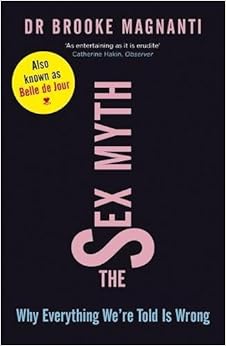
Brooke Magnanti
The Sex Myth: Why Everything We’re Told is Wrong
Weidenfeld & Nicolson; 2012
If, like me, you’re always doubtful of what “they” are telling us about sex (well actually about anything) then this book is an eye-opener. And who better to open our eyes than Brooke Magnanti, for if anyone knows then she should:
Brooke Magnanti studied Genetic Epidemiology and gained her PhD at the Department of Forensic Pathology, University of Sheffield. Her professional interests include population-based research, standards of evidence, and human biology and anthropology. In 2009 it was revealed that she is an ex-call girl and author of the bestselling Belle de Jour series of memoirs, which were adapted into the TV series, Secret Diary of a Call Girl.
She is also a novelist, blogger and activist who, in 2016, was called to give evidence about sex work conditions in the UK to the Home Affairs Committee investigating prostitution laws in Britain.
In describing the content I can’t do a lot better than the book’s cover blurb:
Is there any truth to the epidemic of sex addiction? Are our children really getting sexualised younger? Are men the only ones who like porn? Brooke Magnanti looks at all these questions and more – and proves that perhaps we’ve all been taking the answers for granted.
Brooke Magnanti is no stranger to controversy. As Belle de Jour she enthralled and outraged the nation … Now her real identity is out in the open, Brooke’s background as a scientist and a researcher comes to bear in this fascinating investigation into the truth behind the headlines, scandals and moral outrage that fill the media (and our minds) when it comes to sex.
… Brooke strips away the hype and looks at the science behind sex and the panic behind public policy. Unlike so many media column inches, Brooke uses verifiable academic research. This is fact, not fiction; science not supposition.
 Don’t let the “science” label put you off. Yes, Brooke references all her sources but her style is light and eminently readable. She combines her skills in statistics, epidemiology and research with her experiences as a call-girl to blow the lid off what the Agenda Setters and politicians are telling us, thus exposing all the myths surrounding sex in society.
Brooke follows what the Agenda Setters and Evangelisers are saying and traces back where they get (or more usually fabricate) their data – and then by reference to peer-reviewed research shows where and how it is false. From sex addiction, through trafficking for sex, to the decriminalisation of prostitution, myths are well and truly busted.
If I had to find criticisms of the book they would be four, albeit relatively small: (1) It’s a shame the book is now 5 years old; it would be good to have an update. (2) Personally I would have liked more diagrammatic explanations of the data presented. (3) In each chapter a summary of the evidence, and how it is built into the arguments, would have helped my understanding of the (often necessarily) convoluted and detailed analysis. And (4) like so many books these days it could well be reduced in size by better design and typography and not printed on such cheap paper.
But that aside, the book is highly illuminating and well worth reading.
Overall Rating: ★★★★☆
I’ve just finished reading Brooke Magnanti’s The Sex Myth: Why Everything We’re Told is Wrong (review later) and she makes a useful point about pornography and obscenity.
The word ‘pornography’ comes from Greek roots: porno-, related to prostitution; graphos, to write. Stories about hookers, in other words … People in the nineteenth century became more worried about drawing a line between what was art and what was obscene. Those worries helped shape the view of what today is labelled ‘pornography’ versus what is labelled ‘erotica’ – even though few people, if any, can give a clear idea of the difference.
‘Obscenity’, meanwhile, comes from the Latin obscenus, meaning repulsive or detestable. Something obscene is something that is offensive to the morality of the time, something taboo. The definition of obscenity is different in different cultures, and even people in the same culture can disagree about what is obscene. Many laws have tried to define obscenity. While erotic imagery can be defined as obscene, it isn’t always considered so, and some laws recognise this
To which I would like to add the word ‘prostitute’: one who engages in sexual activity in exchange for money (payment).
Put that lot together and it means my world view goes something like this …
Technically pornography is stories about those who engage in sex for money. To me this means that any video (or other medium) which portrays a sexual act, where one can reasonably expect that (some of) the participants have been paid is pornography and (depending on one’s predilections) may also be erotic. Mere photographs of vulvas or penises may also be erotic, but are not a sexual act so are not (at least in my world view) pornographic; they aren’t ipso facto a sex act.
Whether one defines the pornographic, or the erotic, as obscene depends very much on one’s personal morality. We each have our own moral code, which may or may not align with that of society at large, and an act (image, description) doesn’t become obscene until it offends our morals and transgresses the line into being taboo. And that act doesn’t have to be sexual.
To use my own views as an example, I have no problem with the depiction of sexual acts, let alone the depiction of breasts, vulvas or penises. Pornography (as defined above) for me only becomes obscene when it crosses the boundary into being violent, non-consensual or involving minors or animals. There are sexual acts I greatly dislike (eg. male homosexuality), but that doesn’t per se make them obscene. But I do find many other things in this world obscene, amongst them the gratuitous killing of people and animals, blatant disregard for human rights, FGM, rape (of people and the environment), corporate greed and bankers mega-bonuses. YMMV.
So pornography is essentially, technically, amenable to definition. Obscenity is not readily definable so easily in anything other that one’s personal world view. Pornography is (should be) a largely objective measure. Obscenity can only ever be subjective. Which, of course, doesn’t mean that legislation cannot prohibit certain acts because the moral view of the majority of the legislature is that they are obscene for them – that’s how our collective, social, morality works and it is only by iconoclasts like me pushing the boundaries that such collective views are shifted.
Michael Puett & Christine Gross-Loh
The Path: A New Way to Think about Everything
(Penguin, 2017)
This purports to be a self-help book of a new kind: one which encourages us to change our philosophy, and hence our actions, by doing small, simple things. As the cover blurb says:
The first book of its kind, The Path offers a profound guide to living well. It reveals for the first time how the timeless wisdom of ancient Chinese philosophers can transform the way we think about ourselves. Covering subjects from decision-making to relationships, it shows how making small changes in our everyday routines – as simple as showing weaknesses in meetings or greeting people differently – can make us happier and more productive.
 The idea is good and the book should have been interesting, but I found it facile and superficial: like cheap brawn, lots of aspic with very little meat. I had to give up on it half way through.
As Ambrose Bierce once commented in a review “The covers of this book are too far apart”. It is a book of 200 pages, which frankly should have been no more than a third of that.
First off it suffers from the current publishing malaise of an over-large typeface, excessive leading, and wider than needed margins; ie. much too much white space. It is also, typically of Penguin, printed on appallingly cheap and nasty paper which is not going to withstand the ravages of time.
But for me, worse than all that, it is written is a very simplistic, almost dumbed-down, laborious style which I found it hard to read – it is so wishy-washy I had trouble picking out the key concepts. Consequently it gave me nothing to think about and take away. It needed a robust editor.
In a way I don’t blame the authors: the concepts are sound and the content would be a good subject of a single philosophy seminar. But it isn’t a book, and for that the publishers have to shoulder the blame.
Overall Rating: ★☆☆☆☆
Anyone who needs cheering up on a Sunday afternoon, could do worse than read Jerry Coyne’s blog post A new academic hoax: a bogus paper on “the conceptual penis” gets published in a “high quality peer-reviewed” social science journal – and the papers to which it refers.
If you don’t understand a word of it, that’s fine, because the paper being described, The conceptual penis as a social construct in Cogent Social Sciences, is a total and elaborate hoax which even the authors admit they don’t understand! Just as a small example:
Nowhere are the consequences of hypermasculine machismo braggadocio isomorphic identification with the conceptual penis more problematic than concerning the issue of climate change. Climate change is driven by nothing more than it is by certain damaging themes in hypermasculinity that can be best understood via the dominant rapacious approach to climate ecology identifiable with the conceptual penis.
The paper was designed to expose the trendy opaque nonsense of much of the social sciences. And it succeeded as it was published in a peer-reviewed journal.
The paper’s text sort of makes superficial sense – and I could see it becoming a radical feminist meme – but it is actually complete bollox. Enjoy it!
As a quick follow-up to yesterday’s post on the fears surrounding radiation, I came across an item, by science journalist Geoff Watts, from a couple of years ago: Is your fear of radiation irrational? This considers the whole question in rather more detail. It’s a long read but worth the effort.