
So here we are again with this month’s selection of interesting and amusing quotes.
Visitors should bear in mind that architects can become extremely excited by plasterboard-wrapped columns, structural grids & road markings.
[Olly Wainwright]
The barn-owl turns in the darkness of an oak, and floats forward over fading giraffe-skins of light and shade …
[JA Baker, September]
In the real world, we have to talk about things and find ways to respect each other’s opinion, even when we disagree. A healthy, mutually satisfying relationship involves celebrating the things you love about each other and ignoring, whenever possible, those quirks that you can’t change.
[David J Ley, Ethical Porn for Dicks]
When people tell you to be afraid, in an ambiguous, unclear situation, you need to wonder why they want you to be afraid, and what they intend to do with that fear of yours.
[David J Ley, Ethical Porn for Dicks]
Part of the problem here is that our media thrives on instilling fear and inadequacy in people. They want you to be afraid, to feel anxiety, so that you read their article or watch their television show, all so they can sell you shit via advertisements and commercials. Fear about sex and health are two of their main strategies.
[David J Ley, Ethical Porn for Dicks]
Our freedoms and privileges in a liberal democracy are ultimately guaranteed by the willingness of the state to use violence to protect them … Is an open society that tolerates dissent even possible without its being underwritten by violence?
[Stephen Batchelor quoted at http://hardcorezen.info/the-zen-buddhist-who-advises-trump-about-nukes/5561]
Don’t try to use what you learn from Buddhism to be a better Buddhist; use it to be a better whatever-you-already-are.
[Dalai Lama]
If you want to go bomb somebody, there’s remarkably little discussion about how much it might cost. But when you have a discussion about whether or not we can assist suffering people, then suddenly we become very cost-conscious.
[Andrew J Bacevich, American historian]
The West won the world by applying organized violence. Westerners often forget this fact; non-Westerners never do.
I have a foreboding of an America in my children’s or grand-children’s time – when the United States is a service and information economy; when nearly all the key manufacturing industries have slipped away to other countries; when awesome technological powers are in the hands of a very few, and no one representing the public interest can even grasp the issues; when the people have lost the ability to set their own agendas or knowledgeably question those in authority; when, clutching our crystals and nervously consulting our horoscopes, our critical faculties in decline, unable to distinguish between what feels good and what’s true, we slide, almost without noticing, back into superstition and darkness. The dumbing down of America is most evident in the slow decay of substantive content in the enormously influential media, the 30-second sound bites (now down to 10 seconds or less), lowest common denominator programming, credulous presentations on pseudoscience and superstition, but especially a kind of celebration of ignorance.
[Carl Sagan, in 1996]
Parenting to grow our sons’ relational capacities is all about staying in conversation with them over the years to help them see how powerful their capacities for communication and expression are. It’s about getting them to that tipping point whereby they commit to their own voice over the scripted silences of traditional manhood.
[Mark Greene; “Why Do We Murder the Beautiful Friendships of Boys?” at https://medium.com/@remakingmanhood/why-do-we-murder-the-beautiful-friendships-of-boys-3ad722942755]
Thoughts on #metoo
I’ve been thinking about all the recent #metoo posts. While in one way I’m not surprised, in another it is frighteningly disturbing to realise the level of abuse that we men inflict and remain totally unaware of. But from what I’ve seen (and I may be misinterpreting) I don’t think most women are saying that every man harasses them or is a sex offender.
(On the other hand, in some senses maybe we all are offenders, if only in our heads. Be honest, which of us doesn’t look at a pretty girl and think some variant of “I wonder what she’d fuck like?”. But then there is a line between thinking it and grabbing it.)
However if even 50% of women have experienced men being inappropriate (and 50% seems to be a very low estimate) then it isn’t just a tiny minority of men doing it.
We are all thoughtless and stupid towards others at times, whatever our gender and whatever the gender of the other person. (This isn’t just men on women, although that is almost certainly the vast majority or the “action”.) That’s not an excuse – there are no excuses – but a fact of life. We will never totally eradicate it, just as we can never be completely certain that our actions can ensure “X never happens again”. There will always be outliers. But we can all work hard to ensure our thoughtlessness and stupidity is reduced to an absolutely minimal level and those few outliers are all that remain.
I’m not conscious of ever having done anything wrong physically – though I will concede I probably have unknowingly. But I know that at times I have said, either verbally or in writing, and mostly without meaning to, something stupid, thoughtless or just plain badly worded. At times I’ve been called for it; at times I’ve realised myself I’ve overstepped the mark. I hope that on all such occasions I’ve apologised, learnt something, improved; and hopefully we have all been able to move on with some level of dignity restored. Even so there are a few of these occasions which still haunt me.
And for those occasions where I still don’t realise I’ve overstepped the mark, I apologise now!
Obviously as, I hope, a considerate being I would never deliberately set out to harass or abuse anyone; something I outlined in my post earlier in the year on my personal ethics and morals.
I feel sure that very often men don’t realise they’re behaving inappropriately; but I don’t buy the “that’s just because it’s the way men are” non-excuse. I suggest it’s because we’ve never been taught to be aware of such things – how can we have been when previous generations of men haven’t been aware of the problem and women have been too frightened to speak up, so no-one could teach us – and we’ve been too lazy to think about it for ourselves?
Hopefully the new, heightened, awareness can help change this, but realistically it isn’t going to happen overnight. Hopefully men can start to trust and believe what women say; they can start thinking about how they behave; and they can learn about being generally more sensitive, considerate and thoughtful human beings. Many – the more thoughtful men – will. But I do worry that the majority, who go through life relying only on their animal cave-man instincts, are just going to say “fuck off” and carry on regardless. They are going to need a lot of work by the rest of us – men and women. We all have to be brave and stand up to them, and that in itself isn’t always going to be easy – but if we’re being considerate human beings we have to try, pro bono pubico.
Cat of the Week
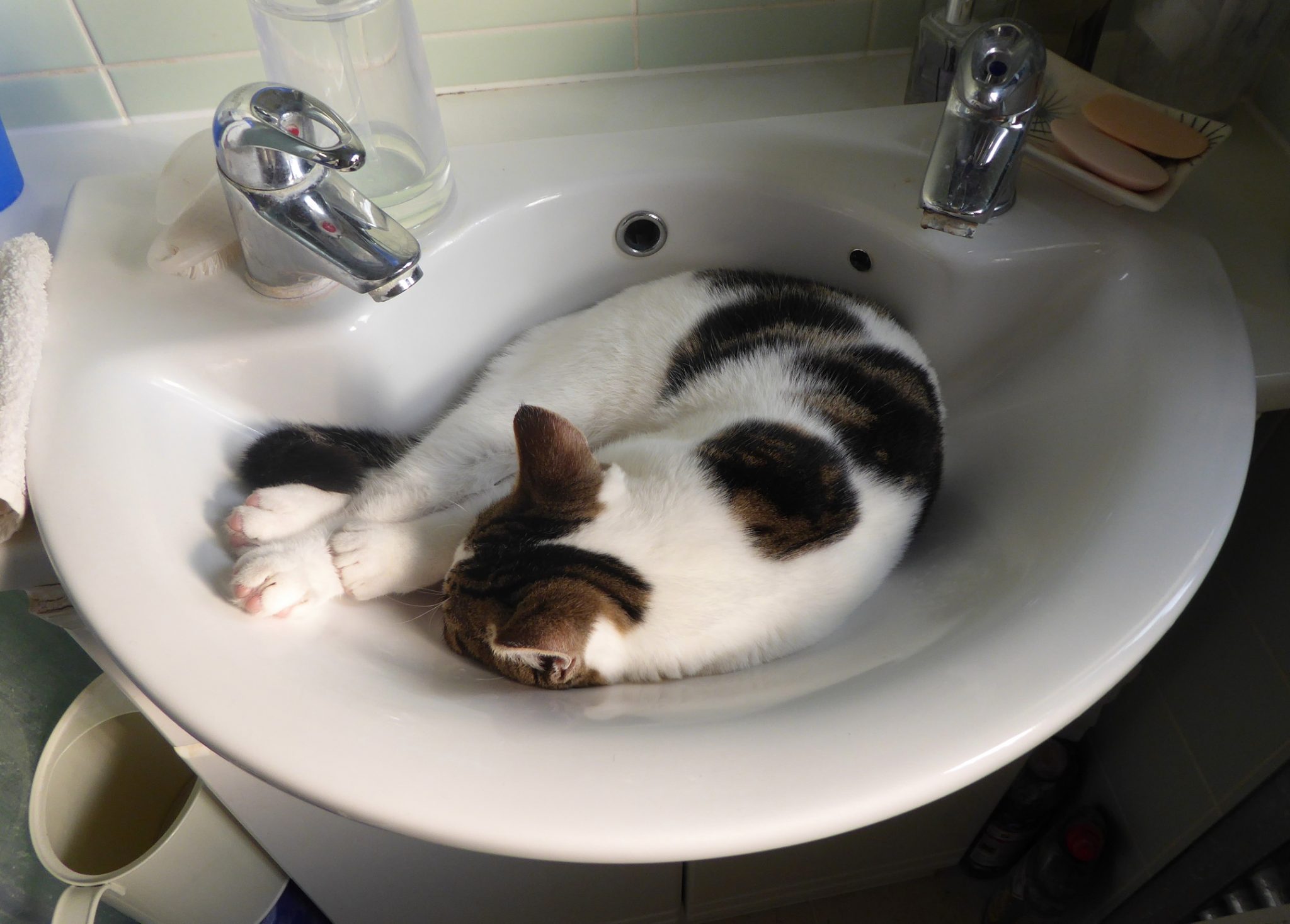
Boy-Cat has a really terrible life; he’s had to find a new place to sleep …
Something for the Weekend
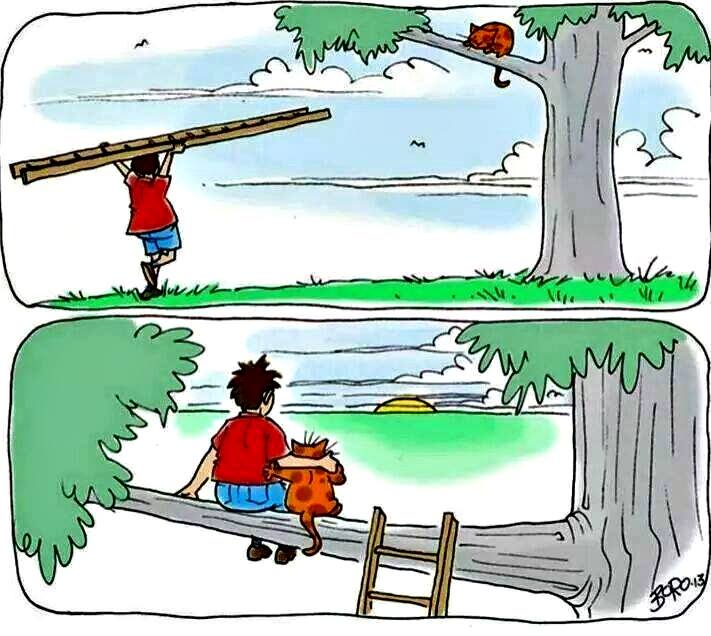
Quote: Fun
More Knees Up
[Medical trigger warning]
As today is four weeks since surgery, I thought we should have a progress report on the rehab of my left knee.
Things are now definitely getting better physically; but I’m still feeling very low mentally. Most of the bruising has gone as has almost all the swelling – ice-packs several times a day have helped (the hospital provided a specially designed cuff cooler when I had the right knee done). For some days now I’ve been walking around the house without the aid of crutches or sticks – the exception being the stairs where I still don’t feel entirely safe. I’m still taking crutches if I go out, if only for safety.
When I saw my physiotherapist this time last week I had 110° of flex on the knee, and I know it will be even more by the time of my appointment next Monday. Needless to say the physio was very happy; the flex and function of the knee are good although still painful; he even had me on an exercise bike doing gentle to and fro motion (a full cycle is not yet possible, although I did try). I was given an extra set of exercises to do, which are all about strengthening the muscles as well as improving the range of movement; and the exercises are gradually getting easier and less painful. I’m still being subjected to the torture of the green anti-DVT stockings though.
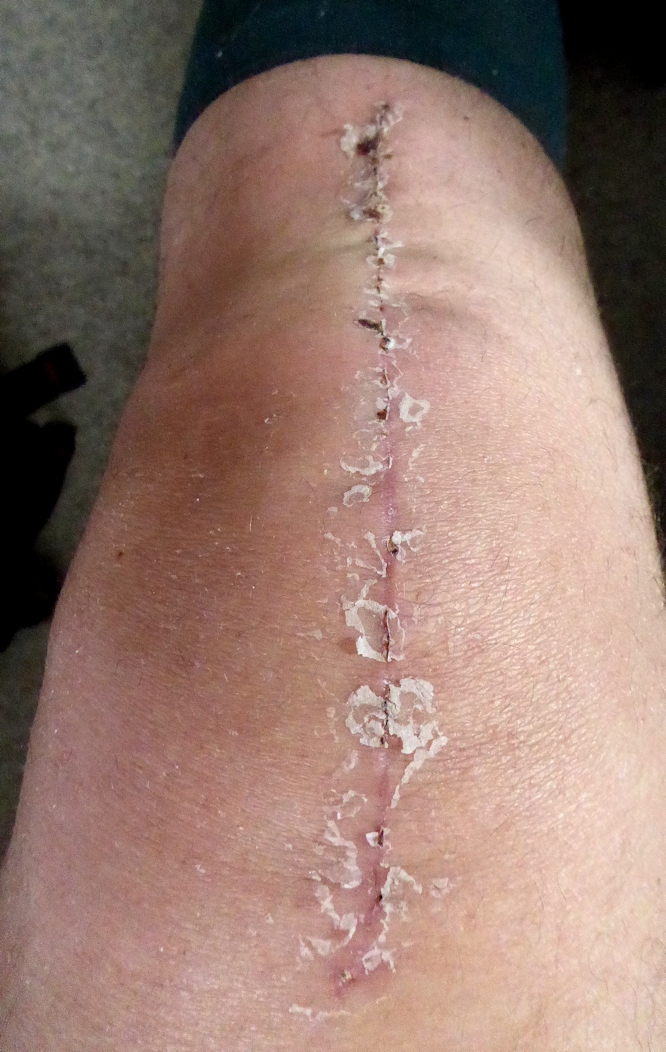 As you can see from yesterday’s photo, the scar itself is healing well and looks as if it might eventually be even less obvious than the one on my right knee. (Incidentally I don’t know if the visible flaking is dead skin, surplus glue from closing the wound or some form of plastic skin which was applied to cover the wound. But the right knee was the same and it seems to be OK.)
The pain is very definitely subsiding. Yesterday was the first day since surgery that I’ve awoken at 6 or 7 AM and not immediately thought “Bloody hell I must have some painkillers”. In fact yesterday I didn’t need to take any painkillers from midnight to lunchtime – although by then the knee was very achy. So with luck I in the next week I can start thinking about tailing off the codeine, if not the paracetamol as well.
Meanwhile I managed to screw up my lower back last week; and yes, on the left side! This entailed two trips to the osteopath. The first on the Monday helped immediately but then the muscles were going into spasm every time I tried to move. This settled down overnight with a couple of small doses of Valium as a muscle relaxant. But by Friday the lower back was giving trouble again, so Saturday saw me back at the osteopath seeing a different guy who comes to osteopathy via a sports training background. I have to say he was brilliant – not just at releasing the back but also at explaining how this was all down to the muscles and joints readjusting to different ways of moving following the operation. His prescription was to walk (do what you can and build up slowly) to get the muscles etc. used to working properly again. I came away walking well and feeling much more at peace mentally. So far I’ve concentrated on walking around the house, but our long back garden is beckoning.
I’m still feeling anxious, depressed and panicky at times but that mostly isn’t the knee but everything else I have piled up getting me down. But with the pain receding, and a more positive outlook for the knee, I am at last managing to catch up on some of the stuff I’ve ignored over the last few weeks.
So the bottom line is: keep going; keep doing what you’re doing; it does get better (even if it doesn’t always feel that way hour-to-hour or day-to-day). Onwards and upwards.
Ten Things
Having just had my second knee transplant (sorry, total prosthetic knee replacement) I thought that for this month’s Ten Things I should maybe write a few of the important things I’ve learnt about knee replacement operations.
Ten Things I’ve Learnt about Knee Replacement
I’m taking as read all the usual stuff about operations, general anaesthetics, etc. (like anti-DVT stockings, morphine causing constipation). This is knee replacement specific things. First of all it is important to realise that no two knee operations are the same, so what follows is based on my experiences; yours may be different.
- There are three key people in a good outcome: a good surgeon, a good physiotherapist and you! Yes, you! A good surgeon and good physio are critical, but it is equally critical that you put in the work at rehab!
- If you can find out who your surgeon will be, check him (or her) out. If you have a choice, ensure you get someone who specialises in knee replacements rather than a generalist. What’s their track record? How many have they done? The more experienced they are the better.
- Anything you can do before your operation to strengthen your legs muscles, specifically the quads at the front of the thigh, is going to be helpful in rehab.
- Before you go into hospital ensure everything is ready at home, especially think about trip hazards: gangways are clear, rugs are stuck down or removed.
- Get a urinal (maybe two) with a lid – something to pee into in the middle of the night. (They’re cheap and many come with a “female funnel attachment”.) Even with a light on, you do not want to be staggering to the bathroom, on crutches, maybe in pain, barely half-awake, in the wee small hours and while trying to avoid the lurking cats and dogs.
- Unless you have a “slave” (aka. a partner) to fetch and carry for you, get a good bag (shopping bag size) which you can put over your shoulder or round your neck to carry things around when you’re using crutches.
- Post-op your #1 enemy is infection. Ensure no-one (and I mean no-one) touches your operated leg without having visibly washed their hands and are preferably wearing disposable gloves.
- Do as much as possible to ensure you get a good physiotherapist. Poor, or no, physio is the fastest way to ensure you don’t recover your mobility. Rehab physio will start in hospital; they’ll likely have you standing with a frame and walking a few gentle paces just 12 or so hours after your operation. You will be given exercises to do. Do them – as much as you can through the pain (but stop when it gets too painful). And keep doing them. Make sure you get as much post-op out-patient physio as you can and that your first session is within 7-10 days of leaving hospital; these sessions will help monitor your progress and adjust the exercises to your needs. The physios are not there to be sadistic (though sometimes it feels like it!) but to get you doing the right exercises, the right way, and at the right time, to ensure the best possible outcome.
- Recovery is painful! Think about what has been done – someone has done around 90 minutes serious carpentry to remove the degraded bone and replace it, very accurately, with some highly engineered metalwork; and that’s all on one of the most complex joints in the body. Discuss pain control with your clinicians; they will prescribe the right analgesics. Although the pain will recede over time, do not expect to be pain-free for several weeks. But a good outcome is well worth the pain.
- You should be provided with elbow crutches and taught to use them in the day or so after your operation. You will need them for several weeks. Go carefully and don’t get over-confident as this will lead to accidents. On the other hand you should be encouraged to dispense with the crutches as soon as you safely can.

There is a lot more I can say, and I do intend to try to write all this up for the benefit of others. But that will do for now!
Written Rules
If you think that good, clear, written English is irrelevant, pedantic or elitist you really need to think again and read this from the Guardian …
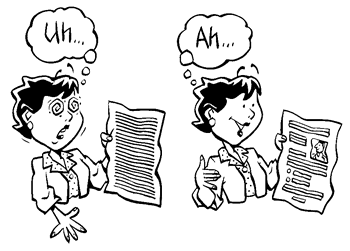
Regardless of style (which needs to vary with context) good, clear, factually correct writing which is correct in grammar and spelling, helps engage the reader. And after all, that is what you want, isn’t it!?
And yes, NHS and HMRC, I’m looking especially at you!
Badgers
This is worth reading …
Essentially it drives a coach and horses through the governments ridiculous programme of culling badgers.
Word: Cunctation
Cunctation
Procrastination; delay; tardy action.
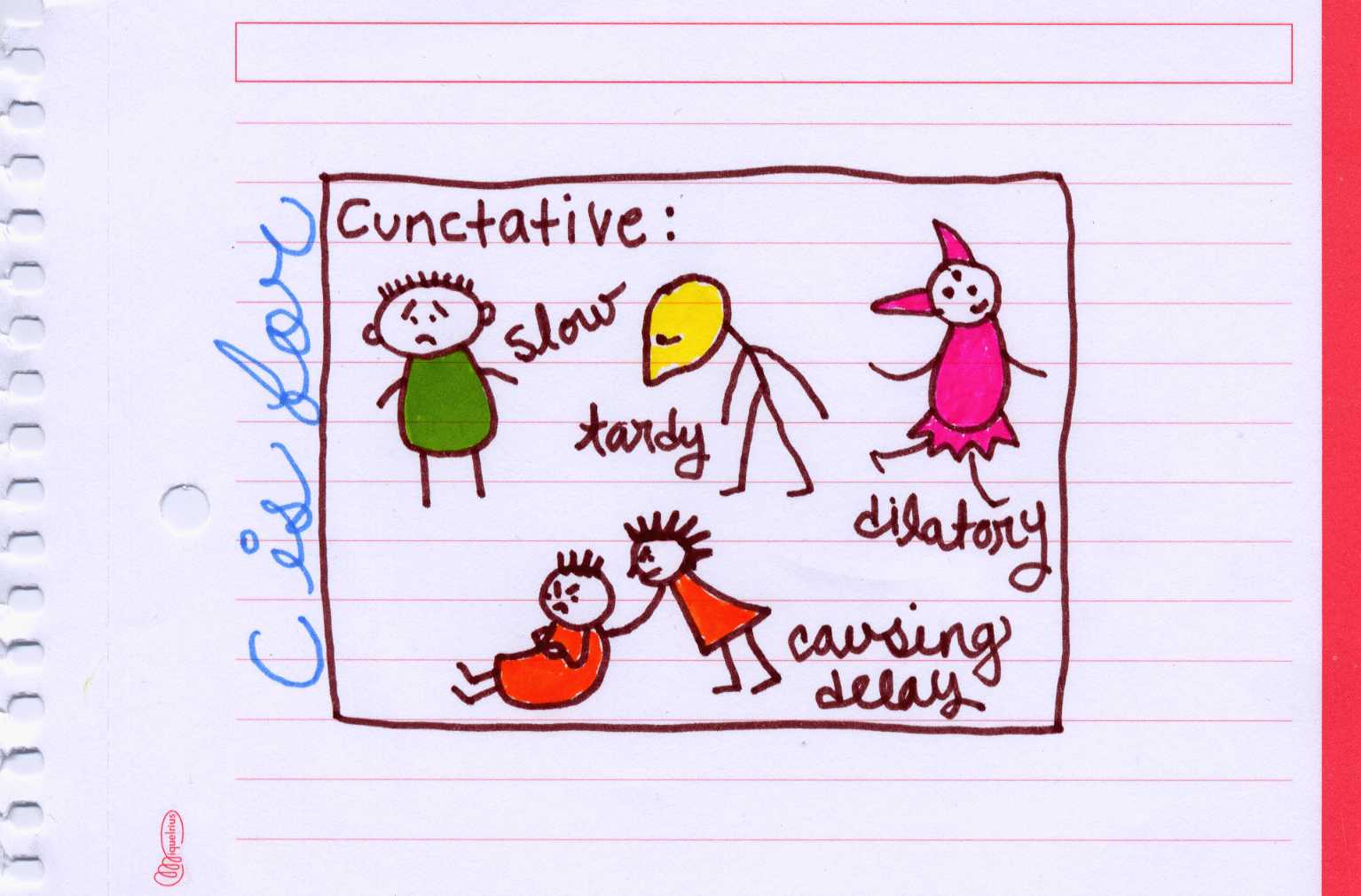
The word is derived from the Latin cunctārī, to delay, and according to the OED was first used in English in 1585.