Philosophy is questions that may never be answered. Religion is answers that may never be questioned.
Experimental Food
This evening’s food was a bit by way of an experiment. We’d bought some ready-prepared ravioli (mushroom and ricotta, as you ask) and I decided we would have it with a tomato sauce, but ended up experimenting. So what I ended up with was …
Tomato, Olive and Port Sauce
I used …
medium Red Onion, finely chopped
3 clove Garlic, finely chopped
a few small Cherry Tomatoes, halved
small can Chopped Tomatoes (or more chopped fresh tomatoes)
2 tablespoons Tomato Paste
12 Black Olives, chopped
half wineglass of Port
Roughly what I did …
Sauté the onion and garlic in some (olive) oil until the onion is just beginning to brown.
Now throw in the fresh tomatoes and olives and sauté for another couple of minutes.
Add a couple of egg-cups of port and cook for a further couple of minutes.
Now add the tinned tomatoes if you’re using them, if not just let the fresh tomatoes cook down.
Season with a small pinch of salt and a generous amount of black pepper.
Let the whole lot cook for a few minutes to thicken and reduce; add more port if it gets too jam-like.
Towards the end add another couple of egg-cups of port and the tomato paste; the result should be nether jam-like nor too liquid but somewhere in between.
I ended up with a deep red, very robust, sauce which was quite tasty but rather too robust for the ravioli, but stood up well to a hearty Sicilian red wine. It would go well with braised rabbit, or pheasant, or maybe lamb. And it would work well with blackberries in place of port, when it would be especially good with rabbit (rabbit and blackberries is a favourite here!).
Experiments don’t always work, or at least not the way one thinks they might. But nonetheless this was an experiment worth doing, and worth eating!
Yay! Nudity!
Here’s another journalist getting to grips with naturism – and against expectations enjoying it.
[Alice O’Keeffe; Guardian; 26 July 2018]
And quite right too in this (for once) glorious English summer.
Something for Jacqui …

Monthly Quotes
So, a day late, here is this month’s collection of quotes interesting and amusing.
The original is unfaithful to the translation.
[Jorge Louis Borges]
I’m skeptical of any claims to a special, singular women’s spirituality (just as I’m skeptical of a singular “women’s” anything – including bathrooms).
[Gesshin Claire Greenwood; Bow First, Ask Questions Later]
The Ten Commandments are a warning from an all-powerful, all-knowing God, eternally separate from ourselves, not to do certain things or else He’ll kick our asses. The Buddhist precepts are reminders to trust our own intuitive sense of right and wrong.
[Brad Warner]
Making ethical choices based on external systems of value (societal norms, religious doctrine) seems to me like an insufficient way of going about things because it means I would be using someone else’s definition of reality and someone else’s experience instead of understanding for myself what is good and useful.
[Gesshin Claire Greenwood; Bow First, Ask Questions Later]
The only power the [Buddhist] precepts have, the only power any of this practice has, is the power we give it, the meaning we make of it. This is why I have such a high tolerance for teachers, ceremonies, and ritual; they’re inherently devoid of meaning until I create my own, through and with those external points of reference.
[Gesshin Claire Greenwood; Bow First, Ask Questions Later]
“Berks and wankers”
Not every reader will immediately understand these two terms as I use them, but most people, most users of English, habitually distinguish between two types of person whose linguistic habits they deplore if not abhor. For my present purpose these habits exclude the way people say their vowel sounds, not because these are unimportant but because they are hard to notate and at least as hard to write about.
Berks are careless, coarse, crass, gross and of what anybody would agree is a lower social class than one’s own. They speak in a slipshod way with dropped Hs, intruded glottal stops and many mistakes in grammar. Left to them the English language would die of impurity, like late Latin.
Wankers are prissy, fussy, priggish, prim and of what they would probably misrepresent as a higher social class than one’s own. They speak in an over-precise way with much pedantic insistence on letters not generally sounded, especially Hs. Left to them the language would die of purity, like medieval Latin.
In cold fact, most speakers, like most writers left to themselves, try to pursue a course between the slipshod and the punctilious, however they might describe the extremes they try to avoid, and this is healthy for them and the language.
[Kingsley Amis; The King’s English (Penguin Modern Classics)]
Being hyper-aware of problems I can do nothing to solve never brought me any joy, nor did it ever make the slightest difference in those problems.
[Brad Warner at http://hardcorezen.info/hitler-sells-but-im-not-buying/5926
Girls can wear jeans and cut their hair short and wear shirts and boots because it’s OK to be a boy; for girls it’s like promotion. But for a boy to look like a girl is degrading, according to you, because secretly you believe that being a girl is degrading.
[Ian McEwan; The Cement Garden]
On Friday at Chequers the government will do what it has been doing for the past two years: spend an inordinate amount of time negotiating with itself before producing a ‘solution’ that is unworkable, only to take it to Brussels and discover it is also unacceptable. The problem is not just that they don’t have a rabbit; they don’t even have a hat.
[Gary Younge; Guardian; 6 July 2018]
Much can they praise the trees so straight and high
The sailing pine, the cedar proud and tall,
The builder oak, sole king of forests all,
The aspin good for staves, the cypress funeral,
The laurel, mead of mighty conquerors
And poets sage, the fir that weepest still,
They yew obedient to the bender’s will,
The birch for shafts, the sallow for the mill,
The myrrh sweet bleeding in the bitter wound,
The warlike beech, the ash for nothing ill,
The fruitful olive, and the platane round,
The carver holm, the maple seldom sound.
[Edmund Spencer; The Faerie Queene]
The overriding sadness … is that the nation lacks the political leadership required to tackle the 2016 referendum outcome informed as it was by lies, misinformation and the antics of bodies such as Vote Leave … Surely, there is no need to follow a referendum result given that it is now clear that it will lead to ruin.
[Law and Lawyers blog; http://obiterj.blogspot.com/2018/07/uk-eu-future-relationship-uk-proposals_14.html]
An ancient Greek walks into his tailor’s shop with a pair of torn pants.
“Euripides?” says the tailor.
“Yeah, Eumenides?” replies the man.
[Origin unknown]
More next month!
Simple Sunday Kitchen (2)
Following on from the Tangy Duck Salad, I put together another of our summer favourites: Alcoholic Summer Fruit Salad. This is another really simple, but surprisingly impressive recipe. In the case of yesterday I did it to use the first of the blackberries from our garden.
Alcoholic Summer Fruit Salad
You can do this with almost any mix of summer fruits you like, but you’ll want three or four different fruits for best effect. Choose from nectarines, peaches, apricots, plums, cherries, raspberries, strawberries, blackberries, blueberries, blackcurrants, loganberries, gooseberries. (Avoid orange, apple, banana, melon, kiwi, grapes. This isn’t a cheap hotel!)
You’ll want one small nectarine or peach per person, and similar quantities of each other fruit you’re using. I guarantee this will disappear like snow in summer, so don’t worry about making too much – but if you do have any left over it goes well on your breakfast cereal.
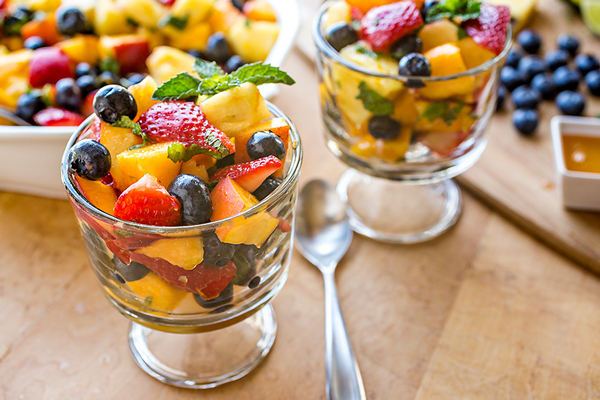
Put the berries in a salad bowl – halve or quarter any large strawberries or gooseberries.
If using cherries, stone and halve them. Add to the berries.
Stone the peaches, nectarines, apricots, plums and cut them into bite-sized pieces; add to the berries.
Add a few mint leaves or some lavender leaves if you wish – yes lavender really does work OK!
Optionally sprinkle with a couple of teaspoons of sugar.
Now add a small wine glass of liqueur of your choice. (Port works well, as do amaretto, peach schnapps, apricot brandy and cherry brandy – the choice is yours.)
Mix gently but well.
Lightly chill while you eat the preceding courses.
Serve plain, or with cream, and maybe a meringue nest.
(If you want a non-alcoholic version, use good fruit juice – apple or mango are good – instead of liqueur.)
Simple Sunday Kitchen (1)
A couple of very simple, but worthwhile interlopes into the kitchen today. Here’s the first.
Tangy Duck Salad
Actually you could do lots of things with this duck (either hot or cold), but we chose to make it into our trademark “all in one” salad.
You’ll need, for the duck …
1 duck breast per person
Tomato ketchup
Brown sauce (HP Sauce or equivalent)
Worcester Sauce
And for the salad …
Pasta (enough for each person, cooked and cooled), we used linguine
Tomatoes
1 small Onion
3-4 cloves Garlic
Can Kidney Beans
1 Fennel (or other salad ingredients of your choice; crisp lettuce would work well)
You need to start the day before, by cutting the duck breasts, crosswise, into 5mm slices. Put them in a plastic box with a large slug of tomato ketchup, brown sauce and Worc. Sauce. Mix well and leave in the fridge to marinade overnight.
On the next day, pan fry the duck (+ marinade) in a very small amount of oil until done (maybe 5 minutes). You might want to strain off most of the liquid halfway through so the duck has a chance to get nicely sticky. Set the duck aside and leave to cool. You should end up with slightly sticky and tangy, almost sweet and sour, duck.
When mealtime approaches, halve the duck pieces and mix together with the pasta; thinly sliced onion, tomato, fennel etc.; drained beans; and chopped garlic. Season lightly with salt and pepper and dress with white wine vinegar and olive oil (you can mix this together as dressing if you wish, but I never bother). Serve with a robust white wine.
Enjoy!
(You could do lots of variants on the marinade, maybe by including lemon juice, lime juice, soy sauce or even a dash of chilli.)
HS2 (again)
 Lord (Tony) Berkeley writes a regular column in the Railway Magazine. In the July issue he once again takes a very scathing look at HS2. The article isn’t online but here are a few key extracts:
Head in sand over escalating HS2 costs
New Civil Engineer reports design elements for one of the main design and construct contracts let for the civil works were coming in at 18% over the target price, up from £6.6billion to £7.8bn.
… some bids were as much as 30% to 40% higher than their individual target price.
… the project is probably running three to four years late, even before any serious work on the ground has started. Other estimates from along the route indicate the project is held up because the purchases of the necessary land and additional areas needed for accommodation works are late.
Has HS2 allowed for the cost of diverting a 12in-diameter fuel pipe a dozen times along the route? Have they applied to the National Grid for the necessary power supply for the trains and for the required capital cost contribution to build the necessary power station capacity? Have they allowed for the cost of driving piles to support 20km of double slab track in the mushy ground of the Trent Valley?
I have asked many questions in the Lords since that time and have always been told the funding
envelope of £23.73bn at 2015 prices is still valid.Given what we are now discovering there seems to be every reason to suppose the out-turn cost of Phase 1 will be a lot closer to £50bn than the DfT’s £25bn.
Surely it is time to reflect on why ministers continue to allow HS2 to have a blank cheque to spend what they like – a figure likely to reach more than £100bn if Phases 2A and 2B are included – while at the same time starving Network Rail of any investment …
It is all investment in the railway and there are many who believe £100bn could make a massive
difference to improving the present network in a greater number of beneficial ways.
Now we know that Tony Berkeley is a powerful voice in the rail freight side of the industry (so he’s not totally unbiased), but he is also a respected civil engineer. Even if half of what he says were to stand up to scrutiny (and from what I’ve read I’m unsure about the cost figures quoted) then it is yet another damning condemnation of this benighted government.
HS2 is a vanity project, pure and simple. It is government “willy waving” on a massive scale. See, for instance, this in the Spectator, this and this in the Daily Mail.
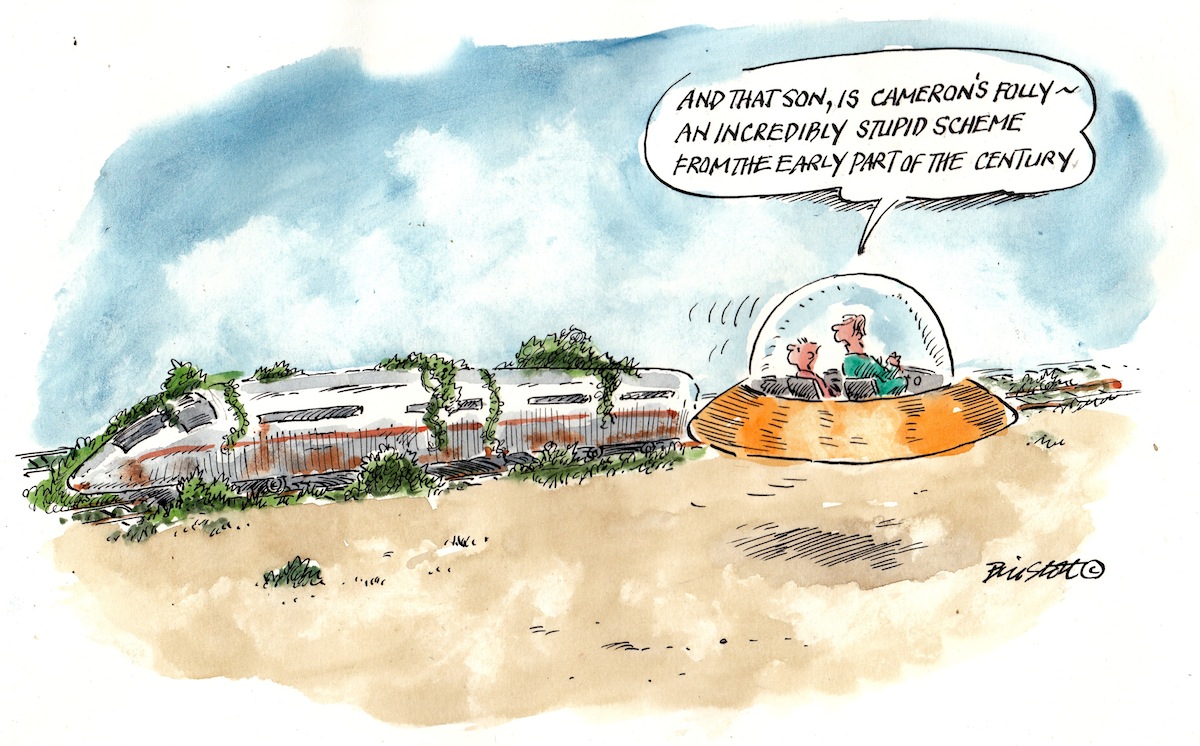
And all of that is without the environmental damage HS2 will do – as the Woodland Trust and the National Trust highlight.
Isn’t it time for everyone to come clean and admit that we just cannot afford HS2? Environmentally or financially. If nothing else, wherever the money is supposed to be coming from, it just isn’t there. Not when we have such a huge public debt. Not now, and certainly not after Brexit.
Something for the Weekend
Ten Things
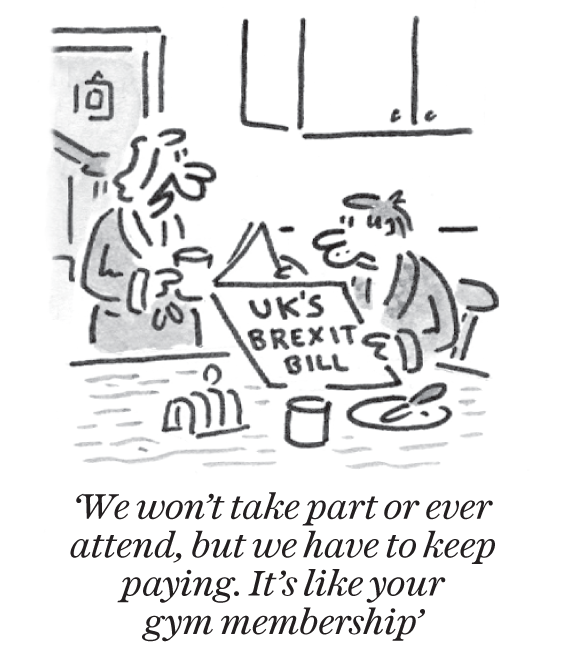
Ten Things this month takes a brief look at where the money goes.
Ten Things I’ve Bought in the Last Month:

- Top hat
- Bacon sandwich
- Army regiment cap badge
- 18 bottles of wine
- Sausages
- Pelargoniums
- Peach Schnapps
- Indian restaurant lunch
- Petrol
- Train tickets