In doing my family history I, like most, keep my records in a piece of software designed for the purpose. In my case this is Family Tree Maker (FTM), which (is no longer owned by but) syncs with Ancestry [https://www.ancestry.com]. I looked quite hard at the options many years ago and found that FTM was the most useable of the many family tree applications available.
And then a couple of years ago, when Ancestry announced they were ceasing support and development of FTM, and before it was acquired by Mackiev, I looked again at the market and still found nothing I thought came up to FTM for either functionality or usability. So like many others I was very happy when Mackiev took on FTM and have worked with Ancestry to maintain the FTM-Ancestry integration.
What all family tree software allows you to do is plot not just your direct line, but also the branches by adding the laterals (siblings etc.) for each person. I know many don’t bother with this but concentrate only of their father’s father’s father’s … line, or at least their direct lines. To me this is not a good approach for two reasons.
First of all, adding in all those laterals (siblings, uncles, aunts, cousins, half- and step-siblings, and more, going ever backwards) provides more information. And hunting around them can often provide key evidence to verify (or at least suggest) one’s actual ancestral line. Nefarious family members are often witnesses at marriages, the person registering a death, or shown on a census as sharing a house.
Secondly, this provides a huge amount of rich interest, and often the odd skeleton in the wardrobe. Ah, so great-grandmother was actually a tailor with her own business and not just any old seamstress. GGGG-uncle Bulgaria did serve at Waterloo, as Grandma always said. And no-one in the family knew great-grandfather had a bastard child after he left great-grandmother in 1910, and in the process he told fibs to either the registrar of births or the 1911 census. [This latter actually happened in my family: my mother had a half-aunt who she was totally unaware of until I found her.]
But in amongst all this it is often quite hard to remember where the gaps in your research are, and how good is the quality of the data you have. This is important if, like Noreen and I, you believe in being forensic in proving linkages. I’m never really happy until I can be pretty sure my evidence would stand the “beyond reasonable doubt” test of a criminal court. However, as Clarenceux King of Arms has reminded me more than once, you do occasionally have to fall back to the civil court standard of “on the balance of probabilities” – which does still require substantial evidence which would be allowable in court but not quite as rigorously as in a criminal court. There’s far too much guesswork and wishful thinking amongst family historians, and that won’t do, nor will copying other people’s research without checking it. Remember also the plural of anecdote is not data.
All the software packages I’ve looked at do allow you to reference and source your information, as any good researcher should. But what I have never found is a package which allows you to set, for each piece of information, a Red/Amber/Green traffic light style flag to indicate the quality of the data with a quick visual check. For instance a birth registration might be GREEN if you have the birth certificate or have seen the baptismal register; AMBER if it is information which is known in the family but not well documented, like Great-grandma’s birthday; but RED if is a date you’ve back-calculated from the age given on a death certificate or census (both of which are notoriously unreliable, albeit useful). To me this is a major failing and any family tree software application which includes RAG flags will have a significant selling point.
One thing I have found useful, and which provides some part of a way round the omission of RAG flags is a “family table”. Many sources provide pretty charts which allow you to plot out you, your parents, their parents, and their parents, and so on; ie. just your direct ancestors. This can be in circular form or in the more usual form of a tree. And they are mostly large cumbersome wallcharts with room for little more than the name; dates of birth and death if you’re lucky.
I’ve found it better to make my own using a simple table structure in MS Word (any word processing or spreadsheet software should do) – I stole the original idea from my wife and have since adapted it. I have three sheets, which takes me back to my GGGG-grandparents (so 250 or so years). It is designed to be printed on normal A4 paper; and carrying two or three sheets of paper in a pocket or handbag isn’t unreasonable – and very useful if you get into family conversations with relatives or friends. OK, so it isn’t as pretty as many of the commercial offerings, but that’s not important; it’s much more convenient.
Here are the first couple of pages of my table (click on the images for a larger view):
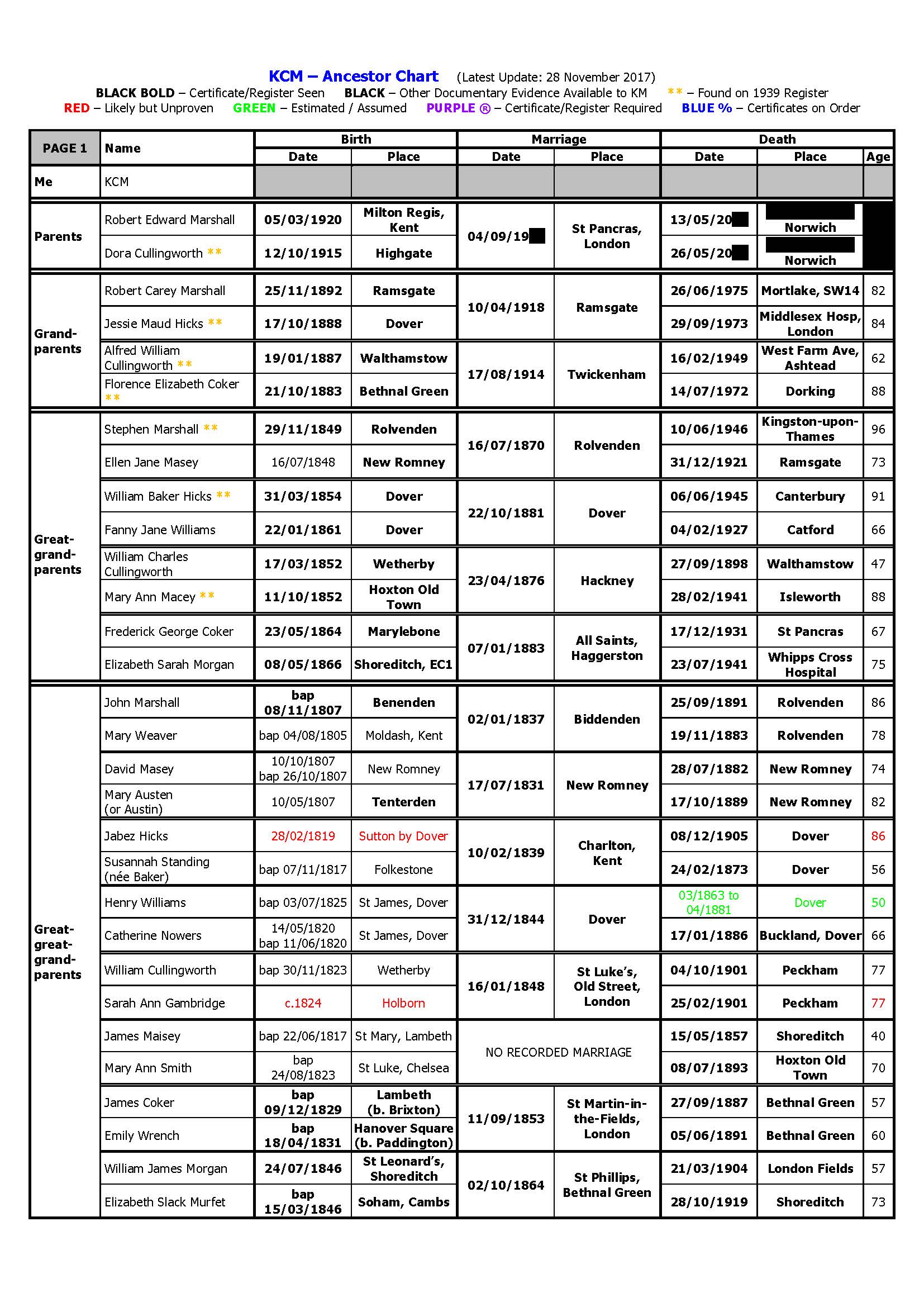
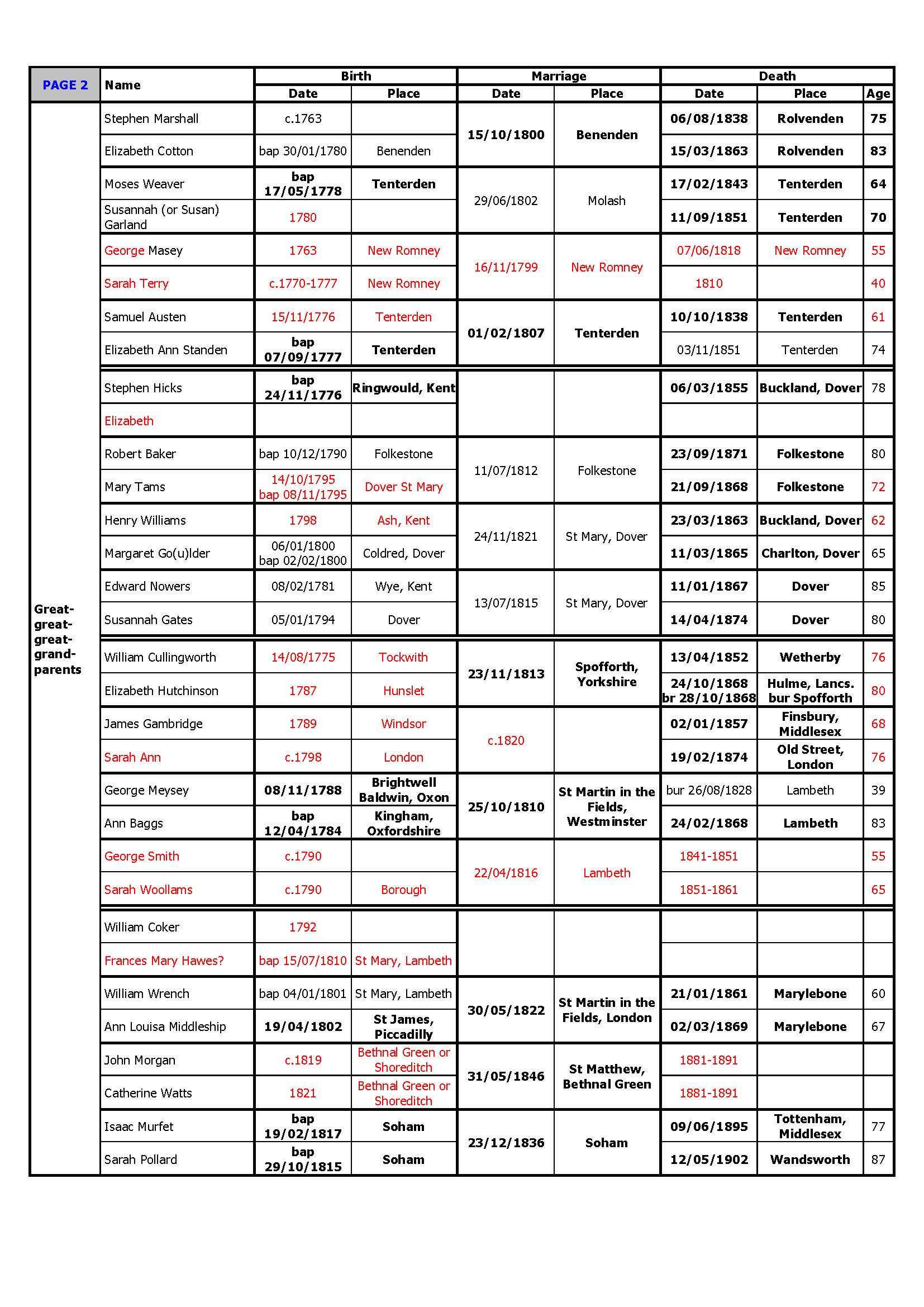
[I’ve redacted a few details, just to make it a bit harder for the criminally minded, but even if I hadn’t all the information is in the public domain, although it might cost a few quid and a lot of time to get at it.]
For me the other way this table wins is because I’ve used colour-coding. That means I have a very quick visual check on where I have holes and information I need to prove. The more black there is on the table the better the data. And as one might imagine by the time one reaches page 3 there are a lot of gaps and a lot of red – it’s all work in progress.
If anyone would like a blank copy of the table you can download the MS Word version here. If you do use it, let me know – just so I can wallow in feeling slightly useful! 🙂
Meanwhile happy ancestor hunting.

 Know that we are here if you ever need us. No parents, however good they are (and our friends really are brilliant parents) can provide everything a child needs. However open, frank and honest your relationship with your parents there will always be something you don’t want to talk them about – but something you would like to discuss with someone detached and outside the family. That is what we are here for. You can come and talk to us at any time and about anything; literally anything: boyfriend/girlfriend problems, exam worries, sexuality; if you’re in trouble and need bailing out of the police station; if you need a bed for the night; if you want to talk about life and what direction you’re going; or you just want someone to talk to. Remember, we may be geriatrics, but we’ve been there ourselves. We were students in the heady hippie days of the late-60s/early-70s so we’ve either done it or we have a friend who has. You are very unlikely to shock us – one way or another we’ve encountered most things. We don’t do judgement. And we aren’t going to tell you what you must do. We’re here to listen and to help you work through whatever is worrying you. Just pick up the phone or turn up on our doorstep (call first if you can to ensure we’re at home) at any time; day or night. And most importantly anything you tell us is in complete confidence; it will not be repeated to your parents/family/friends unless you specifically ask that it is. This is what we are here for and why we chose not to have children of our own. Here’s a card with our contact details; put it in your wallet and keep it in case you ever need it.