Category Archives: sexuality

Five Questions, Series 4 #3

So it’s that time again. Well to tell the truth it was probably than time days ago but who round here is clock-watching? Isn’t retirement all about not having to worry about clocks?
Anyway, yes, it is time for an answer to question three in the latest series of “Five Questions”. So here goes …


Question 3: If you could be the opposite gender for a day, what would you do?
To put it very simply: Fuck.
I’ve always wondered what it is like to be female, and especially to have sex — because it seems to me from the outside that sex is a much different experience for girls than for boys.
More importantly, perhaps, I feel I should know, and would like to know, what it’s like to be female. And I don’t just mean the good bits like fucking, but also the messy bits like periods and childbirth. No I doubtless wouldn’t enjoy those bits, but it’s about understanding as well as having fun.
I’m sure if even 10% of men could experience what it’s like to be female, even for just a few days (and conversely 10% of women experience what it’s like to be male) then we’d understand each other so much better and everything would work so much better. Yes, I know we all have these ideas of what being the opposite gender is like, but I suspect they are mostly delusions. And there’s nothing quite like the real thing.
But yes, basically, if I had only one day, I’d fuck. It might be fun, it might be educational and it might even be lucrative. Sounds like a winner to me. 🙂

On Sex Work

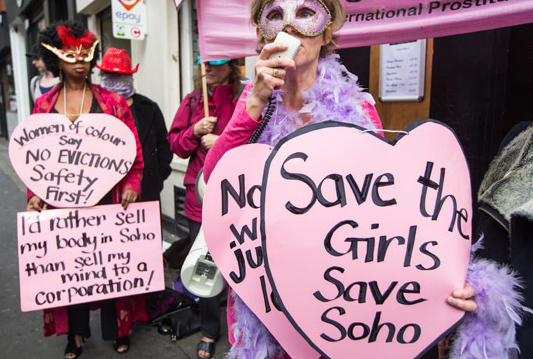
The latest New Scientist (dated 6 July 2013) carries a short but interesting article under the headline “One minute with … Laura Agustín”. Her thesis is that banning prostitution does not make women safer, in fact it does exactly the opposite.

As New Scientist is behind a paywall, I’m naughtily going to reproduce the complete item here as I believe Agustín’s ideas should have a wider audience before our politicians make ever more hasty and ill-considered rules. And because I happen to agree with her.

Most of what we think we know about sex trafficking is wrong, says Laura Agustín, who has spent 20 years investigating the sex industry

There is a proposal in the UK to clamp down on prostitution by criminalising the purchase of sex. Why do you object?
Millions of people around the world make a living selling sex, for many different reasons. What are they expected to do? This would take away their livelihoods. Selling sex may be their preference out of a limited range of options. In the UK, migrants may have paid thousands of pounds to get here. This debt has to be paid off somehow, whether it is by working in the back of a restaurant or selling sex. Migrants who sell sex can pay off the debt much faster.

But prostitution is dangerous, especially for those who work on the street …
Women who work on the street are a small proportion of all the people who sell sex. Many more work through escort agencies, brothels or independently from home.

It is disrespectful to treat them all like victims who have been duped into what they are doing. In the UK, there are thousands of articulate sex workers who say, “Leave me alone, I did know what I was getting into and I’m okay doing it.”

Isn’t the “happy hooker” a myth? Doesn’t research show it is a miserable existence?
Given the millions of people selling sex in the world, generalisations are impossible. Much research has been done at medical clinics or shelters for victims. If you go to a trauma centre, you meet traumatised people. When people tell me they have never met anyone who wanted to be selling sex, I ask where they did their research.

Why do you think anti-prostitution laws can make life more dangerous for sex workers?
If you think what sex workers do is dangerous, why insist they do it alone? It is legal in the UK for individuals to sell sex, but they may not work with companions or employ security guards. Brothels are illegal. If you prohibit businesses but people run them anyway – which they do – then workers must please bosses no matter what they ask. That is why this is a labour issue. Also, targeting kerb-crawlers makes things more dangerous since sex workers may have to jump in cars without getting a good sense of the driver.

What about trafficking of unwilling victims?
The numbers of trafficking victims reproduced by the media have no basis in fact. There is no way to count undocumented people working in underground economies. Investigations showed that one big UK police operation failed to find any traffickers who had forced people into prostitution. Most migrants who sell sex know a good deal about what they are getting into.

If there is no proof it is common, why is there widespread belief in sex-slave trafficking?
Why do moral panics take off? Focusing on trafficking gives governments excuses to keep borders closed. Perhaps it is easier to campaign moralistically against prostitution than to deal with the real problems: dysfunctional migration and labour policies that keep large numbers of people in precarious situations.

There are other augments too. By legalising sex work, as the Dutch have done, means it can be regulated, the workers given regular health checks, and also have their income taxed. It takes sex work out of the grey economy, whereas criminalisation pushes it ever further into the murky depths of the blackest of black economies.

Laura Agustín studies gender, migration and trafficking. She is the author of Sex at the Margins (Zed Books, 2007) and blogs as The Naked Anthropologist at lauraagustin.com

If Scotchmen can wear kilts …

Well indeed! If Scotsmen (and Irishmen) can wear kilts, and females of all ages can wear trousers, why in blazes can’t boys wear frocks?

It makes no sense. Except as a means of perpetuating the male dominant status quo.

There was an interesting, and rather worrying, article a few weeks back in the New York Times about the angst that parents go through when their son wants to wear what they think of as “girl clothes”. Of course, being America, whole families are in analysis rather than just getting on with life.

And do you know what? Most of these kids are no more than four or six years old. But they’re still seen as deviant, or worse. The article even acknowledges that few of them continue to want to dress as girls beyond the age of about 10.

And so what if they do? Why on earth does it matter?


Read this for another scary example of sexist reaction
to a 15-year-old boy in a dress.
Doesn’t the lad look rather good?

It is really only in the western world that we’ve become wedded to the idea than men have to wear trousers, and to do anything else is either deviant or at best a huge joke. See most people’s reaction to the aforesaid Scotsmen in kilts, or actors in drag.

Until about 100 years ago effectively all small boys, regardless of class, would have been routinely dressed in frocks until they were at least five years old. In Arabia and northern Africa men and women still wear loose robes. In Japan men traditionally wore kimono the same as women. Not to mention the Romans, Greeks, Egyptians … or monks.

OK, it’s easy for me. I’m not a parent and I haven’t had to cope with it. But I would hope that if I had I might have been a bit more level-headed. And yes, I do concede that it must be hard — especially for the young kids — when most of society doesn’t understand and people are so spiteful. So they need strong and sympathetic parents, not analysis!

But FFS why do parents have to worry when the kids are only six, or in one case in the article as young as three!? Kids of both genders, especially young kids, like to dress up. Whether that’s in mum’s high heels, as Davey Crocket, or Spiderman, or My Little Pony. And some kids are more comfortable in some clothes than others; some (heaven help us!) are most comfortable in no clothes. Where’s the problem?

When I was young we didn’t have much choice in clothes. There were no t-shirts, sweatshirts, football strip, trainers, batman outfits, jeans, … Today kids can have a whole range of choice, so no wonder a few will pick something a section of “society at large” thinks unsuitable. Most of them grow out of it, just as they grow out of collecting Pokemon, plastic pigs or used tea bags.

Even if they don’t grow out of wanting to wear dresses, WTF does it matter?

Society is able to accept many things that were formerly seen as deviant or unacceptable — men with earrings, homosexuality, bikinis, tattoos … So why can’t we be more comfortable with boys wearing dresses?

Brazilians

No, not waxing, not even lyrical waxing! Nor another of Brizil’s other exports: parrots. Although “poly” certainly come into it …

Apparently a Public Notary in Brazil has agreed a civil union between a man and two women, which could (my guess) be the first officially endorsed polyamory relationship in the world.

The BBC News site, amongst others, ran the story yesterday.

Apparently the Public Notary, who goes by the wonderful name of Claudia do Nascimento Domingues, says that there is nothing in law to prevent this union and that the threesome should be entitled to family rights.

Needless to say the (mostly American) Christian press are having a field day.

More power to Senhora Domingues for breaking the mould, say I. We need more lateral thinking like this.

Friends without Benefits

Up-Front Disclaimers:
(1) I am male and 110% heterosexual so this post is written from that standpoint. If your sexuality is other than male and straight hetero adjust what follows to suit your predilections.
(2) No-one will be identified herein. One or two persons may think they can identify themselves, and maybe they can, but they may be mistaken.
(3) I have been happily married for over 30 years and nothing that follows has, as far as I am aware, any disruptive effect on that; if anything, because I think, and am open, about such things the opposite is true. And of course my wife is entirety excluded from what follows.

I’ve been thinking recently about my reactions towards female friends and sex. First of all let me say that I am not talking about “friends with benefits”, because I don’t have any of them.

The first thing I have come to realise is that my female friends (friends, rather than casual acquaintances) past and present, fall rather neatly into two groups according to what are, I hope my underlying, impressions of the sexual content of that relationship. Sex with any of these friends has never been “on the table”.

There is a group of ladies (young and not so young) who I find to a greater or lesser extent sexually attractive — although I would never attempt to “cash in” on this. But however close our friendship, and however attractive I find them, almost to a woman I can look at them and say to myself “I could never live with her; she’d drive me up the wall!” because of whatever foible. I expect the feeling to be mutual. But nevertheless there is always this nagging feeling of “But I’d love to have sex with her, just because I’m curious to know what it’s like”. And I mean that just as written: I have a curiosity as to what sex with the lady is like — no more, no less. But, my friends, you’re safe; I would never insult you by overtly exposing my curiosity, let alone instigating anything sexual.

The other group of friends are almost the opposite. However close I am to them, and however delightful I find them, I have no curiosity at all about having sex with them. The thought just never occurs; it is not part of my (inner) equation of the relationship.

And I emphasise that sex is not on the table in any of these friendships and never has been. All of which I find curious, especially given the overlying sexual nature of the human male. After all it is often said (and I don’t know how much this is borne our by research) that men lose interest in women, even ones they’re friends with, when sex is definitively taken off the table — something I’ve always felt is a very male chauvinist attitude. But then men in western society generally are chauvinists, and I would admit that, much as I try not to be, I’m no exception.

The other thing I’ve come to realise is to do with my former girlfriends; those with whom I’ve had a sexual or proto-sexual relationship. Looking back at those relationships from a distance I realise that however much I still cherish and value them (and I do) they are done and gone. There was great and fun sex in some of them, and in others what sex there was was pretty rubbish. But, in retrospect, I learnt something from them all.

However with one exception none has left what I would term “a hole in my heart”. The one exception was my first real girlfriend; even after almost 40 years there is still a hole in my heart and a special place for that young lady. Whether that is because she did the breaking up, or because I found that break-up so hard (I’m still annoyed with myself for not coping better with it), or because I have never really reached full closure, I don’t know. We never had (penetrative) sex and despite our collective inexperience I still wonder what sex with her would have been like. I would love to know what happened to her; how she got on in life; and whether after all these years there would still be any friendship there. But I am sanguine enough to know that I never will know, and that she probably doesn’t care.

Am I alone in these feelings? Do others find their friendships divide into two groups: those where there is an inner sexual curiosity and those where there isn’t? And do others have long-gone relationships which have left a gaping hole in their heart even after half a lifetime? I’d love to know whether this is a common experience or whether I’m just deranged. (No, maybe don’t’ answer that!)

Keys to a Robust Relationship

I’ve been thinking, idly, as one does, for some time about what it is that makes any relationship really robust. Not just one that will last, but one that will last through almost everything and get stronger.

First of all we need to be clear about what I mean by “relationship”. In this instance I am talking of the long-term, bonded, probably sexual, live together partnership between two (or more) people — and regardless of the mix of genders of the partners.

So I’ve come up with …

5 Keys to a Robust Relationship

1. Multi-level
It seems to me, as outlined on my website, that the best relationships operate at multiple levels with the partners dropping in and out of different roles at different times. Sometimes it will be lover-lover, sometimes parent-child (for instance when one partner is ill, or in fun), sometimes there will be child-child playtime. And so on.

Many things seem to spring from this. The more levels there are present the stronger the relationship is likely to be, although not all levels may be there all the time. Occasionally a level will go missing, and that may be when things feel out of kilter. That’s fine as long as it returns after a while. And where a relationship is in trouble it is often because too many of the levels are absent for too long. Having a relationship which works only as lover-lover may be good for short-term lust but is unlikely to work long-term.

2. On-going Intimate Communication
There’s an old adage I came across in business: Communicate, communicate, communicate. I wish more people would take it to heart, in business and in personal life.

Ongoing intimate communication between partners is essential for a healthy relationship. And by intimate I don’t mean just about sex (though that is a highly important element) but communication about anything which is given in an open, honest, frank, straightforward and non-judgemental way — and is properly listened to, and considered, by the receiving partner. This builds respect and trust between the partners. Trust that the important things are being shared; trust that each partner can accept the other as they are; trust that any problem, great or small, can be discussed and worked through. Respect for the other person’s opinion and values, even if you don’t agree with them.

3. Mutual Trust and Respect
Trust and respect have to be built, preferably early on in the relationship. As we’ve seen above, communication is one key aspect of this. Openness and honesty are essential. It almost boils down to “do what you say and say what you do”. Certainly keep your commitments (unless there is really good reason you can’t in which case explain, honestly, as soon as possible beforehand why you can’t).

Respect the other person’s opinions and values, even if you yourself are unable to agree with them. We each hold our opinions and values for a reason (which we may not know) so they have an importance to us. So don’t attack them or ridicule them. Discuss them by all means, in a civilised way, but accept that you may not come to mutual agreement, just mutual understanding of each others’ views.

As that builds, early in the relationship, it should become apparent that you could trust your partner with your last shirt or your best mate. If you can’t maybe you shouldn’t be in the relationship?

4. Shared Bed
In my view sharing a bed is an equally key element of a relationship. You are going to spend 30%+ of your time in there so make sure it is a comfortable bed, which is big enough and soft (or hard) enough.

Physical intimacy is important. That doesn’t mean it has to be sexual. A lot of the time it will not be sexual. Just the proximity of your partner should be something you cherish, something comforting. However miserable or depressed you feel, or however much you are out of sorts with each other, it is hard to fall asleep together without making up.

Even after many years together what better than to fall asleep embracing, to wake in the middle of the night to stroke your (sleeping) partner’s body, to wake in the morning and cuddle into consciousness?

And if you can sleep in the nude, well it gets even better. Get a warm(-enough) duvet so you don’t need pyjamas, knickers or socks and enjoy the delight of lying skin-to-skin.

5. Shared Meals
To me shared meals are also an important factor. If you are both working they may be the only time you get to sit and talk together, or as a family. For us evening meal is sacrosanct time. Time when we eat together, at the dining table, without the TV, book or computer game. Time to enjoy food and to talk. When we were both working it was often the only hour of the day when we could guarantee we were together, not pre-occupied and awake enough to be sentient. Thus it becomes important communication time and important decision-making time — we often sit for some while after finishing eating just talking, about whatever the subject at hand is: do we need to take the cat to the vet; shall I go to that conference next month; should we buy a new freezer; shall we have another bottle of wine.

Having said that, it is important to remember that meals are primarily about food, and enjoying food. What better way than to do this together, with a bottle of wine. And we often discuss food while we eat: ideas for recipes, what do we fancy eating at the weekend, does the wine rack need restocking. Most importantly of all, being together and enjoying food.

So there we have it. Five keys to a robust relationship, which boil down to communication, trust & respect and enjoyment.

Every relationship still has to be continually worked at. And each relationship will be different; working in its own peculiar way. Nonetheless I feel these principles will be the essence of any worthwhile, long-term successful relationship.

They certainly seem to be working for us!

Bird Watching : The Tits

Spring is sprung. The birdies are singing. Once again the British birdwatcher can enjoy their pleasure without having their nuts frozen off. So we are starting a new occasional series to introduce those unfamiliar with British birds to species identification in the field. First …

The Tit Family
There are seven (or maybe eight) species of tits seen in Britain (most commonly seen first).

Blue (or Tiny) Tit
Great Tit
Coal Tit
Long-Tailed Tit
Marsh or Willow Tit
May be two separate species but impossible to tell apart except hand. Named after the weeping willow tree.
Crested Tit
Bearded Tit

A certain truth …

There is indeed a certain amount of truth in today’s XKCD cartoon!


Click the image for a larger version

And here’s an interesting thing. How is it that one can find a stick figure, which is female only from the length of the hair, sexy? I don’t know. None of the other characters in XKCD cartoons do this to me, but that’s how I react to Megan! It is something visual and not related to the language/words. Very weird. Must say something awfully odd/worrying about me. But then you knew I was deranged. 🙁

Sex and Robots

A week or so before Christmas Kyle Munkittrick wrote what I consider to be an important post over on Discover Magazine blogs under the title The Future: Where Sexual Orientations Get Kind of Confusing.

It is important because it looks to the future and asks what sexual orientations should be acceptable and when.

The situation at present if reasonably clear. Heterosexual and homosexual relationships are both accepted as sexual orientations and as being acceptable. So are polyamory, queer and transgender relationships. As long as all the parties are consenting.

But paedophilia and zoophilia, while arguable sexual orientations are not acceptable. The difference is that in the latter neither a minor nor an animal can give consent.

This seems to provide a simple rule: sexual orientations/relationships are acceptable as long as the parties all give informed consent. Where there is not consent, then they are verboten.

But, Munkittrick asks, what of the future? A future where it is conceivable that humans may wish to have sexual relations with cyborgs and robots? Should human-robot sexual orientations be acceptable, and under what circumstances? Can a robot or cyborg give informed consent? If so under what circumstances and how would we know?

Thinking about this is important, not just for the future but because it helps us understand our present moral position. [For instance, how and why does incest fit the model?]

It also begs the question of whether we should be worrying about our relationship with our dildo, vibrator or blow-up doll! 🙂

Go read the full article!