Category Archives: science

Sublimely Ridiculous

This week’s selection of things which attracted my attention and which you may have missed …

Can the human body combust spontaneously? Most of us think not, unless you’re an Irish Coroner.

Fake degree? Check. Fake Rolex? Check. Fake girlfriend? What? You want fake girlfriend? OK, then see here and here.

Bored with your current home? Fancy your own Lord of the Rings film set? Then build your own Hobbit home. Must admit it looks comfy, but where’s the bathroom?

Now you’ve mastered being an architect here’s just the thing for your design studio … Use your Amazon Kindle as an Etch-a-Sketch. Sadly available only in the US.

And finally the big news of the week: Wasabi fire alarm scoops Ig Nobel prize! Yes, it’s that time of year when the Ig Nobel awards are announced. If you’ve missed out on them before they are serious scientific prizes which honour achievements that “first make people laugh, and then make them think”. Full reports here and here.

Enjoy your weekend!

It's Been a Busy Week!

There seems to have been a lot going on this week which drew my attention but which I didn’t get to write about here. So here’s a summary (in no particular order) …

First an interesting item on how belief can kill. It’s a curious phenomenon but even so I can’t bring myself to read the book. See The Dark Side of the Placebo Effect: When Intense Belief Kills.

Much more interesting and useful is a long article on the National Geographic site about the workings of Teenage Brains and how this should be seen as a sensible evolutionary trait. It might also help all of us understand and relate with teenagers. It certainly seems to explain quite a lot.

Next an investigative journalism piece about the Fukishima Disaster and especially the long-term effects on the Japanese population. The suggestion is that the effects of stress etc. will be far more significant than the actual radiation doses (I guess excluding the immediately affected workers). For my money the article still doesn’t delve deep enough — but the journo writing it probably couldn’t get access to do so.

Law and Lawyers has written several pieces about the worrying machinations of the Metropolitan Police in attempting to get The Guardian to reveal some of its sources. First they were going to use the Official Secrets Act, then PACE 1984. For now though it seems the dogs of war remain caged.

Also this week Obiterj at Law and Lawyers has pointed out that the Fixed Term Parliaments Act 2011 comes into force. This means the next General Election will be on 7 May 2015 — unless both Houses of Parliament decide otherwise by a two-thirds majority.

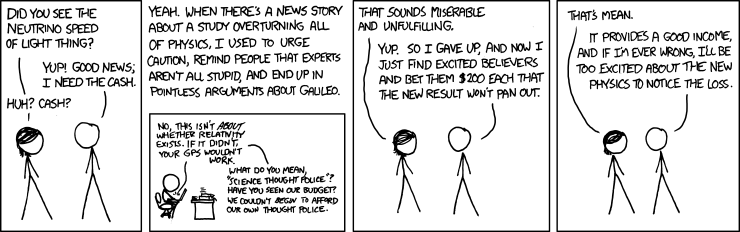
Which for a scientist somewhat pales into insignificance beside the apparent result from a team at CERN that they have detected neutrinos doing the impossible and travelling faster than light. But hold on guys, they don’t quite relieve it either and they’re asking the scientific community for help to test their results. Good scientific commentary by Adrian Cho at Wired and Phil Plait of Bad Astronomy.

Finally back to earth. There’s been lots of twittering in the dovecotes about female orgasm, how it relates to evolutionary pressures and to male orgasm. Also some good demonstrations on how to demolish a (supposedly) scientific study. The best of the critiques I’ve seen is from Scicurious. Maybe you girls should just be allowed to enjoy it?

Have an orgasmic weekend!

We Live in Peaceful Times

What do you mean, you don’t agree? According to Michael Shermer in his article The Decline of Violence in the October 2011 issue of Scientific American, there is very much less violence now, per head of population, than there was in times of old.

English philosopher Thomas Hobbes​ … argued in his 1651 book, Leviathan, that … acts of violence would be commonplace without a strong state to enforce the rule of law. But aren’t they? What about 9/11 and 7/7, Auschwitz and Rwanda … What about all the murders, rapes and child molestation cases we hear about so often? Can anyone seriously argue that violence is in decline?

Take homicide. Using old court and county records in England, scholars calculate that rates have plummeted by a factor of 10, 50 and, in some cases, 100—for example, from 110 homicides per 100,000 people per year in 14th-century Oxford to fewer than one homicide per 100,000 in mid-20th-century London. Similar patterns have been documented in Italy, Germany, Switzerland, the Netherlands and Scandinavia.

As for wars, prehistoric peoples were far more murderous than states in percentages of the population killed in combat, [Harvard University social scientist Steven] Pinker told me: “On average, nonstate societies kill around 15 percent of their people in wars, whereas today’s states kill a few hundredths of a percent.”

I have no reason to doubt either Shermer or Pinker, but, yes, I was surprised too.

Colour Test

Apparently 1 in 255 women and 1 in 12 men have some form of colour sight deficiency. Well yes, we know that red-green colour blindness is a largely male inherited trait. But of course it’s more complicated than that.

Thanks to Ed Yong over at Discover Blogs I’ve just found this rather strange, and quite tricky colour acuity test. It’s not a test for colour blindness as such but more about how well you differentiate colours.

Try it. It’ll take about 5 minutes.

Oh and I scored 7, which seems pretty good (0 is best; 100 is worst).

There’s a lot more on colour vision and colour blindness on Wikipedia.

Fact of the Week

You can’t comb a hairy ball smoothly. Or to state it more correctly in topology: any smooth vector field on a sphere has a singular point.

[from Ian Stewart, Professor Stewart’s Hoard of Mathematical Treasures]

Quotes of the Week

This week’s accumulation of leaf-mould …

Nothing in the world is more dangerous than sincere ignorance and conscientious stupidity.
[Martin Luther King, Jr]

With or without religion, you would have good people doing good things and evil people doing evil things. But for good people to do evil things, that takes religion.
[Steven Weinberg]

What we can or cannot do, what we consider possible or impossible, is rarely a function of our true capability. It is more likely a function of our beliefs about who we are.
[Anthony Robbins]

The idea of monogamy hasn’t so much been tried and found wanting, as found difficult and left untried.
[GK Chesterton]

The prerequisite for a good marriage, it seems to me, is the license to be unfaithful.
[Carl Jung in a letter to Freud, 30 January 1910]

Why does society consider it more moral for you to break up a marriage, go through a divorce, disrupt your children’s lives maybe forever, just to be able to fuck someone with whom the fucking is going to get just as boring as it was with the first person before long?
[Susan Squire, I Don’t: A Contrarian History of Marriage]

If Botticelli were alive today he’d be working for Vogue.
[Peter Ustinov]

When we were kids, our mums used to write our name in our school uniform. Now we are adults, we have other peoples names on the front of our clothes!
[Thoughts of Angel]

Fact of the Week

Because fit is so important in the effectiveness of condoms, World Health Organization guidelines specify different sizes for various parts of the world: a 49-millimeter-width condom for Asia, a 52-millimeter width for North America and Europe, and a 53-millimeter width for Africa (all condoms are longer than most men will ever need) … According to an article published in Nature, Japanese and Chinese men’s testicles tend to be smaller than those of Caucasian men, on average. The authors of the study concluded that “differences in body size make only a slight contribution to these values.” Other researchers have confirmed these general trends, finding average combined testes weights of 24 grams for Asians, 29 to 33 grams for Caucasians, and 50 grams for Africans.
[Christopher Ryan and Cacilda Jethá, Sex at Dawn]

So there you are girls … Negroes really do have larger equipment. And the Chinese remain inscrutable. Not exactly PC but then that’s science for you!