For this month’s Ten Things we have something more summery …
Ten Butterflies which Visit My Garden

- Large White
- Small White
- Orange Tip
- Meadow Brown
- Speckled Wood
- Holly Blue
- Painted Lady (right)
- Red Admiral
- Peacock
- Small Tortoiseshell

For this month’s Ten Things we have something more summery …
Ten Butterflies which Visit My Garden
So this was the exciting part of our day out on Monday of this week …
For Christmas I bought Noreen and half-day falconry experience with Coda Falconry, who are a couple of miles north of Waltham Abbey. I also made sure we had a couple of guest passes to go with it, especially as I wanted the chance to do some photography (which was not just allowed but actually encouraged).
Noreen has always been interested in falconry, mainly because of its use in medieval times. So this was a superb chance to have four hours hands-on experience. And did we have a great time!
We were a small group: 4 taking part and 3 guest observers. Paul, the falconer, was patient, interesting and knowledgeable about a whole range of natural history and not just falcons.
Starting at midday, and after some brief introduction, Paul brought out a variety of birds, one at a time. And as the day wore on the birds got bigger and bigger!
The first three birds were in turn a tiny Scops Owl (from SE Asia), a European Kestrel, and a Barn Owl. Otis, the Scops Owl was really sweet; he was no more than six inches tall; and he loved being stroked, siting happily on a gloved hand, eyes shut, head tucked in, apparently dozing off!

Bramble, the male Kestrel, was really beautiful with grey head and chestnut back …

Next up was Dizzy, a female Barn Owl …

Paul let us all (participants and observers) feel the Barn Owl’s plumage as it is just so soft – unbelievably softer than anything previously encountered, and softer even than eider down – the feathers were almost ethereal! No wonder Barn Owls are so silent in flight.
All these birds were flown. They would all sit on a post, waiting for a gloved hand, with a piece of food, to be proffered. Then they’d fly over and enjoy the morsel. All the participants experienced this with every bird.
By this time it was pushing 1.30 and, after a short break, time for an hour-long woodland walk to show off Griffin, a 15-year-old Harris Hawk. I opted out of this part as I wasn’t sure how my knees and back would stand up; and besides it was very hot and sunny and a cool drink and some shade was needed. Just as well I did opt out as the walk lasted more like an hour and a half!

I used the gap to have a quick look at the “zoo” on the rest of the farm site (it is very family and school group orientated), see a few of the other birds of prey and have that cool bottle of pop.
When everyone returned about 3pm, Paul showed the final two birds of the day: a Eurasian Eagle Owl and a Golden Eagle.
Logan, the Eagle Owl, is a mean-looking, brute of a bird, although according to Paul he’s actually a softie! But he is certainly fearsome in flight.

Apparently there are now thought to be two pairs of Eagle Owls living in Thetford Forest, and there is a lone female on the loose in Epping Forest (not very far away from Coda’s site). Apparently the females (which as with all birds of prey are larger than the males) are quite capable of taking a fox. (One of Coda’s Harris Hawks has also been known to take a Greylag Goose – no mean feat!)
Last up was the largest bird of the day, Nelson, the Golden Eagle, who weighs in at around 6lbs (almost 3kg). We were all of us allowed to have Nelson sit on our hand: as Paul said “It’s not every day you get to hold a Golden Eagle!”.

The photo above is of Nelson sitting on my (thankfully gloved) hand. He was certainly a magnificent beast: around 75-80cm from beak to tail and with the wonderful bronze/gold head and nape which gives them their name. You wouldn’t want to meet either the Golden Eagle or the Eagle Owl on a dark night!
By this time it was pushing 4pm and the afternoon wrapped up with with the group seeing a number of Coda’s other falcons.
We went off very tired, rather stunned and slightly sunburnt for a much needed couple of pints!
Coda Falconry are a small, award-winning, friendly outfit, with a wide range of birds of prey most of which have been hand-reared and/or are rescues; their team even includes Loki the Raven, who is apparently incredibly mischievous and cunning. Coda do several different experience sessions as well as frequent filming, regular re-enactment displays (many at Headingham Castle), routine pest control work, and more.
What a brilliant day, and thoroughly recommended!
PS. More photos on my Flickr photostream at https://www.flickr.com/photos/kcm76/albums/72157692159960390.
Here’s the usual selection of links to articles which interested me and which you may have missed. We’ve a packed house, so on with the show …
Science, Technology & Natural World
Some interesting speculation on whether a pre-human industrial civilisation could have existed on Earth, and whether we would be able to tell.

Apparently European women are twice as likely to be naturally blond as men.
Ravens. The Tower of London has them. So who better to ask about the intelligence of Ravens.
Wasps. There are countless species of them, they’re mostly tiny, and most are parasitic – indeed there’s thought to be at least one parasitic wasp species for every other insect species.
Ants perform triage and launch rescue missions on the battlefield, but only if it’s worth the effort.
Scientists are suggesting that trees may have a form of “heartbeat”, but it is so slow we wouldn’t normally notice.
Why does soil, especially newly wet soil, Springtime soil and forest soil, smell so identifiably?
It seems many trillions of viruses fall to Earth each day – millions per square metre – and it’s not all bad.
A meteorite found in Sudan contains some tiny diamonds, which means it is thought to be the remnants of a lost planet.
Health & Medicine
Do you suffer from chronic pain? Medics are suggesting that a change of mindset could help reduce the pain as much as analgesics.
Who, apart from me, had flu this last winter? If you did you shouldn’t be surprised as apparently we don’t take flu seriously enough. It really is worth getting the flu jab (especially if you’re in an “at risk” category). Although I was vaccinated and still got flu which floored me it wasn’t anything like as bad as if I’d not been vaccinated.
The NHS is being urged to include boys & young men in the HPV vaccination scheme (currently only adolescent girls are eligible). Not only would it help contain the general spread of the virus, but more and more men are getting head/neck cancers from the human papilloma virus, thought to be due to the young having more oral sex.
A test is being developed that will allow a foetus’s sex to be determined from just a finger-prick drop of blood during the first trimester of pregnancy.
There needs to be much greater awareness of the state of our post-birth vaginas. As usual the UK lags behind our old enemy, France, in post-partum rehabilitation.
And while we’re at it, we still have an appallingly poor knowledge of the anatomy for the clitoris. Yes, that’s all of us, it seems!
Environment
Unlike my neighbour, most of us understand that plants are important. Here’s why.
Bees are important too. And you can help the bees by doing less. Just mow your lawn only every two to three weeks.
Scientists are developing an enzyme to eat plastic bottles.
Art & Literature
It’s reported that Neil Gaiman is to make a film of Mervyn Peake’s Gormenghast trilogy.
Stockholm residents are up in arms over a five storey high blue penis mural.
London
IanVisits has created a useful map of all London’s miniature steam train rides.
Meanwhile another London blogger, Diamond Geezer, has produced a London Random Tourist Inspiration Generator for when you want to go somewhere but don’t know where.
Lifestyle & Personal Development
We’re moving towards a cashless society, or so we’re told. But being cashless puts us at risk, so the Swedes are turning against the idea.
Why are some societies strict and others lax? New Scientist investigates.
Do you want to be more assertive in life? If so there’s a dominatrix in New York who will teach you.
Chiltern Railways, whose trains run north-west out of London’s Marylebone Station, are suggesting eight seated yoga poses you can do on your commute. I struggling to decide how serous they are.
Crazy cat lady is a frequent image in pop culture. But why?
Food & Drink
A recent column in the Guardian is suggesting that eating goat is as tasty as lamb and a sustainable, ethical choice of meat.
Shock, Horror, Humour

And finally, one for the engineers and kids out there. John Collins, aka. “The Paper Airplane Guy“, holds the distance record for flight by a paper airplane. And he shares a few of his secrets with us.
Yes, indeed, you never know what you’ve got until you look.
We have the decorator man in to give the hall/stairs/landing a lick of paint before we have new carpet put down.
On day 1 (yesterday) most of the time was taken removing the old carpet. And on the turn of the stairs we were awestruck at finding treasure …
Nestled in the angle of the tread and riser, between two strips of carpet gripper, underneath the carpet were found two tiny and entire mummified mice.
The poor little things had obviously, years ago, crawled in round the edge of the carpet to escape a feline kidnapper, and been unable to get their way out (or died from injuries).
Treasure trove indeed.
This month’s large collection of articles encountered which you maybe didn’t want to have missed.
Science & Natural World
First off we must pay our respects to this year’s IgNobel award winners amongst whose investigations were solid and liquid cats, didgeridoos and cheese disgust.
Budburst on many trees is temperature dependent and March temperatures seem to be the key for many. And they’re getting slowly warmer, so budburst is getting earlier.
[Disclosure: I’ve been submitting records to UK phenology research for many years; many more years that the 17 covered by this research. It takes little time and is valuable “citizen science”.]
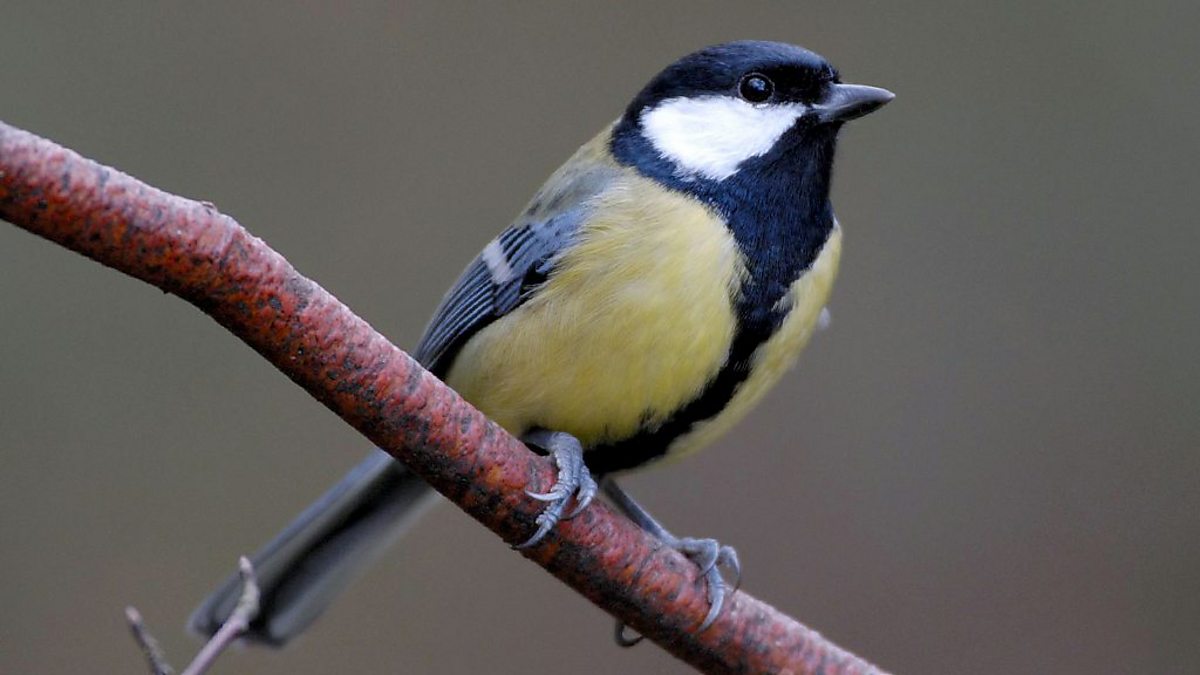
It is that time of year when we start seeing black and yellow flying insects about. Yes, summer is wasp season.
There are essentially three wasp species in the UK. The two we see most often are the ones most people despise: the small ones the Common Wasp, Vespula vulgaris, and German Wasp, Vespula germanica. Both are definitely yellow and black. To all intents and purposes they look identical (if you really want to see the difference you’ll need to get up close and personal with them – most of you won’t want to).


Oh, go on then, let’s have another word. In writing about frass, I was minded to wonder about the origin of caterpillar, so …
Caterpillar
1. The larva of a butterfly or moth; sometimes extended to those of other insects, especially those of saw-flies, which are also hairy.
2. A type of tractor which travels upon two endless steel bands, one on each side of the machine, to facilitate travel over very rough ground. (And by extension to other such vehicles.)
3. To move like a caterpillar or on caterpillar tracks.
The first uses, in sense 1, recorded by the OED is from c.1440 in Promptorium Parvulorum 63: Catyrpel, wyrm among frute, erugo.
I’m going to reproduce the etymology from the OED essentially in full:
(Some think the word a direct compound of piller. The giving to hairy caterpillars a name derived from the cat, is seen not only in the French word cited, but also in Lombard gatta, gattola (cat, kitten), Swiss teufelskatz (devil’s cat); compare also French chenille (from canicula, little dog), Milanese can, cagnon (dog, pup). Compare also catkin, French chaton, applied to things resembling hairy caterpillars.)
In other words, we don’t know!
Frass
The fine powdery refuse or fragile perforated wood produced by the activity of boring insects.
The excrement of insect larvae.
(Or to put it in the vernacular: caterpillar shit.)
First used in an academic paper in 1854, the word is derived from the German frasz, fressen, to devour.
Paul Waring & Martin Townsend
Field Guide to the Moths of Great Britain and Ireland
2nd edition; Bloomsbury; 2009
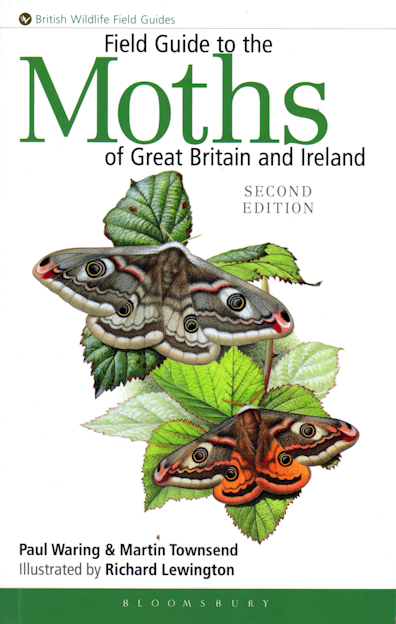 This is a magnificent tome, but not what I would define as a “field guide”: for an octavo paperback of almost 450 pages, on glossy paper and weighing almost 900 gm you would need a poacher’s pocket or a JCB to carry it around. It is a reference book — and a brilliant one at that — but as such it is not something to be read from cover to cover but explored when needed. It is an essential on the shelves of anyone with an interest in the huge diversity of the insect world, especially, obviously, moths.
Having said that, it doesn’t cover all moths but just the “macro-moths” (essentially anything with a forewing length over about 1 cm); micro-moths are covered elsewhere.
I’ve long wanted such a book (why didn’t I get this before?) as there was for many, many years a huge hole in the field guide coverage of British moths; I remember my mother complaining at least 40 years ago that there was no good, available, guide to moths — how she would have loved this book!
The book does what it sets out to do: describe for the naturalist (both professional and amateur) every known species of moth in the British Isles. The descriptions are organised by genus, with each species getting an entry of a third to half a page in quite small type. The descriptions cover mostly the adult moth, its habitat, lifecycle and distribution.
Strangely all the illustrations of adult moths occupy the central 20% of the book. This is not obvious from the colour-coding of the pages and I’ve found the only way to know quickly where the illustrations start is with a bookmark. Having said that, the illustrations (by Richard Lewington) are magnificent — much the best I’ve encountered — and they show the wonderful diversity and beauty of these important but much disliked insects. Moreover the illustrations show the adult moths in their normal sitting pose, unlike many guides which show the wings displayed as they would be in a museum case (something that’s not helpful to the non-specialist).
There is, however, one significant thing I don’t like about this book. In general it does not illustrate the larvae (caterpillars) of each species. Some (maybe 15%) of species have a photograph of the caterpillar along with the description (not with the illustrations). This I find curious. I know that many caterpillars look very similar (even more than adult moths) but why not illustrate them and have a complete section of the illustrations — separate from the adult moths would be OK — as an aid to identification. For me, this stops the book getting a top 5-star rating.
My only other gripe is the cost; at around £30 for the paperback this is beyond the reach of many.
Nevertheless this is a reference book which will live on the shelf over my desk and quite likely become well used.
Overall Rating: ★★★★☆
Let’s catch up on a couple of recent (like this week) photographs. Specifically we’ve had two common, but quite interesting, moths in the house in the last few days. First of all we had this …

