Category Archives: natural history

Hairy-Footed Flower Bees

You learn something every day – well at least you do if you keep your eyes open.

This lovely warm sunny weather has brought out all the bumblebees and we’ve got our usual share buzzing around the garden. But this year I noticed one I’ve not registered before. Well I probably have seen it but not closely enough to wonder at what it is. It is an all black bumblebee-like bee and I’ve seen several in the last couple of days.

This morning one was silly enough to fly in through the study window and of course it then couldn’t find its way out. I rescued it in a clear perspex bug-catching pot I keep, so I was able to have a good look at it before releasing it. I also tried to photograph it but it was so constantly on the move I could not get a decent shot.

This bee was about 1.5-2 cm long, bumblebee shaped, black and hairy but with distinctive ginger hairs on its back legs; no other colour at all. At first I thought the ginger patches were full pollen sacs but they were much too dark and on closer inspection turned out to be patches of gingery hairs.

Looking it up it turns out to be a female Hairy-Footed Flower Bee, Anthophora plumipes. This is an important early pollinator. This s good because we seem to have lost our colonies of Osmia rufa (the Red Mason Bee) in the last couple of years. And it’s even better because our apple tree is in full bloom now so if we have good weather for the next few days we may get a decent apple crop this year. These bees are one of the very earliest to emerge from hibernation, with the males appearing as early as February and the females in March; they’re on the wing only until late-May. They’re quite common in the southern half of the UK, roughly south of a line from Birmingham to The Wash.

There’s a bit more information here for those who are interested.

Image from BWARS.

[9/52] Forsythia


[9/52] Forsythia, originally uploaded by kcm76.

Week 9 entry for 52 weeks challenge.

The Forsythia in our hedge has been in flower for several days now, although there isn’t much of it as the hedge gets too regularly trimmed. This piece is in the hedge archway over our front gate, so will hopefully delight passers by. This is a bit early as it really shouldn’t be in flower for another couple of weeks. Our Fuji Cherry (Prunus incisa ‘Kojo-no-mai’; the picture below is not our tree) has it’s first few flowers open as well, and that is also early. So despite that the weather has turned cold again, it looks as if Spring might well be on the way. Yipee!!

[7/52] Crocuses


[7/52] Crocuses, originally uploaded by kcm76.

Week 7 entry for 52 weeks challenge.

Our lawn and fruit border are full of crocuses, mostly in shades of purple. I know we’ve planted some, but they must be spreading as I’m sure (like these in the fruit border) they’re in places we wouldn’t have planted them. And they seem to be doing well despite the waterlogged clay soil of the lawn.

Squirrel

There’s a Grey Squirrel sitting almost in the top of our Silver Birch tree. It has been there since about 1015 this morning. It is now 1545-ish and beginning to get dark. Apart from turning round two or three times it has been stock still, as if asleep. I find it hard to believe that a healthy squirrel would choose to sleep for this long in broad daylight, in the open, in the rain and in the top of a bare tree being blown hither and yon by a freezing wind. Maybe it is ill and dying. If so it can’t be long before either it falls out of the tree or the carcass is taken away by the crows. This is (a crap photo of) the fellow at about 1030, soon after I first spotted him …

… and he’s still there!

Interesting times we live in. We’ll have lions whelping in the streets next!

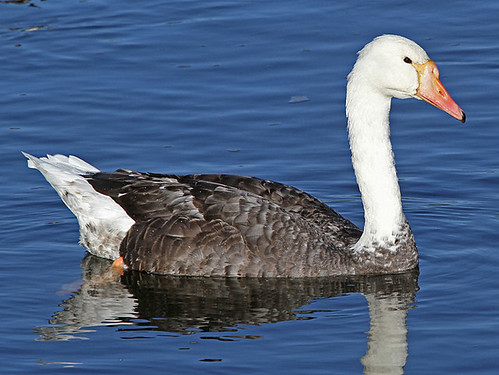
Swoose


Swoose, Wool (Dorset), 24-Oct-10, originally uploaded by Dave Appleton.
Swoose? No I’d never heard the word either until today. But then I saw birder Dave Appleton’s superb image (reproduced above) and followed the link to his website where he describes a bird which is a hybrid of a swan and a goose … hence a “swoose”. In fact he is describing this bird; publishing several sets of photographs of it; and documenting its history.

Now I didn’t know either that swans could cross-breed with geese. (That’s two things I’ve learnt today!) But, although it is extremely rare, apparently swans and geese can interbreed. As Dave explains the offspring don’t usually survive to adulthood. However the bird pictured is known to have hatched in 2003 and was photographed by Dave last October, possibly having successfully bred itself.

Following the story on Dave’s website, it seems that the parentage of this bird is pretty well authenticated short of someone managing to get samples and do the DNA profiling. I hope that it is possible to get the DNA profiling done; the results would be extremely interesting to those interested in birds but also, I imagine, to academic zoologists. And it would be interesting too to see if the bird’s proposed parentage is correct. If nothing else this is an interesting puzzle and I’d like to say “thanks” to Dave for making all this information available.

Of course, there’s another rather interesting and deeper legal puzzle here. All Mute Swans (our native, resident British species) belong to the Queen and are as such protected. Geese however appear to be protected only during the closed season (February through August) and are thus treated as game birds like duck). But what is a Swoose? Is it a swan or a goose? Were these birds to become common and a pest (very unlikely, I know) I feel sure this would be a most interesting legal debate. Just don’t anyone dare go and shoot the bird in the meantime because …

Whatever the bird actually turns out to be it is a most handsome and interesting creature which deserves a lifetime of quiet observation and protection.

Barn Wowl !!


Barn Owl , originally uploaded by nigel pye.

This just leaves me stunned! It is probably the most spectacular shot of a Barn Owl I’ve ever seen. The colours and the detail are just out of this world. Nigel Pye, the photographer, specialises in birds and particularly Barn Owls. Despite my years as an amateur photographer I just don’t know how you take pictures like this. Guess that’s why I’m not a pro.