Category Archives: medical

Pubic Hair Removal – Why?

An interesting article in the Guardian on Friday (11 Feb) by Bidisha in which she asks why women are these days removing their pubic hair. Her contention is that it’s a fashion (almost certainly) and that it is generally a bad idea, psychologically, for both men and women. I’m not sure I entirely agree with this, but it’s an interesting argument:

Are women so ashamed of their bodies’ natural beauty, so unaccepting of things as they are that they will do anything at all, even if it’s degrading, to get some willy time? A man who withholds his attention and affection according to the follicle count of a lady’s crotch doesn’t deserve intimacy with a real-life woman. A man who likes a woman without pubic hair despises adult women so much that he wants us to resemble children […]

I worry about these men too […] They are now in danger of returning to a Victorian naivety. They may well believe that […] women naturally do not have any body hair. Upon seeing some real hair on a real woman for the first time they may well vomit or faint, or both […]

As for the women, don’t you have anything more interesting to do than dutifully coif your cassoulet?

You can find the full article here.

Quotes of the Week

Quite a lot of quotes, and slightly early, this week as I missed last week’s post. And lot’s of zen type quotes too as I’m getting to the end of several zen books. So here goes …

There is no optimal state of consciousness. Optimal is just an idea, another manifestation of the Great Somewhere Else. Consciousness is just an idea.
[Brad Warner; Hardcore Zen: Punk Rock, Monster Movies and the Truth about Reality]

What is true during dreamless sleep is true no matter whether you can recall the experience and write about it or not. What is true in a whorehouse in Bangkok is true whether you visit it and take Polaroids or not. What is true for six-legged aliens on the fifth planet circling Epsilon Centauri is true whether you go there and talk to them or not. You may never know the life your toothbrush leads when you’re not around but it’s certainly real.
[Brad Warner; Hardcore Zen: Punk Rock, Monster Movies and the Truth about Reality]

Reality is the leading cause of stress amongst those in touch with it.
[Jane Wagner]

After all, it is no more surprising to be born twice than it is to be born once.
[Seagal Rinpoche; comment at http://hardcorezen.blogspot.com/2011/01/literal-rebirth.html]

Reincarnation is a fun subject. I do like the concept ‘how can you return if you never leave?’ I think that sums it up nicely. From the perspective of our experience, it’s easy to find examples of how this might actually work. Consider this: when you were five, playing in your yard, you suddenly thought a strange thought – I wonder who I will be when I grow up? Will I still be me? And of course, you did grow up, and you are still you – but you are not the child who asked that question so long ago. Did the child ‘die’? No,it didn’t. But the child is not there any more – so how can that be? Maybe reincarnation is a little like that?
[Mr Reee; comment at http://hardcorezen.blogspot.com/2011/01/literal-rebirth.html]

The pen is mightier than the sword but a vagina beats anything you’ve ever seen.
[Bizarro Seagal; comment at http://hardcorezen.blogspot.com/2011/01/literal-rebirth.html]

‘Bonsai?’
‘The Japanese art of training little trees to resemble big ones. Wouldn’t work unless there was a scale-independent structure.’
‘I knew a bloke once did bonsai mountains,’ said Olly. It took a few seconds for us to twig.
‘You mean pet rocks?’ enquired Deirdre.
‘Suitably fragmented rocks do look a lot like mountains,’ I said.
‘He didn’t just sit a rock in a bowl, you know,’ said Olly. ‘It’s lots of work making proper bonsai mountains. He had all the gear – little hosepipes with spray-action nozzles and fans stuck on special stands to weather them with miniature rainstorms, spark generators for small-scale lightning, lots of tiny mirrors to focus the Sun’s rays. Even a tiny snow machine.’
‘Really?’ Deirdre was interested in gardening and this just about counted.
‘Yeah. But he had to stop.’
‘Why?’
‘The rocks got infested with greenfly. On skis.’ Deirdre hit him.

[Ian Stewart; Cows in the Maze]

The tricky part about being human is that you have to be your own pack leader. You have to know that you can keep yourself safe, stand over your own emotional center of gravity and stay stable but responsive.
[Emily Nagoski; at ]

Let me tell you, friends, this is an amazing book. Just reading it put me into an altered state of consciousness. I entered a realm where perceptions of form and matter vanished, to be replaced by an amorphous void beyond all thought and senses, a world of peace and quiet undisturbed by the anxieties and uncertainties of the material universe. In other words, I fell right to sleep.
[Brad Warner; Sit Down and Shut Up: Punk Rock Commentaries on Buddha, God, Truth, Sex, Death and Dogen’s Treasury of the Right Dharma Eye]

Forgiveness is a virtue of the brave.
[Indira Gandhi]

What is religion but the distillation of an individual’s perception of the truth? By that definition, even atheists have religion.
[Amelia Nagoski]

Chinese medicine calls the gut the lower dan t’ien – guess where the upper dan t’ien is? Yep, the head. My gut is a brain just like the one in my skull.
[Amelia Nagoski]

There are times to cultivate and create, when you nurture your world and give birth to
new ideas and ventures. There are times of flourishing and abundance, when life feels in full bloom, energized and expanding. And there are times of fruition, when things come to an end. They have reached their climax and must be harvested before they begin to fade. And finally of course, there are times that are cold, and cutting and empty, times when the spring of new beginnings seems like a distant dream. Those rhythms in life are natural events. They weave into one another as day follows night, bringing, not messages of hope and fear, but messages of how things are.

[Seagal Rinpoche; comment at http://hardcorezen.blogspot.com/2011/02/reasons-to-be-cheerful.html]

Thing-a-Day – FAIL!

Well to misquote Robert Burns, the best laid plans of mice and men often go awry.

I started with every intention of completing this year’s Thing-a-Day. Then everything went “castors up”!

Last Thursday I had a relatively routine medical procedure (trust me – you really don’t want to know the details!) as a day-care patient at our local private hospital. Everything appeared to go OK and I was discharged early that evening feeling surprisingly good despite the sedation.

By Friday morning I was in quite some abdominal discomfort and had a raging fever. To cut a long and tedious story short I got back to see the consultant at 2pm on Friday and he immediately re-admitted me to hospital with instructions to get a CT scan on the way. The scan showed that I had one of those 1 in 1000 complications: peritonitis. Major Gerry Bummer!

The upshot was that I spent the weekend connected up to drips (IV fluids, antibiotics and insulin), on a diet of “clear fluids” only and being disturbed every 1 hour 27 minutes (well it certainly wasn’t regular) round the clock to have everything measured. By Monday I was well on the way to recovery and was discharged, without a demob suit but with a box more antibiotics and an instruction to “take it easy for a few days”. So I am. And I’m still getting better; the discomfort has almost entirely gone; and I go back to see the surgeon on Friday for a check-up.

With a couple of notable exceptions I have to say the care I received was brilliant. My GP was on the ball, helpful and sympathetic. So was my consultant who actually came in to see me at 0830 on Sunday morning! The nursing staff were great and mostly friendly and chatty and had time for you. I did like the way when I was with him the consultant picked up his phone, asked when the Imaging Department would scan me and then told them that no, he wanted a scan now and not in 3 hours time! No-one was in any doubt who was in charge.

What wasn’t I impressed with? One of the night nurses didn’t inspire a lot of confidence, but she was the only one of the many nurses I saw who didn’t. But worse was the reception from the Endoscopy Department when I called them on the Friday morning, clearly unwell: the best they could do was “go to your GP”. My GP nearly blew a gasket and I suspect someone got an Exocet suppository when I wasn’t there.

Let’s just hope things keep rolling downhill and there are no nasty surprises in the biopsy results.

Meanwhile having missed some days of Thing-a-Day I don’t have it in me to start over. This was not the intention. MAJOR FAIL.

Time to go and take the antibiotics!

Swoose


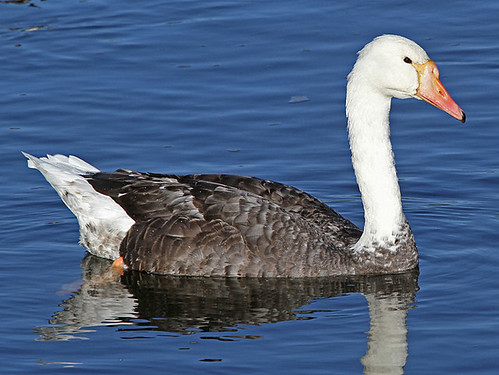
Swoose, Wool (Dorset), 24-Oct-10, originally uploaded by Dave Appleton.
Swoose? No I’d never heard the word either until today. But then I saw birder Dave Appleton’s superb image (reproduced above) and followed the link to his website where he describes a bird which is a hybrid of a swan and a goose … hence a “swoose”. In fact he is describing this bird; publishing several sets of photographs of it; and documenting its history.

Now I didn’t know either that swans could cross-breed with geese. (That’s two things I’ve learnt today!) But, although it is extremely rare, apparently swans and geese can interbreed. As Dave explains the offspring don’t usually survive to adulthood. However the bird pictured is known to have hatched in 2003 and was photographed by Dave last October, possibly having successfully bred itself.

Following the story on Dave’s website, it seems that the parentage of this bird is pretty well authenticated short of someone managing to get samples and do the DNA profiling. I hope that it is possible to get the DNA profiling done; the results would be extremely interesting to those interested in birds but also, I imagine, to academic zoologists. And it would be interesting too to see if the bird’s proposed parentage is correct. If nothing else this is an interesting puzzle and I’d like to say “thanks” to Dave for making all this information available.

Of course, there’s another rather interesting and deeper legal puzzle here. All Mute Swans (our native, resident British species) belong to the Queen and are as such protected. Geese however appear to be protected only during the closed season (February through August) and are thus treated as game birds like duck). But what is a Swoose? Is it a swan or a goose? Were these birds to become common and a pest (very unlikely, I know) I feel sure this would be a most interesting legal debate. Just don’t anyone dare go and shoot the bird in the meantime because …

Whatever the bird actually turns out to be it is a most handsome and interesting creature which deserves a lifetime of quiet observation and protection.

Labia minor

Labia minor is a good example of the unexpected surprises and humour which exist in the world of biological nomenclature. In this case the name applies not just to the “two longitudinal cutaneous folds on the human vulva” but is also the specific name for the Lesser Earwig.

Fortunately such eclecticisms are being collected by Mark Isaak at Curiosities of Biological Nomenclature. As Isaak says:

Scientific names of organisms are not usually known for their entertainment value. They are indispensable for clarity in communication, but most people skip over them with barely a glance. Here I collect those names that are worth a second look.

Some names are interesting for what they are named after (for example, Arthurdactylus conandoylensis, Godzillius), some are puns (La cucaracha, Phthiria relativitae), and some show other kinds of wordplay (such as the palindromic Orizabus subaziro). Some have achieved notability through accident of history, and many show the sense of humor of taxonomists.

If you’re interested in either biology or words it’s well worth a look. But prepare to be amazed for amongst the collected examples you’ll also find:

  • Unifolium bifolium (European May Lily); basically “single leaved plant with two leaves”
  • Abra cadabra (a clam)
  • Ba humbugi (a snail); from the Fijian island of Mba
  • Panama canalia (braconid fly)
  • Mozartella beethoveni (encyrtid wasp)
  • and of course Labia minor (Lesser Earwig); “small lips”; don’t ask why this would be appropriate for an earwig!

Isaak has even included an essential guide to the basic rules of biological binomial nomenclature. And a section on the (increasingly weird) names being given to genes – the well known gene sonic hedgehog isn’t the half of it!

My favourite? Well one of the best named is surely Boselaphus tragocamelus, an antelope (below) whose name translates from the Latin as “ox-deer goat-camel”. Clearly named, as well as designed, by a committee!

On Legalising Sex Work

In the UK, as in much of the English-speaking world sex work (selling sexual acts for money) is illegal, although there are naturally nuances of the law defining where the boundaries are. But this is not the case in many other countries and, somewhat surprisingly, it isn’t the case in the entire English-speaking world.

There’s an interesting article by Kate McCombs over at My Sex Professor about sex work in the Australian state of Victoria where it is both legal and regulated. And it isn’t as if Australia is any less puritanical than the UK or USA.

I’m not going to reproduce the whole of McCombs article (you can read it for yourself) but what follows is a summary with a few observations of my own.

To be legal sex workers must be consenting and over 18 which is achieved through registration of individuals, brothels and escort agencies. Street-based sex work is illegal for both worker and client but, of course, hasn’t been entirely eliminated – and frankly never will be. (Any legalised and regulated activity will always have someone prepared to work outside it, for whatever reason.)

All sex workers in Victoria are required to undergo monthly checks for chlamydia, gonorrhoea and trichomonas; and quarterly tests for HIV and syphilis. (You can’t enforce that without a registration system, which of course also has the side benefit that it brings the sex workers within the tax system!) Legal sex workers have significantly lower rates of all STIs than the general population of the state. What’s interesting is that the few STI cases which do occur among legal sex workers almost all derive from their partners and not from clients.

While there is still stigma and discrimination within the healthcare system this is an improving situation. State police are formally trained about sex worker rights and take charges against clients seriously. Consequently sex workers can make decisions based on their own safety without fear of legal reprecussions.

This is all supported by good education for the sex workers about their rights, navigating the health and legal systems, and what to do if they’re the victim of a crime. This education incorporates feedback from the sex workers themselves, which further helps drive the positive outcomes.

The police believe sex workers themselves (both legal and illegal) are one of the best resources for reducing trafficking, which remains illegal. Apparently sex workers do inform the police when coerced or underage work is happening in their areas.

Overall it seems that compared with the more normal prohibitive situation, the approach of Victoria has well researched public health benefits, based as it is on laws which help keep people safe and reduce stigma for both worker and client. Surely this has to be a better way forward?

A Two "Duh"s Day

Two, totally unrelated, oddities that have impinged on my eyes today.  The first is from BBC News:

Abbey Road zebra crossing from Beatles cover listed

This seems to be a nonsense. How do you list a zebra crossing? What is being listed? What is there now is not the same crossing as when the Beatles created Abbey Road: the road has been resurfaced, the zebra stripes repainted and zig-zigs added. Or is there to be an archaeological excavation to see if the Beatles’ era road surface remains? Or is the current road never to be resurfaced or repainted?

Secondly …

Mutant Mouse Chirps Like a Bird

“It’s furry like a mouse but sings like a bird […] It’s a mutant mouse developed by the genetic engineers at the University of Osaka that is able to tweet and chip like a bird, instead of a mouse’s normal squeak […] The research group currently has over a hundred singing mice […] it seems that they use their chirp in different ways than normal mice use their squeaks. The more conventional squeaks are used when a mouse is stressed, while the singing mouse seems to use its chirp in different environments, including in the presence of mates.”

Douglas Adams thou shouldst be living at this time!

Trapped Hosepipes

I’ve today spotted the following on PubMed. The mind boggles!

Removal of a Long PVC Pipe Strangulated in the Penis by Hot-Melt Method.
Jiatao J, Bin X, Huamao Y, Jianguo H, Bing L, Yinghao S.
Department of Urology, Changhai Hospital, […] China.

Abstract
Introduction. Penile incarceration for erotic or autoerotic purposes has been reported in a wide range of age groups, and often presents a significant challenge to urologic surgeons. No ready method has been reported for removing a polyvinylchloride (PVC) pipe entrapped on the penis. Aim. To present our experience in using hot-melt method to remove a constricted PVC pipe on the penis. Methods. A long melting split was made on the PVC pipe entrapped on the penis by using the long narrow branch of forceps heated on a gas stove. Results. The heated forceps was able to make a melt split on the PVC pipe. Consequently, the PVC pipe was removed by pulling the edges of the pipe apart without much difficulty. The total operation time was 20 minutes. Conclusion. Penile incarceration is a urologic emergency, for which resourcefulness is required in some unexpected cases. Hot-melting has proved to be an easy and effective method for removing penile strangulation by a PVC pipe. To our knowledge, it is the first report about the removal of PVC pipe entrapped on a penis.

Quotes of the Week

Just three this week …

It is good to rub and polish your mind against that of others.
[Michel de Montaigne]

Our life depends on others so much that at the root of our existence is a fundamental need for love. That is why it is good to cultivate an authentic sense of responsibility and concern for the welfare of others.
[Dalai Lama]

I’m selfish, impatient, and a little insecure. I make mistakes, I’m out of control and at times I’m hard to handle, but if you can’t handle me at my worst, then you sure as hell don’t deserve me at my best.
[Marliyn Monroe]

Quotes of the Week

A rich vein of quotes this week. Here are some of the best …

A committee is a cul-de-sac down which ideas are lured and then quietly strangled.
[Sir Barnett Cocks]

It is a primitive form of thought that things either exist or do not exist.
[Sir Arthur Eddington]

We [doctors] do things, because other doctors do so and we don’t want to be different, so we do so; or because we were taught so [by teachers, fellows and residents]; or because we were forced [by teachers, administrators, regulators, guideline developers] to do so, and think that we must do so; or because the patient wants so, and we think we should do so; or because of more incentives [unnecessary tests (especially by procedure oriented physicians) and visits], we think we should do so; or because of the fear [by the legal system, audits] we feel that we should do so [so called covering oneself]; or because we need some time [to let nature take its course], so we do so; finally and more commonly, that we have to do something [justification] and we fail to apply common sense, so we do so.
[MS Parmar, “We do things because”, British Medical Journal Rapid Response, 2004, March 1 quoted in Imogen Evans, Hazel Thornton & Iain Chalmers, Testing Treatments: Better Research for Better Healthcare]

A wise man makes his own decisions; an ignorant man follows public opinion.
[Chinese proverb]

I am proud that our country remains the scourge of the oppressed. Freedom is once again on the march, as the good people of America join together to wave it goodbye.
GEORGE W BUSH
[Craig Brown; The Lost Diaries]

Born to American-Indian parents, he spent his formative years in abject poverty in Ireland, nibbling on crusts in a tepee in the exclusive slum area of Limerick. Though there were no books in the family home, he occupied his childhood reading the tepee’s assembly instructions over and over again, and in this way gained an unsurpassed command of the English language, as evidenced by his early Tepee Trilogy: Lay the Fabric Flat (1968), With the Long Side Facing Up (1972) and Now Set the Pole in an Upright Position (1975).
[Craig Brown; dust-jacket of The Lost Diaries]

Maturity is only a short break in adolescence.
[Jules Feiffer]

Marriage isn’t a passion-fest; it’s more like a partnership formed to run a very small, mundane, and often boring non-profit business. And I mean this in a good way.
[Lori Gottlieb]