
Learn the rules so you know how to break them properly.
[Dalai Lama]
All posts by Keith
Horrible Times 12: Business doesn’t Matter
I’m thinking, again, about Covid-19 and the overall scheme of things.
What I suspected long long ago is still true.
No-one gets it! Not just the government, but YOU, out there 🠞 🠟 🠜 🠝 🠞
In the overall scheme of things, BUSINESS DOESN’T MATTER!
Yes, that’s right: protecting business, in these troubled times, is NOT the first, or even a high, priority.
What has to be done is to protect, and look after, the people. Get the people through this pandemic. And do that at the expense of almost anything else!
Yes, that’s a draconian – and no doubt unpopular – view. And I make no pretence it will be easy or comfortable.
But look at it this way … Businesses are expendable. It doesn’t matter if they fail. Businesses can be rebuilt, started afresh, etc. but only if there are people there to do it. There is no point in having a business if there is no-one there to run it or buy from it. And if the people are there then at least a core of businesses will survive. And when all this is over those surviving businesses can grow to fill the new demand, along with new start-ups and resurrections.
Business is secondary to people. No people = No business.

Yes, OK, there are a core of businesses which are essential: specifically utilities (water, electricity, gas, sewerage, rubbish collection), food supply (farm to shop), healthcare (drugs, doctors, hospitals), and transport (haulage, some public transport, fuel).
Beyond that it isn’t important if pubs, restaurants, car manufacture, garden centres, tailors, fashion houses, gunsmiths, jewellers, publishing, and so on, cease. It doesn’t matter if I can’t buy Epsom salt, a mousetrap, or a new camera. All these can, and will, be rebuilt to the extent that the post-pandemic world, and it’s population, needs them and there are people to work them. If there aren’t the people (either as employees or customers) then the business isn’t viable.
Even education (all of it from kindergarten to university) isn’t essential. Yes, we need educated people, because educated people feed business. But missing a year or two won’t be a tragedy, as many who’ve been long-term sick demonstrate. You can catch up on education later. Although again it may not be easy or pretty.
People’s ability to survive has to be supported and protected, first and foremost.
So wake up governments. People first. Then education. And business later.
Jersey Tigers
As any of my readers who follow me on Facebook know, a few days ago I had a beautiful Jersey Tiger Moth (Euplagia quadripunctaria) in the garden; in fact feeding on our buddleia. As my photograph shows, these are very distinctive creatures.

I love seeing them, not just for their beauty but also because they are a success story of something extending its range.
As you might guess from their name they originate (as far as the British are concerned) in the Channel Islands, although their range extends across much of Europe and western Asia.
Until relatively recently the moth was absent from the British Isles. However they are now found along the southern coast of England: first in Devon, then Cornwall. While some moths are likely migrants from the Continent (or Channel Islands), they clearly are now breeding here as they have extended their range to much of southern England and London.
The first one I saw was in Lyme Regis, on the border between Devon and Dorset. It was sitting, bold as brass, on a bedding plant in a park. This was in 2006. Since then I’ve seen an odd specimen most years here in west London, and this year I have a couple of other reports of the moth in the local area. On Twitter there are lots of recent reports of sightings from around southern England; I’ve even seen a mention by one enthusiast with a moth trap who had over 3 dozen trapped one night recently. (Of course I can’t now find that post!) They do seem to be becoming more common and spreading slowly northwards – too much for them all to be migrants.
For the UK they’re a fairly large moth, with a wingspan of 50-65mm. Like most moths they fly largely at night, although they do fly during the day. I spotted the one I photographed because of the movement of its flight. They do also seem to have a habit of resting in the open in rather conspicuous places on leaves, tree trunks etc.; presumably they rely on their warning colouring for protection, if not camouflage.
As well as the bold black and white forewings, their hind wings are a bright reddish-orange. There is though a colour morph with yellow hind wings; and a melanistic form with all black forewings.
Now instinct says that such a boldly coloured moth would be a garden pest, but actually they aren’t. The larvae feed on a wide variety of plants such a nettles, raspberries (OK not so good that one), dandelion, dead-nettle, ground ivy, groundsel, plantain, and more. The larvae are mostly black and (often gingery) brown and hairy. They overwinter as small larvae. The moths are generally on the wing from mid-July to early-September.
What I find interesting is that every image of a Jersey Tiger I’ve ever seen appears to be female. How do you sex a moth? Well with most species the males have frilly antennae to pick up the female’s pheromones – because shagging, y’know! But there are exceptions to the rule and wonder if the Jersey Tiger is one of them.
You would think that something this highly coloured and day-flying would be a butterfly. But no, there are day-flying moths. And there’s an easy way to tell a moth from a butterfly: butterflies have small knobs on the end of their antennae; moths don’t. Again I’ve no doubt there are exceptions, but I don’t off-hand know of one.

Don’t confuse the Jersey Tiger with the Garden Tiger Moth (right) which has more broken, less linear, patterning to the forewings and a brown furry head. The caterpillar of the Garden Tiger is what we always knew as kids as a Woolly Bear. Garden Tigers do seem to have become much less common over the last few decades. There’s also the Scarlet Tiger Moth in UK, but that is even more different, is around earlier in the year, and is quite locally distributed.
As always there is a lot more information on the internet and Wikipedia is as good a place as any to start.
On Cooking and Recipes
A few days ago, over dinner, we were discussing food (as you do) and Noreen happened to comment that I am a good cook. The word “imaginative” was also used. Well, I’m not so sure.
I’m certainly an competent and adequate cook. I can provide a good range of simple main courses (roasts to steak to curry) without having to think about it; as witness the recipes etc. posted here over the years. Similarly I can do some basic starters (including home-made terrine), and simple tarts and pies; plus some outliers such as parmesan biscuits, cantuccini and chutney. I can do variations on all this without the need for a recipe – except for the occasional inspiration and if I (unusually) decide to do anything like cake which needs precision.
However I have no formal training; just what I’ve picked up from my mother, odd friends, Noreen and the occasional cookery book. There are many things which I’m sure I don’t do “the right way”; and there are many things I don’t/won’t do. I don’t do fancy, pretty, cake and patisserie, nor anything “tricky” like soufflé. Yes, I probably could do all these, but they’re things we’re happy to keep for eating out occasions – why go out to eat what you can do easily and as well at home? My method is basically quick, easy and wholesome; and preferably low sugar and salt. In many ways what the French would term “cuisine grand-mère”.
Even as an undergraduate I was an adequate cook. In student residences each of our kitchens had a Baby Belling, so of course I heard lots of myths about what you couldn’t do with one: you can’t do jacket potatoes, or pastry or bread in a Baby Belling. I was confident enough to disprove every one of those myths. Obviously I’ve improved over the ensuing 60-ish years.
However, I am definitely not competent to even consider going on “Masterchef” or “Bake Off”. Nor would I want to. I dislike cooking under pressure; I couldn’t turn out intricate, fancy food at the drop of a hat; I likely don’t do things the approved way; and I hate the pretentiousness of it all.
Even leaving the pressure aside, I wouldn’t want to have to cook for large numbers, nor in a restaurant. I couldn’t turn out the same dish, 27 times every evening, and ensure they’re all exactly the same. That’s not the way I work; variety is built in to my method.
I proved most of this to myself on Sunday evening when we had Salmon en Croûte with sugar-snap peas and tartare sauce; followed by Apricot Frangipane, Peach and Blackberry Tart with cream. OK, so having found a brand we like the Tartare Sauce came from a jar, the puff-pastry was (good, Jus-Rol) commercially produced, likewise the cream.
Starting a 6.30 the salmon and the tarts were in the oven before 7 and we were eating by 7.30. And that included sitting twiddling my thumbs for 15 minutes while Noreen fed the cats. This is what I did …
Salmon en Croûte
I knew we had a (500g) block of puff pastry in the fridge which needed to be used. Some weeks back the supermarket were selling packs of 2 salmon tail fillets at “3 for £10”, so we bought 6 packs, used 2 and put the other 4 in the freezer. One pack was defrosting now. I knew that wrapping the salmon would need no more than half the pastry. And so it was: half the pastry rolled out, wrapped round the two salmon fillets, which were stacked head to tail, and sealed. About 30 minutes in the oven (pre-heated to 220°C/200°C fan/gas mark 7). Sugar-snap peas take 5 minutes in the steamer. No need for potatoes as there’s plenty of carbs in the pastry. And served with a bottle of Crémant de Bourgogne.
Tarts
So how to use the other half of the pastry? I knew we had about ¼ jar of (commercial) apricot compote in the fridge. Thinking this would be too runny just to make “jam tarts” I figured that I could mix it with a roughly equal amount of ground almonds to make a frangipane-like paste. The pastry made 3 (9-10cm) tart cases in a Yorkshire pudding tin. Two of these were filled with the apricot mix. I added half a peach, some freshly-picked blackberries, a sprinkle of flaked almonds, and a tiny sprinkle of sugar to each. (The third tart case was filled with plain blackberries.) Again 20-30 minutes in the oven – in fact they came out at the same time as the salmon, so were still nicely warm when eaten. Served with double cream and a tot of Amaretto. Here’s one, literally just out of the oven …
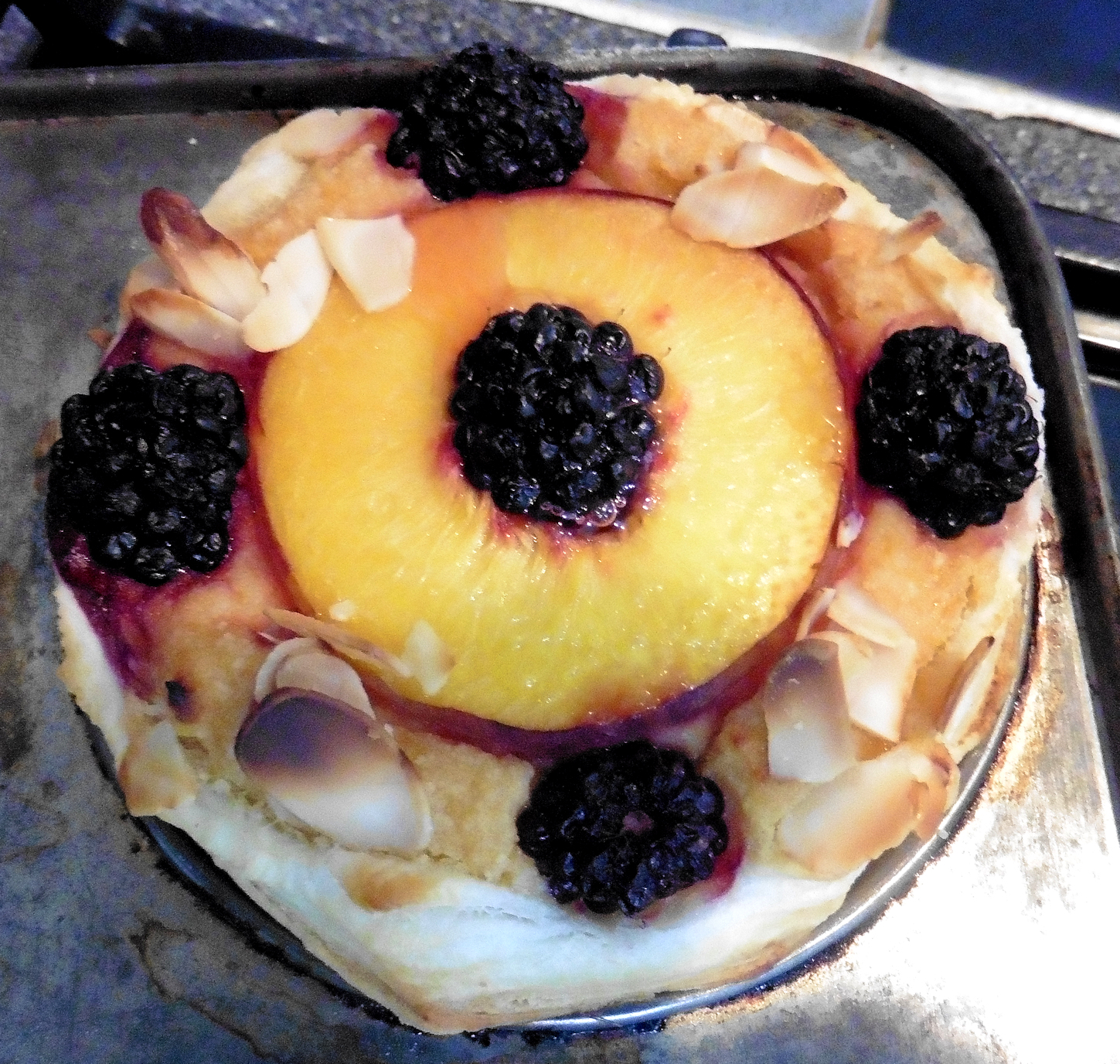
Noreen’s comment was “I’ve eaten much, much worse in good restaurants”. And for once I was forced to agree: it was simple, quick, and used what was available; and it worked magnificently well. It wasn’t prettily presented, but it was good.
Yes, it could have been improved. I used too much pastry on the salmon. The salmon would have benefited from another veg or two to add some variety. The “frangipane” could have done with a little lift: Noreen suggested a shot of apricot or cherry brandy, I was thinking maybe some almond essence. I shall undoubtedly do both again.
So OK, I concede: maybe I am a good, everyday, cook; with the imagination to do variations. As Noreen often comments: compared with my mariner great-great-grandfather (c.1820-1905) we are living like the gentry. It’s one good thing lockdown has done: we’re actually eating better than we were before (and not putting on weight!). It’s something we can take pleasure in to get us through all the current mess.
August
We’re beginning every month this year with a haiku (or a longer poem made of haiku) relevant to the month.
song of green
leaves soak summer sun
rustling wind sings song of green …
still shade serenades
[Subimal Sinha-Roy ]
All the poems can be found online at http://www.haikupoemsandpoets.com.
Monthly Interesting Links
Once again we come to our monthly collection of links to items you missed the first time round and which you’ll find interesting. This month we have a well packed collection (lots of science and lots of history), so it’s straight in the deep end.
Science, Technology, Natural World

Astronomers still think there’s a large planet out beyond Pluto, so of course they’re still hunting for it (artist’s impression above).
So when you have this new vaccine how are you going to package it? Pharmaceutical Chemist Derek Lowe takes a look.
Many plants have stingers (think, stinging nettles), and it seems they have achieved optimal pointiness. [£££]
Oh dear! It seems likely the world’s smallest dinosaur is a lizard. [£££]
Ornithologists are revealing the long-distance travels and longevity of British birds.
Scientists still don’t know how birds navigate, though it is likely magnetic and they’re narrowing down the options.
30 years ago Red Kites were reintroduced to the Chilterns to the west of London, and this has proven to be a huge conservation success. (I’m 30 miles east of the release area, and in suburban London, and I now regularly see Red Kites over this area.)
Where have all our swifts gone? Are they on the Grand Tour?
There’s a growing realisation that old paintings can provide valuable information about agriculture both livestock and arable. [£££]
Here’s a brief look at the chemistry of cat allergies, catnip and cat pee.
Health, Medicine
How on Earth do you do surgery in the weightlessness of space without having bits of body floating around?
I find this hard to believe, but seemingly damaged human lungs can be revived for transplant by connecting them to a pig. [£££]
Researchers are worried that a new swine flu identified in China has pandemic potential.
Researchers are also looking at the potential for using magic mushrooms to help ex-soldiers overcome trauma.
Art, Literature, Language
Where are the bones of Hans Holbein? Jonathan Jones went looking, but we still don’t know. [LONG READ]

An astronomer has finally(?) pinpointed the exact date and time of Vermeer’s “View of Delft” (above).
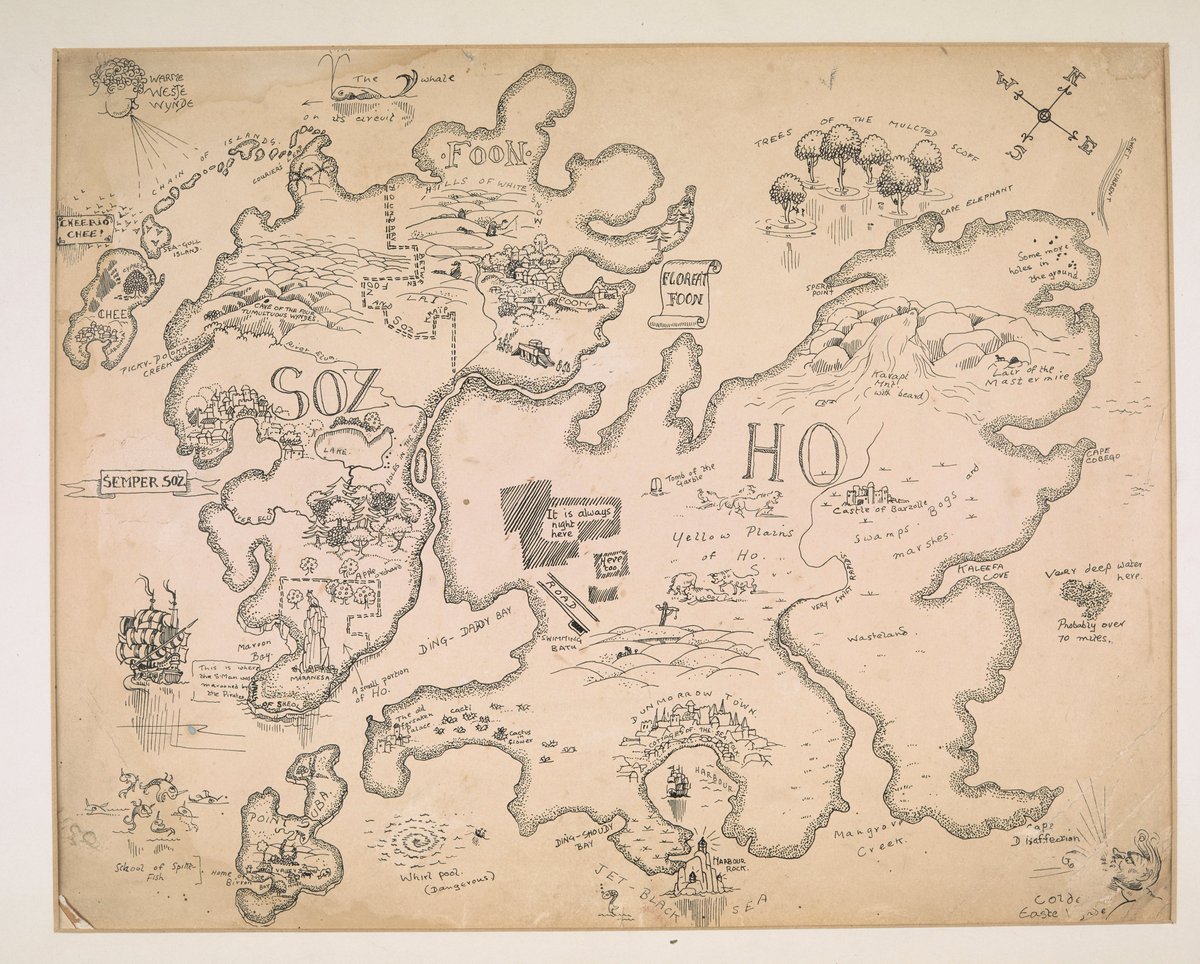
The British Library has acquired an important archive of Mervyn Peake‘s original illustrations, preliminary drawings and unpublished early works (example below).
History, Archaeology, Anthropology
Archaeologists have uncovered stone tools which they believe show that humans occupied the Americas around 33,000 years ago – that’s over 10,000 years earlier than previously thought.
Work on the UK’s HS2 rail link has unearthed the skeleton of a possible iron age murder victim.
Drinking games have a long history. Michael Fontaine, in History Today, takes a look.
 So how old is the Cerne Abbas Giant (right)? New archaeological thinking by the National Trust suggests it is not prehistoric.
Our favourite medieval historian, Dr Eleanor Janega, takes a look at colonialism, imperialism, and the perils of ignoring medieval history. [LONG READ]
Going Medieval also take a brief look at the medieval obsession with the Moon.
A look at the symbolism of the medieval haircut. Scissors or sword, Sir?
Coming closer to our time, apparently Georgian London was a haven for sexual diseases.
Even closer to home, a look at what happened on the morning of the first nuclear test in 1945. [LONG READ]
And almost up to date, the purrrplexing story of the British Museum cats.
ARCHI is a UK archaeological site containing old maps (largely Victorian, it seems) which you can overlay on the current map to see what was there before we were.
London
Here are two pieces from the History of London on the area to the east of the Tower of London. First, the St Katherine’s area, and second the development of the area around Stepney.
Going Medieval (again) introduces us to the magnificent Agas Map of London (it’s detailed and zoomable!) as well as the lfe of medieval and early modern cities. [LONG READ]
Lifestyle, Personal Development, Beliefs
And finally for this month … Dungeness is one of my favourite places and the late Derek Jarman’s cottage and garden (thankfully saved for the nation) is an absolute delight (below). Now there’s an exhibition about Jarman’s garden at the Garden Museum in London.
Monthly Quotes
Here is this month’s selection of interesting or amusing quotes. In no particular order …
Grassi, in theorizing about heat, relied on … ancient authors when he claimed that Babylonians could cook eggs by whirling them around at the ends of slings … Galileo’s retort … translates to: “If we do not achieve an effect which others formerly achieved, it must be that we lack something in our operation which was the cause of this effect succeeding, and if we lack one thing only, then this alone can be the true cause.”
The ball thus teed up, Galileo swings away: “Now we do not lack eggs, or slings, or sturdy fellows to whirl them, and still [the eggs] do not cook, but rather cool down faster if hot. And since we lack nothing except being Babylonian, then being Babylonian is the cause of the egg hardening.”
[Steve Mirsky; Scientific American; 07/2020]
What is to be expected of [the English ruling class] is not treachery, or physical cowardice, but stupidity, unconscious sabotage, an infallible instinct for doing the wrong thing. They are not wicked, or not altogether wicked; they are merely unteachable.
[George Orwell, 1941]
Mr Speaker the figures I gave that the Prime Minister says are inadvertently misleading are the slide at his press conference yesterday!
[Keir Starmer MP, at PMQs, 24 June 2020]
To think that we are supposed to live this life without asking for help and without being interconnected is insanity.
[Amanda Palmer]
There is no cure for birth and death save to enjoy the interval.
[George Santayana (1863-1952)]
O sophisticated drinkers –
you unthirsty thyrsus-linkers
down your rounds, ignore the blinkers,
bent on being wineglass-clinkers! …
If you can’t brook a libation,
get out of our celebration!
Out! Begone! Why in tarnation
Stay? We don’t host moderation.
[Carmina Burana]
The custom of shaking hands originated in the ancient and universal practice of grasping the weapon hand during a truce as a precaution against treachery. So we see that from a comparatively dark and illiterate period a custom having a rational origin, which rationale dwindled into nothingness during its spread and migration through successive centuries, was ushered into our glorious civilization, unnecessary in its essence, devoid of all intelligence, and positively injurious to public health.
[Nathan Breiter, Medical Record, 1897]
Extremely into this explanation of sinning by senses from the 15th century Krumlov Miscellenea: “[I have sinned b]y my hands, touching my body wrongly and vainly or touching other persons’ breasts or crotch forcing to commit an evil act, arousing myself or someone else to sin.”
It’s a great reminder of the idea of the conception of the contagious nature of sex. You grab someone’s crotch and BLAM, they pretty much have to have sex because that is just way too hot. (At least that is what happens when I do it.)
But it is also a great reminder of the medieval conception of sodomy, (or what we would call foreplay cuz we basic), as medieval people were like “Hell yeah hand stuff? That is the sex worth risking the death of my immortal soul for.”
[Dr Eleanor Janega, @GoingMedieval, on Twitter]
I think there’s something fundamentally disrespectful about someone who can’t be bothered to take their socks off if they think they’re going to get some.
Make a bloody effort … It’s all very well jumping on your Raleigh Chopper with a come hither look in your eye, but if … you’ve got your football socks and Birkenstock on, it’s a stone cold passion killer and no mistake.
[Katy Wheatley]
It does not make any difference how beautiful your guess is. It does not make any difference how smart you are … if it disagrees with experiment it is wrong.
[Richard Feynman]
The whole country was lighted by a searing light with the intensity many times that of the midday sun. It was golden, violet, grey and blue. It lighted every peak, crevasse and ridge of the nearby mountain range with clarity and beauty that cannot be described but must be seen to be imagined.
[Brigadier General Thomas Farrell, on the Trinity nuclear test, 1945]
Being wrong is not a bad thing like they teach you in school. It is an opportunity to learn something. There are no mistakes, only lessons. Growth is a process of trial and error.
If you cannot explain something in simple terms, you don’t understand it. The best way to learn is to teach.
[Richard Feynman]
Horrible Times 11
Today is Day 125 of my house arrest. Yet again not a lot has changed since my report on day 100.
At a country level we continue our journey to Hell in a handcart, thanks to the lies and selfishness of our so-called government. Yes, you’re right, I have absolutely no respect or trust in any of them. And a large swathe of the British public continue in their stupidity. But hey, we’re doing well; the USA is far worse, they’re totally out of control is what it looks like from here.
At a more personal level we continue muddling along through lockdown. Procrastination and depression seem to be the order of the day, although nice sunny days do bring some noticeable relief, even if it is temporary. Nonetheless too many things are not getting done, and it seems to be impossible to unlock the wheels.
So, a few things (good and not so good) that have happened since my last report on day 100.
| Good | Not So Good |
|
|
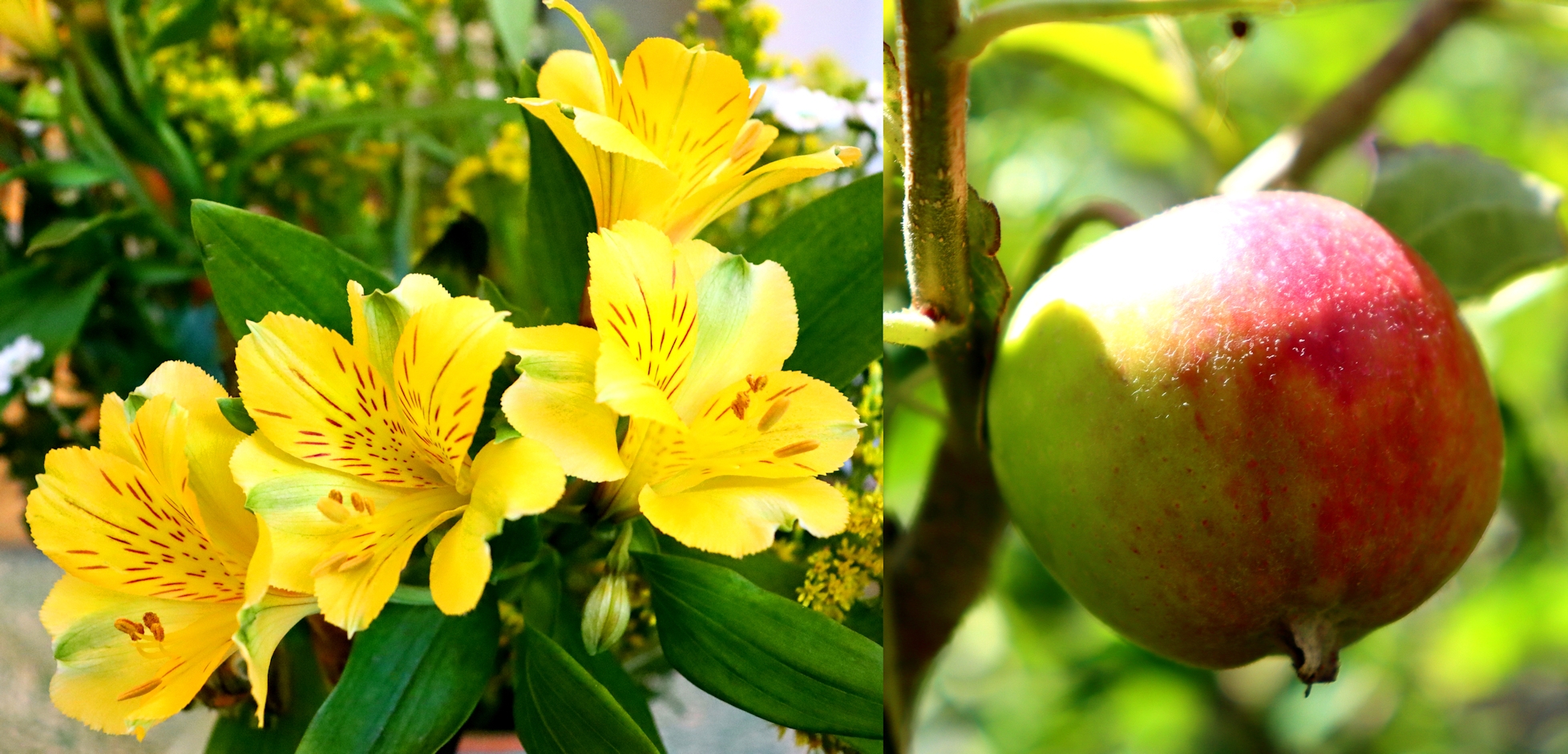
Right: One of the first apples on our new trees.
Talking to people in the healthcare arena they’re saying that little is going to loosen up (at least in terms of the way healthcare is operating at present) until there is a good Covid-19 vaccine in widespread use. Their, and my, assessment is this isn’t going to be until at least the end of 2021. So don’t hold your breath.
I still reckon we’re going to see quite a bit in the way of a second wave starting in August; fuelled by the indigenous idiots going out on the town (restrictions now having been eased); returning from holiday in “who knows where”; and schools going back in September. This second wave could well continue up until Christmas. I just hope I’m wrong!
So, like many, I’m getting to the point where the outside world is just too scary; and all in all I expect to stay in isolation for a while to come.
But with luck things might have improved by the time of my next report, which I’m scheduling for Day 150. Meanwhile, be good and enjoy the summer as best you can in safety.
Recipe: Using Pastry Offcuts
This is number 3 in the “rusticated tart” recipe series; see Rusticated Fruit Tart and Rusticated Veggie Tart.
It is worth using your pastry offcuts, especially if you’re doing a big bake and have a number of offcuts.
Although re-rolling the pastry doesn’t do it many favours, it doesn’t matter too much for these free-form, informal, snacks. I’m assuming puff pastry, but shortcrust would work too; obviously you’d not want to re-roll filo pastry sheets.
I guarantee these will not hang around for long – hence no pictures!
Here are two options:
Mini Fruit Turnovers
They make a nice little amuse bouche with your morning coffee.
- Re-roll the pasty and cut into rough 5cm squares.
- In the middle of each square put a slice of fruit (or a strawberry, or 2-3 raspberries; you get the idea).
- Egg-wash the pastry and fold the edges over.
- More egg glaze and sprinkle with a couple of pinches of sugar.
- Bake for 20-30 minutes until golden.
Simple Cheese Palmiers
These make a yummy snack at any time!
- Re-roll the pastry to make a rough oblong about 10 wide.
- Sprinkle liberally with grated cheese, and if you wish a good grind of black pepper or some chopped herbs.
- Fold both long edges to the middle and then fold the two halves together.
- Cut into 5-10mm slices and lay flat on a baking sheet.
- Bake for about 20 minutes until the cheese is running and the pastry browning.
Enjoy!
Recipe: Rusticated Veggie Tart
So following on from yesterday’s recipe for Rusticated Fruit Tart, here’s how I did a veggie version. It’s quite like the fruit tart, but obviously not sweetened.
Serves: 4 as a main course or 6-8 as a starter
Preparation Time: 15-20 minutes
Cooking Time: 30-40 minutes
Ingredients
- 500g packet of puff pastry
- A good quantity of “summer” vegetables (see below)
- 2-3 handfuls of grated hard cheese (cheddar or a cheddar/parmesan mix)
- 2 tbsp olive oil
- Fresh ground black pepper
- 1 egg, beaten (or some milk)
For the veg I used 2 yellow peppers, 8-10 cherry tomatoes, a fennel, 3 large mushrooms, small red onion, 2 cloves of garlic. You could also use chopped fresh herbs (thyme would be good), aubergine, courgette, celery, leeks. Of course, if you want a non-veggie version you could always add some chopped bacon.
Go easy with the cheese but don’t be mean. While you want enough for good flavour, too much cheese will make the tart too greasy.
Instructions
- Preheat the oven to 220℃/200℃ fan/gas mark 7.
- Prepare a baking sheet and cover with baking parchment.
- Prepare the veg much as you would for doing roast vegetables (just cut a bit smaller). Cut into pieces to roughly match the cherry tomatoes or 2cm pieces. Roughly chop the garlic (and any herbs). Put in a food bag with black pepper to taste and the olive oil. Shake up to get the veg coated in oil.
- Roll out the pastry to form a rough circle the size of the baking sheet (or slightly bigger; it doesn’t have to be precise) and transfer to the baking sheet.
- If the pastry has come out square-ish, snip off the corners to make something rounder, otherwise you end up with too many thick folds of pastry. Keep the pastry offcuts!
- Paint the pastry liberally with the egg.
- Sprinkle about 2/3 of the grated cheese in the centre of the pastry leaving a 3-4cm border around the edge.
- Pile the veg on the cheese. If you think you have too much veg, you haven’t as it will cook down.
- Fold the edges of the pastry up and over the veg to form a tart. Try to get some veg inside the fold so it isn’t just pastry!
- Brush the edge of the tart with the egg. And if there’s any egg left over sprinkle it over the veg.
- Top with the remaining cheese.
- Bake for about 30 minutes until the pastry is crisp & golden, the veg cooked and the cheese browning.
- Serve either hot or cold with a good white wine.
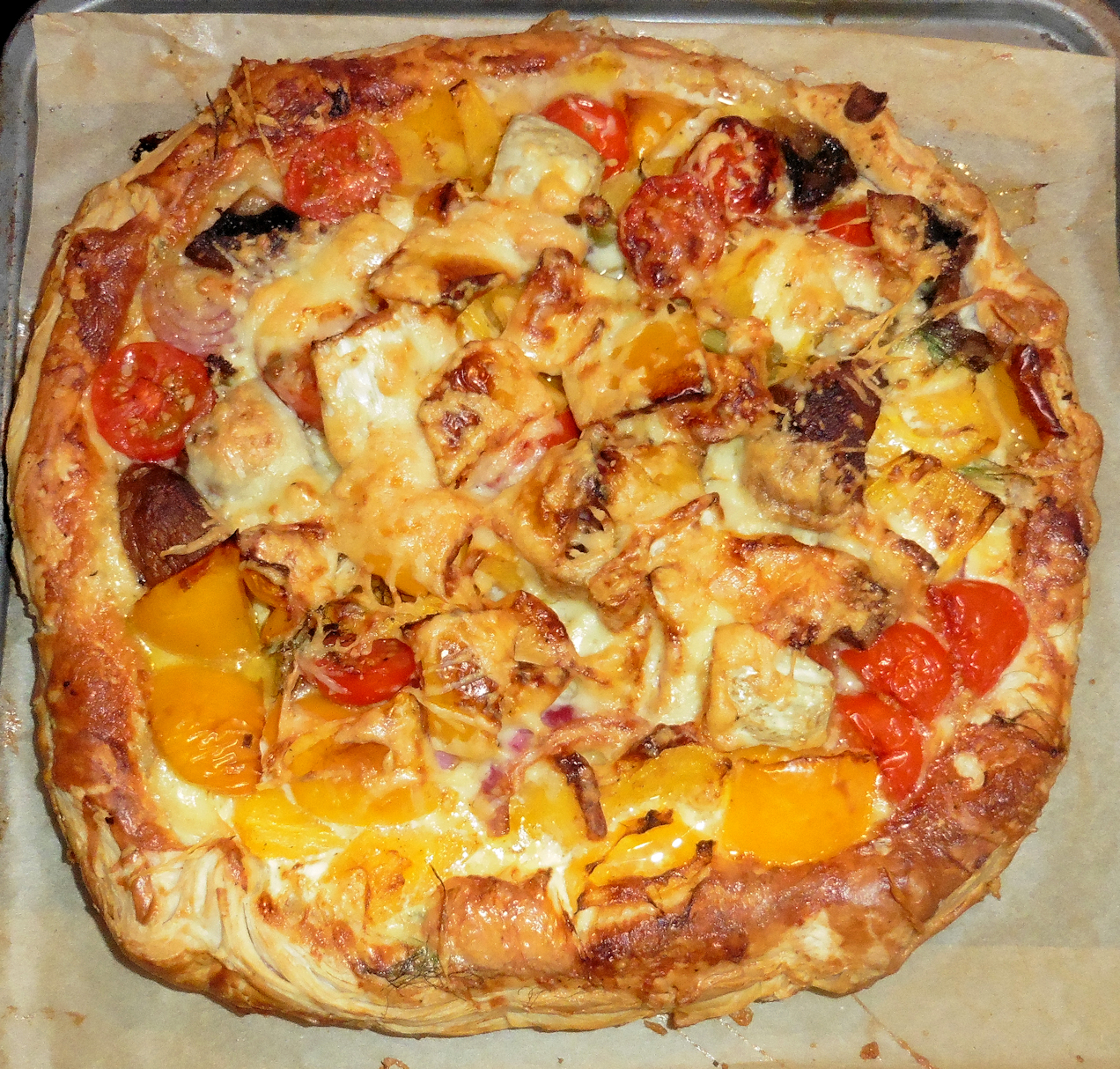
Here’s one I made earlier, fresh from the oven.
Tomorrow, what to do with those pastry offcuts.