
Yet another selection of recently encountered bon mots.
If people never did silly things nothing intelligent would ever get done.
[Wittgenstein]
What is true during dreamless sleep is true no matter whether you can recall the experience and write about it or not. What is true in a whorehouse in Bangkok is true whether you visit it and take Polaroids or not. What is true for six-legged aliens on the fifth planet circling Epsilon Centauri is true whether you go there and talk to them or not. You may never know the life your toothbrush leads when you’re not around but it’s certainly real.
[Brad Warner; Hardcore Zen: Punk Rock, Monster Movies and the Truth about Reality]
Man is the religious animal. He is the only religious animal. He is the only animal that has the True Religion, several of them. He is the only animal that loves his neighbour as himself and cuts his throat, if his theology isn’t straight.
[Mark Twain]
To have his path made clear for him is the aspiration of every human being in our beclouded and tempestuous existence.
[Joseph Conrad]
He isn’t a household name even in his own living room.
[David Mellor]
Every scar comes with a story, a memory. Our scars make us who we are. And I’m not only talking about physical scars. We have many scars on our heart and in our mind. Some of these we proudly show off as a sort of trophy of our accomplishments. Others we prefer to keep hidden … every scar has changed the course of our life and is proof of what we’ve been through and what we’ve endured and made it through.
I wouldn’t change one scar. While there are things in my life I wish I would’ve handled differently or avoided altogether, I can never regret those decisions or experiences because they have made me who I am. And I’m OK with that.
[Stephanie Hughes at The Stolen Colon]
As the scholar Paula Arai wrote in a review of Richard Jaffe’s book on clerical marriage, “Men escape domestic duties by marrying. Women escape domestic duties by taking monastic vows!”
[Gesshin at That’s So Zen]
What some people don’t understand is that naturism is designed to heal negative body image. It’s the truest form of body acceptance.
[Steve White on Twitter]
Intuition is the universe telling you what you really want to do. The problem is that we have been taught since birth to drown out our intuition with thought before we can really even understand what those intuitions are.
[Brad Warner; There is No God and He is Always with You]
Water is the softest thing, yet it can penetrate mountains and earth. This shows clearly the principle of softness overcoming hardness.
[Lao-tzu (thanks John Monaghan)]
The Sage falls asleep
Not because he ought to
Nor even because he wants to
But because he is sleepy.
[Lao-Tsu]
At all costs, the Christian must convince the heathen and the atheist that God exists, in order to save his soul. At all costs, the atheist must convince the Christian that the belief in God is but a childish and primitive superstition, doing enormous harm to the cause of true social progress. And so they battle and storm and bang away at each other. Meanwhile, the Taoist Sage sits quietly by the stream, perhaps with a book of poems, a cup of wine, and some painting materials, enjoying the Tao to his hearts content, without ever worrying whether or not Tao exists. The Sage has no need to affirm the Tao; he is far too busy enjoying it!
[Raymond Smullyan, The Tao is Silent]
The Tao does not talk. That’s another reason I like the Tao so much; it doesn’t talk! I hate people who talk too much. When I’m in company, I like to be the one to talk; others should just respectfully listen!
Is it not marvellous that I can talk to the Tao to my heart’s content, and the Tao never contradicts me or answers back? The Tao never criticizes me for being egocentric or talking too much.
When I talk about talking to the Tao, the more sophisticated and psychoanalytically oriented reader will say that I am not really talking to the Tao, I am really talking to myself. But this is not so! Since all words come from the Tao, my talking to the Tao is not really me talking to myself but the Tao talking to itself! So, you see, the Tao talks to itself. Yet the Tao does not talk, it is silent! Is this not a remarkable paradox?
[Raymond Smullyan, The Tao is Silent]
In a rare uncalculating moment, Boris Johnson wrote last year that, if Britain finally ended its “sterile debate” over Europe by leaving the EU, it would quickly discover “that most of our problems are not caused by Brussels, but by chronic British short-termism, inadequate management, sloth, low skills and a culture of easy gratification and under-investment”.
[Michael White; What if Britain left the EU?; Guardian; 04/11/2014]
All posts by Keith
Oddity of the Week: Fannies
You just could not get away with this these days!
From: 22 Vintage Adverts That Would Be Banned Today. Look at the other adverts in this series; they’re American but they’re a total hoot!
Book Review: There is No God …
Brad Warner
There is No God and He is Always with You: A Search for God in Odd Places
New World Library, 2013
 Brad Warner is an American Sōtō** Zen master, and monk, who lives in the world. He has been practising and studying Zen since 1983 in America and Japan. This is his fifth book looking at various aspects of Zen, what it is and how it works for him in the world rather than in an enclosed monastery.
Zen does not require belief in a god, or gods, or an afterlife, or any of the trappings of the Abrahamic religions (Christianity, Judaism and Islam), Hinduism or many of the other Buddhist traditions. Warner’s assertion is that Buddhism, as a philosophy and way of life rather than a religion requiring faith, has no need of god(s); those “mainstream Buddhism” has have been bolted on over the centuries. In this sense the Zen schools are truer to the original way taught by Gautama Buddha.
And yet Warner says there is a god. Not the Santa Claus figure sitting on a white cloud of the Abrahamic religions; nor the pantheon of Hinduism. God is much more nebulous, not really there at all, certainly not an identifiable figure, and yet is everything and always. To me this seems an essentially pantheistic view, but one emanating from much deeper: from Warner’s enlightenment.
 This book looks at a variety of aspects of this god; at what some of the Zen teachings say; and where Warner says they have hitherto been poorly interpreted. The book also looks at the ways and times Warner has encountered this god in the world. He also touches on the philosophical concepts of the meaning of life and the afterlife. Unsurprisingly there is a lot of Brad Warner in the book as he develops nearly all the 22 short chapters from a real worldly experience.
Warner has a light, readable style, which means you can read this book quickly and at a superficial level, as I admit I have mostly done. While the book is an easy read I didn’t find it as captivating as his previous books. That’s not to say it doesn’t make one stop and think from time to time, and I feel sure it would repay another, deeper, reading as Warner packs a lot into just under 200 pages.
If you’re interested in Buddhism, Zen or comparative religion this is worth a read. Who knows, it may even lead you to enlightenment.
Overall Rating: ★★★☆☆
** Forget about the tricks of Zen koans; these are the teaching methods of the Rinzai school of Zen. Sōtō Zen (founded by Dōgen in the 13th century) is more about using pure meditation to discover things for oneself.
Weekly Photograph
Saturday was the Anthony Powell Society quarterly London Pub Meet at the Audley in Mount Street, just off Park Lane. Although attended by fewer than usual we had a jolly time with the some fun and eclectic discussion accompanied by a few beers and some food. And it is the food which brings this week’s photograph for we discovered one of our number about to demolish his, rather dilapidated, chapeau.
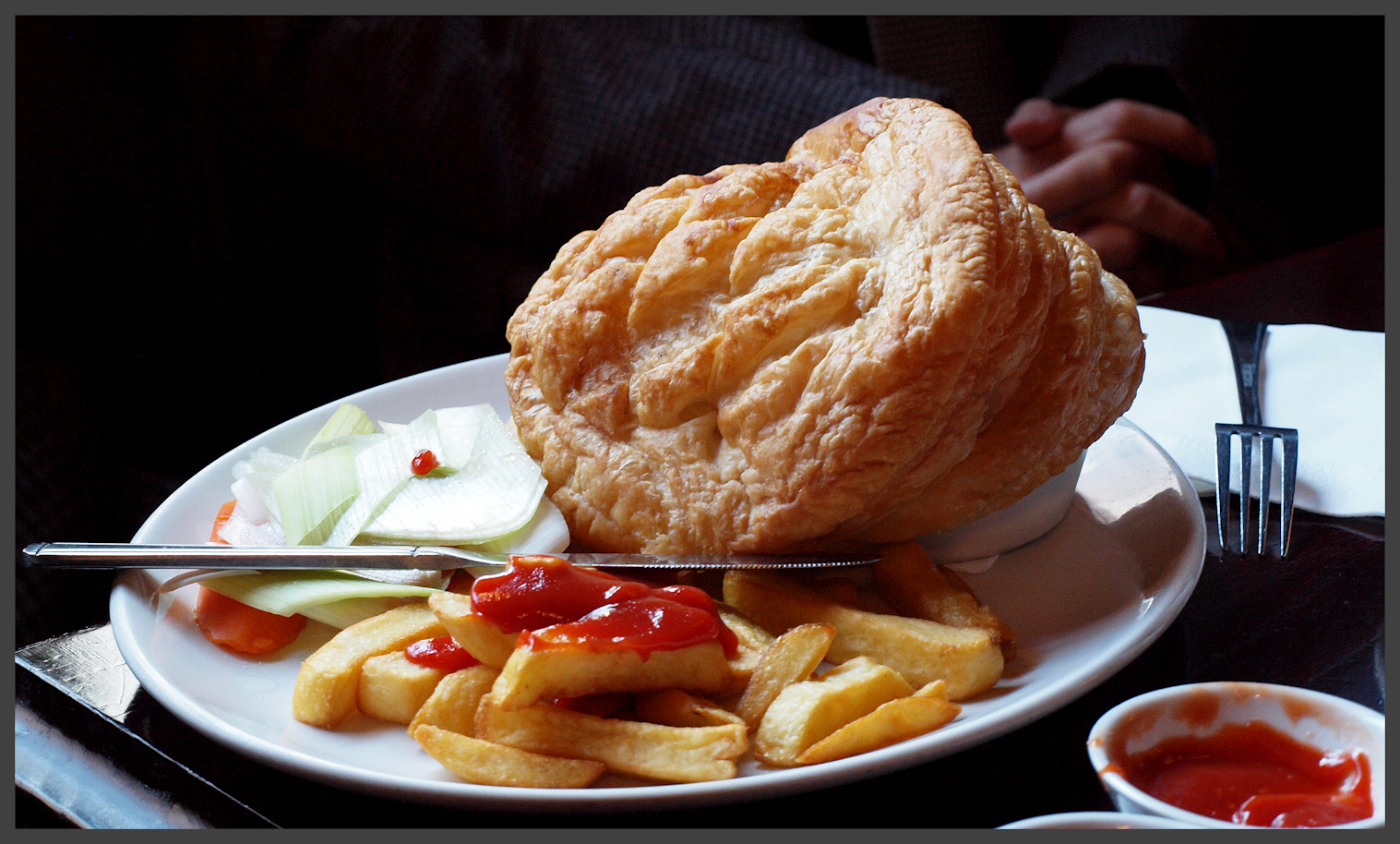
Well I’ll Eat My Hat
London; November 2014
Contrary to initial appearances this crust was the topping for a Venison Pie, which I was assured was excellent.
This image appears by courtesy of one Robin Bynoe, who challenged me to make it my weekly photograph.
Long Arm of the Law
 The long arm of the law is getting longer and needs to be amputated!
It has been widely reported in the last couple of days (see, inter alia, here and here) that the Government wants to abolish Police cautions and instead allow the Police to fine people directly for most minor offences.
Like many others I see this summary justice as an erosion of our liberties and another move towards a police state.
Just because, according to the Police Inspectorate, around a third of cautions are issued incorrectly doesn’t mean they should be replaced with a more draconian measure. If anything it suggests the scheme doesn’t work and should be abolished. Yes, I dislike the notion of Police cautions as a piece of instant justice as much as I do summary fines.
A Police caution still gives the offender a criminal record. However the person concerned has had no opportunity to have their side of the case properly heard, in court, as the Police are acting as prosecutor and either magistrate or judge and jury. This to me is an infringement of the justice system which is based on the principle that everyone has the right to be heard in court by their peers (either in the persons of magistrates or a jury).
And allowing the Police even greater powers to fine offenders makes that far far worse.
We know why the government want to do it. They see Police cautions as a “soft option”, which it isn’t as it gives the offender a criminal record. Moreover it will probably save money which would otherwise have to be spent on the magistrates’ courts (already severely cut back) and will likely bring in extra revenue — in the way speed cameras and parking wardens have done.
But it means that many people will accept the caution or fine — often when they shouldn’t — because they don’t want to have to go to court for whatever reason; possibly because the Police have used scare tactics on them.
Out of court disposals (by which I understand cautions and the proposed fines) are incredibly problematic in terms of giving someone a criminal record without any form of legal procedure or check and balance. Both summary fines and cautions should, in my mind, be abolished: either the offence is serious enough to put the suspect before a magistrate or it isn’t.
Instant justice like this cannot be a good thing in a democratic, supposedly free, country. It all smacks too much of the Police state!
Your Interesting Links
Another selection of interesting articles you may have missed.
First one for the physics geeks and anyone else who wants their head exploded … Scientists are beginning to believe that the wave function of an electron — an elementary particle — can be separated into many parts and the parts individually trapped. That has some strange implications for the theory of quantum mechanics, which is hard enough at the best of times.

But just to make it harder for you, we’re all powered by the effects of quantum mechanics. Apart from anything else photosynthesis is a quantum process. (And my PhD was on the periphery of the jigsaw of working out how photosynthesis holds together.)
Slightly more prosaically … What happens when chemists don’t wash their hands?
Next up an amazing video clip of a really bizarre fish that just doesn’t look at all real. It’s called the Smallspine Spookfish (Harriotta haeckeli).
I know many of my friends are, like me, cat lovers. If you aren’t then sorry, but all those things you say about cats are not upheld by science.
And that may well be because your cat thinks you’re a huge, unpredictable ape.
Now for more mythical creatures. Mermaids. Forget Disney, they have a murderous and sometimes sexy history.
With a quick soft shoe shuffle into the medical, almost three-quarters of Danish people want to ban male circumcision, at least under some circumstances. I’m with them on this.
You know how granny always said she could tell in her bones when it was about to rain? Well it turns out that people can feel the weather in their bones and there is now a possible mechanism.

Until the around the 16th century trade between East and West travelled overland along the Silk Road. Except it didn’t, because there was no Silk Road but a network of routes between trading posts through which goods passed.
I’m not sure if this next story is going to be scoop of the century or conspiracy theory of the decade. One scholar is suggesting that many of JS Bach’s finest works were composed by his wife Anna Magdalena. It all sounds a bit fishy, but then again …
Now one for the linguists amongst you. Minna Sundberg has drawn a most excellent linguistic family tree.
Now we’ll quickly slide into something foodie … First up here’s an interesting history of vanilla.
Brains — Eyes — Tripe … Have you ever thought about what foods you and your friends don’t like to eat. Here’s a look at some of those foods people seem to find terrifying … and it is in large part down to “innards and slime”.
On the other hand if you like onions and garlic here’s an interesting look at why they’re quite so pungent — plus a recipe for Brimstone Tart.
Staying with plants and the outdoors, there is a suggestion going round that the whole of London should be designated a National Park. And yes, although it is a very urban environment it isn’t such a crazy idea.
Almost last, here’s a good one for all of you who like travel and especially those who go to dodgy places on dodgy airlines. Welcome to Air Koryo.
And finally one for those of you with children who are trying to think about what they want to do … What would you like to do if money were no object? Because it is a good way to focus your thoughts, and you probably can do it! I wish someone had challenged me with this!
Quote: Tax
A tax is a fine for doing well.
Something for the Weekend
Word: Baryton
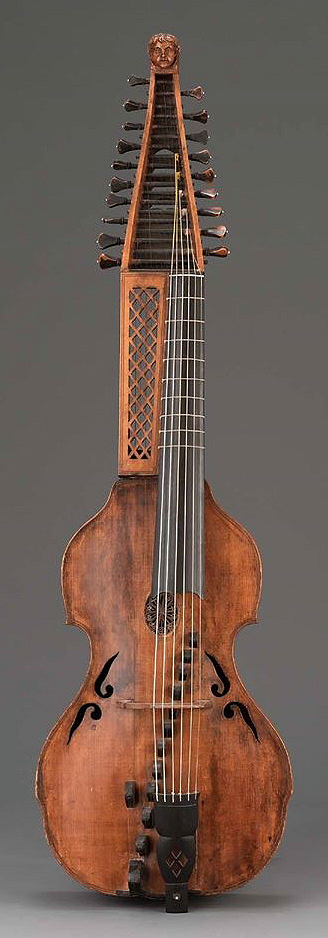 Baryton
A bowed string instrument of the 18th century, similar to the bass viol, but having sympathetic strings on the rear of the fingerboard.
According to Wikipedia:
The baryton can be viewed as a sort of augmented bass viol. It is similar in size to the latter instrument and likewise has six or seven strings of gut, arranged over a fretted fingerboard and played with a bow. The instrument is held vertically and is supported by the player’s legs …
The baryton differs from the bass viol in having an additional set of wire strings. These perform two functions: they vibrate sympathetically with the bowed strings, enriching the tone, and they can also be plucked by the left thumb of the performer, creating a contrasting tonal quality.
According to the OED, the name of the instrument is a loan word from French baryton or Italian baritono, and ultimately derives from Greek bary- + tonos ‘deep-pitched’.
Coming up in November
Here’s my selection of events, celebrations and customs that are happening during November.
[Reminder: These listings contain an eclectic mix of anniversaries, historical events, red letter days and upcoming “awareness events”, mostly UK-centric. My rules for the inclusion of awareness events are that they must not be medical, nor aimed specifically at children, nor too obviously purely commercial; and they must have a useful website.]
1 to 30 November
National Novel Writing Month. Can you write a novel in a month? That’s the challenge for all the budding authors out there. The idea is to write your 50,000 words in just thirty days. More information, hints, tips and events over at http://nanowrimo.org/.
1 November
London (Regent Street) Veteran Car Concours. If you’re in central London on this day you’ll find many of the cars taking part in the London-Brighton Veteran Car Run on display in Regent Street. And some may even be limbering up around the West End. So take your camera and keep your eyes open. Basic evnet information at www.classicshowsuk.co.uk/classic-car-show-event-information/classic-car-show-by-date.asp?id=515.
2 November
London-Brighton Veteran Car Run. This is reportedly to be the longest running car event in the world and ranks as one of Britain’s biggest motoring spectacles. It attracts entrants from around the world, all eager to take part on the first Sunday in November. Only cars built before 1 January 1905 are eligible to take part so this is a fine spectacle of early automobile engineering. More details at www.vccofgb.co.uk/lontobri/.
5 November
Guy Fawkes Day when the UK celebrates the defeat of terrorism by the foiling of Guido Fawkes’ 1605 plot to blow up King James I along with the whole of Parliament. The celebration is traditionally marked with bonfires and fireworks, much to the annoyance of most of our pets. Many places have their own special Guy Fawkes celebrations, including Tar Barrel rolling at Ottery St Mary, Devon and Lewes Bonfire Night in East Sussex.
8 November
Lord Mayor’s Show. Held on the second Saturday in November, this is the pageant to accompany the inauguration of the new Lord Mayor of the City of London. Along with the usual plethora of floats there are military bands and pikemen in gaudy medieval dress.
9 November
Remembrance Day. The UK’s annual commemoration of those lost not just in WWI and WWII but in all wars.
11 November
Martinmas, the Feast of St Martin of Tours, is a time for feasting celebrations — much like American Thanksgiving — and in many places another bonfire festival. Traditionally at this time the autumn wheat seeding was completed and there was the annual slaughter of fattened cattle and swine which could not be kept through the winter. Historically, hiring fairs were held where farm labourers would seek new posts.
29 November to 7 December
National Tree Week is the UK’s largest tree celebration and launches the start of the winter tree planting season. It is also a great chance for communities to do something positive for their local treescape. Full details at www.treecouncil.org.uk/Take-Part/National-Tree-Week.
30 November
On this day in 1934 the Flying Scotsman was the first steam locomotive to exceed 100 mph.