All posts by Keith

I’m a controversialist and catalyst, quietly enabling others to develop by providing different ideas and views of the world. Born in London in the early 1950s and initially trained as a research chemist I retired as a senior project manager after 35 years in the IT industry. Retirement is about community give-back and finding some equilibrium. Founder and Honorary Secretary of the Anthony Powell Society. Chairman of my GP's patient group.

Quotes

Our mid-monthly round up of recently encountered quotes, inspirational, educational and amusing.
If porn is inherently & in all contexts destructive, then SEX is inherently & in all contexts destructive.
[Emily Nagoski]
Most people can’t fathom why naturist families have such positive, wholesome relationships. Children from clothes free families grow up with relatively few body confidence issues.
[British Naturism]
Save the Earth; don’t give birth. This is the really radical ecological message people aren’t willing to face: the most damaging thing you can do environmentally is breed.
[Mark Walsh & Dane Burman quoted on Facebook]
It’s hard to win an argument with a smart person, but it’s damn near impossible to win an argument with a stupid person.
[Bill Murray]
I sympathise a little with Hunt [UK Health Secretary] — he was born into military aristocracy, a cousin of the Queen, went to Charterhouse, then Oxford, then into PR: trying to get him to understand the life of an overworked student nurse is like trying to get an Amazonian tree frog to understand the plot of Blade Runner. Hunt doesn’t understand the need to pay doctors — he’s part of a ruling class that doesn’t understand that the desire to cut someone open and rearrange their internal organs can come from a desire to help others, and not just because of insanity caused by hereditary syphilis.
[Frankie Boyle]
You go through life blind but with the delusion of sight. Try not to be fooled by what you think you see & what other people think they see.
[Brad Warner on Twitter]
The proposals the Secretary of State outlined did not appear to depart significantly from the Human Rights Act — we note in particular that all the rights contained within the ECHR are likely to be affirmed in any British Bill of Rights. His evidence left us unsure why a British Bill of Rights was really necessary.
… … …
If a Bill of Rights is not intended to change significantly the protection of human rights in the UK, we recommend the Government give careful thought before proceeding with this policy.
… … …
Given the seemingly limited aims of the proposed Bill of Rights, the Government should give careful consideration to whether, in the words of the Secretary of State, it means unravelling “the constitutional knitting for very little”. If for no other reason, the possible constitutional disruption involving the devolved administrations should weigh against proceeding with this reform.

[House of Lords European Union Select Committee; Report The UK, the EU and a British Bill of Rights; May 2016]
To bring about structural change, lasting change, awareness is not enough. It requires changes in law, changes in custom … You consolidate your gains and then you move on to the next fight from a stronger position.
[Barrack Obama]
Earl Cathcart: My Lords, the noble Lord, Lord Hunt, has twice mentioned weights and measures authorities enforcing this [tobacco regulations] in a heavy-handed or a light-touch way. Can the Minister comment on which he thinks they will do?
Lord Prior
[the Minister]: I certainly hope that enforcement will be more Italian than traditionally British, if I may put it that way.
[House of Lords debate on the new Tobacco Regulations from the EU]
Wind chimes are made from the metallic bones of robots that tried to overthrow us. Hang them outside your house as a warning to the others.
When you are dead, you don’t know that you are dead. It is difficult only for the others. It is the same when you are stupid.
Not every day is a good day,
live anyway.
Not everyone tells the truth,
trust anyway.
Not everyone will love you back,
love anyway.
Not every game will be fair,
play anyway.

We act as if the Earth was a craft ball someone told us to bedazzle.
[Rob R Dunn]

Refurbishment Complete

It looks as if all the updates and changes are good,
so I’m declaring refurbishment complete and removing the odd test post.

If anyone finds anything which needs snagging then please let me know.

Once again, apologies for the inconveniences caused and thank you for your forbearance.

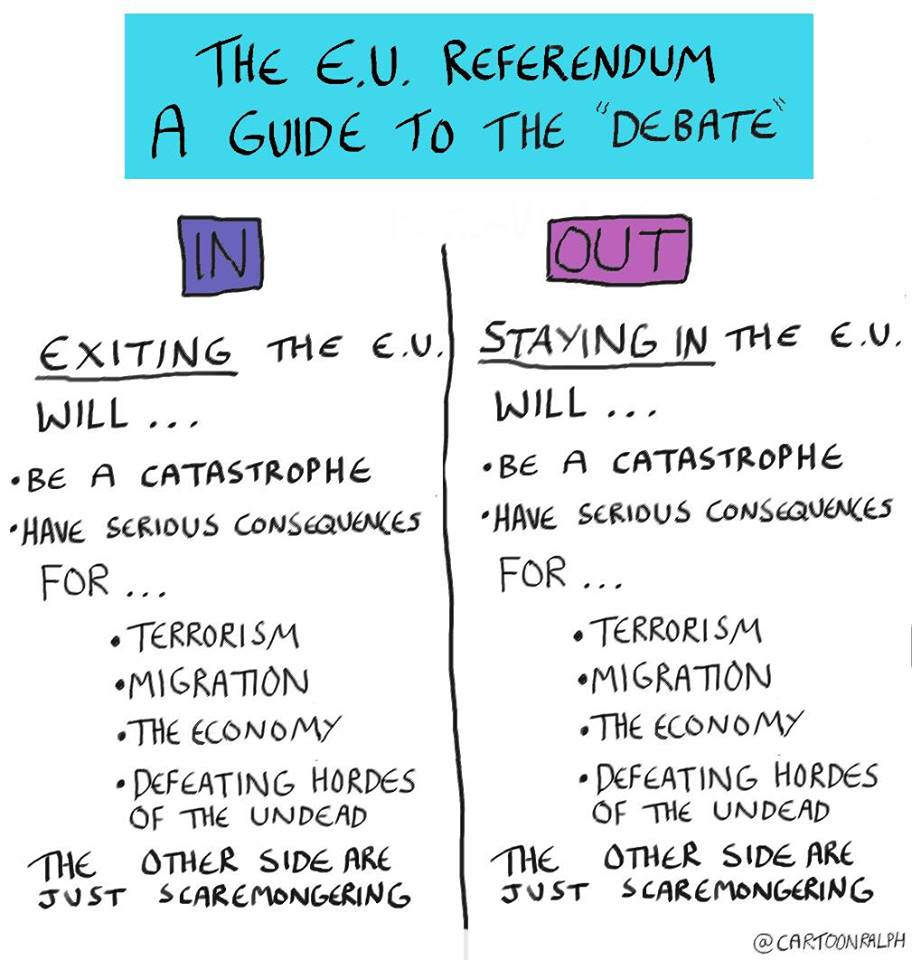
To Brexit or Not to Brexit?

So should the UK stay in the EU or leave? This is the question we are being asked to decide at the referendum on 23 June.
Importantly there is the question of whether anyone can make anything other than an emotional decision. And I suspect the vast majority of the great British public — or at least those who bother to vote — will do just that: make an emotional decision.
How can they do otherwise? Because no-one actually knows the consequences of either staying or leaving, and all we’re hearing is speculation, guesswork and wishful thinking. I have yet to find anyone with a reliable crystal ball.
As I have an almost total mistrust of everything which comes from the mouths of politicians, I’ve been almost completely ignoring the hot air, waffle and rhubarb which is permeating our airwaves.
Nonetheless we do need to try to come to some sort of rational decision, so in the following table I’ve attempted to pull together what little we do know of the facts, for and against, staying and leaving the EU. It isn’t easy, and some of this is still undoubtedly emotionally biassed, although I’ve tried to avoid this.
So this is the state of play as I see it.**

  For Against
Stay in the EU

  1. Human Rights protection (although much of that is down to the ECHR, not part of the EU, so a separate issue)
  2. Workers’ rights protection (holiday, equal pay, maternity leave, working hours)
  3. Some protection from the worst ravages of UK government
  4. European Arrest Warrant
  5. Open international trade
  6. Inward funding for universities
  7. Large farm subsidies
  8. Free movement (in and out of UK) — yes that means easy visa-free travel to Spain, Cyprus, Greece etc. on holiday as well as for Europeans coming here
  9. Ability to buy (cheaply) and import alcohol and tobacco for personal use
  10. … which (probably) keeps UK duty down
  11. Flights and mobile phone charges are among the goods and services that are cheaper, because of EU regulation
  12. Curtailing of market abuse by corporations like Microsoft
  13. British tourists enjoy free or cheaper healthcare in other EU countries

  1. Fewer border controls
  2. TTIP
  3. Cost of membership
  4. Huge, expensive and unchecked bureaucracy

Leave the EU

  1. More border controls
  2. More control of tax (eg. VAT)
  3. Fewer food etc. regulations
  4. Decreased Nanny State micromanagement. Well maybe?
  5. No TTIP? Well maybe?
  6. No Common Agricultural Policy

  1. Opens up unhindered privatisation of NHS by government with no checks and balances — although to be fair TTIP may do that too
  2. Are trade deals (not just with Europe) negotiable? And even if they are how long will it take? See for instance Canada.
  3. Possible loss of rights for ex-pat Brits living in Europe
  4. Possible dismantling of workers’ protection
  5. Probable dismantling of human rights (although much of this is not directly EU controlled)
  6. Households allegedly ~£4300 a year worse off by 2030. Ummm, maybe.
  7. Possible barriers to travel to Europe (eg. visas)
  8. UK would still have to contribute to the EU budget to retain access to the single market. See Norway and Switzerland.
  9. It’s a complete leap in the dark; no-one has a clue what will happen because no-one has been here before

That looks to me like a good case for staying in the EU. But of course, you should all do your own research, decide how important you feel each of the factors to be and make up your own minds. All I ask is that you make a properly informed decision — the best decision you can, at the time, with the information you have (and that information includes the proclivities of your brain).
Sadly, though, I suspect the British public will be beguiled by the speculative arguments and sound bites of those campaigning to leave. If they are, it really will be a leap in the dark, because no-one knows what will happen. So gawdelpus!


20/05/2016 Update
I promised updates, so here is the first. In the last few days I’ve come across this graphic from Richard Murphy of Tax Research LLP.


Click the image for a larger view

It appears to refer to the way in which the 2014 “tax take” was used by the government. If we assume the data is correct, then we pay just 0.37% of our taxes to the EU (yes, it’s that tiny figure at 12 o’clock on the pie chart). Now that strikes me as being eminently reasonable.
In fact extrapolating the figures from this recent Daily Telegraph article suggests that the net cost of the EU is in the region of £100 a year per person in the UK. Which again seems to me to be eminently reasonable.


** I will try to update this as we go along if any new evidence (as opposed to spin, myth and guesswork) appears.

Oddity of the Week: Train Stations

It is well known, at least around here, that Britain has more than its fair share of eccentrics. And we have had for a very long time. Think back to John Aubrey, John Evelyn and even Samuel Pepys. Then there are the eccentric Victorian clergyman, with too much time on their hands, who investigated everything from stone circles to the propagation of primulas and photography.


Dolau station in Wales (photo: David Brewer)

Should we therefore be surprised that, even today, the eccentrics are still amongst us? And the latest example: David Brewer, from Chorley in Lancashire, who has spent the last 8 or 9 years photographing every single railway station in mainland Britain. Why? Because they’re there.

Ten Things

I love the summer months for the variety of locally grown foods, and some from warmer climes, are available and at their best. And May is when one of my favourite foods — asparagus — is in season here in England. With summer fruits like strawberries hard on its heels.
As Noreen often observes, to our 19th century (and earlier) ancestors we must be living like the gentry because here are …

10 Foods I’ve Eaten in the Last Week
(some of them more than once!):

  1. Asparagus
  2. Avocado
  3. Smoked Salmon
  4. Duck Breast
  5. Brie
  6. Fruit Crumble
  7. Curried Steak Salad
  8. Sausages
  9. Olives
  10. Strawberries

British Bill of Rights

A House of Lords European Union Select Committee has been looking at the UK, the EU and a British Bill of Rights. Its report was published yesterday. It is long; it runs to nine chapters and two appendices.
While I’ve understandably not read it all, I have read their Summary of Conclusions and Recommendations. Their Lordships aren’t impressed. Here are what were for me the stand-out points from their 30 paragraph conclusions.

The proposals the Secretary of State outlined did not appear to depart significantly from the Human Rights Act — we note in particular that all the rights contained within the ECHR are likely to be affirmed in any British Bill of Rights. His evidence left us unsure why a British Bill of Rights was really necessary.
If a Bill of Rights is not intended to change significantly the protection of human rights in the UK, we recommend the Government give careful thought before proceeding with this policy.
We call on the Government to explain its grounds for concluding that … the UK public sees human rights as a “foreign intervention”, and how a Bill of Rights would address this concern any more than the Human Rights Act does.
[T]he weight of evidence we received does not support a conclusion that the Court of Justice has sought to expand the reach of EU law over Member States through its judgements on the scope of the EU Charter.
The weight of evidence demonstrates that, were a Bill of Rights to restrict victims’ rights to bring legal challenges under the Human Rights Act, more challenges under the EU Charter in domestic courts would be likely. This, in turn, is likely to give rise to more references from UK courts to the Court of Justice …
The common law would be unlikely to fill the gaps in human rights protection were the Human Rights Act to be replaced by legislation providing a lower level of protection.
The model of the German Federal Constitutional Court, advocated by the Secretary of State … appears ill-suited to the UK’s constitutional context … We question whether this is a model the UK, with its constitutional principle of Parliamentary sovereignty, would want to follow.
We heard concerns that a British Bill of Rights that reduced the UK’s explicit commitment to the ECHR would undermine the UK’s standing …
We call on the Government to state explicitly whether or not it intends that the UK should remain a signatory to the ECHR.
Human rights are entrenched in the devolution settlements of Scotland, Wales and Northern Ireland in a way that they are not under the UK’s constitution …
The evidence we received from the Scottish and Welsh Governments demonstrates strong support for the role of the European Convention on Human Rights and the EU Charter to be preserved … the vital role being played by the European Convention on Human Rights and the Human Rights Act in implementing the Good Friday Agreement.
The evidence demonstrates that the Scottish Parliament and Northern Ireland Assembly are unlikely to give consent to a Bill of Rights which repealed the Human Rights Act … Were the UK Government to proceed without such consent, it would be entering into uncharted constitutional territory.

And the final turn of the knife between the ribs …

The difficulties the Government faces in implementing a British Bill of Rights in the devolved nations are substantial. Given the seemingly limited aims of the proposed Bill of Rights, the Government should give careful consideration to whether, in the words of the Secretary of State, it means unravelling “the constitutional knitting for very little”. If for no other reason, the possible constitutional disruption involving the devolved administrations should weigh against proceeding with this reform.

Out of the 30 paragraphs of conclusions, I think I spotted just one which could suggest that the proposed Bill of Rights might be a good thing.
That’s a pretty damning condemnation in my book. But then when did governments ever take much notice of Parliamentary Select Committees?