All posts by Keith

I’m a controversialist and catalyst, quietly enabling others to develop by providing different ideas and views of the world. Born in London in the early 1950s and initially trained as a research chemist I retired as a senior project manager after 35 years in the IT industry. Retirement is about community give-back and finding some equilibrium. Founder and Honorary Secretary of the Anthony Powell Society. Chairman of my GP's patient group.

Book Review: Ethical Porn for Dicks

David J Ley
Ethical Porn for Dicks: A Man’s Guide to Responsible Viewing Pleasure

ThreeL Media, USA; 2016
Do you watch porn? If you’re male there’s a very high chance that you have at sometime in your life, even if you don’t now. If you’re female the chances are still good that you have done.
Do you believe that porn is bad for you? That it incites sexual abuse and violence? That all the performers are doing it because of exploitation, their working practices are unsafe and they have no control?
Do you feel shame because you, or your partner, watch porn?
If the answer to any of these questions is “yes”, then this book is for you. OK it is American and is aimed directly at men, but in my view it is relevant for everyone from mid-teens upwards, and whatever their gender and sexual orientation.
Our media are filled with cautionary, polarizing messages about the dangers of porn, even while sexually explicit images are exploited deliberately and persuasively in adverts and entertainment. This book offers anyone feeling shame and anxiety about their own, or their partner’s, behaviour a non-judgmental way to view and use pornography responsibly, while exploding many of the surrounding myths.
Ley is an expert on issues relating to sexuality, pornography and mental health. As a practising psychologist he is the head of a large behavioural health and substance abuse out-patient programme. Consequently he is able to bring years of first-hand experience, and academic credibility, to understanding what the problems of pornography are, and aren’t.
The book’s style is casual and accessible while remaining evidence-based – it isn’t littered with footnotes, but all the referenced texts are listed in the bibliography. Because it is broken down into about ten chapters, each consisting of several discrete sections, posed as questions, it can either be read cover-to-cover (as I did) or can sensibly be dipped into.
Just two quotes from the book …

Porn, for better or worse, is here to stay. In the US, it is protected under free speech, and it needs to be because if we lose the right of free sexual expression, we lose many other critical protections. Porn, as illustrated by … cave drawings … has been around as long as humanity. Attempts to get rid of porn are just more likely to drive it underground, where it is secret and hidden. And under such secrecy, people are more likely to get hurt or taken advantage of, and lose the ability to freely consent.

Rates of sexual offending go down as people in a society have more access to pornography. This is research that has been replicated in the United States and around the world. People don’t talk about this because they don’t want to acknowledge what it means. Porn is good for society. A society with more access to porn is a sexually safer society. Access to pornography may decrease rates of juvenile sex offending even more. If pornography were a moral-altering thing, turning weak-minded people into rapists and paedophiles, it would have a greater negative effect on teen boys. And it doesn’t. Just the opposite. Gay men watch more porn than straight men. But rates of rape and sexual violence in gay men are lower than in heterosexuals.

These are two of the key messages from the book. But there are two more which struck me:
First … We need to keep firmly in mind that porn is fantasy, in just the same way that Terry Pratchett and Disney are fantasy. It isn’t real life and we shouldn’t treat it as such. Just as real life isn’t filled with giants, battles and fairy princesses the way fantasy novels/films are, so real life sex isn’t (certainly shouldn’t be) violent, abusive and non-consensual. Porn may portray these traits as part of their fantasy fiction (and indeed many have them as mental fantasies) but neither is real life, properly adjusted, sex. We need to help people, especially the younger generations, understand this.
Secondly … If you worry about the exploitation aspects of porn then there are many producers who create ethical porn – the performers are well paid, their health is looked after, their working practices are safe and they have control over what is, and is not, permissible – then this book references several of these together with a long list of resources at the end.
Having said all that I did find the book rather too easy-reading; I wanted some more meat – but that’s me with my scientific background. Overall, if porn is a subject which interests you, or on which you feel you need more knowledge to help inform your children, then you could do much worse than read this book.
Overall Rating: ★★★★☆

Knees Up Again

[If you don’t like things medical, skip this.]
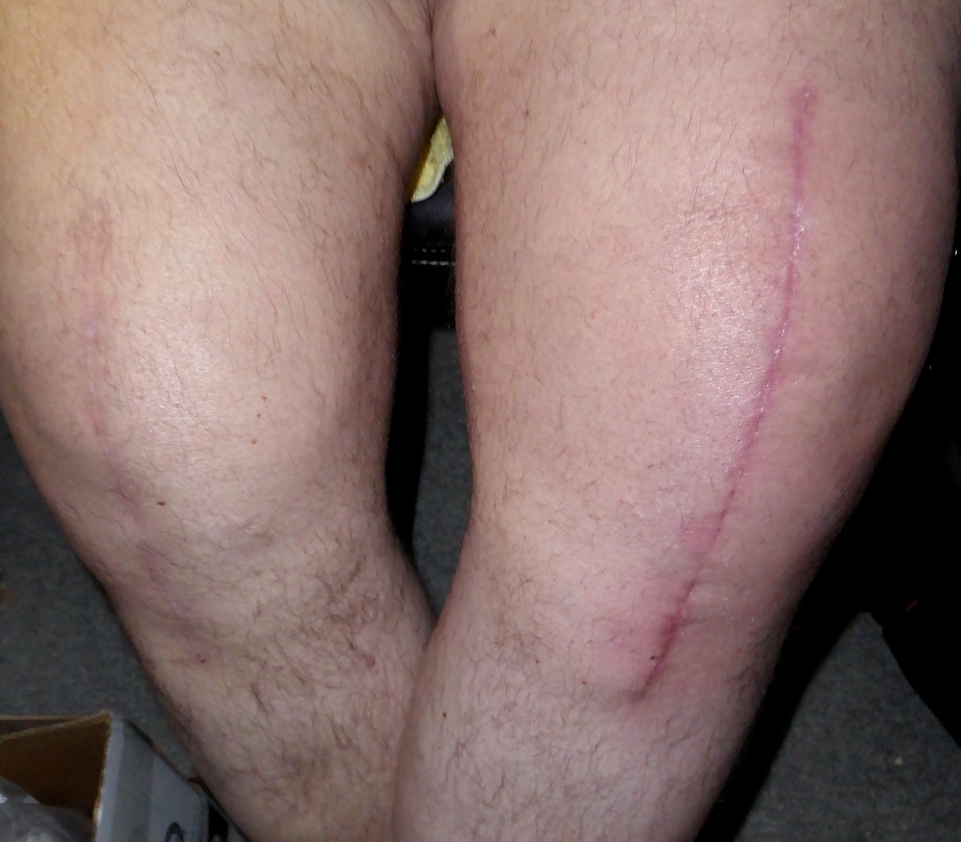
So it’s now a week and the day since I was let out of hospital after a complete left knee replacement to match the right one that was done at the beginning of the year. On the left, here’s the knee before (notice the impressively neat scar on my right knee that was prepared earlier) and on the right dressed post-op:


I suppose the knee is getting better although it doesn’t feel like that much of the time. Initially when I was in hospital it was a lot less painful than the right one had been but since I’ve been home the pain has been more like the same and at times obviously quite bad – which is very frustrating, depressing and demoralizing; but I guess that all part of healing process.
Admittedly all this is being done privately – we’re very lucky in that we can afford medical insurance – and generally I cannot fault hospital. [For anyone contemplating having knee surgery privately, don’t expect any change out of £15,000 per knee.] I had the same surgeon, the same anaesthetist, most (if not all) the same theatre team, and even the same physio on the ward – and I’m even booked in with the same guy as before for outpatient physio – that’s just one of the benefits of going private!
I had a spinal anaesthetic (so I was conscious; recovery is much nicer than a general anaesthetic) and was in theatre on the Wednesday afternoon (13 September) for about two hours. This was followed by an hour in recovery and overnight in the HDU because of my sleep apnoea. Then back in my room for lunch on Thursday.
I still don’t understand how the medics do this! They can rip you open; do 90 minutes serious carpentry; glue you back together; and have you on your feet 12 hours later. In fact the physio had me out of bed and walking few steps with a frame at 10 o’clock the following morning. Rinse and repeat twice a day. On the Friday morning the physio took the Zimmer frame away and left me with crutches; they also made me do a very small, test, staircase in their gym – this was fine although I had struggled with it back in December.
On Saturday morning my surgeon ran in about 8:20, wearing jeans and a rugby shirt, had a quick look, said yes OK you can go home, I’m now off to Portugal for a week (playing golf, needless to say!). Later that morning a physio arrived and took me to do a complete flight of stairs (down and up) and walk a corridor, which was all OK. All the boxes ticked I was allowed my freedom at lunchtime.
What annoyed me was that everyone arranged follow-up appointments according to some notional idea of what they should be and not what the surgeon had told me to do, and as I had requested. They then left me to chase around on the Monday to rearrange everything. That I was not impressed with.
By the time left hospital I had about 80° of flex on the knee; I probably now have about 90° – which is more quite a few people manage after a year; so I guess I should not be too downhearted.
However since I’ve been home everything seems to have been more painful. My GP had a quick look at the knee on Thursday as she was slightly concerned I might have wound infection. However the nurses at hospital changed the dressing on Friday and were very happy everything was OK and no infection. In fact the wound was actually very good and healing well as you can see from the photograph below.

Yesterday, Saturday, I was worried because I seemed to be able to do nothing except sleep all day; totally unable to stay awake. I just could not get the knee comfortable: sitting at my desk was unbearable, lying down slightly better. It’s still not great, but a bit better today.
What more is there to say? Obviously I’m still on crutches and painkillers and will be for a while – although my surgeon says to get rid of the crutches as soon as possible. Obviously I’m also having to do exercises and I know once I see the physio in out-patients in a couple of days time they will get more and harder.
Noreen is being heroic in putting up with me – anxiety, misery, depression and all – and everyone has been sending me good wishes (thank you, one and all!). To top it all, to cheer me up, my lovely friend Katy has sent me a tasting box of various gins (below) which I shall enjoy exploring once I’m no longer on wall-to-wall codeine.

Monthly Quotes

So here’s this month’s selection of interesting, amusing or thought-provoking quotes.


Theory is when you know everything but nothing works.
Practice is when everything works but no-one knows why.
In our lab, theory and practice are combined: nothing works and no-one knows why.

[unknown]


The execution of Brexit has been [the government’s] real undoing, for the simple reason that nobody with the competence to do it has any enthusiasm for it, and nobody with the enthusiasm has any competence. It’s not a bad working definition of the worst idea ever, but that’s democracy. It is fitting that the party that put it on the menu should have to cook it.
Theresa May’s early flirtation with a Kim Jong-un Brexit (we do it my way, and nobody needs to know what that way is because I am glorious) has left her rather weakened, but even that isn’t the problem. Her job now is to manage down expectations, and maturely present a series of choices which are hard because they are all suboptimal.

[Zoe Williams, Guardian]


“Having sex for money is bad because it is counterfeiting feelings” wow dude, I have bad news about every other customer service job ever.
[someone unknown on Twitter]


The academies send more people out into the world with their heads full of inanities than any other public institution.
[Kant to his pupils]


Love is not about sex, going on fancy dates, or showing off. It’s about being with a person who makes you happy in a way nobody else can.
[unknown]


The Bill weaves a tapestry of delegated powers that are breathtaking in terms of both their scope and potency …
It is a source of considerable regret that the Bill is drafted in a way that renders scrutiny very difficult, and that multiple and fundamental constitutional questions are left unanswered.

[House of Lords Select Committee on the Constitution, Interim Report on the European Union (Withdrawal) Bill, September 2017]


I am not a liberal snowflake. My feelings aren’t fragile, my heart isn’t bleeding. I am a badass believer in human rights. My toughness is in tenderness. My strength is in the service of others. There is nothing more fierce than formidable, unconditional love. There is not a thing more courageous than compassion. But if my belief in equity, empathy, goodness, and love indeed makes me or people like me snowflakes, then you should know – winter is coming.
[unknown]


He [George Rapp] believed that a prolonged practice of celibacy would restore man’s ability to multiply himself alone, according to God’s original plan for Adam.
[William E Wilson; The Angel and the Serpent: The Story of New Harmony]
Adjectives in English absolutely have to be in this order: opinion-size-age-shape-colour-origin-material-purpose Noun. So you can have a lovely little old rectangular green French silver whittling knife. But if you mess with that word order in the slightest you’ll sound like a maniac. It’s an odd thing that every English speaker uses that list, but almost none of us could write it out. And as size comes before colour, green great dragons can’t exist.
[Mark Forsyth, The Elements of Eloquence]


They were not life forms. They were … non-life forms. They were the observers of the operation of the universe, its clerks, its auditors. They saw to it that things spun and rocks fell. And they believed that for a thing to exist it had to have a position in time and space. Humanity had arrived as a nasty shock. Humanity practically was things that didn’t have a position in time and space, such as imagination, pity, hope, history and belief. Take those away and all you had was an ape that fell out of trees a lot.
[Terry Pratchett, Thief of Time]


Woke to hear Aunt Leonie this morning talking in a low voice as she’s got something floating loose in her head & does not want to disturb it.
[Marcel Proust]


Ten Things

Here we are again with his month’s off-the-wall ten things …
Ten Concepts I Try to Live by:

  1. Treat others as you would wish to be treated yourself
  2. If it harm none, do as you will
  3. Nude when possible, clothed when necessary
  4. Gender, colour, race etc. are irrelevant to ability and worth
  5. Sex and nudity are normal
  6. Openness and honesty in all things
  7. Say what you mean and do what you say
  8. Don’t worry about things you can’t change
  9. Pro bono publico, nil bloody panico
  10. Zen Mischief

Greenstead-juxta-Ongar

A few days ago I promised a post about the second church we visited on our very brief perambulation of Essex, the first being Stondon Massey, so here it is …
A handful of miles from Stondon Massey, the other side of the lovely small town of Chipping Ongar, is the hamlet of Greensted, or more correctly Greensted-juxta-Ongar. Although I’ve been there before (like 50+ years ago!) Noreen hadn’t, and that was an omission to be corrected.
The church of St Andrew is, according to the church website, the oldest wooden church in the world, and the oldest “stave built” timber building in Europe. The walls of the nave, which date from around 1060, are built from a series of upright tree trunks. Needless to say the church has been restored several times over the centuries; as an example in the the south wall of the chancel you’ll see Norman flint-work below Tudor brickwork; and the tree trucks have had to be underpinned with brick to ensure their stability.

Greensted-juxta-Ongar

The photo above shows this tiny church and something of the well-kept and very pretty churchyard, complete with glorious yellow roses lining the path to the south door. Behind the roses, against the church wall to the right of the porch is the 12th century grave of a Crusader, probably a bowman.
Below are two views of the north wall, which better show the detail of the stave construction.
Greensted-juxta-Ongar North

Greensted-juxta-Ongar North

Delightfully the church was open, despite there having been a number of thefts – so more power to the rector and churchwardens for maintaining access for the not inconsiderable trickle of visitors. (In the 45 or so minutes we were there at least three other small groups of visitors arrived.)
As you might imagine, with light only from half a dozen dormer windows and a panelled interior, it is is fairly dark inside the church, so I didn’t attempt taking photographs but just took in the intense calm. That’s a calm which, in my experience, comes most in a really old church (there is evidence of a church at Greensted at least as early as the 6th century) which is used and cherished. Greensted is one of those delightful places.
Adding to the delight were this (unintentionally) amusing sign and those gorgeous yellow roses.
Greensted Church Sign Greensted Yellow Rose

I somehow doubt this will be the last time we visit.
PS. If anyone can identify the variety of those yellow roses I would love to know.

Monthly Interesting Links

There seems to be quite a lot in thus month’s round-up of links to items of interest which you may have missed the first time round. So let’s get straight in …
Science & Medicine
A lump of rock the size of a house is apparently going to whiz past Earth on 12 October at a distance of 44,000 km – that’s like an eighth of the way to the moon. And yes, astronomers are confident in the predicted distance so DON’T PANIC, but do take a towel!


And now to the more mundane … New Scientist has a rather spectacular feature on the variety of jellyfish in the oceans. You never knew they were so beautiful!
Octopus and squid have the unhelpful habit of producing ink to cover their escape. But why? And what is the ink?
Don’t breathalyse a goldfish. At least not in the winter. For you see they avoid being frozen to death by turning turning the lactic acid in their body into alcohol.
Now you don’t expect a new species to be discovered in the UK, and certainly not right under our noses. But it seems that our (not so common) grass snake is actualy two different species.
Most of us don’t like ants in our kitchens, however the humble ant is a rather amazing creature, as researchers are beginning to understand. And there are lots of them too!
Wasps! Yes they’re intensely irritating at this time of year. But that’s only the handful of social wasps we have; there are many thousands more species of solitary wasps. Without them we would be knee deep in creepy-crawlies as they are excellent predators of other insects (as well as your BBQ burger). They are also important pollinators. But surprisingly little is known about the UK’s wasps, which a citizen science project is now trying to delve into.
Incidentally ants, wasps and bees are all quite closely related and are all members of the order Hymenoptera.
Now to our pets! Very few animals can be said to know themselves, at least according to the standard test using a mirror. And on that scale dogs are not included. However it seems that they probably do know who they are using smell.
We all know that in emergency we can give CPR to our fellow humans. But did you know it works on cats and dogs too? Here and here are a couple of items on the subject.
And finally in this section … Medics are now coming to realise that some common surgical procedures are no better than a placebo, just as some drugs aren’t.
Social Sciences, Business, Law
Constant worry, anxiety and panic about the future now seems to be a part of everyday life. But it is counter-productive and leads to burn-out rather than action.
Art & Literature
Here’s one for your diary … Next Spring the National Portrait Gallery will be showing Lewis Carroll’s photographs of the real Alice among an exhibition of early Victorian portraits.
History, Archaeology & Anthropology

I wasn’t sure whether to put this under “science” or “history” … It appears that trigonometry wasn’t discovered by the Greeks, but around a millennium earlier by the Babylonians. As one might expect it was all recorded in cuneiform on clay tablets. And they used a totally different system from that used today. However, Evelyn Lamb in Scientific American has pointed out that in fact little of this is actually new knowledge.
You wouldn’t really expect biologists to be doing research on ancient manuscripts, but they are … and they’re discovering all sorts of odd things about the parchment, the book covers and even the monks who did the calligraphy.
While on the medieval, and in other research, historians are coming to realsie that many of the supposedly iconic medieval images of the plague are nothing of the sort.
London
Did you know that for just £10 you can visit the Royal Mews and see all the Queen’s horses and carriages?
Lifestyle & Personal Development
Author Kasey Edwards discovers that so many people would like not to be married and just stay together for all sorts of reasons – but she isn’t one of them.
Berlin is designing new unisex urinals for its unisex public toilets.
Food & Drink
And finally … another that could have gone under “science” … geneticists have been hard at work on the apple and have traced its roots back along the Silk Road to Kazakhstan and China. The Romans may have brought the desert apple to England, but it had a long journey before that.

As usual more next month!

Stondon Massey

A week or so ago we had a little jaunt through SW Essex; I needed to go there on business and it seemed an opportunity not to be missed. Regrettably we didn’t do as much as we would have liked as I wasn’t feeling very brilliant – but we did visit a couple of churches.
The first church was at Stondon Massey, north of Brentwood. The church is a mile or so north of the current village, the suggestion being that the village centre moved due to the various plagues, especially the Black Death of 1349-50. The church dates back to around 1100, with several periods of extension and rebuild. The west window, shown below, appears to date from the early 15th century, and possibly earlier. The wall is of flint, which is the only local “stone” as Stondon Massey is on the southern edge of the ice from the last great glaciation. This flintwork is delightful and “rustic” – much more in keeping with the place than the dull, dark, finely worked, obviously Victorian flintwork on the north-east corner of the church. Note too the decorative use made of the lovely red (probably Roman) tiles.

Stondon_Massey_west end

Unfortunately the church was locked (fie to parishes who lock their churches!) so we could only appreciate it’s age and beauty from the outside. Not that we minded too much as the churchyard (below) was one of the most delightful I’ve seen, embroidered as it is by a multiplicity of oaks and yews with lots of dappled shade and well kept grass all paying homage to the carefully tended graves.
Stondon Massey, Essex, churchyard

Those of you who know your English music will recall that the Tudor composer William Byrd (c.1540-1623) retired from the Chapel Royal in his early 50s and lived his last 30 or so years at Stondon Massey. Byrd was a recusant Catholic who was regularly heavily fined for failure to attend Anglican Sunday worship and it’s possible he chose Stondon Massey due to its proximity to his patron, Lord Petre, who lived at Ingatestone. Byrd died at Stondon Massey and may be buried there, although there is no documentary evidence for his burial.
Byrd is one of my “heroes” hence snapping up the opportunity to visit on a lovely sunny August day. I think we shall be revisiting.
I’ll keep you in suspense about church number two; watch this space for a post in (I hope) a few days time.
Click on the images for larger views on Flickr.