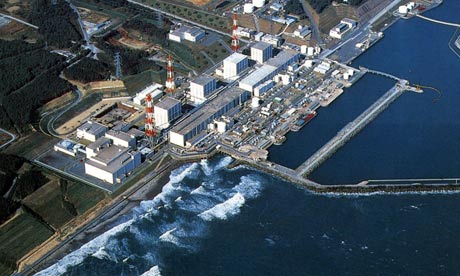
The follow-up to the Fukushima accident, in the wake for the March 2011 earthquake and tsunami, continues.
In the last week there has been a thoughtful essay in the Wall Street Journal by physicist Richard Muller looking at the likely additional rates of cancer in Japan as a result of the nuclear problems.

What he says, and I have to assume his numbers are correct, is quite revealing. First a bit of background, which is in the article:
- The average American gets an annual dose of 0.62 rem of radiation.
(“A rem is the unit of measure used to gauge radiation damage to human tissue”.)
- Anyone living in Denver gets 0.3 rem on top of that due to Radon gas from the local granite.
- Yet Denver has a lower cancer rate the the US as a whole, despite its high radiation figures.
- The International Commission on Radiological Protection recommends evacuating an area if the excess dose of radiation is just 0.1 rem. Yet people still live in Denver.
- Following the accident the Fukushima evacuation zone showed radiation at the level of 0.1 rem.
So what does this mean? Well here is Muller’s explanation:
If you are exposed to a dose of 100 rem or more, you will get sick right away from radiation illness. You know what that’s like from people who have had radiation therapy: nausea, loss of hair, a general feeling of weakness. In the Fukushima accident, nobody got a dose this big; workers were restricted in their hours of exposure to try to make sure that none received a dose greater than 25 rem … At a larger dose — 250 to 350 rem — the symptoms become life-threatening … and your chance of dying (if untreated) is 50%.
Nevertheless, even a small number of rem can trigger an eventual cancer. A dose of 25 rem causes no radiation illness, but it gives you a 1% chance of getting cancer — in addition to the 20% chance you already have from “natural” causes. For larger doses, the danger is proportional to the dose, so a 50 rem dose gives you a 2% chance of getting cancer; 75 rem ups that to 3%. The cancer effects of these doses, from 25 to 75 rem, are well established by studies of the excess cancers caused by the atomic bombs at Hiroshima and Nagasaki in 1945 …
Here’s another way to calculate the danger of radiation: If 25 rem gives you a 1% chance of getting cancer, then a dose of 2,500 rem (25 rem times 100) implies that you will get cancer (a 100% chance). We can call this a cancer dose. A dose that high would kill you from radiation illness, but if spread out over 1,000 people, so that everyone received 2.5 rem on average, the 2,500 rem would still induce just one extra cancer … Rem measures radiation damage, and if there is one cancer’s worth of damage, it doesn’t matter how many people share that risk.
In short, if you want to know how many excess cancers there will be, multiply the population by the average dose per person and then divide by 2,500 (the cancer dose described above).
In Fukushima, the area exposed to the greatest radiation … had an estimated first-year dose of more than 2 rem. Some locations recorded doses as high as 22 rem …
How many cancers will such a dose trigger? … assume that the entire population of that 2-rem-plus region, about 22,000 people, received the highest dose: 22 rem. (This obviously overestimates the danger.) The number of excess cancers expected is the dose (22 rem) multiplied by the population (22,000), divided by 2,500. This equals 194 excess cancers.
Let’s compare that to the number of normal cancers in the same group. Even without the accident, the cancer rate is about 20% of the population, or 4,400 cancers. Can the additional 194 be detected? Yes, because many of them will be thyroid cancer, which is normally rare (but treatable). Other kinds of cancer will probably not be observable, because of the natural statistical variation of cancers.
Sadly, many of those 4,400 who die from “normal” cancer will die believing that their illness was caused by the nuclear reactor.
Sure these numbers are regrettable, and tragic for those affected. But by and large they will be indistinguishable from the variation in the normal background cancer rate, especially if the 194 excess cancers is (as Muller suggests) an over-estimate. It is the psychological effect on the people which is potentially the greater danger.
Let’s put this in a different context. One nuclear accident in 20 years is likely, over time, to result in somewhere around 200 deaths in Japan.
Compare that with coal mining where in China alone in 2004 there were over 6000 deaths of miners due to accident — plus any resulting from later pneumoconiosis. In fact it is estimated there are annually 4000 new cases pneumoconiosis just in the US. (Data from Wikipedia.)
Another comparison. We all take air travel for granted. Yet in the 12 years since 2000 plane crashes have caused on average 1183 death a year worldwide. (Data from the Air Crashes Record Office.)
(OK, a real comparison would cover far more data and causes, but you get the picture.)
Now there are other approaches to calculating the excess cancers caused. Another approach cited in Muller’s article suggests that Fukushima will cause 1500 excess cancers over a 70 year period. But I suggest that over such a long time period that number too is going to be pretty indistinguishable from the background. And anyway it is still a factor of at least 10 less than the number of people killed directly by the tsunami.
All of which leads Muller to conclude:
The reactor at Fukushima wasn’t designed to withstand a 9.0 earthquake or a 50-foot tsunami. Surrounding land was contaminated, and it will take years to recover. But it is remarkable how small the nuclear damage is compared with that of the earthquake and tsunami. The backup systems of the nuclear reactors … should be bolstered … We should always learn from tragedy. But should the Fukushima accident be used as a reason for putting an end to nuclear power?
Nothing can be made absolutely safe. Must we design nuclear reactors to withstand everything imaginable? What about an asteroid or comet impact? Or a nuclear war? No, of course not …
It is remarkable that so much attention has been given to the radioactive release from Fukushima, considering that the direct death and destruction from the tsunami was enormously greater. Perhaps the reason for the focus on the reactor meltdown is that it is a solvable problem; in contrast, there is no plausible way to protect Japan from 50-foot tsunamis …
Looking back more than a year after the event, it is clear that the Fukushima reactor complex, though nowhere close to state-of-the-art, was adequately designed to contain radiation. New reactors can be made even safer … but the bottom line is that Fukushima passed the test.
The great tragedy of the Fukushima accident is that Japan shut down all its nuclear reactors. Even though officials have now turned two back on, the hardships and economic disruptions induced by this policy will be enormous and will dwarf any danger from the reactors themselves.
Indeed. And hence I still believe — nuclear waste disposal problems not withstanding; I acknowledge that as an unsolved challenge — nuclear is our best and friendliest hope of managing our power requirements for the foreseeable future.


 Prejudice and privilege are why we haven’t just sorted out resources (we have enough, we really do) to ensure that all humans get to eat nutritious food, receive medical care and vaccinations so they can live beyond the age of 5, have access to our bodies of collected wisdom and knowledge, have a safe place to sleep, and get a chance to experience play and pleasure so that we can all live in peace and explore the universe together.
  You need not be shocked at my being spoken against. Anybody, who is spoken about at all, is sure to be spoken against by somebody, and any action, however innocent in itself, is liable, and not at all unlikely, to be blamed by somebody. If you limit your actions in life to things that nobody can possibly find fault with, you will not do much!

 So as promised let’s get this show on the road and try to answer the first of the questions in Series 2.