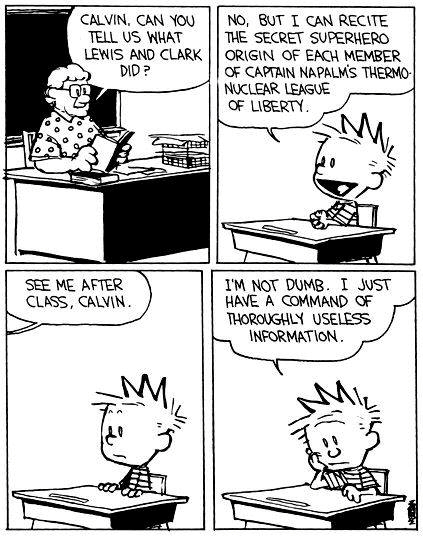
Something for the Weekend

Another in our series of interesting, thought-provoking or humorous quotes recently encountered.
The universe consists primarily of dark matter. We can’t see it, but it has an enormous gravitational force. The conscious mind — much like the visible aspect of the universe — is only a small fraction of the mental world. The dark matter of the mind, the unconscious, has the greatest psychic gravity. Disregard the dark matter of the universe and anomalies appear. Ignore the dark matter of the mind and our irrationality is inexplicable.
Joel Gold
To understand how something works, you must first understand how it got that way.
PZ Myers
So there’s the land — this real stuff we walk around on. Then there’s territory — the maps and lines we use to define the land. But then there are wars fought over where those map lines are drawn. The levels can keep building on one another, bringing people to further abstractions and disconnection from the real world. Land becomes territory; territory then becomes property that is owned. Property itself can be represented by a deed, and the deed can be mortgaged. The mortgage is itself an investment that can be bet against with a derivative, which can be secured with a credit default swap.
Douglas Rushkoff
[We wonder why the banking industry goes tits up, and the world is strewn with tribal warfare!]
We may perhaps date the beginning of modern thought from the night of January 7, 1610, when Galileo, by means of the instrument he developed [the telescope], thought he perceived new planets and new, expanded worlds.
Marjorie Nicolson
If people were meant to pop out of bed, we’d all sleep in toasters.
Cartoon cat, Garfield
So next time someone asks you whether you believe in evolution, the best answer you can give would be something like, “No, I don’t. I accept the overwhelming evidence for evolution, belief isn’t necessary.”
Found at Evolution Happens
Cuvée des Sires, usually a classic 70/30 blend of Aÿ Pinot Noir and Chardonnay, is a serious wine to be savoured; not, as Brun puts it ‘to be drunk from an actress’s shoe.’
Philippe Brun of Champagne house Roger Brun at imbibe.com
Dirt is matter out of place.
Mary Douglas
Everything is the way it is because it got that way.
D’Arcy Wentworth Thompson, On Growth and Form
We are here on Earth to fart around. Don’t let anybody tell you any different.
Kurt Vonnegut
And what is this? ‘It is a cat. It arrived. It does not appear to wish to depart.’ The cat, a feral ginger tom, flicked a serrated ear and curled up in a tighter ball. Anything that could survive in Ankh-Morpork’s alleys, with their abandoned swamp dragons, dog packs and furriers’ agents, was not about to open even one eye for a bunch of floating nightdresses.
Terry Pratchett, Thief of Time
Interesting events an anniversaries in the month ahead.
4 March
Shrove Tuesday, and therefore Pancake Day. Traditionally this was the feast to eat remaining winter food stocks on the last day before the fasting of Lent. It was also the day when the penitent went to confession (hence “shrove” from “shriven”) in preparation for Lent.

Grenade
1. A pomegranate. (Now obsolete)
2. A small bomb or explosive missile that is detonated by a fuse and thrown by hand or shot from a rifle or launcher.
3. A glass container filled with a chemical such as tear gas that is dispersed when the container is thrown and broken.
Another round-up of links to articles you may have missed.
To state the bleeding obvious, the weather’s been terrible on both sides of the Atlantic for months. Here’s a look at why.

Sir Walter Scott coined the word “freelance” in Ivanhoe, using it to refer to a mercenary knight with no allegiance to one particular country and who instead offers his services for money.
From ‘A’ to ‘ampersand’, English is a wonderfully curious language; Guardian; 15/02/2014
In this week’s photograph you get four for the price of one.
Four shots of the same tiny insect. It was probably a member of the Braconidae, possibly Apanteles glomeratus or as the body looks “waisted” one of the Ichneumonidae. Head and body about the size of a British black ant (so around 4-5mm?). Antennae and ovipositor are each roughly the same length as the body. Legs definitely reddish. It liked walking about (it was quick too) making it quite a challenge to photograph.

We’ve not had a Dilbert for a while, so time to rectify that …
Until as recently as the early 1900s, “&” was considered a letter of the alphabet and listed after Z in 27th position. To avoid confusion with the word “and”, anyone reciting the alphabet would add “per se” (“by itself”) to its name, so that the alphabet ended “X, Y, Z and per se &”. This final “and per se and” eventually ran together, and the “ampersand” was born.
From ‘A’ to ‘ampersand’, English is a wonderfully curious language; Guardian; 15/02/2014