Tasse de Dégustation

A couple of months ago I acquired from a friend four tastevin (or tasse de dégustation, tasse du vin, wine cups, depending on your predilection). My friend had bought them in northern France and cleaned them up before passing them on to me in exchange for a few drinking tokens.

tasse1

crestThey are all of the same standard design with bowls 75mm in diameter and have the crest of Bouchard Aîné & Fils, a recognised Beaune wine house. All appear to be white metal plating over a yellow metal base, the latter showing through where the white plating is rubbed. The base metal is therefore likely to be brass (or possibly some form of pewter).
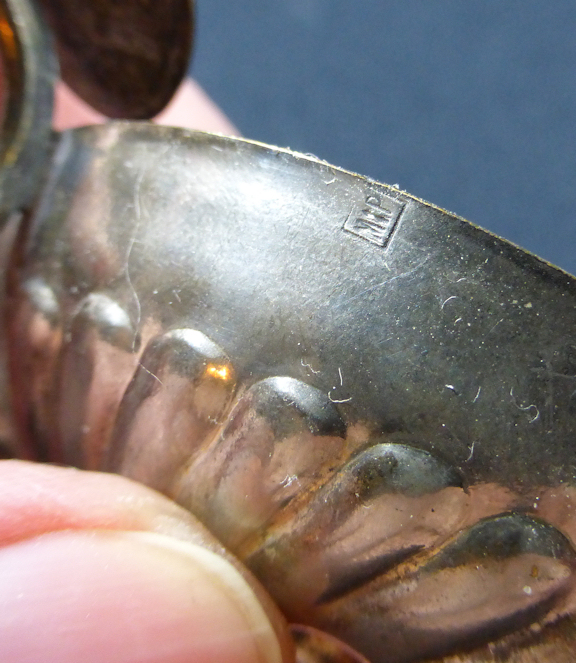
One of the four is clearly silver plated as it has a small stamp “METAL ARGENTE” (the French indication of silver plate) on the bowl near the handle. Two are stamped just “METAL”. The fourth has a tiny (2mm) square maker’s mark of M and P with what appears to be an upward pointing arrow between the letters — I have not been able to satisfactorily identify this maker. As far as I can see there are no other marks. The two “METAL” ones have a very slightly greyer/duller lustre than the other two, which makes me suspect they are maybe tin plated, the brighter two both being silver — but that is pure speculation on my part.
MetalArgente    Metal1
MP

This fourth, with the maker’s mark, is noticeably the most worn, with more yellow metal showing through, so it looks as if it may have been someone’s favourite. The stamping of the crest is also of a slightly better quality, so this one could be older.
Looking further at the wear on the handle of this one with a maker’s mark, two further things become apparent: (a) there is a slight wear mark where the tasse would have been worn on string/ribbon round a sommelier’s neck (in fact all four have this) and (b) the wear on the crest suggests that the sommelier was right handed.
Nonetheless I doubt any of them is of any significant age.
I have no expectation that they are of any useful monetary value but nonetheless I’m interested to work out their provenance. I have written to Bouchard Aîné & Fils asking if they can date them or provide other information, but I have so far not received a reply.
If anyone can shed further light on them, then I would love to hear from you.
Meanwhile they are nice little things to have!


Your Interesting Links

Interesting items seem to be coming thick and fast at the moment, so here’s another instalment of links to items you may have missed. And not so much boring science stuff this time!
Apocalypse? So what would happen if all our satellites fell from the sky? Yep, apocalypse may not be far off the mark!
Do you wear glasses? Or lenses? Ever wondered whether you could see without them? You can. Here’s how. And it really does work!
The strange story of a tetragametic woman — that’s someone made from four gametes (two eggs, two sperm) rather than the usual two. This is a form of chimerism and as chimeras are normally detected only because of external abnormalities (for example differently coloured eyes) we don’t really know how common it is.
We know the phases of the moon influence the behaviour of many creatures from big cats to owls, but how much does the moon affect human behaviour?


An interesting short read on saffron, that brightly coloured spice from crocus flowers.
While on plants, this stunning piece of sculpture was carved into an olive stone in 1737.
And so to religion … here’s an interesting evolutionary tree of religion.
Allegedly the human mind is primed to believe in god. If so, how is it that atheism is on the rise?
Meanwhile archaeologists have been staring into the mists of time and come to the conclusion that Britain’s oldest settlement is Amesbury, near Stonehenge, in Wiltshire. Doesn’t seem too surprising to me.
An American mother takes a very sensible look at nudity and how it does not cause any problems for kids.
And to finish on our usual theme of sexuality, here’s a considered response to the Nordic conception of controlling prostitution from a Canadian sex worker.
These final two items may not be safe for those of a pathetically puritanical mind; they are included here in the interests of normalising our attitudes to sex and sexuality.
Girl on the Net asks whether blowjobs are anti-feminist. Spoiler: No, because feminism is a state of mind not an attribute of “things”.
And really finally, with the spotlight on Girl on the Net, here’s an interview with her in the University of York student newspaper, York Vision (it was called Nouse in my day!).

Special Salmon

Another culinary triumph from our kitchens. At first sight it sounds fairly ordinary, but the little touches made it really yummy …
Zen Salmon Wellington
This serves two, generously.
You need:
2 100g salmon fillets
4 scallops (with coral)
1 pack chilled puff pastry
juice ½ lemon
butter
fresh black pepper and dill herb (optional)
egg or milk to glaze


What you do:
1. Pre-heat the oven to 200°C (with fan, 220°C if no fan) and line a baking sheet with some baking parchment.
2. Halve the pastry and roll out each piece to make an oblong about 10×12″.
3. Rinse the salmon fillets and scallops.
4. If the salmon fillets have a long thin edge, cut half this off and just fold it over so the piece is smaller and of more even thickness.
5. Place a fillet on each piece of pastry, and two scallops on each fillet.
Top each with a good knob of butter and a teaspoon of lemon juice; plus if you wish pepper and dill.
6. Dampen the edges of the pastry with more lemon juice, fold over and crimp the edges sealed.
7. Cut a couple of slashes in the top of each wellington and glaze with egg or milk.
8. Bake for about 30 minutes.
9. Serve with salad or lightly steamed veg — we had plain steamed English asparagus with a knob of butter.
It is simple. But the lemon juice is what makes this, adding an unusual tang to the pastry. And the scallops add that touch of luxury.

Book Review: The Disappearing Spoon

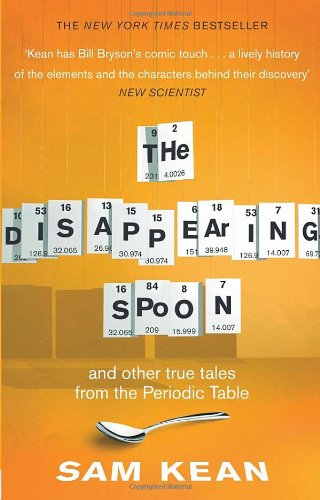
Sam Kean
The Disappearing Spoon and Other True Tales from the Periodic Table
Black Swan, 2011
This is a science book for the interested layman. Its premise is to tell interesting stories about the elements, their discoveries and their properties.
Each of the 19 chapters follows the fortunes (or otherwise) of several, not obviously related, elements — who discovered them and how; why they are interesting and idiosyncratic. Kean is certainly able to tell the stories well and keep the reader engaged; as the cover quote from New Scientist says:

Kean has Bill Bryson’s comic touch … a lively history of the elements and the characters behind their discovery.

I found the book easy, but engaging, reading and quite hard to put down to the extent that I had to ration myself to a couple of chapters a night rather than stay up reading all night.
It is an interesting read although for a trained chemist it doesn’t really go deep enough. There are almost no pictures, diagrams or chemical formulae. That’s fine as it does make it accessible to the intelligent layman and means the book can be printed cheaply in monochrome on poor quality paper. But as a trained scientist I found I wanted more explanatory images and formulae. To that extent I was disappointed.
Overall a book I enjoyed and which should appeal to those with a scientific interest, although I would have liked something deeper.
Overall Rating: ★★★★☆

Quotes

Another in our series of interesting, thought-provoking or humorous quotes recently encountered.
Don’t feel stupid if you don’t like what everyone else pretends to love.
[Emma Watson]
Goodness knows what may have changed since then. Worlds have turned, parallel universes have made and unmade themselves. People have been born. People have died. Stars have winked in and out of existence like the breath of God, leaving a transient mist on a universal car window where the Holy Spirit has drawn a giant knob with his finger.
[Katy Wheatley at katyboo1.wordpress.com]
In order for you to insult me I would first have to value your opinion.
[Unknown]
We need people in our lives with whom we can be as open as possible. To have real conversations with people may seem like such a simple, obvious suggestion, but it involves courage and risk.
[Thomas Moore]
Our lionisation of size zero, our aversion to pubic hair, even an increasing trend towards vaginaplasties are all symptomatic of a desire to take the female body back to its pre-pubescent state. The full Brazilian is a look that is borrowed from pornography — can there be a more damning style endorsement?
[Helen Walsh, So older women don’t have sex?, Observer, 13 April 2014]
Sacred cows make great hamburgers.
[Robert Reisner]
In the end only three things matter: how much you loved, how gently you lived and how gracefully you let go of things not meant for you.
[Buddha’s Little Instruction Book]
What we find in a soulmate is not something wild to tame, but something wild to run with.
[Robert Brault]
When I free my body from its clothes, from all their buttons, belts, and laces, it seems to me that my soul takes a deeper, freer breath.
[benudetoday.tumblr.com]
I will always remember what it felt like to have a little mermaid swimming in my belly.
[Leone Dawson]
Alcohol is the anaesthesia by which we endure the operation of life.
[George Bernard Shaw]
And finally …
Don’t forget: Jesus died for your sins in advance, so make sure you get your money’s worth.
[Girl on the Net; ‏@girlonthenet]

Weekly Photograph

This week another photograph I took some years ago on a day trip to Dublin. These two young lady Garda officers were on duty outside the iconic O’Connell Street Post Office. No doubt they were keeping a weather eye out for the untoward but they seemed more intent on chatting.

Click the image for larger views on Flickr

Guarding O’Connell Street Post Office
Dublin, October 2006

Coming up in May

Some interesting events an anniversaries in the month ahead.
23 April to 21 June
British Asparagus Festival. The Vale of Evesham is the asparagus growing centre of the UK and each year they hold a 2 month-long festival during the asparagus season, starting with the first crop on St George’s Day. English asparagus is the best and has to be enjoyed during its short season, hence the festival. Find out more at www.britishasparagusfestival.org.
1 to 31 May
Local and Community History Month. The aim is to increase awareness of local history and promote history in general. There are activities across the UK which include trips, library exhibitions and local lectures. It is a great way for groups to highlight local history and for local people to get involved. Find a database of events at www.history.org.uk/resources/general_resource_1567_55.html.
1 May
May Day and the ancient Pagan festival of Beltane celebrate Spring in the northern hemisphere. This is a time when there will be ancient festivals taking place around the country, with maypoles, morris men and the like. If you are in London there is the Deptford Jack in the Green. See Wikipedia for a quick introduction to both May Day and Beltane.
4 May
International Dawn Chorus Day . This is a worldwide celebration of the daily miracle of birdsong. More details and a events in your area at www.idcd.info/.
6 May
On this day in 1954 Roger Bannister ran the first sub-4 minute mile.
8 May
Furry Day, Helston, Cornwall is a Spring festival to celebrate the end of winter and mark the arrival of the new vitality and fertility with the trees and flowers bursting into life. The houses and shops of the town are decorated with greenery and floral arrangements to express the spirit of renewal. From 7AM some eighty couples dance through the streets, entering houses and shops to drive out the darkness of winter and bring in the light of spring. Much more detail at www.helstonfloraday.org.uk.
10 & 11 May
National Mills Weekend. The annual festival of our milling heritage which provides great opportunities to visit mills — both windmills and watermills — many of which are not usually open to the public. Find out what’s happening near you at www.nationalmillsweekend.co.uk.
14 to 25 May
Be Nice to Nettles Week. We’re all familiar with the stinging nettle having experienced its ferocity. Unfortunately many see it as only a troublesome weed to be eradicated, whereas it is a valuable wildlife habitat and resource — you can even eat young nettle shoots! Find out more about the humble nettle at www.nettles.org.uk/.
14 May
On this day in 1264 the armies of Simon de Montfort, 6th Earl of Leicester, and King Henry III engaged at the Battle of Lewes which de Montfort’s men won and which was he height of his power. There is more about the battle on Wikipedia and at Simon de Montfort 1264.
22 May
World Goth Day is a day where the goth scene gets to celebrate and make its presence known to the rest of the world. Find out everything about the day at www.worldgothday.com.
25 May
Towel Day. The annual celebration of the life and work of Douglas Adams, author of The Hitch-Hiker’s Guide to the Galaxy. More about the day at towelday.org.


Oak Apple Day celebrations at Castleton, Derbyshire

29 May
Oak Apple Day. This day was established by Parliament in 1660 as a public holiday to commemorate the restoration of the English monarchy, it being the birthday of Charles II.

Parliament had ordered the 29 of May, the King’s birthday, to be for ever kept as a day of thanksgiving for our redemption from tyranny and the King’s return to his Government, he entering London that day.
[Samuel Pepys, Diary, 1 June 1660]

This is another day on which many ancient festivals take place; it is also kept as Founder’s Day by the Royal Hospital, Chelsea. Why is this not still a public holiday?
31 May & 1 June
Asparafest 2014. Held at Ashdown Farm, Evesham this is Worcestershire’s asparagus themed music and food festival and all part of the British Asparagus Festival. Full details at www.asparafest.co.uk.

Your Interesting Links

So soon already we have another instalment of links to items you may have missed. Although many of the links in these articles are scientifically inclined, I do try to steer away from heavy science in favour of things which are of more general interest and intelligible by intelligent non-scientists. And of course I do try to include items on history, pets and other interests as well as amusements. Anyway here is today’s collection.
So you don’t really need to know the science of how any of this works to appreciate these freaky chemical and physical reactions. [Animated GIFs]
No there isn’t soap in your mayonnaise! Why are we all so terrified of chemicals? Everything is a chemical! Gal Science shows how ridiculous these fears can be.


Garlic eating cows fart less methane, so could this save the world from climate change? Nice idea, but I suspect it will turn out to be a big definite “probably not” when the true effects are realised.
Changing tack, here’s an interesting piece on how IUDs work as contraceptives — and it mostly isn’t how you think!
Got a cold? Then take care who you spread it to, because we have a lot of delusions about when we are contagious — and it is more than you probably think!
While on things infectious, how much do pets bring bacteria into our homes? Answer, yes, just as much as you feared!
Every cat owner knows that, despite being inscrutable, cats think, but what do they think about and how intelligent are they really? Are you surprised that finding out was a real challenge?
Do animals give each other individual names, just as we do? It is hard to tell, although it seems that parrot parents do give their chicks names which stick for life.
Many many things have been used as a writing pad, but an ostrich egg?!

And remaining on things medieval, here are some wonderful blue maps of the medieval world. And they’re surprisingly accurate.
Next up, the history of food. How was tomato ketchup invented? Well, no, not originally by HJ Heinz although they had a finger in the jar.
Changing tack again, here’s a piece on the, to me scary, world of extreme cavers. Surely these guys are out of their trees! What is it about the human species that makes us have to do these things “just because they’re there”? [Very long read]
I’m not sure this is quite right but certainly the Awkwardness Zones should be bigger.
We’re always busy — busy, busy, busy. No wonder we’re always tired. We need to kill the culture of “always busy/always on”. Here are a few ways that will help at an individual level — and yes, these really do work!
Why is there such a resistance to nudity? Because we have this myth that nudity is sexual. But it is just a myth.

And finally an article from the Independent saying that the UK is too prudish and we should follow Munich’s example and legalise public nudity. Errr … actually public nudity isn’t illegal in the UK unless with intent to cause distress, alarm or outrage — although the Plod so often ignore this distinction.