NHS Funding

So. According to all the media reports, and the scaremongering from professional bodies, the NHS is in crisis and falling apart because it is significantly under-funded and a political football. It is barely “muddling by” [1,2,3].
Well maybe.
It cannot be denied that the NHS is in crisis. It is badly organised and badly managed. And yes it is a political football.
I’ve written about this before [4,5] and I make no apology for doing so again.
It cannot be denied that some sectors of the NHS are woefully under-funded. This is especially true of GP services where funding has fallen from a high of 11% of NHS budget in 2006 to around 8.3% today against a background of significant increases in the number of consultations and demands from politicians [6].
However overall I cannot believe that the NHS is under-funded. It seems to me the NHS has shed-loads of money to do everything you and I could reasonably want it to do. But that money is badly used, in large part because of the appalling level of wastage.


The NHS employs way more managers and administrators than it needs. That in itself is a huge waste of resources. Just take a look next time you visit a hospital at how many staff are wandering about apparently aimlessly. What do they do? Is it useful? How many are doing nothing but moving pieces of paper from A to B? In this day and age moving pieces of paper around by hand is an inexcusable waste. Do it electronically! Use email, or on-line documents, or database systems.
Yes, to get the NHS using pervasive electronic communication is going to take time, and will need an up-front investment. It will also need the Civil Service and government not to cut corners on cost by being constrained to choose the cheapest bidder, to understand how to manage a big IT project (like don’t keep changing the project scope) and to listen to advice from their trusted suppliers.
The NHS also has far too many managers. Their lives seem to be predicated on bullying staff and chasing meaningless government targets. If we could get rid of the pointless targets and teach the managers how to manage people the NHS would need far fewer of them. In doing this it will take the NHS quite a long way towards trusting and empowering its employees. Trust them to do their job. Trust them with the empowerment to do it efficiently. Empower them to change things sensibly if they can see a better way. In other words, act like a good private company.
Somewhere else the NHS wastes money is in the sheer waste of supplies. One hears stories of hospitals where Ward A needs supply Y but can’t buy it because there’s no money; yet Ward B has a cupboard full of the same supply but has to throw it away because it has gone out of date. In one instance I know of where this happened, and it was pointed out to the top brass by a junior nurse, just changing the procurement policy saved the hospital several million pounds in the first year. Practices like this are not uncommon.
And let’s not talk about hospital food. If patients were fed properly, not only would there be a lot less food waste but the patients might actually get better quicker so they could be discharged sooner.
This is all well and good but I fear it will never happen. For a start politicians, almost by definition, have to keep meddling. Not only is it ideological but it is the only thing they can do to try to show they are doing something.
The other reason it will never happen is that there is no-one at the top of the NHS who has the ability to grasp the whole organisation and energise it. That is not the Civil Service way. But without this there will be no change. The NHS needs someone highly skilled, robust, no-nonsense and bloody-minded to head it up. Someone who will energise the employees, from top to bottom. Who will empower from the top and support empowerment from below. Who will give his or her henchmen a job to do and expect them to get it done — or get out. And most importantly someone who will tell the politicians to butt-out and stay out.
Names like Richard Branson, Alan Sugar and Digby Jones come to mind. You may not like them, but they are the type of people who are needed. Badly needed.
Without someone like this, and without government getting a proper, business-like grip, the NHS is indeed going to go nowhere except, as predicted, down the tubes. And that is something the country cannot afford!
——————————
References:
[1] Observer; 28 June 2014
[2] Daily Telegraph; 18 June 2014
[3] Independent; 29 June 2014
[4] https://zenmischief.com/2014/02/transforming-the-nhs/
[5] https://zenmischief.com/2012/08/reforming-the-nhs/
[6] Royal College of General Practitioners; 27 June 2014
More Auction Oddities

Another selection of oddities and amusements from the catalogue of our local auction house. Nothing especially outrageous in this selection, just the variety of old toot and the assemblages to make lots which strain the mental equilibrium.
A mixed lot including military badges, penknives, rulers, thimbles, old tine, hip flasks, pill boxes, pocket watch, a collection of old pipes, fossil stones, etc.
A Concorde pendant with articulated nose, stamped silver, on a fine chain …
And there’s nothing quite like having an articulated nose!
A collection of polished agates for fob seals, Dik Dik horns, the claw of a bird of prey, old ivory pieces, etc.
A cased set of silver Dickensian character cherry sticks, Birmingham 1973 …
Souvenir ware — a cruet in the shape of a plane, Barry Islands gardens, a pair of bisque figurines of a girl and a boy playing crochet [sic], a figure of a gentleman playing the bagpipes, and a smaller figure of an 18th century gent.
A model of a hand-painted gypsy caravan pulled by a shire horse, Carmen England, a further model carriage decanter set with five shot glasses and decanter, again pulled by a shire horse, two further shire horses and two model drays, brassware including iron on trivet, two model dolphins, a pair of vases, copper and brass bugle, three football trophies and a cased brass cruet on tray.
All in the best possible taste!
A good quantity of ceramic piggy banks and figurines of pigs including a very large floral decorated piggy, and a similar smaller, treacle glazed, white glazed, black glazed, Masons, etc., plus floral decorated piggy figurines.
Two oriental inlaid three-legged tables and a tooled leather pouffe decorated with Egyptian scenes
Why do I find the idea of a tooled leather pouffe quite disturbing?
‘Whatsoever thy hand findeth to do, do it with they might’, a 19th century sampler dated 1848 by Catherine Davies, and a 1930s embroidery in an oval frame of a lady in a crinoline
Clearly the Victorians hadn’t thought about that verse!
An oak-framed striking mantel clock, 4 cameras incl. Halena Anastigmat 3.5, a Minolta Beirette Junior 2, and a Coronet, also 17 teapots, incl. Wade antique shop, Sadler Carousel, and Coronation Street’s ‘Rover’s Return’
The teapots, my dear. The teapots!
A brass bugle and a pair of large brass ducks
A Continental Art Nouveau porcelain fish dish, a French black silk opera hat and a wig with two card boxes
Someone please explain to me the significance of attaching cardboard boxes to one’s wig.
And next everything one needs to be murder mystery writer …
A Mercedes portable typewriter in lime green plastic, two tennis racquets and two ladies hats
A large Oriental horn intricately carved and pierced with pine and other motifs
The mind boggles a bit over this one too!
The cured hide of a buffalo, from Pakistan, c.1864
A brass Tibetan prayer bowl on wooden stand, a grass skirt and an African carved wood game.
Talk about mixing ones ethnicities!

Lines on Maps

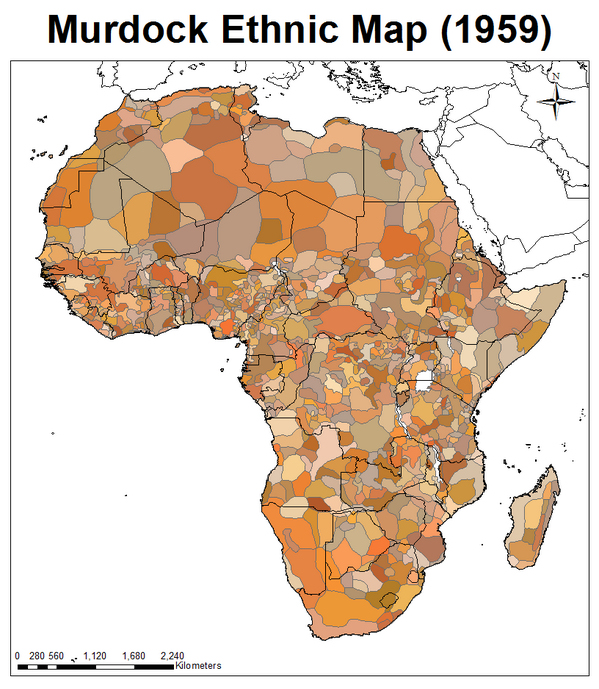
Yesterday I came across this map on Twitter …

africa

It shows Africa with its national boundaries (black lines) as they were in 1959 and (shaded) the continent’s division into ethnic/linguistic areas — ie. basically tribal areas.
Note just how many of the national boundaries are (a) straight lines and/or (b) cut straight across tribal areas. Every country contains multiple tribal/ethnic/linguistic areas.
Yet, we expect these peoples to be able to get on with each other as nations and embrace our democratic traditions. And we’re surprised when they can’t!
Is it any wonder they can’t get on, there is continual civil war and countries wanting to break themselves asunder. It is basically all the result of us, white man, drawing “arbitrary” lines on maps.

Coming up in July

Interesting events an anniversaries in the month ahead. Not a lot this month, probably because it is the end of the school year and the start of summer holidays.
4 July
This day 60 years ago in 1954 saw the final end of WWII rationing. According to the Imperial War Museum meat was the last item to be taken off ration. I would have been three, so I don’t quite remember it.
4 July
American Independence Day. In 1776 the US congress proclaims the Declaration of Independence and independence from Britain.
14 July
90th birthday of James Whyte Black (1924-2010), Scottish doctor and pharmacologist who invented the beta-blocker Propranolol and synthesized Cimetidine (forerunner of Zantac) for both of which he received the 1988 Nobel Prize for Medicine.


26 July to 10 August
National Marine Week (which is actually a fortnight!).
The UK’s marine areas are home to a number of amazing creatures like dolphins and basking sharks, as well as iconic birds like puffins. Organised by The Wildlife Trusts, this National Marine Week celebrates these, and many other, marvellous animals and encourages us to go out and explore our local seashores. Find out more at www.wildlifetrusts.org/living-seas/get-involved/national-marine-week.
27 July
Battle of Bouvines, 1214, which ended the 1202-1214 Anglo-French War consolidating the grip of the French royals on French lands. King John of England was so weakened by the defeat he eventually had to succumb to signing Magna Carta.

Your Interesting Links

More items you may have missed and will wish you hadn’t. As usual the more scientific (though that doesn’t mean more difficult or incomprehensible) stuff first …
Ten scientific ideas that have transferred to common parlance and which we all misuse.


We’ve known for a long time that building bigger roads actually makes traffic worse, not better. Here’s a piece on why this is.
Ever wanted to know what it’s like to do research on whale vaginas? This will tell you (some of it).
Humans are very successful at domesticating animals — so successful there are three times as many chickens in the world as there are humans! Moreover we’re so good we apparently domesticated ourselves.
Apparently there is evidence that nudity provides health benefits for both body and brain.
Men’s naked bodies are the stuff of nightmares — NOT!
One day scientists will actually make up their minds … Maryn McKenna suggests it is likely that fat is good for us.
An interesting piece from Emily Nagoski re-analysing old data which shows that even before the pill, more sex did not mean more pregnancies.
So men think about sex every few seconds. Well maybe not!
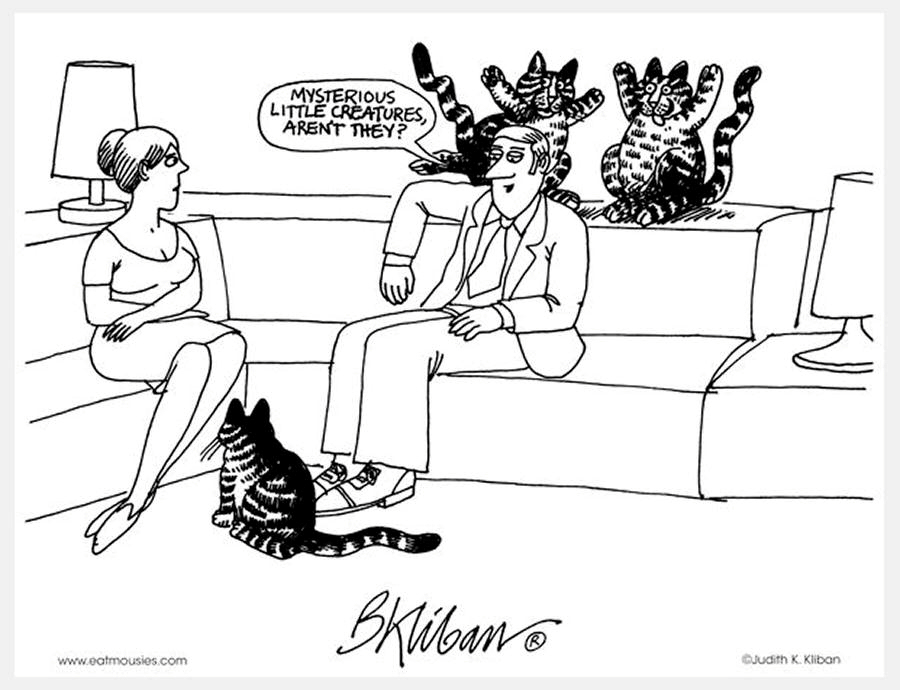
So from sex to pussies … There are a few things you can do to hopefully add years to your cat’s life.
An interesting short piece on why it is so hard to objectively judge expensive wines — actually make that any wine.
Like judging wine, it’s all in the mnd. Here’s a quick “index card” summary of memory loss.

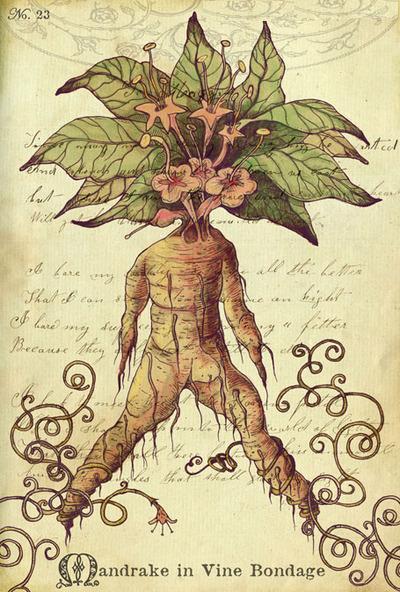
How the medievals got it so fantastically wrong about mandrake: the plant they thought murderous and grown from the blood of a hanged man.
Next year we celebrate the 800th anniversary of Magna Carta and the British Library is staging a special exhibition as well as bringing together the four surviving 1215 copies of Magna Carta. Here’s a portal to their Magna Carta exhibition page, webpages and medieval manuscripts weblog.
Our friendly blogging London cab driver is still investigating the history of Waterloo Station. Here’s part 7: trivia.
Finally to end on a worrying note, WTF is wrong with Americans? According to this guy it is all down to their education system. And the UK isn’t too far behind!
Gawdelpus!

Weekly Photograph

It’s summer, so this week’s photograph is a summer flower. This is a large ornamental allium (onion) which was growing in my mother’s garden at the bungalow, before she moved to a care home.

Click the image for larger views on Flickr
Purple Allium
Purple Allium
Norwich; May 2008