
Oddity of the Week: Train Stations
It is well known, at least around here, that Britain has more than its fair share of eccentrics. And we have had for a very long time. Think back to John Aubrey, John Evelyn and even Samuel Pepys. Then there are the eccentric Victorian clergyman, with too much time on their hands, who investigated everything from stone circles to the propagation of primulas and photography.

Dolau station in Wales (photo: David Brewer)
Should we therefore be surprised that, even today, the eccentrics are still amongst us? And the latest example: David Brewer, from Chorley in Lancashire, who has spent the last 8 or 9 years photographing every single railway station in mainland Britain. Why? Because they’re there.
Ten Things
I love the summer months for the variety of locally grown foods, and some from warmer climes, are available and at their best. And May is when one of my favourite foods — asparagus — is in season here in England. With summer fruits like strawberries hard on its heels.
As Noreen often observes, to our 19th century (and earlier) ancestors we must be living like the gentry because here are …
10 Foods I’ve Eaten in the Last Week
(some of them more than once!):
- Asparagus
- Avocado
- Smoked Salmon
- Duck Breast
- Brie
- Fruit Crumble
- Curried Steak Salad
- Sausages
- Olives
- Strawberries
British Bill of Rights
A House of Lords European Union Select Committee has been looking at the UK, the EU and a British Bill of Rights. Its report was published yesterday. It is long; it runs to nine chapters and two appendices.
While I’ve understandably not read it all, I have read their Summary of Conclusions and Recommendations. Their Lordships aren’t impressed. Here are what were for me the stand-out points from their 30 paragraph conclusions.
The proposals the Secretary of State outlined did not appear to depart significantly from the Human Rights Act — we note in particular that all the rights contained within the ECHR are likely to be affirmed in any British Bill of Rights. His evidence left us unsure why a British Bill of Rights was really necessary.
If a Bill of Rights is not intended to change significantly the protection of human rights in the UK, we recommend the Government give careful thought before proceeding with this policy.
We call on the Government to explain its grounds for concluding that … the UK public sees human rights as a “foreign intervention”, and how a Bill of Rights would address this concern any more than the Human Rights Act does.
[T]he weight of evidence we received does not support a conclusion that the Court of Justice has sought to expand the reach of EU law over Member States through its judgements on the scope of the EU Charter.
The weight of evidence demonstrates that, were a Bill of Rights to restrict victims’ rights to bring legal challenges under the Human Rights Act, more challenges under the EU Charter in domestic courts would be likely. This, in turn, is likely to give rise to more references from UK courts to the Court of Justice …
The common law would be unlikely to fill the gaps in human rights protection were the Human Rights Act to be replaced by legislation providing a lower level of protection.
The model of the German Federal Constitutional Court, advocated by the Secretary of State … appears ill-suited to the UK’s constitutional context … We question whether this is a model the UK, with its constitutional principle of Parliamentary sovereignty, would want to follow.
We heard concerns that a British Bill of Rights that reduced the UK’s explicit commitment to the ECHR would undermine the UK’s standing …
We call on the Government to state explicitly whether or not it intends that the UK should remain a signatory to the ECHR.
Human rights are entrenched in the devolution settlements of Scotland, Wales and Northern Ireland in a way that they are not under the UK’s constitution …
The evidence we received from the Scottish and Welsh Governments demonstrates strong support for the role of the European Convention on Human Rights and the EU Charter to be preserved … the vital role being played by the European Convention on Human Rights and the Human Rights Act in implementing the Good Friday Agreement.
The evidence demonstrates that the Scottish Parliament and Northern Ireland Assembly are unlikely to give consent to a Bill of Rights which repealed the Human Rights Act … Were the UK Government to proceed without such consent, it would be entering into uncharted constitutional territory.
And the final turn of the knife between the ribs …
The difficulties the Government faces in implementing a British Bill of Rights in the devolved nations are substantial. Given the seemingly limited aims of the proposed Bill of Rights, the Government should give careful consideration to whether, in the words of the Secretary of State, it means unravelling “the constitutional knitting for very little”. If for no other reason, the possible constitutional disruption involving the devolved administrations should weigh against proceeding with this reform.
Out of the 30 paragraphs of conclusions, I think I spotted just one which could suggest that the proposed Bill of Rights might be a good thing.
That’s a pretty damning condemnation in my book. But then when did governments ever take much notice of Parliamentary Select Committees?
Weekly Photograph
This week another photo from our recent trip to York.
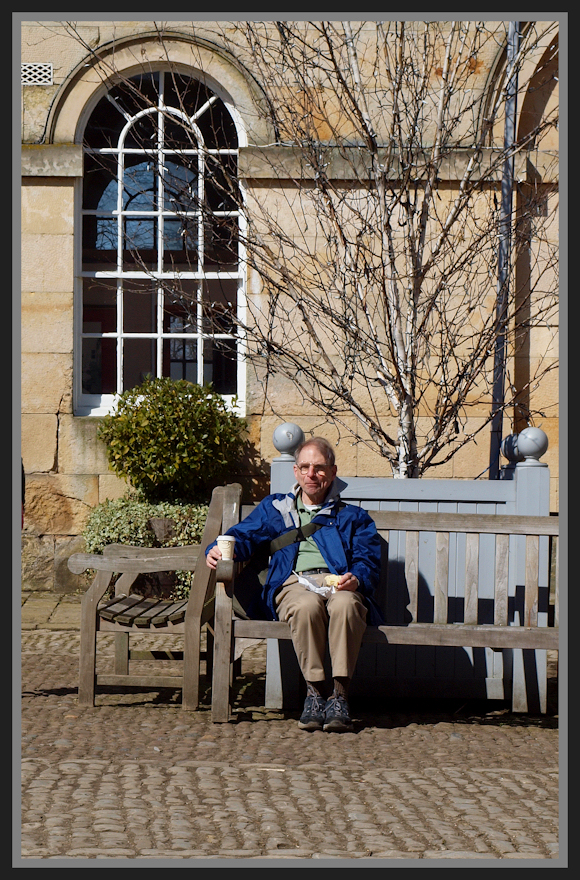
Professor Henle takes Tea
Castle Howard, York; April 2016
Something for the Weekend
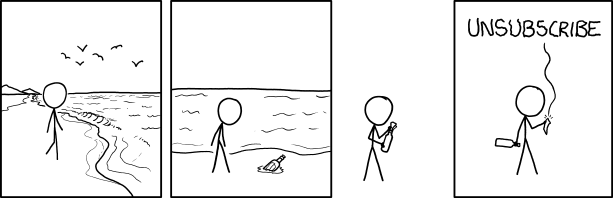
Nanny State
Atlantic Insight has an interesting interview (podcast & transcript) with Christopher Snowdon, Head of Lifestyle Economics at the Institute of Economic Affairs. He’s not at all impressed by the nanny state or public health lobbyists.
It’s worth a read, or listen: Interview with Christopher Snowdon
Oddity of the Week: B.O.
Nivea appear to have developed a smartphone app called Nivea Men Nose that will tell you (well men, ‘cos it’s aimed at men) if you have stinky body odour. The app needs a special phone case that has sensors to detect body odour chemicals. To find out your body odour level, you just hold the phone close to your armpit.
Why is it apparently for men only? Do male and female chemicals differ that much? Or it is confused by perfume? Or … ? Who knows.
But surely if you can’t be bothered to worry about body odour then you aren’t likely to be sort to use such an app, are you?
More in this really irritating video.
Quote: Life
Your future is not about people who walk away.
It’s about the people who stay in it for the ride.
Your Interesting Links
Lots of science-y bits again in this months offering …
Science & Medicine
I wonder when humans first started pondering about aliens? Well certainly they were in medieval times.
On the discovery of dinosaurs among us.
So what would you guess is the world’s deadliest poison? Well here are five of the top contenders.
Clean water. We all depend on it, but do you know what happens to it between its source and your tap? Simple explainer from Compound Interest.
Hugs generally feel good. Now researchers are beginning to understand why.
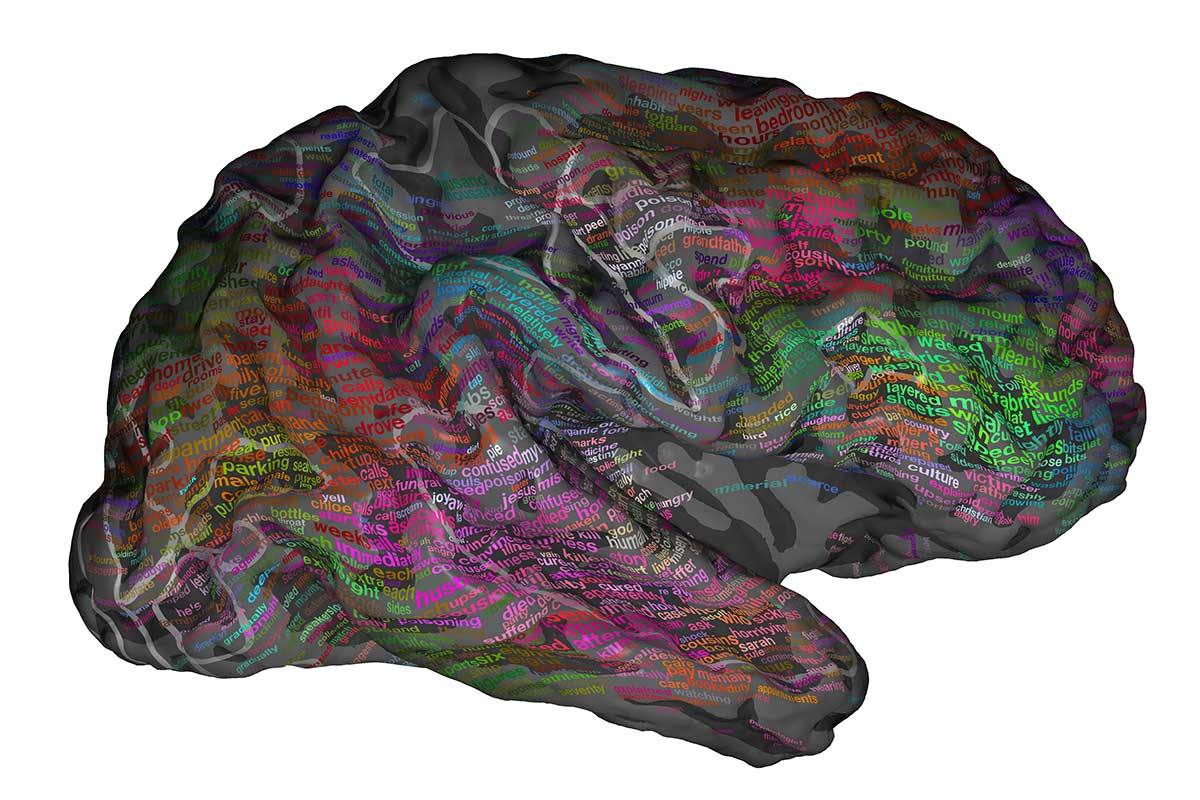
Wow! In what looks a stunning piece of work some neuroscientists have been able to create an atlas showing how words are organised in the brain. The implications could be worrying though.
Next up another stunning piece of research and development … A biotech company has developed a DNA sequencer that fits in a pocket and will go literally anywhere. Of course it is still expensive, but that should change. [Long read]
More new work shows that women get healthier after their husbands die. It must be finally having been able to stop doing childcare.
So really how do female astronauts cope with menstruation? Seems it is currently most down to persona choice.
Sexuality
So here are some of those sex myths debunked.
Here’s the story of a childless young lady who chose to be sterilised in her 20s and 40 years later she hasn’t regretted it, despite the harassment.
Social Sciences & Business
Bodyhackers: people who ave stuff implanted in them, like the microchips we put in our cats and dogs. They’re all around us. And most of them are women.
Language
Speed-reading. Too good to be true? Well that’s what the latest research is telling us.
History
Here’s an interesting piece on the early history of London’s St Paul’s Cathedral.
Archaeological divers found a 400-year-old dress in a shipwreck off the Netherlands. And it seems it sheds light on plot to pawn crown jewels.
The oddities of maritime history … the SS Baychimo, one of the strangest ghost ships on record sailing unmanned for 38 years.
Food & Drink
Well the French may call them pissenlit, but the humble dandelion is an interesting and useful herb. I remember when I was a kid we made both dandelion wine (lots of flowers) and dandelion coffee (from the roots). Love the illustrations too.
Out there are some amazing heirloom breeds: from woolly pigs to deodorant squash. And they’re vanishing, which is a shame as we’re losing some rich variety.
Shock, Horror, Humour
And finally … If you live near the sea what do you do with all the flotsam you find? If you’re artist Stuart Haygarth you sort it all to make interesting collections of weirdness.
More at the end of the month.