
Ten Things

Thirty-six years ago tomorrow, 11 July 1981, Noreen and I moved into our present house, and in that time a lot of water has flowed under the bridge — and the house has acquired a lot of “silt”. So for this month’s Ten Things I thought we should have a look at some of the things that have happened to me over those years.

10 Things I’ve Done Since July 1981 (in no special sequence):

  1. Started (with others) the Anthony Powell Society
  2. Taken early retirement and got my state pension
  3. Had 7 cats (not all at once)
  4. Had 3 months off work with glandular fever
  5. Built a koi pond
  6. Got the local council to plant a tree in the pavement outside the house
  7. Had an affair (yes, it’s OK, it’s public knowledge)
  8. Planted at least 12 trees in our suburban garden (much to the bewilderment of the neighbours)
  9. Lost both my parents
  10. Developed Type 2 Diabetes

And here is another view …

10 World Events that have Happened since July 1981 (again in no special sequence):

  1. America’s first black President (Barak Obama) (2009)
  2. Iraq War (2003 and years following)
  3. IBM PC announced (1981)
  4. Fall of Berlin Wall (1989)
  5. Chernobyl Disaster (1986)
  6. Tiananmen Square demonstrations in Beijing (1989)
  7. Introduction of the Euro (1999)
  8. 9/11 “bombing” of World Trade Centre (2001)
  9. Queen Elizabeth II becomes the UK’s longest reigning monarch (2015)
  10. Worldwide banking collapse (2008)

Interesting times we live in, but I wonder how many of those (or what events I’ve excluded) will be remembered in 100 or 200 years!
Non-EU Options

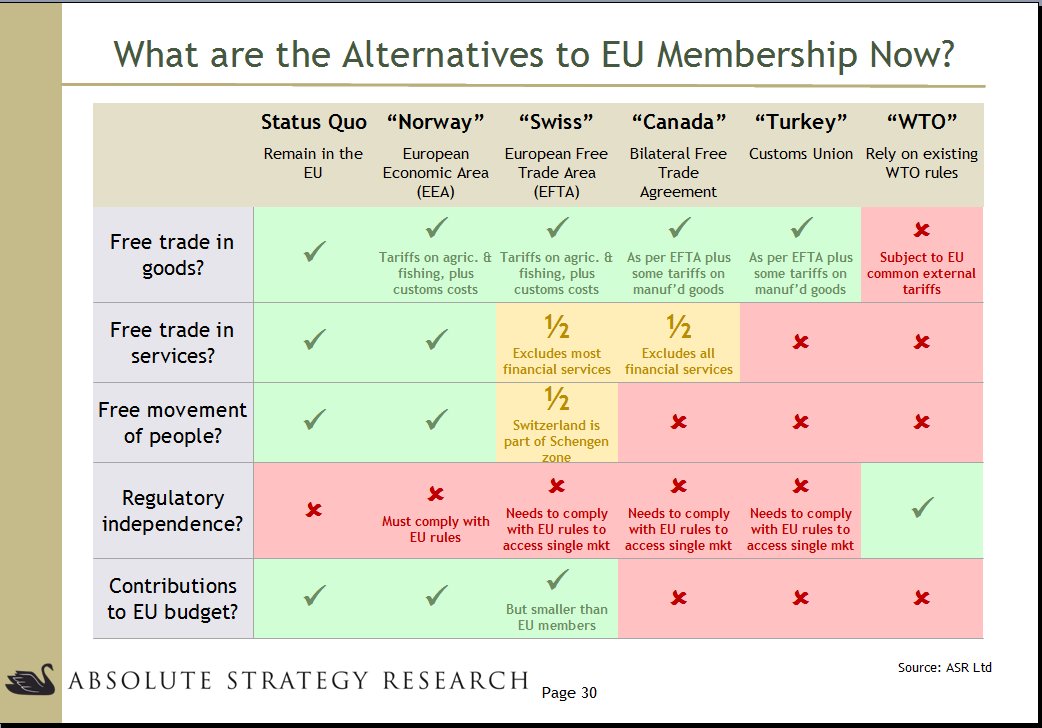
Earlier in the week I came across this graphic, which seems to nicely sum up our options for trade arrangements following exit from the EU — and compares them with the EU.

EU_Alternatives
Click the image for a larger view

Is it me, or do none of them look very attractive as trade deals?

Word: Pelage

Pelage
1. The coat of a mammal, consisting of hair, fur, or wool, as distinct from bare skin.
2. Something that resembles the coat of a mammal
Pelage is the mammalian equivalent of “plumage” for birds.


The word is not recorded by the OED until around 1830, whereas it is derived from the Old French peil, pel, or poil meaning hair or down.
Compare with French peler, to deprive of hair — and hence depilation (which is a much older arrival in English).

Good Deed

It isn’t often that one gets the chance to a really good deed for the day, and dig someone else out of the midden. And what’s more someone you don’t know, and will likely never meet again.
On Saturday morning I was in central London and stopped for a coffee in the Brunswick Centre. On leaving the Centre I was stopping to get some cash from the machine outside the small Sainsbury’s store. As I approached it a large, foreign-looking, middle-aged man walked away and into the Sainsbury’s store … leaving the cash machine beeping at nobody.
As I approached I could see that he’d left his money in the mouth of the machine! Duh!


Luckily there was no-one else much in the immediate vicinity. Arriving within seconds at the machine I removed the money, folded it and held onto it. I considered running after the man, but figured this would be pointless given my crocked knees, especially as he was unlikely to disappear from the store in the minute it would take me to get money for myself. So I did just that.
I then wandered into the Sainsbury’s store, easily located the man, who was quite distinctive, and handed him his notes. Needless to say he was profusely grateful.
I’ve no idea how much money was involved as I didn’t count it; it looked like about £50. I could have had a nice little bonus at someone else’s expense. But I didn’t.
However I did get something back. The satisfaction of saving some guy’s embarrassment. Oh and a £25 win on Saturday evening’s National Lottery.
It isn’t that often one gets to do a significantly good deed for a random stranger. But it feels good when you do.

MPs with some sense?!

There is hope that some MPs, at least, are beginning to see some sense.
The Commons Home Affairs Select Committee has issued an interim report on possible changes to the law on prostitution with MPs coming down on the side of decriminalisation.


According to a BBC News report they are suggesting that soliciting should no longer be a crime and that the rules on brothel-keeping be relaxed to allow prostitutes to share premises. They are however also saying that using brothels to control or exploit sex workers should remain illegal.
Note though that this is only an interim report and that the committee still needs to do more work on looking at both the Swedish model and the New Zealand model.
But if they make their current suggestions stick it will be a significant victory for common sense.

And there's more …

Yes, I’m afraid the fallout from the Brexit vote continues.
Last evening I picked up an interesting item on the BBC News feed in which the EU Trade Commissioner, Cecilia Malmstrom, points out the realities of the UK’s exit negotiations. (The article is short, very clear and worth a 5 minute read.)
The Commissioner is quoted as saying “There are actually two negotiations. First you exit, and then you negotiate the new relationship, whatever that is”. This is because:

  1. Under EU law, the bloc cannot negotiate a separate trade deal with one of its own members, hence the commissioner’s insistence that the UK must first leave.
  2. It is also against EU law for a member to negotiate its own trade deals with outsiders, which means the UK cannot start doing this until after it has left the EU.

So basically we have to negotiate just the exit deal (ie. the transitional arrangements). Then, and only then, can we start negotiations to join the EEA and/or arrange bilateral trade deals with other countries. And I have seen it suggested that negotiation to join the EEA normally takes 5-7 years, and bilateral trade deals aren’t usually a lot quicker.
Meanwhile the UK has to trade (with everyone!) under the WTO rules, which may not be to everyone’s liking or advantage — WTO rules restrict the circumstances in which countries discriminate in favour of each other in trade; they must apply to each other the tariffs they apply against the rest of the world.
Unfortunately many people, including some MPs like Geraint Davies writing in yesterday’s Guardian, clearly have no understanding of this. The two year clock started by invoking TEU Article 50 covers only the exit negotiations, and until that clock expires no other negotiations may legally take place.
So basically, if we trigger Article 50, we’re stuffed for years before we can even start to see a route out of the caldera.

Your Interesting Links

So here’s this month’s collection of pointers to articles you may have missed the first time round. And you’ll be pleased to know there is (almost) no mention of the political omnishambles in the UK.
Science & Medicine
Ooo-eerrr. Did you know you can actually see the evidence for evolution on your body? Goose-bumps. Ear muscles. And more. [Short video]
Why do we have so much trouble with our modern reinforced concrete but ancient unreinforced structure don’t?
Bigfoot — the American version of the Yeti. What if it actually was real?
Sexuality
[Not for the faint-hearted] One man tells what it is like to have 90 degree bend in his penis. Apart from painful, that is.
[NSFW] Girls, have you got a pain in c***? If so it might be vulvodynia. And like bent pricks it can be just as painful and is often curable.
[NSFW] Female Ejaculation. Myth or reality? Here’s some more investigation.
Environment
Given that we should all be concerned to conserve water, mathematicians reckon that we should always pee in the shower.


Beavers. They’re definitely beginning to make a difference to the ecology down in Devon. And it’s all for the good.
Samphire, aka Glasswort. It’s that tiny green, succulent-like plant that is sometimes served with fish. And it is a superb defender, and stabiliser, of our coastlines.

Social Sciences & Business
I promised (almost) nothing about the UK political situation. This is the one exception, and it is really sociology we already knew. There are five lessons which have been brought into sharp focus by the current mess.
I find it surprising that apparently pet ownership is in decline. This article looks at some of the possible reasons.
No apology for returning to one of my regular themes: nudity. Jess Staufenberg in the Independent argues that nudity and naturism is ‘best way to teach sex education’ to children. I agree; and it certainly seems to work for the Dutch.
History
Edward Johnston designed his iconic typeface for London Underground during WWI and, although it has been tweaked over the years, Transport for London have brought it up to date for its centenary. This is the history.
Shock, Horror, Humour
Finally, not so much something shocking or amusing but something philosophical to make you think from zen master, Brad Warner. What if we’re wrong? About everything. And there’s good (if circumstantial) evidence that we might be. And there’s a follow up on life after death.
More next month.

More Brexit Thoughts

A few more (random-ish) thoughts on the machinations behind all the mess of Brexit.

  1. First of all let’s be clear where I’m coming from. At this point I do not care about whether the referendum result is right or not. While I would prefer to remain in the EU, the dice have been thrown and we are where we are. My interest now is a (forensic) understanding of what can, should and will happen especially from a legal and constitutional perspective. I am not an expert in this; I rely on those who are, which is why I have been (and will continue to) try to represent the position as objectively as possible based on the reports available to me. I am trying to avoid speculation and wishful thinking.
  2. Contrary to my previous understanding, legal opinion seems divided as to whether the executive (ie. ministers) can serve notice under TEU Article 50, or whether to do so would require the active advance agreement of parliament via an Act. It all seems to boil down to how you view the use and the reach of prerogative powers by the executive.
    Head of Legal argues that the executive have the prerogative powers. Constitutional lawyer Geoffrey Robertson QC and perhaps our top expert public lawyer David Pannick QC [paywall] disagree.
  3. Pace many politicians and commentators, we appear to be in a very weak bargaining position on the exit deal. It seems to me that the EU hold all the chips, bar one.
    The only chip we hold is the timing of the starting gun.
    The EU hold all the other chips.

    • They can (as they have said they will) decline to enter into informal pre-negotiations.
    • They can continue to arm-twist the UK into issuing a notification under Article 50, although as Jack of Kent and others have pointed out they cannot do anything at law to force this to happen.
    • The EU are in a position to dictate the terms of the deal. What we want is irrelevant; it is all about what they’re prepared to offer; they can say “this is the deal, like it or lump it” because if we don’t agree then exit happens automatically anyway even without a deal. Moreover they have no reason to be overly benevolent towards the UK – apart from securing their own trade position (which they can do by offering membership of the EEA at great cost to us) they have no need to be benevolent.
    • Notice too that the formal exit negotiating period (two years or whatever it turns out to be) allows only for negotiating the exit deal (ie. transition arrangements). It says nothing about what deals might be done on the post-exit arrangements, for example by offering the UK membership of EEA. And the EU have said that the exit deal negotiations are unlikely to include anything on post-exit trade deals which would have to be agreed separately post-exit.
    • Once Article 50 has been invoked there appears to be no way to cancel the process; everyone seems to agree that once triggered we must and will cease to be an EU member. Of course we could then apply to rejoin, but what draconian terms might we be offered?
    • And once we’re out, all bets are off. We have to negotiate completely new deals on just about everything and again from a relatively weak bargaining position.
  4. Do we need to trigger Article 50 or can we leave some other way? Essentially, no, Article 50 is the only accessible exit procedure. Again see Head of Legal.
  5. There seems to be growing opinion that neither Scotland nor Northern Ireland (both of whom voted to remain in the EU) can block the UK from leaving if Westminster is determined to do so. This is nicely summarised over at Legal Business.
  6. Legal Business also has an interesting discussion about the duty of an MP being to vote with his/her conscience rather than trying to reflect the whimsy of their constituents’ desires. The conclusion is that the constitutional principle upon which our parliamentary democracy is based is that MPs betray their constituents if they vote against their consciences (they are representatives not mandated delegates) — which is in turn based on this wonderful passage from Edmund Burke’s speech to the electors of Bristol in 1774:

    It ought to be the happiness and glory of a representative to live in the strictest union, the closest correspondence, and the most unreserved communication with his constituents. Their wishes ought to have great weight with him; their opinion, high respect; their business, unremitted attention. It is his duty to sacrifice his repose, his pleasures, his satisfactions, to theirs; and above all, ever, and in all cases, to prefer their interest to his own. But his unbiased opinion, his mature judgment, his enlightened conscience, he ought not to sacrifice to you, to any man, or to any set of men living. These he does not derive from your pleasure; no, nor from the law and the constitution. They are a trust from Providence, for the abuse of which he is deeply answerable. Your representative owes you, not his industry only, but his judgment; and he betrays, instead of serving you, if he sacrifices it to your opinion …
    To deliver an opinion, is the right of all men; that of constituents is a weighty and respectable opinion, which a representative ought always to rejoice to hear; and which he ought always most seriously to consider. But authoritative instructions; mandates issued, which the member is bound blindly and implicitly to obey, to vote, and to argue for, though contrary to the clearest conviction of his judgment and conscience, these are things utterly unknown to the laws of this land, and which arise from a fundamental mistake of the whole order and tenor of our constitution.

    However, again, not everyone agrees with this stance with many of the opinion that an MP is required to reflect the majority wishes of his/her constituents.

More snippets when there is anything useful. This one could run and run!