[Frank Zappa]
Quote: Mind
[Frank Zappa]

Laurence Ward
The London County Council Bomb Damage Maps, 1939-1945
Thames & Hudson, 2015
 During WWII the Architects Department of the London County Council (the LCC; then the local authority for what are now the central London boroughs) set about documenting the cumulative bomb damage in the capital city. This was an area from Woolwich in the east to Hammersmith in the west, and from Crystal Palace in the south to Highgate in the north. Detailed maps were produced showing every property, from the smallest cottage to the large factories. Teams of surveyors soured the area to assess any bomb damage to properties. The damage was graded from “total destruction” down to “minor blast damage” and areas marked for clearance. The sites of V1 flying bomb and V2 rocket impacts were also marked.
The task required 110 maps at a scale of 1:2500 (that’s 25 inches to the mile), and each measuring roughly 75x106cm; these were based on the 1916 Ordnance Survey maps, updated to 1940. And they were hand-coloured according to the level of destruction found. Each of the maps is reproduced here at roughly 1/3 size. And boy do they give a vivid picture of the destruction wrought by the Luftwaffe. Every map contains something interesting — just look at the map for the area of the City around Farringdon and Holborn: it is one big swathe of purple, meaning “Damaged beyond Repair”, from the river to Hoxton and from Bank to the west of Blackfriars Bridge. Overall, getting on for 50% of the Square Mile must have been demolished!

Terry Townsend
Kent Smugglers’ Pubs
PiXZ Books; 2014
This is not a book you would generally think to read from cover to cover — and I haven’t. It is a guide book which one dips into to find somewhere interesting to visit.
It is a well produced guide book which does what it implies: provides a couple of page of information on some of the most interesting and picturesque Kent pubs which have particular associations with smuggling. As the introduction says, pretty much every pub in the 16th, 17th, 18th and 19th centuries would have had some involvement in smuggling, even those which were far inland, as there had to be trade routes for contraband goods from the coast to London.
The book features just over 30 pubs, many (but not all) on the Kent coast, but all of which have well established connections with significant smuggling. Each pub gets 3 or 4 pages of history and description with copious amounts of illustration on good quality, heavy paper. This makes for lots of suggestions for days out, but the book would do this better if there was a map or two.
My only other real complaint is that (like so many books these days) the board covers have very sharp corners, which make reading in bed uncomfortable.
All in all a useful little book which includes a handful of pubs I know.
Overall Rating: ★★★★☆
After halting everything for a few weeks to allow time for a review, Prime Minister Theresa May has now given the go-ahead for the Hinkley Point C nuclear power station.

So, Joanna Lumley and Thomas Heatherwick’s pet vanity project, London’s so-called Garden Bridge, is coming under increasing scrutiny. And it seems to me rightly so as the whole thing appears to have been stitched up behind closed doors with a total lack of transparency, especially around the financing.
Finally London’s Mayor, Sadiq Khan, has instigated a full review of the project. Khan had previously declined to commit further public money to what is basically a private, commercial, project. The review is to be undertaken by Margaret Hodge MP, the former chair of the House of Commons Public Accounts Committee.
While we don’t know the details of the review’s terms of reference, it has to be a good thing providing Margaret Hodge is, and can remain, independent and unbiased.
Meanwhile London blogger Diamond Geezer has taken a somewhat cynical (and sarcastic) look at the project.
In my view it is high time this appalling project was kicked irredeemably into touch.
PS. I decline to (re)post images of the bridge design etc. but if you want some pictures of the location then do look at Diamond Geezer’s post.
Oh dear, there isn’t too much happening this month and it doesn’t hep that I’ve been both swamped with stuff which has to be done, a recalcitrant PC and struggling with an ongoing ear infection. Why do these things always come along together? Maybe they’re London buses?
Anyway, enough of my woes, let’s to our monthly selection of quotes — and even these are rather thin on the ground this month.
Thinking is difficult, that’s why most people judge.
[Carl Jung]
No, you can’t deny women their basic rights and pretend it’s about your “religious freedom”. If you don’t like birth control, don’t use it. Religious freedom doesn’t mean you can force others to live by your own beliefs.
[President Barack Obama]
Try not to think of it as a debate. Try to think of it as couples therapy. Two people with irreconcilable differences fighting for custody of a child that most people have given up on.
[John Crace; Guardian; 09/09/2016; commenting on the Labour leadership contest]
It’s wonderful being able to make people so angry when one is so old.
[Edith Sitwell to Anthony Powell]
I admire those with hairstyles. I don’t have a hairstyle. Most days, it has zero caterpillars in it. That’s about as good as it gets.
[Unknown; but with thanks to Katy Wheatley]
I am really sorry to see my countrymen trouble themselves about politics. If men were wise, the most arbitrary princes could not hurt them. If they are not wise, the freest government is compelled to be a tyranny. Princes appear to me to be fools. Houses of Commons and Houses of Lords appear to me to be fools; they seem to me to be something else besides human life.
[William Blake (1757-1827); Politicians and Politics]
Because I know that time is always time
And place is always and only place
And what is actual is actual only for one time
And only for one place
I rejoice that things are as they are.
[TS Eliot; Ash Wednesday]
Compare that with …
I am sure you will agree with me, Lady Warminster, in thinking, so far as company is concerned, enough is as bad as a feast, and half a loaf in many ways preferable to the alternative of a whole one or the traditional no bread. How enjoyable, therefore, to be just as we are.
[Anthony Powell, Casanova’s Chinese Restaurant, spoken by Edwardian novelist St John Clarke]
To us, the moment 8:17 AM means something — something very important, if it happens to be the starting time of our daily train. To our ancestors, such an odd eccentric instant was without significance — did not even exist. In inventing the locomotive, Watt and Stevenson were part inventors of time.
[Aldous Huxley]
Someone had decided to brighten the ancient corridors of the University by painting them, having some vague notion that Learning Should Be Fun. It hadn’t worked. It’s a fact known throughout the universes that no matter how carefully the colours are chosen, institutional décor ends up as either vomit green, unmentionable brown, nicotine yellow or surgical appliance pink. By some little-understood process of sympathetic resonance, corridors painted in those colours always smell slightly of boiled cabbage – even if no cabbage is ever cooked in the vicinity.
[Terry Pratchett; Equal Rites]
More next month!
There was a scathing article form Nick Cohen on the Guardian website yesterday (so I guess printed in the Observer) pointing out what I said some while back that the EU has no reason to be helpful to the UK leaving the EU. In fact the EU hold all the chips except the timing of invoking Article 50.
I give you a few choice side-swipes …
The lie … which some Leave supporters may even have believed, was that there were no hard choices. We could have it all. Immigration controls, prosperity, access to EU markets, without compliance with EU laws … Whatever we wanted, at no cost at all.
An honest [campaigner] would have gone to the Nissan car workers in Sunderland and said words to the effect of: we may be able to deliver the immigration controls you want if we leave the single market but there is a risk that you will lose your jobs if we do.
We cannot strike agreements with 50 countries currently covered by our EU arrangements until we strike a trade deal with the EU, because everyone else will want to know where we stand.
We won’t strike a deal with the EU, for — what? — three, five 10 years? How many jobs will be lost and foreign investors driven away in the process …
Boris … says we are a great country. Not any more. What greatness we possessed came from our alliances. By voting to leave we have ignored the advice of every friend we had in the world. Now we are asking the countries we spurned to help us and they are finding reasons to look away.
The right says the EU will want to give us a better deal out than we had in because the EU nations will still want their exporters to sell to us. They don’t look at how politically impossible it would be for Europe’s leaders to tear up EU rules when they are having to face down their own xenophobes and Europhobes.
Yes, precisely.
We have shot ourselves in both feet.
This month’s Ten Things is for those, like me, who were children in the 50s and 60s. It is a little nostalgia about radio programmes, in the days before everyone had television and before there were hundreds of radio channels — ie. when there was BBC Radio or nothing; the days of the Home Service, the Light Programme and the Third Programme.
So here are Ten Radio Programmes I Remember from My Childhood:
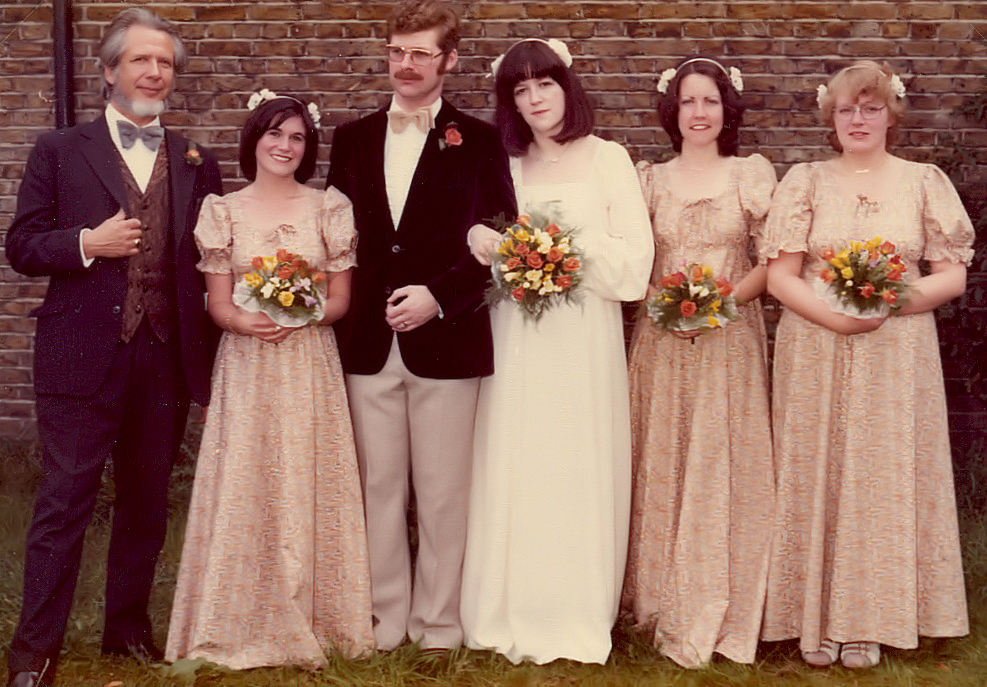
As of about 3 o’clock this afternoon, Noreen and I have been married for 37 years! Eeeeekk!
That’s 10 years more than we haven’t been married!
I can’t decide whether if feels like forever or feels like for never. It just is; it’s like an old shoe that is so comfortable you don’t know you’re wearing it. Although like all shoes you get a stone in it occasionally — indeed, contrary to the usual tenet, marriage is a bed of roses: it looks pretty but has thorns too!
Back in 1979 we were still coming out of the hippie-ness of the 60s and 70s, and we were still students at heart — we still are! So we did the wedding our way, slightly eccentrically. There wasn’t a lot of money around — the country was crawling its way out of recession, we didn’t have any spare money, neither did Noreen’s mother, nor my parents. So we did it all ourselves, made it all up as we went along, did our own thing, very simply, and still had a good time.
We were married at St Peter’s, Acton Green; at the north end of Chiswick where it merges into Acton. We had been living there for about 4 months, and going to church, so it seemed sensible to get married there. St Peter’s was Anglo-Catholic, and sufficiently high church that it even satisfied our RC friends.
We lived just 400 yards from the church, so we walked to church, from our flat. No, cars; what’s the point when it is less than a 5 minute walk? My best man was my friend Victor, from my post-grad days, who was old enough to be my father. Noreen had three “maids of honour” all her own age — friends from school and university — and all four had made their own frocks. Noreen was given away by another university friend, her mother did the flowers and one of my aunts made a cake.