
As a quick follow-up to yesterday’s post on the fears surrounding radiation, I came across an item, by science journalist Geoff Watts, from a couple of years ago: Is your fear of radiation irrational? This considers the whole question in rather more detail. It’s a long read but worth the effort.
Radiation
There was a useful, if short, review by David Ropeik of Harvard in Aeon a couple of weeks ago under the title “Fear of radiation is more dangerous than radiation itself“.
This is something which has been said for a long time, but it is useful to have the threads pulled together in a referenced article.
As usual I’ll give your the tl;dr version.
The fear of ionising (nuclear) radiation is deeply ingrained in the public psyche … we simply assume that any exposure to ionising radiation is dangerous. The dose doesn’t matter. The nature of the radioactive material doesn’t matter. The route of exposure – dermal, inhalation, ingestion – doesn’t matter. Radiation = Danger = Fear. Period.
The truth, however, is that the health risk posed by ionising radiation is nowhere near as great as commonly assumed. Instead, our excessive fear of radiation … does more harm to public health than ionising radiation itself. And we know all this from some of the most frightening events in modern world history: the atomic bombings of Japan, and the nuclear accidents at Chernobyl and Fukushima.
Much of what we understand about the actual biological danger of ionising radiation is based on the joint Japan-US research programme called the Life Span Study … of survivors of Hiroshima and Nagasaki [see also here]… Within 10 kilometres of the explosions, there were 86,600 survivors … and they have been followed and compared with 20,000 non-exposed Japanese. Only 563 of these atomic-bomb survivors have died prematurely of cancer caused by radiation, an increased mortality of less than 1 per cent.
Based on these findings … the lifetime cancer death toll from the Chernobyl nuclear accident might be as high as 4,000, two-thirds of 1 per cent of the 600,000 Chernobyl victims … For Fukushima, which released much less radioactive material … UNSCEAR predicts that ‘No discernible increased incidence of radiation-related health effects are expected among exposed members of the public or their descendants.’
Both nuclear accidents have demonstrated that fear of radiation causes more harm to health than radiation itself … 154,000 people in the area around the Fukushima Daiichi … were hastily evacuated. The Japan Times reported that the evacuation was so rushed that it killed 1,656 people … The earthquake and tsunami killed only 1,607 in that area.
… … …
In 2006, UNSCEAR reported: ‘The mental health impact of Chernobyl is the largest public health problem caused by the accident to date’.
… … …
Fear of radiation led Japan and Germany to close their nuclear power plants. In both nations, the use of natural gas and coal increased, raising levels of particulate pollution and greenhouse gas emissions. Neither country will meet its 2020 greenhouse gas emissions-reduction targets.
… … …
Fear of radiation has deep roots. It goes back to the use of atomic weapons, and our Cold War worry that they might be used again … Psychologically, research has found that we worry excessively about risks that we can’t detect with our own senses, risks associated with catastrophic harm or cancer, risks that are human-made rather than natural … Our fear of radiation is deep, but we should really be afraid of fear instead.
Or in the immortal words of Rear-Admiral Sir Morgan Morgan-Giles: Pro bono publico, nil bloody panico.
How to be Green
Noreen and I have always maintained that we’ve done two of the most important things one ever can in terms of being green and preventing global warming. We don’t have children and we don’t run a car.
It turns out that we’re right, as this article outlines.
Any of [the top] lifestyle changes drastically reduces carbon emissions compared to more common practices like recycling, using energy-efficient light bulbs and line-drying clothes.
- having one fewer child (an average for developed countries of 58.6 metric ton CO2-equivalent (tCO2e) emission reductions per year;
- living car-free (2.4 tCO2e saved per year);
- avoiding airplane travel (1.6 tCO2e saved per round trip trans-Atlantic flight);
- eating a plant-based diet (0.8 tCO2e saved per year).
In fact, according to this list, we should also count the third item.
As always though there is a “but” …
Yes we’ve chosen not to have children. So far, really good. However we are not totally car-free. It’s true that neither of us drives and we’ve never owned a car, but we do use taxis a fair amount. I calculated many years ago that, when one looks at the total (money) cost of ownership, using taxis was much cheaper than running a car. Nevertheless, using taxis can’t count as totally car-free, although I’d maintain it is pretty damn good: on the 2-3 times a week we need car transport, by using a taxi for maybe 20 minutes, we share that car with tens of other people that day. And having to get a cab, makes us think about what we’re doing and where we’re going, as we can’t just jump in the car at any slight provocation, several times a day.
In addition we avoid air travel wherever possible. We’ve only ever done one long-haul trip (Washington DC) and even then we made a special effort to offset the carbon emissions. I don’t see us doing long-haul again; but one never knows. Although over the years I did a couple of dozen internal or European flights for work, we’ve only ever done a handful of short-haul flights for leisure purposes – and again I don’t see that changing significantly. Yes, of course we would love to go and see all these fancy places – but we don’t need to, it’s expensive (in so many ways) and we can live without it.
So while we may not be able to count a full 3 out of the 4, I reckon we’re entitled to 2½. Which is probably 2 more than the average person. No reason to gloat, but a reason to be sad that others are perhaps less compassionate, and a reason for some small contentment.
Ultimately it is all down to one’s ethical compass, how one views the world, and making lifestyle choices.
How well do you do?
Quotes
Our regular monthly round-up of quotes interesting and amusing …
The deeper we go down the internet-porn wormhole, the more it seems narrow-minded to understand porn exclusively in terms of what kind of sex it “teaches” us to have. Because in the streaming era, the amount and diversity of porn we watch exponentially outpaces that of the sex we have … Pornography is more than a mere causal agent in the way we screw. It has also become a laboratory of the sexual imagination – and as such, it offers insight into a collective sexual consciousness that is in a state of high-speed evolution.
[Maureen O’Connor; “Pornhub Is the Kinsey Report of Our Time” at https://www.thecut.com/2017/06/pornhub-and-the-american-sexual-imagination.html]
The globalists are using cats to depopulate whites. Because cats act as surrogate babies they cause white women to not want to have kids. Cats are like a parasite that sucks the maternal instinct from white women.
[Unknown]
We’re not going to introduce ID cards. We’re going to introduce cards of identification.
[David Davis, Brexit Minister]
Religion is the practice of training minds to ignore evidence, reason and logic and increasing the ability of believing in fairytales of Bronze Age and of being proud of them.
[Raghu K Kanam]
It’s an important problem. It’s important because it justifies the many attempts to solve it.
[Dr Sabine Hossenfelder]
We seem okay with violence, but nudity we race to criticise and censor.
[Eva Mendes]
Devon Rex: a delightfully alien-looking cat described by the The Cat Fancier’s Association as a madcap mix of a “cat, a dog, a monkey, and Dennis the Menace”
Civilised disagreement is the hallmark of intelligent people in a humane and rational society
[Robert Neuschul on Facebook]
What is the meaning of life? That was all – a simple question; one that tended to close in on one with years, the great revelation had never come. The great revelation perhaps never did come. Instead, there were little daily miracles, illuminations, matches struck unexpectedly in the dark.
[Virginia Woolf]
Only you can fill in what’s missing. It’s not something another person can do for you.
[Haruki Murakami]
A number of prostitutes in Nevada, where brothels are legal, have organized as “Hookers for Healthcare” to oppose the healthcare legislation now pending in the US Senate. This poses a real quandary. I don’t know which side to believe. I mean, on one side, there’s this small group of amoral people who every day debase themselves by doing anything, no matter how disgusting and depraved, to please the men who give them money. And on the other side, we’ve got hookers.
[Phil Kloer]
Another round next month.
More Auction Amusements
We’ve not had any amusements and oddities from our local auction house for a while, largely because the last few sales haven’t thrown up anything really spectacular. Anyway here are the few highlights(?) of the recent sales. Any childish and inappropriate amusement is, of course, entirely in your brain!
Interesting old ivory including binoculars, a circular box, a bone card case with metal inlay, a desk clock, a glass paperweight, a Wills cigarette tin with a picture of the Queen, etc., and a tin containing miniature Nazi paper flags, etc.
A box of curiosities including a German cut-out 3D ‘theatre’ with actors, in original box, a pair of miniature shoes, an old purse, a chain-mail miser’s purse, two wartime handkerchiefs, a pin doll, an old notebook, military badges, an old lock, cigarette holder, etc., all in a fabric-covered box
Two miniature tortoiseshell guitars, a mandolin and a banjo
A 19th century portrait miniature of a child in a papier mache frame …
I wanted to know what the child was in a papier maché frame!
A vintage hand held fire extinguisher, a small box of vintage medicines in bottles and boxes and a Christmas fairy
Three modern large glass ornaments modelled as horns on metal stands
A replica ancient Greek helmet in steel and brass with black bristle cresting, on stand
A novelty metal garden seat in the form of a nodding dog
A large quantity of assorted fabrics, some on rolls, scraps, throws, cushion covers, needlework items, patterns, buttons, buckles, etc., also a small quantity of ladies accessories including a skin handbag, gloves, etc., two vintage costume dolls and a modern doll, a stuffed cat doorstop, etc.
A child’s rocking chair with stirrups …
An early 20th century instrument, possibly medical, an early photograph of a seated gentleman the frame marked, 58 Strand, a Victorian mahogany box of draughts and two large watermarks one of Darenth Mills Dartford and a portrait of Haile Selassie, etc.
Carved woodpecker inkwell …
A good shelf of African wooden tribal wares including bowls, spears, drums and benches
Which was followed by …
A good lot of wooden African tribal art including carved busts, figurines, bowls, jugs, paddles etc.
A Chinese late Qing Dynasty wood carving of three Buddhistic lions finished in red lacquer, with painted verso, in modern gilt frame, and a pair of native African throwing spears
A Timor horse skull mask incised with geometric decoration
An Eco 4 mobility scooter and battery which can be folded up into a car and transported
Ah yes, the patent folding battery.
Over 600 used golf balls
A decorative modern oil on board, of a Bible clutching a nun
A wooden boxed travelling chess set and board, a New Home sewing machine and two heated servers
A modern gilt framed flower fairies plaque marked spurious Minton on the back
A vintage oak wine barrel, a pair of vintage dog nut crackers and a decorative brass fish
Is cracking a dog’s nuts not classed as cruelty?
Seventeen vintage milk bottles including D Wilson & Sons and Lyndley Dairy, two vintage fire buckets and fire extinguisher, a Gordon wrench set in red metal case and other vintage tools …
Six boxes of terracotta plant pots in various graduating sizes
Yes, they really were used clay flowerpots.
A Celmac new ceramic toilet and seat
A charming Edwardian silver toasting fork with turned wood handle, with silver suspension loop, Sheffield 1908, together with a pair of late Victorian silver-plated and oak salad servers fashioned as gardening implements
More anon …
Something for the Weekend
Book Review: The Watchers
Stephen Alford
The Watchers: A secret History of the Reign of Elizabeth I
(Penguin; 2012)
I mentioned this book some while ago, and promised a review of it when I finished it. At that time I was about four chapters from the end, but have only just got round to reading them – life has intervened in too many ways! Anyway, here at last is a review.
The book is a tour de force of forensic historical document research. There is little remaining evidence to go on, as Alford himself explains in his “Introduction”:
It would be wonderful to have the papers of [Elizabeth’s] secretary and his staff just as they were left at the end of Elizabeth’s reign. Instead we have to make do with tantalizing fragments, scattered pieces of a great documentary puzzle that keep historians on their toes. A stunning exception is the surviving archive of manuscripts belonging to Robert Beale, a clerk of Elizabeth’s Privy Council. Beale was a powerful character, a plainly spoken man of … high intelligence, an experienced bureaucrat and a master of government business. Over his long career, Beale collected the kinds of papers he and his colleagues needed to use every day, organized by themes and topics … Beale’s volumes in the British Library … allow us to understand an Elizabethan archive, to touch it and feel it: the stiff pale animal hide spines and covers, the leather ties to keep the books closed, the indexes for speedy reference, and Beale’s explanatory notes in what, after the frenetic scrawl of Sir Francis Walsingham [Elizabeth’s principal secretary] or the impossibly compressed minute writing of Walsingham’s most secret servant, Thomas Phelippes, is one of the vilest hands of sixteenth-century England … Unfortunately Beale’s papers are exceptional. Time, damp and hungry rodents quickly set to work on the piles of old government papers that lay in heaps in the Tower of London for centuries. Most of what survives today was preserved for us by the enterprising Victorians who … went through the chaos of papers they found in government and family archives and gave them order.
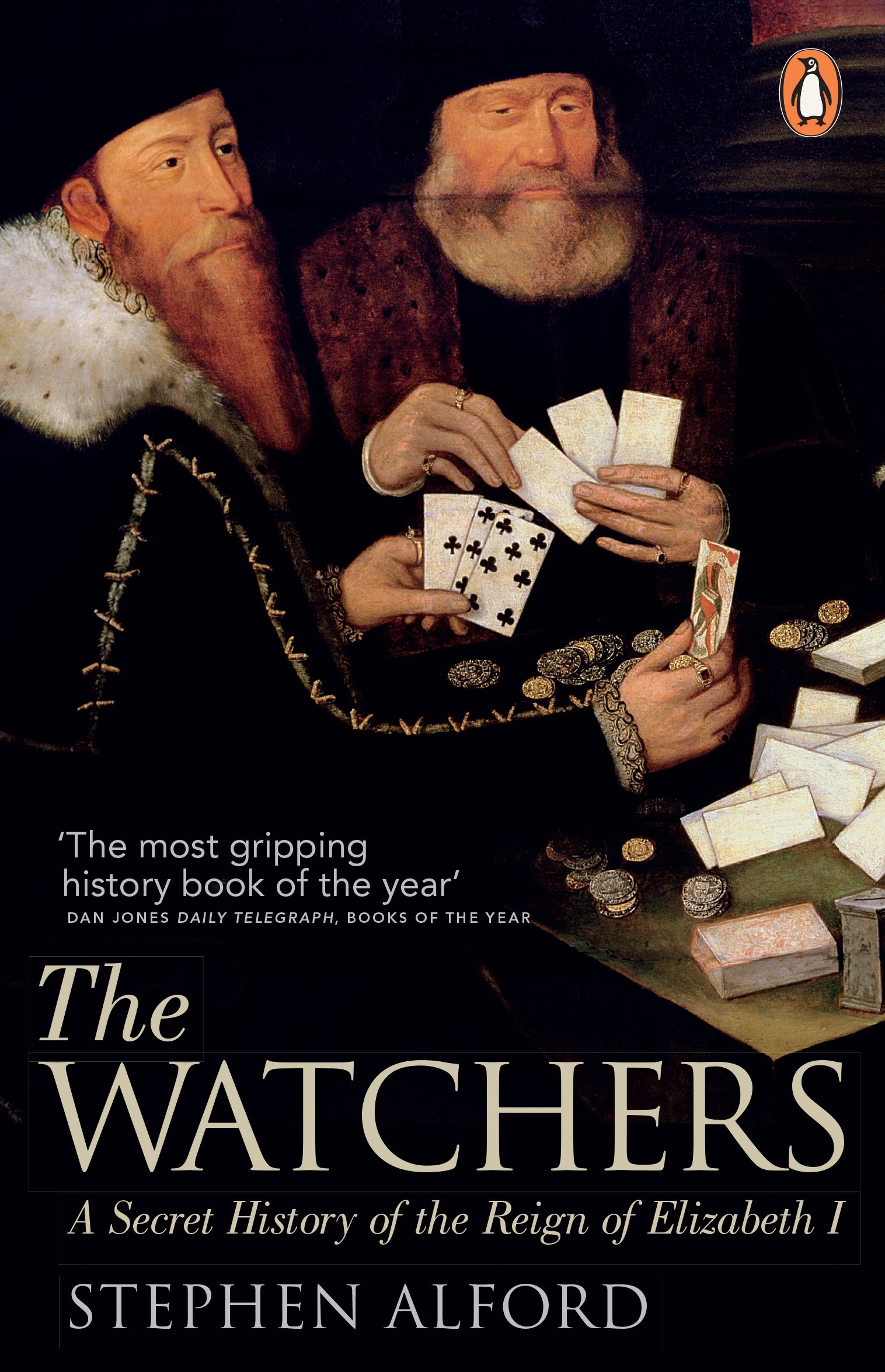 What emerges is a “who nearly done it” from the misty and murky world of Elizabethan espionage. Espionage that, in those dangerously unsettled times, was essential for the survival of Protestant England and Elizabeth. Espionage, which was perhaps the first really consolidated use by the state, and whose methods very much laid the foundations even for today’s shadowy world of subterfuge.
Alford uses the available papers to tell the story of the machinations underneath many of the plots against Elizabeth, and of the subtle, cunning and, yes, dishonest way in which Sir Francis Walsingham, Lord Burleigh, Robert Cecil (Burleigh’s son), and to a lesser extent the Earl of Essex, used spies, couriers and shadowy men to capture Catholic plotters, entrap Mary Queen of Scots and send many to the rack and the gallows.
We all knew that Mary Queen of Scots had been caught out colluding with the Catholic enemy. What we probably didn’t realise was just how many people were involved; many were just couriers of letters who knew not what was happening; but equally many knew parts of the plan and were paid handsome sums of money not to ask questions. We probably also didn’t know that the crucial evidence against Mary was in fact a forgery.
It is a fascinating story with web upon web upon web of interplay between agents, double agents and even triple agents. A web which ranges across much of mainland Europe as well as England. But this tangle of webs does make the book somewhat challenging, as you need a clear head to keep in mind who everyone is, and who is playing who off against who.
It is an engrossing read which is well written and keeps you turning the page – I had to restrict myself to a chapter or two a night just so as not to stay up round the clock to finish the book. This is a book which tells history in the raw, and in the way it happened on the ground at the time, rather than as the sanitised version we are all taught at school. It gives us an insight into what (at least for some elements of society) was a really frightening, unsafe and unstable age.
If you enjoy history, are interested in the Elizabethans, or just like some good intrigue and skulduggery, then this is a book you will want to read. It is perhaps the most fascinating book I’ve read in a long time.
Overall Rating: ★★★★★
Ten Things
Something completely different this month …
Ten Scientific Discoveries that were Later Proven Wrong by Religion:
Extra Cat
Yesterday we acquired another kitten – a boy kitten. Well we can’t have a household of just two girlie cats! Again he came from our local animal rescue charity Guardian Angels and was being fostered by the lovely Kat in Isleworth. Kat said she hadn’t named him but was referring to him as “Boy”. By the time we got him home, it had stuck. He’s about 9 weeks old, mostly white with some tabby splotches. He’s also got noticeably, and strikingly, curly whiskers, a very triangular head and big ears – which makes us wonder if he doesn’t have some Devon Rex (or similar) in his make up; maybe a Devon Rex grandfather?
So here are the first couple of decent photos, taken at lunchtime yesterday, within an hour or so of him arriving. In the first he is offering to help with lunch. Well what self-respecting cat wouldn’t when there’s cold roast salmon on offer?
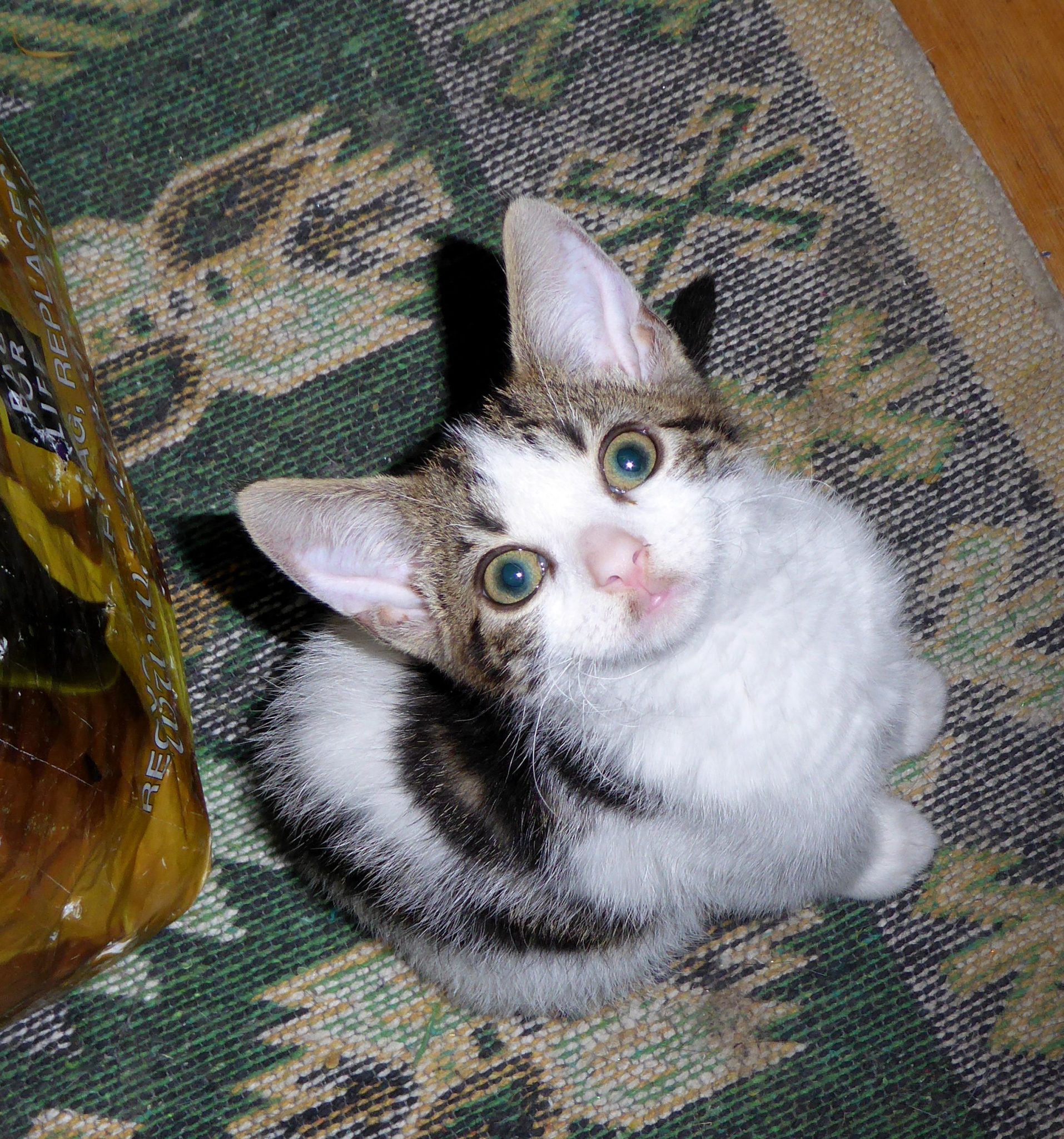
Like all kittens he’s slightly scruffy, but that never stops them looking cute …
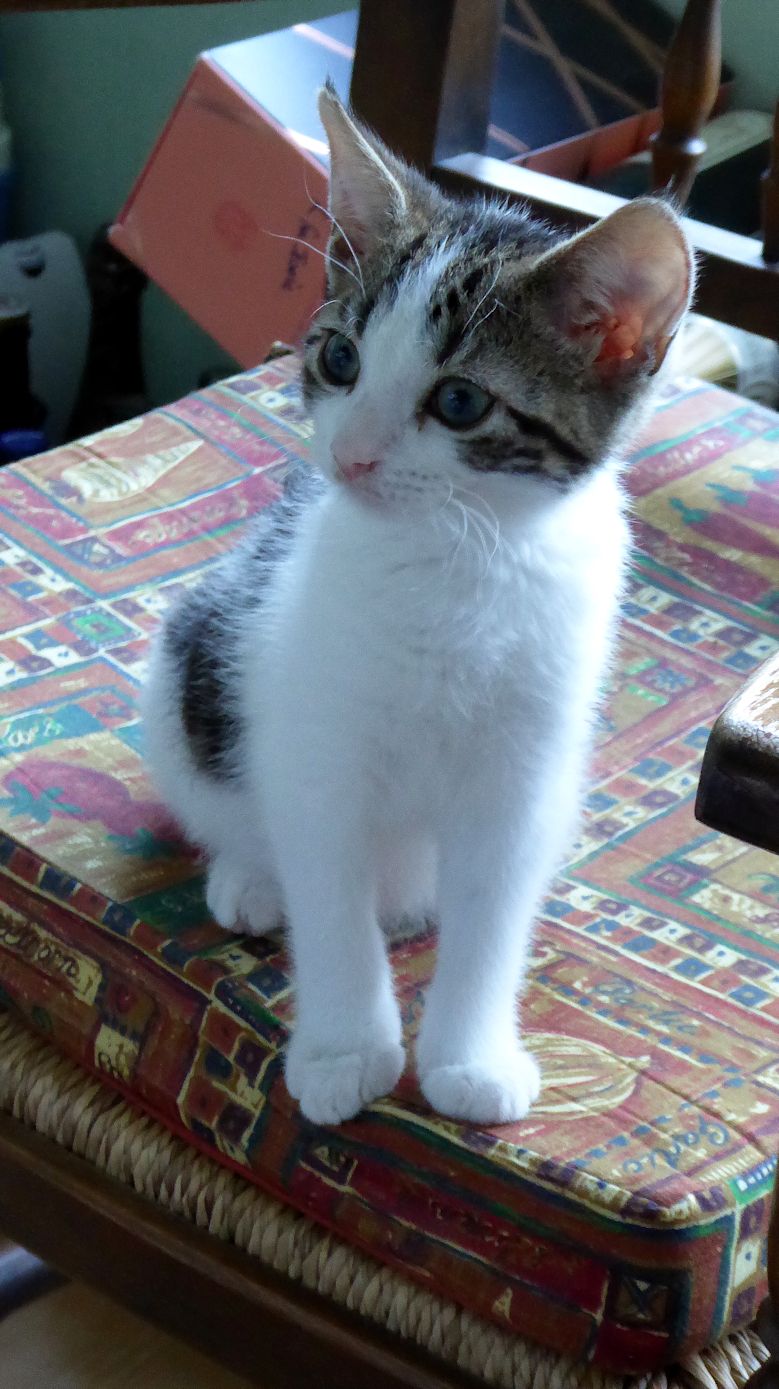
He’s still quite phased by everything. He was the last of the litter to find a home, so he’s been without his brothers’ company for a while. He hated the car journey home. And everything here is different, new and scary especially with two big cats around. But he’ll be fine. I’m confident they’ll all adjust.
If nothing else Boy will eat for England. He clearly wasn’t starving when we brought him home. Nevertheless between about 1pm and midnight yesterday he demolished two complete sachets of kitten food, several teaspoons worth of cold salmon, a piece of raw steak the size of a large almond, and several similar pieces of cooked steak. Oh and the piece of pasta I dropped on the floor. By the evening he was very round and drum-like in the middle; he looked as if he’d swallowed a basketball and was about to split a seam. But then it is every kitten’s ambition to be like that: most cat’s run by the motto “Eat now, lest hungry later”. As Garfield always said: “Eat and sleep. Eat and Sleep. There must be more to life but I do hope not!”
Meanwhile WPC Primrose sat and watched, ready to intervene in any indecorous behaviour:
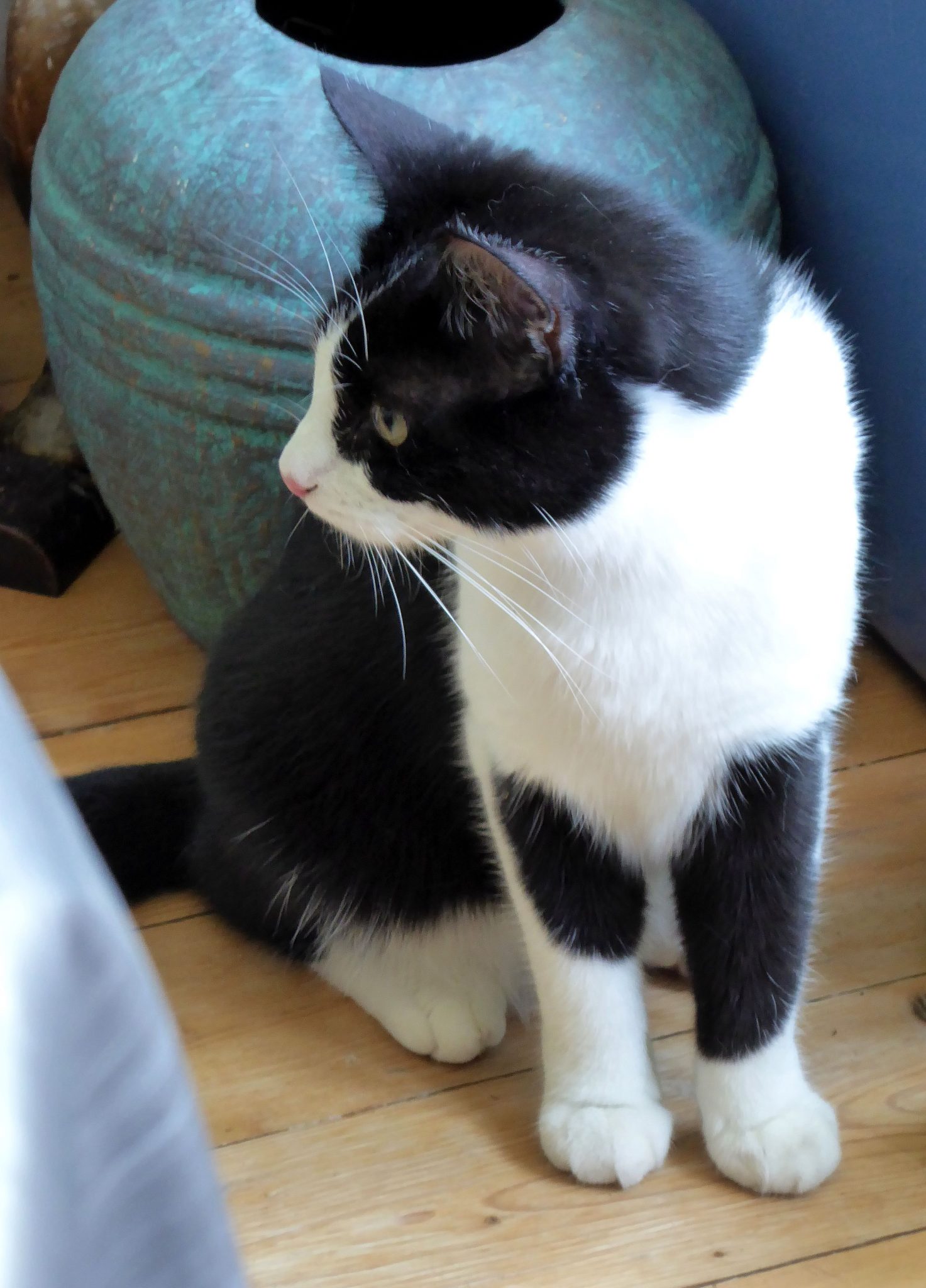
Actually, apart from spending time out, and being pissed off because our bedroom is out of bounds at present, both Tilly and Rosie are being quite good.
NHS Data Sharing – II
What follows in this post is a very short summary of two of the NHS data sharing initiatives (care.data and Summary Care Records) which I wrote back in 2014 when they were new and care.data was still very much alive. I record this here in order to provide more background and clarity to my post of yesterday on NHS Data Sharing. This is unedited and provided in its entirety; note the date at the bottom!
A Very Brief Introduction
The NHS currently has two initiatives to share patient medical data electronically: Summary Care Records and care.data. The two initiatives are very different. Let’s look at them.
Care.data is the initiative which was in the news a lot early in 2014, and is what was referred to in the leaflet which should have been put through your door in January 2014. It is about sharing aggregated data with a variety of organisations (public and commercial) to enable better healthcare planning and research. The programme will take GP and hospital records, remove or obscure anything which can identify you, and then merge all the records into a single national database. Any record which can identify you, as a patient, is not permitted to be shared outside the NHS. This is not new: hospital records have been used in this way for many years and the system is now being extended to include GP records. The intention is that over time this improves everyone’s healthcare by looking at where, and why, better outcomes are being achieved. The start of this has been delayed to at least Autumn 2014 in recognition that it has not been well communicated.
Summary Care Records [SCR] are different; they are about sharing data within the NHS for the provision of your immediate medical care. They will make your essential data (your drugs, allergies, drug reactions) available electronically to other parts of the NHS, but only when they need to treat you. So A&E and out of hours services can see your record if you need emergency treatment. This will mean you, as an individual, get better and safer care especially if you end up, unconscious, in A&E. Only healthcare staff with a special authorisation card and a PIN number will be able to access your data – just like you using your credit card – and if you are conscious and capable they must ask your permission at the time of access.
A very senior A&E consultant of my acquaintance, who works at a major South Coast hospital, recently commented to me:
Please think very carefully before opting out. I have just received my SCR access card, and it has been a revelation. Most elderly people are on lots of medicines and can remember about 10% of them. They turn up at my Emergency Department confused and unable to remember much. I can now get their medication list and their past history exactly and it means that they get much better treatment, especially with medications like Parkinson’s disease ones that are time-critical. I’m not saying that you are elderly and confused, but I am saying that you may be one day, and you won’t have opted back in. Is SCR secure? It seems no worse than the security to access my bank account.
Quite reasonably many people have concerns about the privacy of both Summary Care Records and care.data records. While we can never absolutely guarantee that security cannot be breached or abused, there is no reason to believe your data will be less secure in future than it is now.
Of course, you may opt out of one or other or both of these systems. Opting out of one does NOT opt you out of both. It is your right to opt out if you wish to do so – you just need to tell your GP. But please think very carefully before you do opt out.
Version 2 filed: 2 November 2014