Today’s XKCD cartoon focusses on how amazing we are …
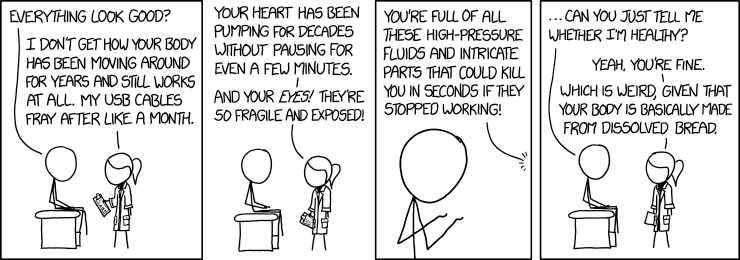
Today’s XKCD cartoon focusses on how amazing we are …
Almost every individual – excluding perhaps those insane persons who have no sense of right and wrong, but certainly including everyone from religious leaders to gangsters and serial killers – has a set of ethics.
… … …
Each person draws portions, sometimes bits and pieces, of their personal … ethics from an almost random variety of sources, such as their childhood upbringing, a dramatic or otherwise pivotal life experience, religious beliefs, discussions with family, colleagues, and friends, and the ethical teachings of whatever philosophers [they] may have read.
https://www.irmi.com/articles/expert-commentary/where-our-ethics-come-from
I’ve written a number of times before about ethics and morals (see for example here and here). But stimulated by a conversation with one of my friends (yes, somehow I do still have one or two!) some days ago I’ve been moved to return to the subject at a more personal, rather than philosophical, level.
What follows is a summary of some of those “bits and pieces” I’ve garnered over the years as my personal ethics and morals. These are the things which I try to live by.
That’s the high level stuff and I feel sure I’ve left something out. I can’t think any of it is very startling, but it is interesting to put it all together – something I’ve never done in quite this way before – as it really does make one consider whether the whole is self-consistent. Of course, I’ve not yet made any attempt to integrate this with my core constructs (such as I know them).
And below all that are my personal beliefs, like the legalisation of sex work and marijuana; nudity and body acceptance; the scientific method; the absence of deities; etc.
Heavy stuff. I need a gin & tonic.
Those who have an interest in energy and the environment might like to look at this article on wind turbines from the Spectator.
If what the article says is correct (and I haven’t checked the assertions) then it supports what I have long maintained: that wind turbines for power generation are a sideshow, and potentially dangerous one at that.
.jpg)
The assertion is that globally they produce less than 1% of power consumption – hardly impressive given all the hype. Moreover, and this is what has always worried me most, constructing them uses so much steel, rare earths and cement – all of which have to be mined, refined and transported – that they can effectively never break even environmentally (at least that’s my extrapolation of what the author is saying).
Now the author, Matt Ridley, admits he has an interest in coal, although he’s not proposing coal as a substitute for wind turbines. What he suggests is that we should invest in gas powered energy generation in the immediate term, pending the development and construction of nuclear. I disagree with him on the former as he is advocating fracking. But I agree about nuclear, although that too is hardly immune from the environmental impact of mining, steel smelting etc. And that’s leaving aside the problem of nuclear waste, which I discussed a while back.
As has been obvious for many a long year, there is no good solution except to drastically cut back on power consumption. And I’m as guilty as anyone of failing at that.
Is there a relationship between manners, our expectations of others and love?
Weaving together three articles from several years ago, I think there may be. This post is really me trying to see if this works. So you may disagree and I’m open to discussion.
First of all let’s think briefly about manners: those actions we try to instil into our children to help them survive in polite society.
According to an article in New Scientist in September 2013, “Manners maketh man: how disgust shaped human evolution” by Valerie Curtis [paywall] …
We need to better understand manners for two reasons: first, because they are a principal weapon in the war on disease, and second, because manners underpin our ability to function as a cooperative species … [M]anners are so important that they should be up there with fire and the invention of language as a prime candidate for what makes us human.
The first, and most ancient, function of manners is to solve the problem of how to be social without getting sick.
…
Those who master manners are set to reap the many benefits that come from living in a highly cooperative ultra-society. Manners are therefore a sort of proto-morality, a set of behaviours that we make “second nature” early in life so that we can avoid disgusting others with our parasites and our antisocial behaviour.
It’s the “cooperative society” part which interests me here as this seems to mesh with the idea (Business Insider; 25 March 2013) that
What one person expects of another can come to serve as a self-fulfilling prophesy.
This was tested on teachers and children. Teachers were told (randomly) a child was a star or a dunce; the children didn’t know how they’d been allocated. A while later when the child’s subsequent achievement was independently tested the stars had done significantly better than the dunces.
Thus we have a situation which reflects what I always say:
If you treat people as you would like them to be, you give then the space and incentive to grow and develop. If you treat them as they are, then they stay as they are.
If you expect manners, you’ll (hopefully) get manners; if you expect no manners, you’ll get no manners. And like it or not, manners oil the wheels of society.
So where does love come into all this?
Reflect on this comment from Candice Chung in an article “Why Chinese parents don’t say I love you” from the Sydney Morning Herald in July 2016.
From a sociological perspective, studies have also found that the phrase ‘I love you’ tends to be used less in a high context culture [eg. Asia] where “expectations are high and well documented”. While in the West (low context society), relationships are often managed with ‘I love you reminders’ to reassure someone of their importance [whereas], in high context culture, “intensely personal and intimate declarations can seem out of place and overly forceful”.
What this is saying seems to be that the Asian way, covert love, is thought to be less intense than the Western, more overt, way. In fact it seems to me the opposite is true and that the Asian way puts far more pressure on families and relationships than we do in the West. There seem to be far greater expectations of family connection, responsibility, loyalty etc. amongst Asians than amongst Westerners, and that the Western way appears to me to be more balanced and permissive of personal freedom.
And that amounts to essentially a difference of manners and expectations between cultures, so it is no real wonder that the cultures work differently.
OK, so let’s get going with the answers to this ninth round of Five Questions.

Yet again it is around a year since I started my last round of Five Questions.
So here is this new series of five questions, ranging from the interesting to the downright crazy and even morbid.
It’s just over 500 years since Sir Thomas More first described what he called Utopia in 1516. So this month’s Ten Things celebrates More’s fabled island nation.
Ten Essential Elements of My Utopia
 No death or life-threatening illness; all illness cured by love
Unfortunately we all know that Utopia is, by definition, unattainable, for if we ever got there there’d be another Utopia just beyond reach. The grass is always greener, and all that!
Inspired, as so often, by my friend Katy I wanted to write down some of the useful things I would have liked my younger self (I’m thinking teenager, student) to know and which I could now impart – but of course can’t until such time as someone perfects time travel. In fact some of these things I still have to learn properly.
In no particular order …
It is that time of year when we start seeing black and yellow flying insects about. Yes, summer is wasp season.
There are essentially three wasp species in the UK. The two we see most often are the ones most people despise: the small ones the Common Wasp, Vespula vulgaris, and German Wasp, Vespula germanica. Both are definitely yellow and black. To all intents and purposes they look identical (if you really want to see the difference you’ll need to get up close and personal with them – most of you won’t want to).

