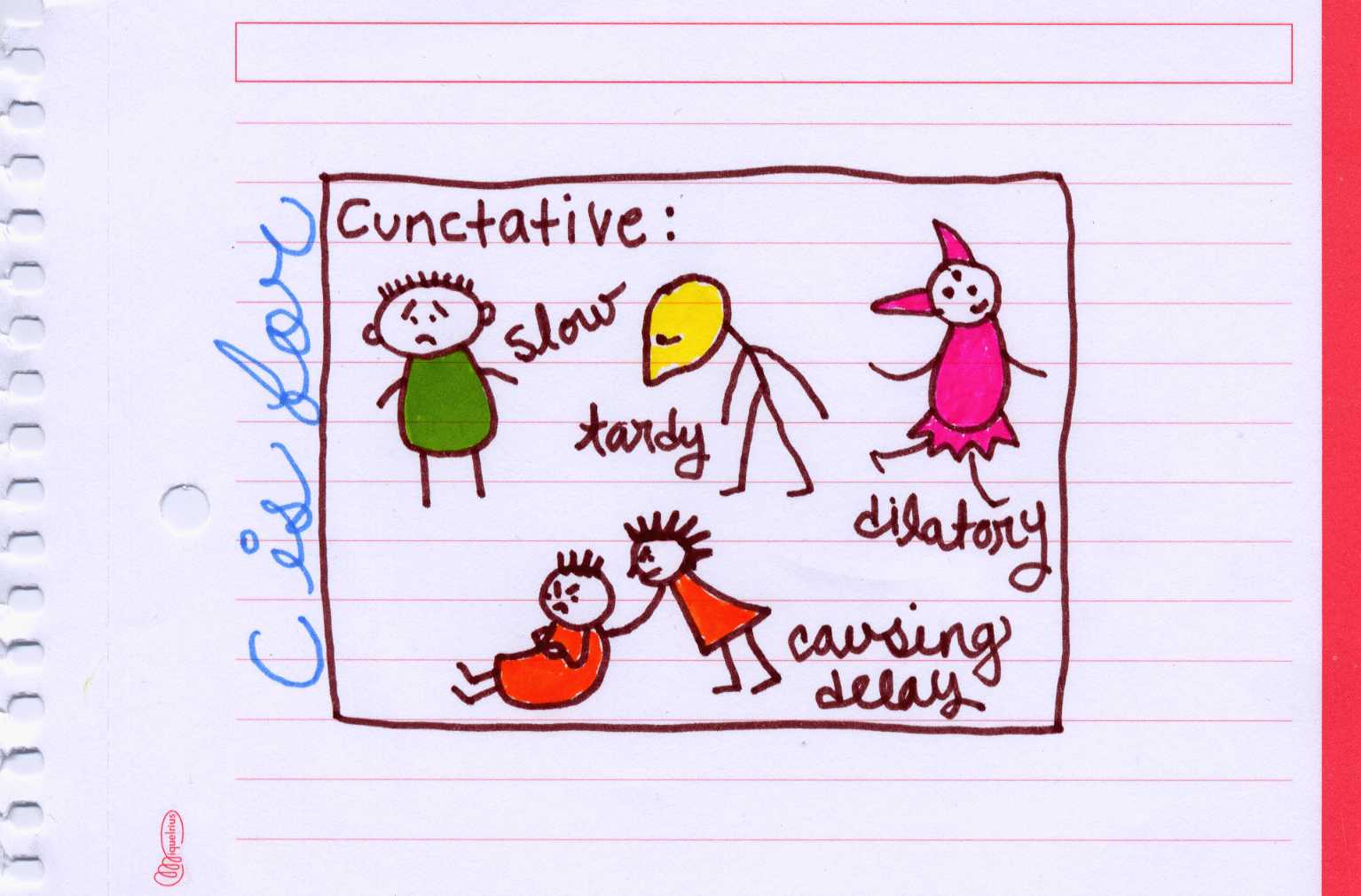
Cunctation
Procrastination; delay; tardy action.

The word is derived from the Latin cunctārī, to delay, and according to the OED was first used in English in 1585.
Cunctation
Procrastination; delay; tardy action.

Panjandrum
1. (A mock title for) a mysterious (frequently imaginary) personage of great power or authority.
2. A pompous or pretentious official; a self-important person in authority.
According to the OED, the word is supposed to have been coined in 1754 or 1755 as part of a a piece of nonsense written by actor and dramatist Samuel Foote (1720–77) to test the memory of his fellow actor Charles Macklin, who had asserted that he could repeat anything after hearing it once. In the first published version (in 1825) the relevant passage (attributed to Foote) is:
So she went into the garden to cut a cabbage-leaf to make an apple-pie; and at the same time a great she-bear, coming up the street, pops its head into the shop. “What! No soap?” So he died, and she very imprudently married the barber; and there were present the Picninnies, and the Joblillies, and the Garyulies, and the grand Panjandrum himself, with the little round button at top, and they all fell to playing the game of catch-as-catch-can till the gunpowder ran out at the heels of their boots.
(It’s not up to Lewis Carroll’s standard, but never mind, eh!)
Cruft
1. Trash, debris, or other unwanted matter that accumulates over time.
2. Unnecessary digital information that accumulates over time, such as unneeded files or obsolete lines of code in software.
The OED describes the word as “computing slang” originating in the late 1950s but with an unknown origin. However I’ve always known the word for the first of the two meanings – as in the detritus which accumulates on a fan grille or dust bunnies.
Oh, go on then, let’s have another word. In writing about frass, I was minded to wonder about the origin of caterpillar, so …
Caterpillar
1. The larva of a butterfly or moth; sometimes extended to those of other insects, especially those of saw-flies, which are also hairy.
2. A type of tractor which travels upon two endless steel bands, one on each side of the machine, to facilitate travel over very rough ground. (And by extension to other such vehicles.)
3. To move like a caterpillar or on caterpillar tracks.
The first uses, in sense 1, recorded by the OED is from c.1440 in Promptorium Parvulorum 63: Catyrpel, wyrm among frute, erugo.
I’m going to reproduce the etymology from the OED essentially in full:
(Some think the word a direct compound of piller. The giving to hairy caterpillars a name derived from the cat, is seen not only in the French word cited, but also in Lombard gatta, gattola (cat, kitten), Swiss teufelskatz (devil’s cat); compare also French chenille (from canicula, little dog), Milanese can, cagnon (dog, pup). Compare also catkin, French chaton, applied to things resembling hairy caterpillars.)
In other words, we don’t know!
Frass
The fine powdery refuse or fragile perforated wood produced by the activity of boring insects.
The excrement of insect larvae.
(Or to put it in the vernacular: caterpillar shit.)
First used in an academic paper in 1854, the word is derived from the German frasz, fressen, to devour.
Inosculation
To unite (as of blood vessels, nerve fibres, or ducts) by small openings.
The opening of two vessels of an animal body, or of a vegetable, into each other.
To unite so as to be continuous; blend.
It is applied anatomically especially to blood vessels and in botany to the growing together of the trunks/branches of separate trees (as shown).
Needless to say the word is derived from In plus the Latin ōsculāre (having a mouth). The first usage is recorded by the OED as being from 1673.
Quidnunc
A person who constantly asks ‘What now?’.
An inquisitive or nosy person.
A gossipmonger.
As one might expect the word is derived from the Latin quid nunc, what now (quid = what, nunc = now).
The OED gives the first English usage in 1709.
They’re off! … On the quest for this month’s links to items you really didn’t want to miss the first time.
Science & Medicine
Many statistics are lies compounded by misleading graphics. Here’s a quick guide to spotting lies in visuals.
I posted about this on Facebook earlier, but it’s so brilliant I have to say more here.
Earlier today on the intertubes I came across the Bible in Polari. Those who know Polari, or are old enough to remember Julian and Sandy from the radio show Round the Horne, will guess how much of a hoot it is. Here, for example, are the first five verses of Genesis …
1 In the beginning Gloria created the heaven and the earth.
2 And the earth was nanti form, and void; and munge was upon the eke of the deep. And the Fairy of Gloria trolled upon the eke of the aquas.
3 And Gloria cackled, Let there be sparkle: and there was sparkle.
4 And Gloria vardad the sparkle, that it was bona: and Gloria medzered the sparkle from the munge.
5 And Gloria screeched the sparkle journo, and the munge she screeched nochy. And the bijou nochy and the morning were the first journo.
And here, the Immaculate Conception from Luke 1:26-35 …
26 And in the seyth month the fairy Gabriel was laued from Gloria unto a smoke of Galilee, named Nazareth,
27 To a nanti charver espoused to a homie whose name was Josephine, of the lattie of Davina; and the nanti charver‘s name was Mary.
28 And the fairy trolled in unto her, and cackled, Hail, thou that art highly favoured, the Duchess is with thee: fabed art thou among palones.
29 And when she vardad her, she was troubled at her cackling, and cast in her mind what manner of salutation this should be.
30 And the fairy cackled unto her, Fear not, Mary: for thou hast found favour with Gloria.
31 And, varda, thou shalt conceive in thy womb, and parker forth a homie chavvie, and shalt screech her name Josie.
32 She shall be dowry, and shall be screeched the homie chavvie of the Highest: and the Duchess Gloria shall parker unto her the throne of her Auntie Davina:
33 And she shall reign over the lattie of Jacob for ever; and of her kingdom there shall be no end.
34 Then cackled Mary unto the fairy, How shall this be, vardaing I know not a homie?
35 And the fairy answered and cackled unto her, The Fantabulosa Fairy shall troll upon thee, and the power of the Highest shall overshadow thee: therefore also that fabulosa fakement which shall be born of thee shall be screeched the homie chavvie of Gloria.
Brilliant isn’t it?!
Incidentally it’s worth downloading the PDF version, even though it is big, as it contains some wonderfully captioned “old style” images (“Gethsemane had always been a notorious cruising ground”) and a huge dictionary of Polari.
What I find interesting is how much Polari has passed into modern parlance (possibly as some was stolen from existing dialect like Cockney and entered the modern English from there). Just in writing this I’ve noticed acdc, troll, barney, butch, drag … the list goes on!
This is what I find so entrancing about language: not just the fun but the interplay between language, dialect, argot and idiolect. And I love it when something in one form is translated into another, but remains amusingly intelligible to speakers of the original – as here and as with the Pidgin of Papua New Guinea for Prince Charles: nambawan pikinini bilong Mises Kwin.
Just excellent!
Cunctation
Procrastination; the action of delaying; tardy action.
The word is derived from the Latin cunctātiōn-em, noun of action; cunctārī to hesitate or delay.
The OED records the first English use as being in 1585.