
Until as recently as the early 1900s, “&” was considered a letter of the alphabet and listed after Z in 27th position. To avoid confusion with the word “and”, anyone reciting the alphabet would add “per se” (“by itself”) to its name, so that the alphabet ended “X, Y, Z and per se &”. This final “and per se and” eventually ran together, and the “ampersand” was born.
From ‘A’ to ‘ampersand’, English is a wonderfully curious language; Guardian; 15/02/2014
Category Archives: words
Word: Haruspicy
Haruspicy
Divination by natural phenomena, especially from inspection of the entrails of animal sacrifices.
Word: Cataphract
Cataphract
1. Defensive armour used for the whole body and often for the horse, also, especially the linked mail or scale armour of some eastern nations.
2. A horseman covered with a cataphract.
3. The armour or plate covering some fishes.

The word is derived from the Latin cataphractes, Greek καταϕράκτης, a coat of mail; also from Latin cataphractus, Greek κατάϕρακτος, clad in full armour.
Surprisingly the OED gives the first recorded usage in 1581.
NHS Communications
Every week someone somewhere in the NHS sends out an email bulletin called NHS Networks News. It is intended to provide a channel of useful information and articles on the happenings in the NHS for clinicians and similar. For some reason I seem to be subscribed, so I see a copy.
And each week this email starts with a short piece called “Editor’s blog”. Sometimes it is useful. Sometimes it is humorous. This week’s was undoubtedly supposed to be humorous. But in actual fact all it has done is highlight the appalling levels to which the NHS culture and NHS communications have sunk, because it is far closer to the truth than I think the anonymous author realises, as you’ll know if ever you have tried reading any NHS documentation. (Although the same is equally true of most corporate cultures.)
Just for your edification, I shall reproduce here the full item.
The gas and air principle
All NHS staff must learn a second language before they can be truly proficient communicators: they need to be able to speak NHS.
In the latest in our occasional series of tutorials, we offer further tips for the aspiring NHS speaker.
Verbs
In most languages, verbs are “doing” words. In NHS they are “actively considering” words. Saying that you will “do” something may make you appear brash or over-confident. Acceptable alternatives include “aim to”, “take steps toward” and “formulate a vision and strategy for”.
When you have practised each of these, you can use them together to convey the desired nuance or level of obfuscation.
So while “aiming to tackle the causes of health inequalities” could still be mistaken for a commitment, “aiming to take steps towards formulating a vision and strategy for tackling health inequalities” avoids the risk of embarrassment and disappointment when nothing happens, but demonstrates very strong active consideration.
Nouns
In English, nouns – or naming words – denote a person, place or thing. In NHS, nouns are used to create the impression of something tangible.
For example “stakeholder” is a useful term meaning someone who is not involved and you have no intention of involving, but who cannot be ignored. A patient is a good example of a “stakeholder”.
When you have mastered “stakeholder”, you can start to introduce “ownership” into your everyday conversation. Here are a few phrases to practise, with English translations in brackets.
- “I’m going to give you ownership” (“It’s your problem now”)
- “We don’t have ownership” (“Nothing is our fault”)
- “We are working with stakeholders to establish full ownership” (“No one knows what’s going on”)
Adjectives
Adjectives in English are used to describe things, usually to make them clearer. Adjectives have a slightly different role in NHS, which is to make statements more emphatic. Simple ones to start with include “key”, “core”, “vital”, “meaningful”, “strategic” and “high-quality”. In NHS it is mandatory to use at least one of these words in front of any noun.
“Increasing” is among the most useful adjectives in NHS. Describing all problems as “increasing” helps to explain why they continue to get away from us despite the steps we have taken to formulate a vision and strategy for aiming to solve them.
Putting it all together
Once you have grasped the different parts of speech, you will soon be ready to try out your new skills. Here are two superb examples of written NHS, taken from a report published this week by the Local Government Association* and Public Health England. Don’t be disheartened if your first attempts are not up to this standard.
“A history of joint working has ensured that health issues are built into planning policies. Healthy urban planning is now high on the council’s priority agenda and a toolkit is being developed to embed health issues further into planning.”
“A number of partnerships and a strategy involving a parallel inter-linked range of initiatives have been set up to tackle the increasing problem of alcohol misuse in the city. Pioneering use has been made of the council’s traditional functions in the service of health. Involving the public and service users has been a key component.”
Note how the sheer density of each sentence creates a sense of meaning without allowing any actual meaning to escape. This is the effect you should aim for in your own written and verbal communications.
All of which leads us to the first rule of NHS, known as the gas and air principle: the purpose of words is not to bring ideas to life but to render them unconscious as swiftly and safely as possible.
(*Not an NHS organisation, but an accomplished NHS speaker in its own right.)
Oh dear! If it wasn’t quite so true it would indeed be amusing.
Something for the Weekend
I rather like this XKCD from earlier in the week:

Click the image for a larger view
Word: Orchidectomy
Orchidectomy
The excision of one or both of the testicles; castration.
This is derived from the Greek ὄρχις (orkhis, a testicle) + ἐκτοµή (ektomi, cutting-out).
According to the OED the first recorded usage was in 1870.
And just to remove any confusion, the group of plants called orchids are so named because of the testicular appearance of the roots of some species.
Words: Absorb and Adsorb
Absorb and Adsorb are two easily confused verbs which scientifically decribe different interactons.
Absorb
1. To swallow up.
2. To engross, or completely engage, the attention or faculties.
3. To suck in, drink in a fluid; to imbibe.
4. To take up by chemical or molecular action.
Absorption is essentially a macroscopic level effect.
Compare this with …
Adsorb
1. To undergo or cause to undergo a process in which a substance (often a gas) accumulates on the surface of a solid forming a thin film, often only one molecule thick. Mostly used in Chemistry and often descriptive of molecular level catalytic processes where a reaction is enhanced with one molecule sticking to the surface of the catalyst.
There is more than a subtle difference here. Note the use of the Latin prefixes ab- off, away, and ad- to, onto, towards.
Think of it this way in everyday terms: A sponge absorbs water, whereas a sticking plaster is adsorbed onto the skin. Alternatively, the man eats the pie (absorption) or the pie sticks to the man’s face (adsorption).
Word: Grizzled
Grizzled
1. Partly grey or streaked with grey.
2. Having fur or hair streaked or tipped with grey.
Usage is now mostly restricted to descriptions of hair, although the name lives on in the names of some species, eg. Grizzled Skipper butterfly.

Surprisingly the first recorded English usage was as early as 1458. The word is possibly derived from the French grisellé, but the OED says this is lacking evidence.
Word: Effluvium
Effluvium (plural, effluvia)
1. A, usually invisible, emanation or exhalation of vapour, gas or small particles.
2. A by-product or residue; waste.
3. The odorous fumes given off by waste or decaying matter.
4. An impalpable emanation; an aura.

From the Latin ex out + fluĕre to flow.
The OED records the first English usage in 1646.
Word: Quinquereme
Quinquereme
An ancient Roman or Carthaginian galley with five banks of oars on each side.
Perhaps the most famous of the Hellenistic-era warships, because of its extensive use by the Carthaginians and Romans, the quinquereme was invented by Dionysius I of Syracuse in 399 BC as part of a major naval armament programme directed against the Carthaginians. During most of the 4th century, the “fives” were the heaviest type of warship, and often used as flagships of fleets.
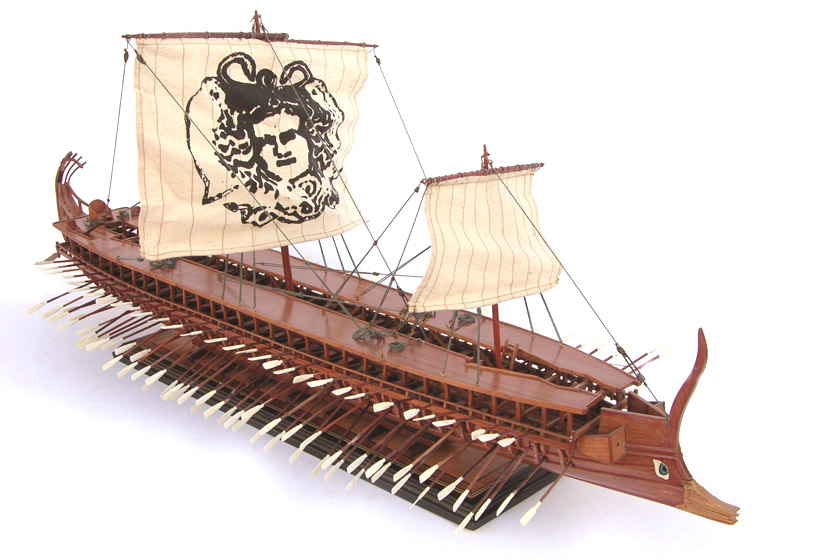
OK, we know the oarsmen were largely slaves but all those oars! The image is a model of a trireme (three banks of oars); just imagine adding another two banks of oars to that! They must have been a nightmare to power and even more of a nightmare to handle. But if done right they would have been awe-inspiringly impressive.