Demiurge
1. A powerful creative force or personality.
2. A public magistrate in some ancient Greek states.
3. A deity in Gnosticism, Manichaeism, and other religions who creates the material world and is often viewed as the originator of evil.
4. A Platonic deity who orders or fashions the material world out of chaos.
The word is derived from the Greek δηµιουργ-ός (Latinized dēmiūrgus), literally a public or skilled worker. According to the OED the word is first recorded in English around 1678.
Irrefragable
1. Impossible to refute or controvert; indisputable; undeniable.
2. Of a person: Obstinate, inflexible, stubborn.
Derived from the Latin ir- + refrāgārī to resist, thwart.
The OED records the first usage as in 1533.
Midden
1. A dunghill or refuse heap.
2. In archaeology, a mound or deposit containing shells, animal bones, and other refuse that indicates the site of a human settlement.
According to the OED the word is of Scandinavian origin, ultimately from møg (muck) + dynge (heap). The first recorded use in English was in 1375.
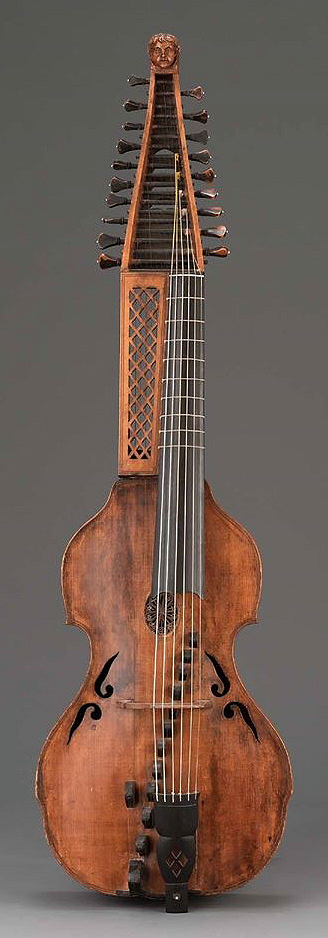
Baryton
A bowed string instrument of the 18th century, similar to the bass viol, but having sympathetic strings on the rear of the fingerboard.
According to Wikipedia: The baryton can be viewed as a sort of augmented bass viol. It is similar in size to the latter instrument and likewise has six or seven strings of gut, arranged over a fretted fingerboard and played with a bow. The instrument is held vertically and is supported by the player’s legs … The baryton differs from the bass viol in having an additional set of wire strings. These perform two functions: they vibrate sympathetically with the bowed strings, enriching the tone, and they can also be plucked by the left thumb of the performer, creating a contrasting tonal quality.
According to the OED, the name of the instrument is a loan word from French baryton or Italian baritono, and ultimately derives from Greek bary- + tonos ‘deep-pitched’.
While we’re on about politicians, George Monbiot had another side-swipe on Tuesday 21 October in his Guardian column: ‘Cleansing the stock’ and other ways governments talk about human beings.
Basically he’s on about the euphemisms that politicians, governments, and indeed companies, use to disguise — from themselves and (they think) us — the horrors of what they get up to. For example:
The [Dept of Work & Pensions can talk of] using “credit reference agency data to cleanse the stock of fraud and error”
Hills, forests and rivers are described … as “green infrastructure”
Wildlife and habitats are “asset classes” in an “ecosystems market”.
Israeli military commanders described the massacre of 2,100 Palestinians … in Gaza this summer as “mowing the lawn”.
People, aka. human beings, can be referred to as “personnel targets”. And then there are the old favourites: “neutralising”, collateral damage” and “extraordinary rendition”.
Dictatorships, and those wishing to conceal what they’re up to have always spoken thus: for example look at Communist Russia and Communist China.
Gawdelpus!
Xanthophobia
A fear of the colour yellow or the word yellow.
From the Greek xanthos, ξανθός yellow with the Latin -phobia, Greek. -ϕοβία, fear, dread or horror.
Nugatory
1. Trifling, of no value or importance, worthless.
2. Of no force, invalid; useless, futile, of no avail, inoperative.
From the Latin nūgātōrius, past participle stem of nūgārī, to trifle. The word was first used in 1603 in a translation of Plutarch. Perhaps slightly surprisingly the word appears to have no connexion to nougat.
Muselet
A wire cage that fits over the cork of a bottle of champagne, sparkling wine or beer to prevent the cork from emerging under the pressure of the carbonated contents.
The muselet was invented in 1844 Adolphe Jaqueson to improve the seal on champagne bottles. The design has been improved over the years with the use of twisted steel wire for added strength and a metal cap.
The word is derived from the French museler, to muzzle.
Thixotropic
Of fluids and gels, having the property of viscosity that decreases when stressed (by stirring or shaking) and returning to the semi-solid state upon standing.
Hence thixotropic paints, which are essentially non-drip because they return to the more solid state quickly following the cessation of stress stirring, brushing).
Some clays are thixotropic, which is important in structural and geotechnical engineering. Landslides, such as those common in the cliffs around Lyme Regis, Dorset and in the Aberfan spoil tip disaster in Wales are evidence of this phenomenon.
Some thixotropic fluids, for example ketchup, return to a gel state almost instantly while others such as yoghurt take much longer.
The word is derived from the Greek thixis, touch + -tropy. The OED gives the first usage in 1927.
Eccentric looks at life through the thoughts of a retired working thinker

.jpg)