Category Archives: science

Monthly Links

So here we are for our last post of 2018, and this month’s links to items you may have missed before. As usual we’ll start with the scientific and get easier as we go along – so hang in there!

Science, Technology & Natural World

Forty-one years ago (that’s 1977) NASA launched the Voyager 1 and Voyager 2 probes to investigate the outer planets. Voyager 1 left the solar system and entered interstellar space some six years ago. And it has now been confirmed that Voyager 2 passed the same landmark on 5 November 2018. Amazingly both probes are still alive and beaming information back to us using their tiny 20w transmitters, although their plutonium power sources will eventually run out and the probes will be dead on arrival at a nearby star in about 40,000 years time. What an incredible achievement! It is feats like this that make me proud to be a scientist.

We know earthquakes mostly happen along the boundaries of tectonic plates. But not all do; some happen far from plate boundaries. Seismologists are now beginning to think that (some of) these “remote” earthquakes may be caused by rivers moving huge amounts of material over the millennia.

Benjamin Franklin is well known for many things, one of them being his experiments with kites and lightning which led to his development of the lightning conductor. But he had another great electrical discovery to his credit: turkey tenderisation – in the process of which he nearly killed himself.

I wonder if anyone can tell us what glitter is, and how it’s made?

Apparently the Leaning Tower of Pisa is leaning a little less.

Wasps. And why we might miss them.

Where grows the mistletoe?

Health & Medicine

1918 saw the destructive Influenza Pandemic. What progress has been made since then?

Meanwhile we have few clues about Disease X, the next pandemic to hit London – as one surely will sooner or later.

Researchers reckon they’ve discovered a genetic cause that links erectile dysfunction and Type-2 diabetes.

Are you shitting comfortably? Actually, probably not. [LONG READ]

So why are more boys born than girls – especially when there are more adult women than men?

Sexuality

The Going Medieval blog dissects the very idea of No Nut November. [LONG READ]

Environment

The Guardian suggests 24 ways in which we can embrace an anti-capitalist life in a capitalist world.

And then here are four actions would help tackle the global plastic crisis.

History, Archaeology & Anthropology

Researchers reckon they’ve found stone tools which suggest that human ancestors spread into north Africa much earlier than previously thought.

Analysis of various records has highlighted London’s murder hotspots.

Meanwhile in the River Thames there is the mystery of the skeleton still wearing his thigh boots.

When and where were the first traffic lights? Answer: Parliament Square in 1868 – long before the motor car.

Lifestyle & Personal Development

Some thoughts on how to be a better spouse from Scientific American.

And finally for this year …

Since 1904, King William’s College on the Isle of Man has set an annual general knowledge test. In the past pupils sat the test twice: once unseen on the day before the Christmas holidays, and again when they returned to school in the New Year, after spending the holiday researching the answers. The test (now voluntary) is highly difficult, a common score being just two correct answers from the 180 questions, with best scores of 40 to 50 for the unseen test. The quiz has been published in the Guardian since 1951 – and you can find the 2018 test in the Guardian or on the King William’s College website. Good luck!

That’s all for this year, so here’s wishing everyone a peaceful and successful 2019. The Kindly Ones permitting we’ll be back after the fireworks.

Monthly Links

WTF happened there? Where has this year gone? It’s already the end of November and we’re deep into SAD season. But let’s not despair ‘cos here’s our monthly selection of links to items you might have missed the first time round.

Science, Technology & Natural World

If you’re an AI designer the Law of Unintended Consequences is never far away. Such systems are well known for gaming the system with a solution that satisfies the stated objective but fails to solve the problem according to the human designer’s intent. There’ll be some examples at the end of this post.

A violent storm on the Sun could cripple communications on Earth and cause huge economic damage, but why are solar storms such a threat?

Health & Medicine

Here are six surprising drug interactions which often fly under the radar but which you should know about. Even I knew about only two of them.

This one is definitely straight out of the “I Don’t Believe It” drawer … apparently llama blood may provide clues to beating the flu.

Researchers at the University of Portsmouth are investigating how the proportion of fat and glandular tissue affects the perkiness of boobs, and why one bra design doesn’t fit all.

Our favourite OB/GYN, Dr Jen Gunter, takes a look at the menopause, and her personal experience in deciding how to manage it.

GPs in England are being encouraged to prescribe social activities to their patients as part of the government’s strategy to combat loneliness. But this is raising some ethical questions: are the consequences acceptable and does the initiative respect people as people?

As so often, the ancient Chinese had an inventive way of doing things: pay your doctor as long as you’re healthy; when you’re sick they’ve failed and don’t get paid.

Sexuality

Here’s one good example of why we must not be too scared to talk about teenagers having sex.

Labour MP Jess Phillips is campaigning to ensure girls are taught about their sexuality from a young age so they form healthy sexual relationships as adults and not just “how to handle and dispose of men’s pleasure safely”. Read her views here and here.

On the other side of the coin, a survey confirms that stress damages many people’s sex lives.

So now relax ‘cos you’re unlikely to be masturbating too much.

Environment

Scientific American looks at why we really do need innovative nuclear power.

History, Archaeology & Anthropology

Researchers have been taking an in depth look at Neanderthal teeth, and discovering some surprisingly intimate details of their daily life.

Meanwhile others have been dating the oldest known animal painting which has been found in a cave in Borneo. I’m glad they know it’s an animal.

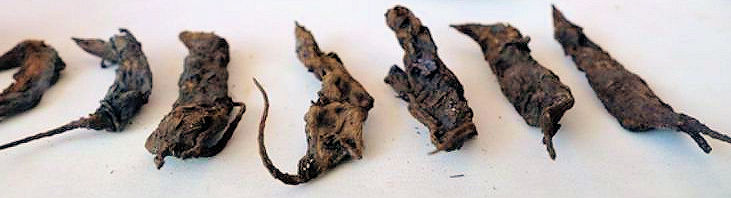
Still with animals but much closer to home, archaeologists at the Vindolanda fort have uncovered a Roman dog with fur intact. Well they say it’s Roman, but they also say it is 2000 years old: both cannot be true!

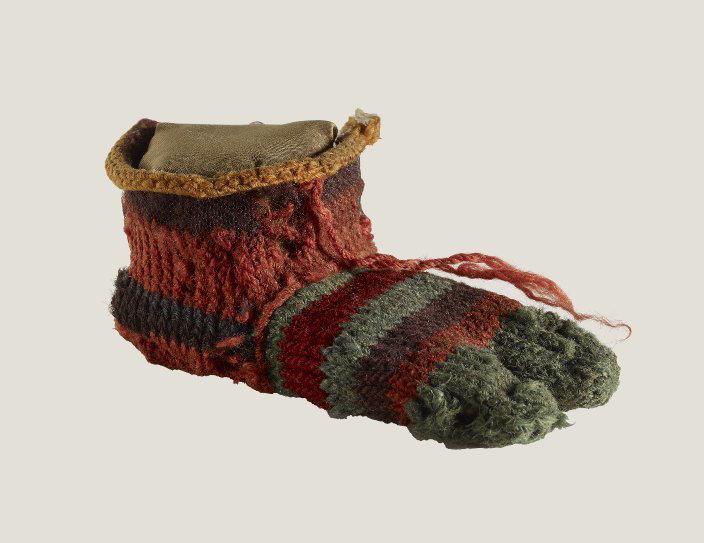
Yet another group, this time at the British Museum, have been delving into Egyptian fashion and examining a 1700-year-old child’s left sock.

Since Ancient Roman times, and right up to Hollywood, witches have been seen as figures of fun as well as malevolence.

From at least 1000 years ago the Peruvians were into making holes in their heads.

Finally in this section, and coming almost up to date, a dredging project at Blenheim Palace has uncovered over 30 rooms flooded when Capability Brown created the estates lakes.

Food & Drink

The Marine Conservation Society has been looking at the humble fish finger and found that they are surprisingly sustainable and some of the best products to buy are also the cheapest.

Shock, Horror, Humour

Finally, we promised some more on the unintended consequences of AI. There are quite a few examples in a Google document, including these two:

A self-driving car which was rewarded for speed learnt to spin in circles.

In an artificial life simulation where survival required energy but giving birth had no energy cost, one species evolved a sedentary lifestyle that consisted mostly of mating in order to produce new children which could be eaten (or used as mates to produce more edible children).

Remember: If a system can be gamed, someone or something will game it.

Enjoy your Christmas turkey!

Monthly Links

So here’s our monthly selection of links to items you may have missed, but will wish you hadn’t. As usual we’ll start with the science-y stuff and go downhill from there.

Science, Technology & Natural World

Astronomers are still on the hunt for “Planet 9” which they think lies way beyond Pluto. And they’ve found a strange, but small, object – nicknamed “The Goblin” – which may provide more clues on where they should be looking.

At home, researchers are looking at the effects of climate change and rising sea levels, and asking which cities will sink into the sea first. The answer may not be what one would intuitively expect.

Talking of the sea, it’s long been thought that few things predated jellyfish, but this turns out to be wrong.

Meanwhile on land it is being suggested that cats are pretty useless at catching rats and prefer smaller prey. Well they had better not tell our felines that!

However the ability of crows to make tools is giving some insights into how the brain generally works.

I wasn’t sure whether this next item belongs here or under “Environment” but it is sufficiently technical I left it here … It is being suggested that we could store unpredictable energy, like solar and wind, using compressed air. It sounds crazy, but might work.

Health & Medicine

There’s a muscle-weakening disease popping up in America which affects children and looks a lot like polio (but isn’t). And weirdly it seems to have a two-year cycle.

Are you like me and have problems with sleep? If so it may be that you’re over-tired.

Still thinking bout sleep, a researcher seems to have worked out why it is that we take so long to wake up and get going in the mornings. And that caffeine doesn’t actually help.

But then it is being recognised that people sometimes just give up and die.

At the other end of the spectrum, there are women who suffer from tokophobia: an extreme fear of pregnancy and childbirth.

Finally in this section, here’s a piece about the medicinal leech and how to farm it. They’re strange beasties with 10 stomachs, 32 brains and 18 testicles!

Art & Literature

No good adventure story, and many others, would be complete without a good map. Here a few writers tell of their favourite literary maps.

History, Archaeology & Anthropology

There’s a puzzle in ancient historical research: how do we know which historical accounts are true? And as one professional demonstrates it isn’t as simple as all oral history is make-believe.

Opium has been known and used for more than 7,000 years. There’s a new book Milk of Paradise: A History of Opium by Lucy Inglis, reviewed in History Today.

King Henry I is said to have died of a surfeit of lampreys, and now archaeologists in London have found lamprey teeth in a medieval layer near the Mansion House. Although lampreys were a medieval delicacy, their teeth are rare (these are the first found in London, and only the second in the UK) as they are made of keratin (like nails and hooves) rather than dental enamel.

Someone has found an old red velvet bag (right) in a Tudor house once occupied by Walter Raleigh’s son and widow. They think it may have been used to carry around Raleigh’s mummified head. It looks more like a 1970s girl’s gym kit bag to me!

London

Have you ever wondered just how much stuff any city transport system actually owns. Here Diamond Geezer looks at Transport for London’s assets, and the scale is somewhat frightening!

Lifestyle & Personal Development

One scientist is annoyed that the likes of the media won’t recognise that her doctorate confers the title “Dr” – because she’s not medic. I find the medical profession are the worst offenders in this regard.

We all doodle, at least sometimes. It turns out your doodles could be important and meaningful.

The ability to do simple, “order of magnitude”, calculations on the back of an envelope is important for learning, verifying your answers and demystifying things like geological time. It is something I was taught, at school as a teenager, to check if answers to science/maths exam questions were likely to be right – and it has turned out to be an invaluable skill.

And finally this month … A Buddhist look at trigger warnings and fixing the world. TL;DR: don’t.

Monthly Links

So here goes with this month’s outsized collection of links to items you may have missed.

Science, Technology & Natural World

Issus coleoptratusA few days ago I had a strange little bug in the house. It turned out to be the planthopper Issus coleoptratus. And I found out the nymphs of this insect are incredible as they have the only known mechanical gears ever found in nature. Here’s a piece about these gears.
[That’s my photo on the right.]

While we’re on strangenesses … What happens when octopus are give MDMA? Does it affect their distributed brain the same way it does ours? Well naturally scientists had to find out!

Many people don’t like termites (and for good reason) but they’re incredible insects which can actually teach us a lot. [VERY LONG READ]

Scientists have realised that they can mine twitter for observations of nature.

Fungi are another of the fascinating orders of nature.

Leaving the natural world behind, scientists have developed artificial genes which demonstrate that life does not have to be based on DNA. [£££££]

But then again, if there are dead civilisations out there in the cosmos, how are we going to conduct cosmic archaeology to search for them?

Health & Medicine

It seems that we dream even when under general anaesthetic. [£££££]

We all know that 98.6°F (37°C) is our normal body temperature. Except when it isn’t, of course.

So what is going on in our guts? And do probiotics actually make any difference?

The vagina is self-cleaning – so why does the ‘feminine hygiene’ industry exist?

100 years on from the Spanish flu and the disease still stalks us.

Many older people have been advised to take an aspirin a day, even if they don’t have symptoms of cardiovascular disease. Medics now think this is risky.

Men and women experience migraine attacks differently due to both physiology and sociology.

A new UK study of depression is recruiting 40,000 volunteers to find if there are genetic markers for the disease.

Sexuality

So what are the secrets to fulfilling sex in a long-term relationship? Seems like there’s no really special magic but lots of being.

Environment

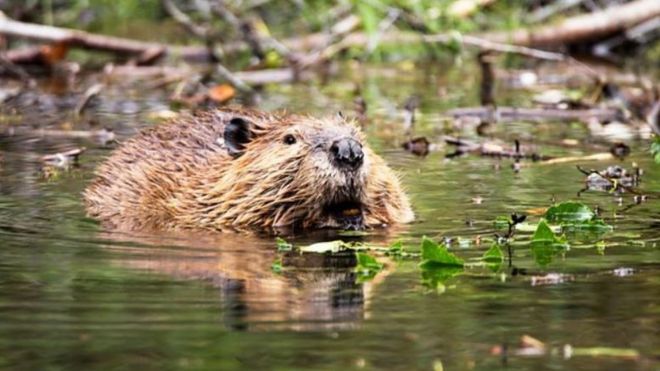
Beavers are amazing creatures and it appears that they could have a role in combating climate change. (But you don’t ever want to have to sex one!)

How would you like a wolf living near you? Personally I’d rather like to have a wolf living in my area. How about you?

The National Trust in South Wales are experimenting with a return to medieval strip farming, and it sounds like an environmental win.

Finally someone has had the courage to call out what I’ve been suggesting for a long time: abandoning nuclear power could increase carbon emissions.

Art & Literature

Apparently the male nude is back in fashion in art circles.

History, Archaeology & Anthropology

Archaeologists were initially puzzled by the skeleton of a 3,000 year old ancient Greek female. But it turns out she was a master ceramicist.

A couple of years ago IanVisits went to Broughton Castle near Banbury. I went there recently during a conference in Oxford, and it is every bit as spectacular as IanVisits says.

In his late 17th century journal sailor Edward Barlow confessed to a rape. But he then covered it over and the evidence lay hidden until modern conservators got to work uncovering an intriguing tale.

Christopher Kissane in the Irish Times blows the lid on the historical nonsense which underpins UK’s Brexit floundering.

Lifestyle & Personal Development

From the annals of the unexpected … Many of us lack a degree of self-control, but researchers have shown that having a simple ritual can help.

We in Britain are losing our shared spaces (pubs, clubs, libraries, churches) and becoming more isolated and cliquey.

So how do you win friends and then keep them for years? Emma Beddington has some ideas.

Food & Drink

Britain’s Food Standards Agency has been testing meat products, and worrying they find 20% contain the DNA of animals they aren’t supposed to, and that it appears to be deliberate.

Shock, Horror, Humour

Finally this years Ig Nobel Prize winners were announced a week or so ago. DIY colonoscopy anyone? Or just the need to use a voodoo doll to get revenge on your boss?

Monthly Links

Herewith are the usual monthly collection of links to items you may have missed. It’s holiday season, so there’s not been so much of interest this month.

Science, Technology & Natural World

This year’s Royal Institution Christmas Lectures should be good. They’re titled “Who are You?” and will apparently be all about evolution and the rise of Homo sapiens. And who better to present them than the ever excellent Prof. Alice Roberts. But I bet there will only be three lectures again this year, rather than the original six.

Talking of human evolution, the latest research suggests that one of the last traits of our primate origins to disappear was our prehensile big toes.

More prosaically, it seems that the UK has this month been plagued by social wasps. I can’t say I’ve noticed, but here anyway are five reasons we should celebrate them. Oh and there’s another reason: our beloved honey bees are descended from ancient wasps.

I’ve seen it suggested that this is old news, but there are recent reports of Pine Marten recolonising the Kielder Forest for the first time in 90 years.

Health & Medicine

There’s a brilliant plan afoot to map the location of every publicly accessible defibrillator in the UK.

And a tragic story: how smallpox claimed it’s very last known victim here in the UK.

There’s new evidence that the HPV vaccine has been responsible for a huge reduction in the rate of cervical cancer. Even better is the news from last month that HPV vaccination is to be offered to teenage boys in England.

Apparently the idea that millions of sperm are in an Olympian race to reach the egg is yet another male fantasy about human reproduction. This Aeon piece has news of what actually seems to happen. [LONG READ]

I wasn’t sure whether to put this item under science or medicine, but here’s a piece of the chemistry of foxgloves, from which we still get the heart drug digoxin.

And here’s a strange phenomenon: aphantasia – the inability to picture things in one’s mind’s eye. It sounds as if there is a spectrum of aphantasia from very lucid to nothing; I suspect I’m somewhere in the lower half as the only pictures I have of events (even significant events like our wedding) are a few “snapshot” images, whereas other people I know can run everything in full HD video in their brains. It’s very curious.

Environment

Here’s another potentially disastrous new vanity project which George Monbiot has got his knife into: the Oxford-Cambridge Expressway. The article contains links to some of the official documentation, and it doesn’t look very pretty!

History, Archaeology & Anthropology

Researchers have made a very interesting discovery of an ancient hominid girl whose mother was a Neanderthal and father was a Denisovan. It suggests that hybridisation between hominid species, and especially our close relatives, was a lot more common than was suspected.

An interesting alternative theory about the development of major monuments like Stonehenge and Easter Island. [£££]

Yet more laboratory research has led investigators to unravel the recipe for Egyptian mummification.

It been a hot summer (although writing this over bank holiday weekend it doesn’t feel that way) and the lack of rain has been a great result for archaeologists as many hitherto unknown sites have become visible in crop marks. And the use of drones has made finding them so much easier than hitherto. [Mostly images]

London

One of our favourite London bloggers has undertaken an epic journey: across London on the 51½°N line of latitude. It is documented in a series of 12 posts of which this is the first – or you can have the whole 51½°N journey in a single post. [LONG READ]

Lifestyle & Personal Development

So what is it really like being an artist’s model? A handful off London’s life models give us a few insights.

Food & Drink

Gluten is getting a bad name. Are problems with gluten in the diet a fad? Or are they a real medical issue? Joanna Blythman in the Guardian looks at some of what seems to be happening. I think the jury is still out.

Despite many people’s dislike, we all know cabbage is good for you and now researchers are suggesting it may contain anti-cancer chemicals. Well if was good enough for Diogenes …

That’s all for this month; more at the end of September.

Monthly Links

So here we are then with this month’s selection of links to items you may have missed the first time round. There’s a lot her again this month, and as usual we’ll start with the “harder” science-y stuff and slalom downhill from there.

Science, Technology & Natural World

So are we alone in the universe? Maybe or maybe not. Science doesn’t know. [£££]

The Earth’s tectonic activity might be essential for the evolution of life.

Most of us hate the sound of our own voices when we hear recordings. Here’s why.

A New Yorker article on the obsessive search for the Tasmanian Tiger (aka. Thylacine). [VERY LONG READ]

Balls! The males of all mammals have them, but not all are on display: some species don’t have descended testicles.

Who could have predicted that crows can work a vending machine – and make their own tokens.

That clean swimming pool smell … turns out it isn’t too good for you!

Health & Medicine

There’s this yeast; it’s a strange and deadly superbug.

So just how easy is it to catch germs from a toilet seat?

Women’s healthcare could be normalised by employers understanding the need for menstrual leave.

Low risk of breast cancer? Seems like skipping that mammogram isn’t such a bad idea.

Two items on fish oil and Omega-3 supplements. A study by the Cochrane Institute (who are the gold standard of medical reviews) concludes the supplements give no protection against heart disease and stroke. And what’s more the second article points out that such supplements are doing immense harm to the planet.

There’s a better medicine for the elderly than umpteen pills. It’s called social prescribing, where GPs can signpost people to activities and support – except most don’t know what is actually available.

Sexuality

Do lesbians have better sex than straight women? Seems like they probably do.

Environment

I remember my father talking about this 50+ years ago, so it’s been known for years (and ignored) that we need to look after and repair the soil to grow crops sustainably and with good yields.

Timber! So just how are tree trunks cut to make wood with a range of uses and appearances?

Social Sciences, Business, Law

Now I was suggesting this as a corporate strategy some 12 or more years ago, and it has taken this long for someone to catch on: accountancy giant PwC is making employees use mobile phones and cancelling landlines.

History, Archaeology & Anthropology

Archaeologists have unearthed an unknown Neolithic site near Woodbridge in Suffolk. Ritual is suspected.

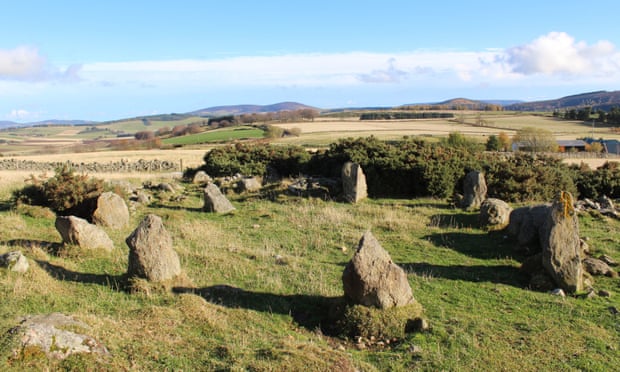
IanVisits pays a visit to Avebury Stone circle (above).

Ireland is having a hot, dry summer which is good for revealing crop marks of ancient remains. In one a drone has spotted the outline of a previously unknown henge near Newgrange.

Slightly nearer home, soldiers have found the skeleton of a Saxon warrior on Salisbury Plain.

There’s an unexpected cockatoo in the margins of a 13th-century manuscript in the Vatican. And it’s forcing a rethink of the ancient trade routes.

Meanwhile on the north Kent coast a 16th-century shipwreck is being revealed by the sea, and it too is expected to reveal a lot about trade in Tudor England.

Still on watery archaeology, there is a massive metro construction project in Amsterdam which is necessitating the clearance of some stretches of canal. The astonishing range of finds, right back into pre-history, has been put online.

London

Kew Gardens station has a remarkable concrete bridge. IanVisits goes to see.

The Horniman Museum in south-east London has a new World Display as well as being all-round interesting.

Lifestyle & Personal Development

Are things getting worse – or does it just feel that way?

And are women’s breasts getting bigger – or is it just bras? (Or is it just low levels of hormones in food?)

Some schools are banning girls from wearing skirts supposedly to protect the girls. But skirts aren’t the problem; the problem is boys who think girls are lesser creatures. No, just let girls and boys wear skirts, or trousers, as they please.

A parents’ guide to surviving children’s teen years.

So just why do people believe in superstition and the unbelievable?

People avoid adopting black cats because they’re supposed to be unlucky and because they are hard to photograph. Neither is actually true!

Ah yes, the cashless society. It’s another big con of the banking sector to boost its profits. As Sweden is beginning to realise, if you don’t have cash the whole of society is vulnerable to computer malfunction, attack and power failure. Just think about that for a minute.

Food & Drink

On the history of borscht.

Shock, Horror, Humour

And finally one from Norfolk Police, who stopped a motorist only to find he was driving while sitting on a bucket and steering with pliers!

Monthly Links

There’s again a lot in this month’s round up of items you may have missed the first time. So here goes …

Science, Technology & Natural World

Maglev trains have been around for a surprisingly long time, so why aren’t they ubiquitous?

Inter-species hybrids were once looked on as just biological misfits, but science is now coming to appreciate their importance for evolution. [LONG READ]

Did you know that witches’ brooms grow on trees? You do now!

Tidal power is supposed to be able to provide a significant percentage of the world’s energy needs, but a close look suggests it won’t. [£££]

Health & Medicine

Here’s a little about how Moorfields Eye Hospital in London really has changed the world.

It’s only a matter of time before we get the next major pandemic. An American-centric look at our preparedness? [VERY LONG READ]

The medical profession prescribe a lot of opioid painkillers. But are they all they’re cracked up to be, and would we miss them if they weren’t there?

Restoring life using CPR is brutal and rarely works. So why do people have so much faith in it and demand resuscitation at all costs?

Against most specialists expectations there’s work going on to develop a single vaccination to prevent several common cancers. It’s about to start a major trial in dogs.

While we’re on cancer, the placenta may just give us insights into cancer treatment – it’s just one of nine ways the placenta is so amazing. [£££]

Scientific American recently asked “When Does Consciousness Arise in Human Babies?”

Did you know you have an “inverse piano” in your head? Well actually there are two and they’re in your ears.

Finally in this section, Fred Pearce in the Guardian, takes another look at the real fallout from the Fukushima Dai-ichi disaster.

Sexuality

Why was it ever in doubt that women can have multiple orgasms?

Environment

Here are two articles on the length of time it takes garbage to decompose. The first is fairly general; the second gives us the following graphic looking at plastic and other rubbish in the sea.

And while we’re on plastic, Annie Leonard in the Guardian says that the “plastic crisis” is too big to be solved by recycling alone.

The Woodland Trust are understandably – and quite rightly – angry at Network Rail’s apparent plans to clear trees from railway embankments.

Social Sciences, Business, Law

History tells us that all cultures have their sell-by date, so has the West’s time come and are we on the brink of collapse?

Oxford and Cambridge Colleges own a bigger portfolio of property than Church of England.

The rail industry are running a public consultation on rail fare structure prior to submitting proposals to the government. Do have your say.

History, Archaeology & Anthropology

Aethelflaed: A Saxon warrior queen who was out to vanquish the Vikings.

London

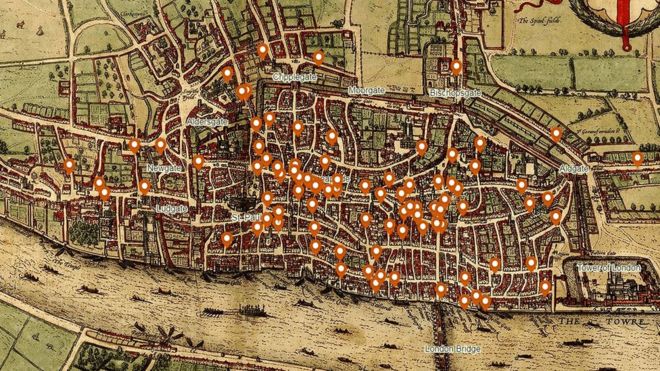
Layers of London is a super resource which allows you to overlay a number of old maps on the current street plan of London. One of the best is the Tudor layout of 1520. IanVisits takes a look.

Lifestyle & Personal Development

So just why are Dutch teenagers among the happiest in the world? And couldn’t we learn something from their approach?

Here’s Zen Master and writer Brad Warner contemplating the problem of spirituality, religion, the ego and intellectual honesty. It is readable, and well worth a read.

Meanwhile the Guardian (again!) reports that UK homes vulnerable to a staggering level of corporate surveillance from smart TVs, smartphones, laptops, security cameras etc.

Shock, Horror, Humour

And finally, just because it isn’t 1st April … a prep school in Derbyshire has lost its Bakewell pudding in space. So very careless!

More next month!

Monthly Links

Here’s this month’s collection of links to items you may have missed the first time round. As usual we start with the seriously scientific and end with … the not so seriously scientific.

Science, Technology & Natural World

London blogger Diamond Geezer visits the National Physical Laboratory in Teddington. I’ve never been there, but I really should because, although it will be much changed, my mother worked here as a draughtsman’s tracer during the WW2.

A guide to the spiritual world of Hawaii’s lava. Guess you need it if you insist on sitting atop a huge volcano!

We have this notion that all humans are descended from a small population in East Africa. However the current theories are that this is wrong and that our origins are much more diverse and colourful. [LONG READ] [£££]

Now you might think this is bit of an obvious thing to do, but scientists have finally unravelled the genetic secrets of roses.

So what sort of nutter spends his life being stung by insects? Justin O Schmidt is the answer.

Health & Medicine

Do you keep marine fish? If so do you know how deadly your aquarium might be?

It seems that migraine changes your brain and the way you experience the world – all the time, not just during an attack. [LONG READ] [£££]

Nothing is off limits at the Menopause Cafe – watch the video!

Sexuality

Oral sex has been around for a long, long time: here’s a brief history from ancient China to DJ Khaled.

Environment

So how are we really going to solve our waste problem? New Scientist takes a look. [£££]

This is why I don’t indulge in long-haul, safari holidays: it seems tourism’s carbon impact is three times larger than previously estimated.

Following which, the Guardian looks at the true cost of eating meat, only to find this is also even worse that we thought.

But then we can’t even manage the food we don’t eat: Sainsbury’s has dropped a pilot project to halve food waste.

Social Sciences, Business, Law

So here’s a 45-year-long American study on how to raise genius children. No it isn’t for parents to “hothouse” normal kids but to take the brightest and stretch them. Now explain to me why we shouldn’t have Grammar Schools! [LONG READ]

History, Archaeology & Anthropology

New evidence suggests that ancient humans settled the Philippines 700,000 years ago. That’s around 600,000 years before previously thought.

The Ancient British Queen Boudica was the scourge of the Roman’s in Britain. Or was she?

How about finding an 800-year-old label to date a shipwreck in the Java Sea – and thereby rewrite its history?

Wow! Just, WOW! An historian has created an incredibly detailed map (above) of the medieval trade routes across Europe, much of Africa and much of Asia. Absolutely stunning!

London

So just why has the number of Londoners using are tube recently fallen so dramatically?

Lifestyle & Personal Development

Scientific American reckons that we don’t understand ourselves as well as we think, and offers ten things you don’t know about yourself.

If you’re really curious, and not at all paranoid, you can get a clue as to how long you are going to live.

Every year there is a Boring Conference in London. Diamond Geezer reports on this year’s siesta fiesta.

Did you ever want to know everything Facebook and Google know about you? Here’s how. [LONG READ]

Shock, Horror, Humour

And to round off this month’s offerings, we have not one, but three amusements …

Ever wondered what to do with your old bras? Well you can always donate them to the cows.

Not to be beaten by the Boring Conference, the Flat Earth Conference suggests the Universe is an egg and the moon isn’t real. There’s another report here.

And finally … If you ever happen across a Tube Snake, do make sure you report its location as they are an endangered species in need of conservation.

Toodle-pip.

Your Monthly Links

Here’s the usual selection of links to articles which interested me and which you may have missed. We’ve a packed house, so on with the show …

Science, Technology & Natural World

Some interesting speculation on whether a pre-human industrial civilisation could have existed on Earth, and whether we would be able to tell.

Apparently European women are twice as likely to be naturally blond as men.

Ravens. The Tower of London has them. So who better to ask about the intelligence of Ravens.

Wasps. There are countless species of them, they’re mostly tiny, and most are parasitic – indeed there’s thought to be at least one parasitic wasp species for every other insect species.

Ants perform triage and launch rescue missions on the battlefield, but only if it’s worth the effort.

Scientists are suggesting that trees may have a form of “heartbeat”, but it is so slow we wouldn’t normally notice.

Why does soil, especially newly wet soil, Springtime soil and forest soil, smell so identifiably?

It seems many trillions of viruses fall to Earth each day – millions per square metre – and it’s not all bad.

A meteorite found in Sudan contains some tiny diamonds, which means it is thought to be the remnants of a lost planet.

Health & Medicine

Do you suffer from chronic pain? Medics are suggesting that a change of mindset could help reduce the pain as much as analgesics.

Who, apart from me, had flu this last winter? If you did you shouldn’t be surprised as apparently we don’t take flu seriously enough. It really is worth getting the flu jab (especially if you’re in an “at risk” category). Although I was vaccinated and still got flu which floored me it wasn’t anything like as bad as if I’d not been vaccinated.

The NHS is being urged to include boys & young men in the HPV vaccination scheme (currently only adolescent girls are eligible). Not only would it help contain the general spread of the virus, but more and more men are getting head/neck cancers from the human papilloma virus, thought to be due to the young having more oral sex.

A test is being developed that will allow a foetus’s sex to be determined from just a finger-prick drop of blood during the first trimester of pregnancy.

There needs to be much greater awareness of the state of our post-birth vaginas. As usual the UK lags behind our old enemy, France, in post-partum rehabilitation.

And while we’re at it, we still have an appallingly poor knowledge of the anatomy for the clitoris. Yes, that’s all of us, it seems!

Environment

Unlike my neighbour, most of us understand that plants are important. Here’s why.

Bees are important too. And you can help the bees by doing less. Just mow your lawn only every two to three weeks.

Scientists are developing an enzyme to eat plastic bottles.

Art & Literature

It’s reported that Neil Gaiman is to make a film of Mervyn Peake’s Gormenghast trilogy.

Stockholm residents are up in arms over a five storey high blue penis mural.

London

IanVisits has created a useful map of all London’s miniature steam train rides.

Meanwhile another London blogger, Diamond Geezer, has produced a London Random Tourist Inspiration Generator for when you want to go somewhere but don’t know where.

Lifestyle & Personal Development

We’re moving towards a cashless society, or so we’re told. But being cashless puts us at risk, so the Swedes are turning against the idea.

Why are some societies strict and others lax? New Scientist investigates.

Do you want to be more assertive in life? If so there’s a dominatrix in New York who will teach you.

Chiltern Railways, whose trains run north-west out of London’s Marylebone Station, are suggesting eight seated yoga poses you can do on your commute. I struggling to decide how serous they are.

Crazy cat lady is a frequent image in pop culture. But why?

Food & Drink

A recent column in the Guardian is suggesting that eating goat is as tasty as lamb and a sustainable, ethical choice of meat.

Shock, Horror, Humour

And finally, one for the engineers and kids out there. John Collins, aka. “The Paper Airplane Guy“, holds the distance record for flight by a paper airplane. And he shares a few of his secrets with us.