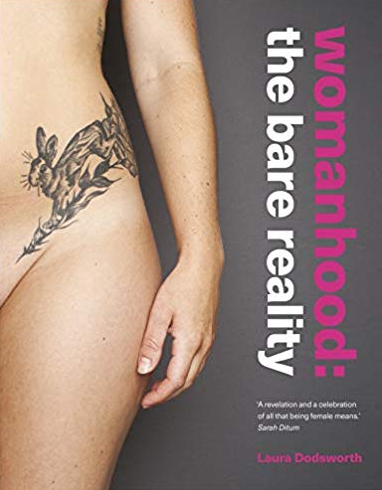
Something for Jacqui …


Gesshin Claire Greenwood
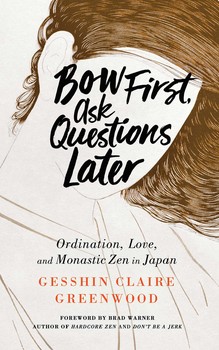
Bow First, Ask Questions Later
Wisdom, USA; 2018
Having just finished this book, I’m still not quite sure what my emotions are towards it – beyond pure admiration, that is. So I’m going to start with a couple of quotes from other people. First here’s Ruth Ozeki on the cover blurb:
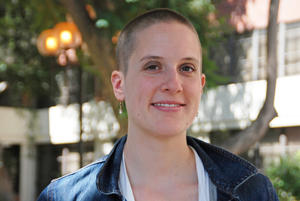
With rigour, honesty, hilarity, and joy, Gesshin shows us how to grapple with the great matter of life and death – as well as with lesser matters, like capitalism, sexism, religious dogma, sex, love, fashion, and Kyoto nightclubs. The result is an inspiring book that I couldn’t put down, even when I’d finished reading it.
And here’s an extract from the Foreword by our other favourite Zen Master, Brad Warner:
Gesshin Greenwood is … an honest-to-Buddha Zen nun, with the shaven head to prove it. She went through the kind of rigorous training in traditional Zen temple practice that most of the folks you see writing puffed-up fluff pieces for those slick spiritual magazines… avoided like politicians evading the draft …
I [am] amazed that someone as young as she had such a deep background in Buddhist practice experience … Gesshin … really did all the stuff … She actually immersed herself in Japanese Zen temple life for years doing all the ceremonies, all the services, all the cooking and cleaning and the rest of it …
… It’s rare that someone from the West does any of this stuff, rarer still when they write about it, and yet even more rare that their writing is as good as Gesshin’s is. This is a truly unique document of a truly unique lived experience.
I’ve been reading Gesshin’s weblog, That’s So Zen, for some years and have always found it illuminating, if at times hard to fully understand. This book travels some of the same ground, which is good because everything is newly written and so helps reinforce the “learning”.
Although the book is autobiographical it is first and foremost a book about Zen Buddhism, but not in a dry academic way; as Brad says it is extremely well written, in a light, engaging style which does indeed make it difficult to put down – I had to ration myself to a couple of chapters an evening to avoid reading through the night.

Gesshin is a self-confessed white, privileged Californian, with hippy, Buddhist parents; and as the book goes on one comes to realise she was probably something of an angry brat (but then aren’t all teenagers?). Nonetheless she wanted to study Buddhism, and felt even in college strangely attracted to it; and that emotional connexion is passed on to the reader.
She started in India, and went to Tibet, before finding her spiritual home in the Sōtō Zen tradition in Japan, and in the rigorous setting of an all female Zen monastery. This is her story, of her journey; and one isn’t sure until well into the book quite where things are going to end up.
Gesshin talks frankly about the hardships, heartaches, tragedies and mistakes – as well as the joys – of her practice and shows how each of them allowed her to grow. Each of the 25 short chapters focusses on some particular event to illuminate her learning. We see something of her relationships with her teachers and her wrestles with the apparently irreconcilable dichotomy of being a nun and a young woman who likes men and can fall in love. We are left, at the end, with the impression that Gesshin has happily resolved that dichotomy.
All this is shared openly with us, and we join in feeling the pain and the joy. Equally I found the book inspiring and stimulating me to move forward in my own journey (whatever that is).
For anyone with an interest in Buddhism, especially Japanese Sōtō Zen, this is a book well worth reading. And even if you just want to follow the quest of a young woman in search of answers to life and death, do read it. I really did find it hard to put down.
Overall Rating: ★★★★★
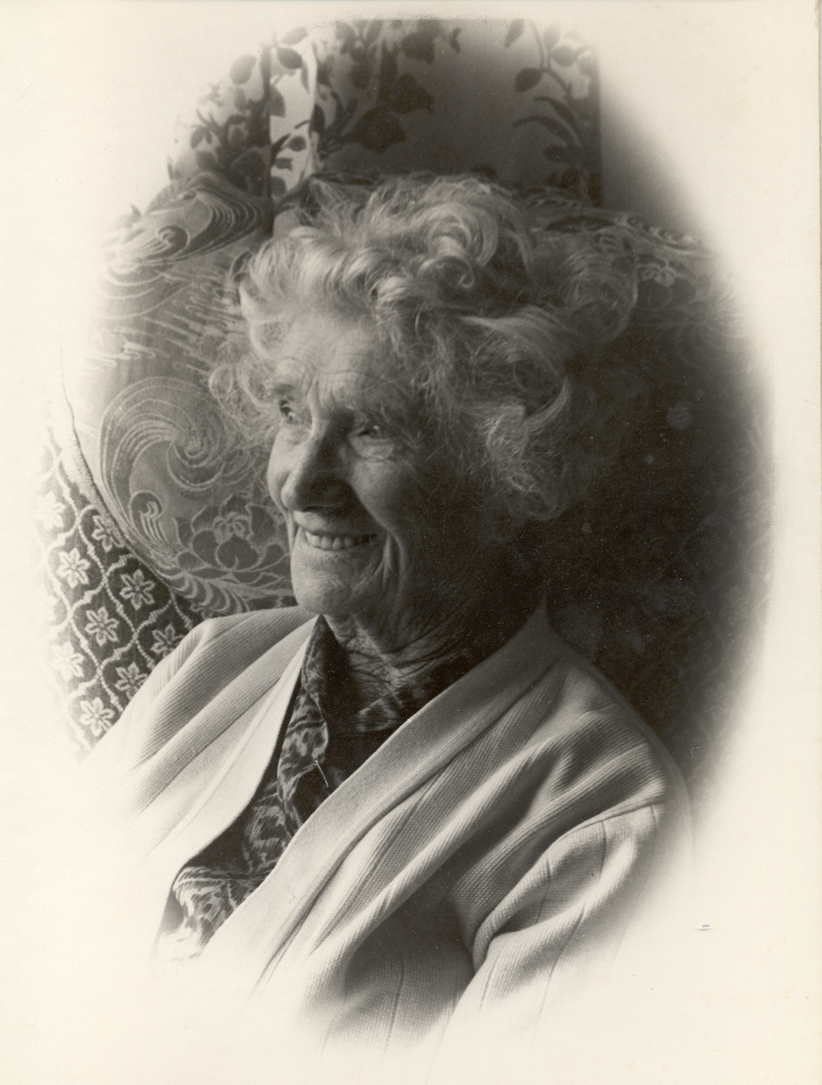
For quite a few years I’ve puzzled over why I am unable to find my maternal grandmother, Florence Elizabeth Coker (pictured right in 1972, about a year before her death aged 88) on the 1911 census. At the time of the census she was 27 and still single (she married a couple of years later and my mother was born in 1915). She was known at that time to be living with her mother and three brothers in the East End of London where she worked in her mother’s tailoring business.
Her mother (my great-grandmother) is on the census with her three sons, one of whom completes and signs the census return. My great-grandfather is known to have left his wife and is on the 1911 census living about half a mile away with another woman, her two sons (by her husband) and a 6-month-old girl who appears to have bee sired by my great-grandfather. [That is a story for another day!]
But where is Flo? She isn’t with either of her parents. Indeed I have been totally unable to find any trace of her anywhere in the country. Was she abroad? I think that’s unlikely, although I can’t rule it out.
It so happens I’m a member of London Historians, and their latest newsletter (February 2018) has an article by Anne Carwardine, a specialist on suffragette history – well this is the centenary of the first round of female suffrage. In it I found the following paragraph:
Census Night
Despite Black Friday, the WSPU maintained a truce for much of 1910 and 1911, hopeful that legislation giving women the vote would soon be passed. In April 1911, the census provided them with an opportunity for peaceful protest. There were two main options – resist (by refusing to provide information) or evade (by staying away from home at midnight, so that you would not be counted). The largest organised evasion took place in central London. Late on the evening of April 1st, small groups of women walked through the streets and converged on Trafalgar Square. A crowd gathered to watch them, although on this occasion the atmosphere was friendly, with plenty of cheers and laughter. After Big Ben had struck twelve, many of the suffragettes headed eastwards, singing “Let’s All Go Down the Strand”. The Rinkeries, a roller skating rink on the Aldwych, was kept open all night for census protestors and several hundred women (together with a few men) skated through the night, accompanied by a band. There was also entertainment – Ethel Smyth conducted the March of the Women, WSPU leaders made speeches and well-known actresses read suffrage poems. Refreshments were available in the nearby Gardenia Restaurant, where suffragettes acted as waitresses for the night. Early the next morning, the skaters headed wearily home, having achieved the publicity they wanted.
Dutifully I have checked a number of other sources and this scenario appears to be correct – indeed it is much more complex than this one paragraph outlines.
This is something of which I was totally unaware!
Now I don’t remember ever hearing my grandmother (who died when I was a student), or my mother, speak about suffrage, votes for women or anything of the sort. Indeed before she died I had told my mother about the mystery of Flo missing from the census and she was as puzzled as I. But here we have a possible explanation. Could she have been one of the partying suffragettes who were deliberately not at home at midnight and hence could truthfully not be counted. Or was Flo one of those who refused to allow her name to be put on the census form (which would have been illegal), a wish which was accepted by her brother who completed the form.
I am never likely to know for certain. But, despite how little I knew my grandmother, I suspect this could well be the answer. It would not have been entirely out of character.
And we think we live in interesting times!
There’s a lot in this month’s edition so let’s get straight in …
Science & Medicine
Medics are now saying that arthroscopic surgery for degenerative knee problems (ie. essentially arthritis) does not actually do any much good.
[TRIGGER WARNING] Breaking the taboo of talking about miscarriage.
Another new study shows that, against expectation, women who source online and use abortion drugs do so with very little need for emergency medical help.


I came across these a few days ago in a family history society magazine. I’ve tidied them up a bit.
The Ancestors’ Commandments
Brilliant, aren’t they. And so, so true. I think Noreen and I each have a full house in our family trees.
I came across the attached article from the Naples Daily News (Florida) at the beginning of the year.
I don’t know I 100% agree with the author – well it is American! – as I think he has tilted the balance too far from the current norm and I think there is a balance to be struck. However from what I see around me the best adjusted children are those where the family apparently adheres, more or less, to his tenets.
Here’s an image of the article, and in case you can’t read it easily I reproduce the text below.
Naples Daily News, Sunday 1 January 2017
John Rosemond, Family Psychologist
I recently asked a married couple who have three kids, none of whom are yet teens, “Who are the most important people in your family?”
Like all good moms and dads of this brave new millennium, they answered, “Our kids!”
“Why?” I then asked. “What is it about your kids that gives them that status?” And like all good moms and dads of this brave new millennium, they couldn’t answer the question other than to fumble with appeals to emotion.
So, I answered the question for them: “There is no reasonable thing that gives your children that status.”
I went on to point out that many if not most of the problems they’re having with their kids – typical stuff, these days – are the result of treating their children as if they, their marriage, and their family exist because of the kids when it is, in fact, the other way around. Their kids exist because of them and their marriage and thrive because they have created a stable family.
Furthermore, without them. their kids wouldn’t eat well, have the nice clothing they wear, live in the nice home in which they live, enjoy the great vacations they enjoy, and so on. Instead of lives that are relatively carefree (despite the drama to the contrary that they occasionally manufacture), their children would be living lives full of worry and want.
This issue is really the heart of the matter. People my age know it’s the heart of the matter because when we were kids it was clear to us that our parents were the most important people in our families. And that, right there, is why we respected our parents and that, right there, is why we looked up to adults in general. Yes, Virginia, once upon a time in the United States of America, children were second-class citizens, to their advantage.
It was also clear to us – I speak, of course, in general terms, albeit accurate – that our parents marriages were more important to them than their relationships with us. Therefore, we did not sleep in their beds or interrupt their conversations. The family meal, at home, was regarded as more important than after-school activities. Mom and Dad talked more – a lot more – with one another than they talked with you. For lack of pedestals, we emancipated earlier and much more successfully than have children since.
The most important person in an army is the general. The most important person in a corporation is the CEO. The most important person in a classroom is the teacher. And the most important person in a family are the parents.
The most important thing about children is the need to prepare them properly for responsible citizenship. The primary objective should not be raising a straight-A student who excels at three sports, earns a spot on the Olympic swim team, goes to an A-list university and becomes a prominent brain surgeon. The primary objective is to raise a child such that community and culture are strengthened.
“Our child is the most important person in our family” is the first step toward raising a child who feels entitled.
You don’t want that. Unbeknownst to your child he doesn’t need that. And neither does America.
As long-time readers will know, in between anything else happening I enjoy a bit of people watching. In the last week or so I’ve seen these.


This week a shot from way back in the archives. I took this on a visit to London Zoo back in 2008. Because it was a nice day the people watching was as good as seeing the animals. I couldn’t decide which were the better “inmates”.

Today Dora, my mother, should be celebrating her 100th birthday. But sadly she died towards the end of May, thus missing out by just over four months. As a tribute, and as this week’s photographs, I thought we should have what are I think the first and last images I have of her.
As far as I know I don’t have any photos from Dora’s childhood (but I should scour the family albums again), so this first is of a self-portrait in oils she painted when she was about 21 (she couldn’t remember exactly when), could be the earliest I have.