Category Archives: natural history

Your Interesting Links

And thick and fast they came at last,
And more, and more, and more

Yes, we are doing well at present for interesting links to items you might have missed the first time round. Here is the latest instalment, and again I promise you nothing too hard by way of science!
What is it that makes wet dogs smell so? Here’s a brief look at some of the chemistry.

There are definite advantages to being female, and if you’re a cat one of them is that you can have splotchy fur.
Most moths can only make noise by rubbing their legs or wings together, but the Death’s-Head Hawkmoth has a built-in flute. They also eat honey.

We all know that seeds can last a long time just by observing what happens when you turn over an undisturbed piece of ground. But how long can seeds really survive?
And from seeds we’re now on to food … We’re often told that western society eats too much meat and we should cut back. While this would undoubtedly be good for our health, can meat ever be eco-friendly?
Have you ever stopped to think about what cooking oil you use? Well some scientists have and the results may surprise you.
Scotch eggs originated in Scotland, didn’t they? Except they probably didn’t.
Who has ever had hiccups after a meal? Or maybe some other time? But why do we hiccup?
So now to some different aspects of lifestyle. What (if any) are the scientifically proven benefits of yoga? Julia Belluz looks at all the evidence.
I wonder how many of you already know these 9 facts about breasts? No, I didn’t!
How to improve your work-life balance by doing one simple thing? You can’t? Oh yes you can! It sometimes takes a bit of discipline, but I did it many years ago and it worked for me.
Next a couple (more) items — here and here — on why family nudity is actually healthy for kids. Girls especially are more likely to grow up with a good self-body image.
And now a quick shuffle across to the history room where first we find a piece on a little known relic of early 17th century London: the York House Water Gate.
Opening-of-St-Katharines-1828

Slightly later, but still on the Thames, a piece on the creation of the St Katharine Docks and how they changed the working of the docks.
And finally, from boats to trains. Here’s the low-down on the ghost trains of Britain.

Oddity of the Week: Victorian (Medical) Oddities

Warning: not for the squeamish.
Conjoined piglets and two-faced kittens! Oooo-eerrr!
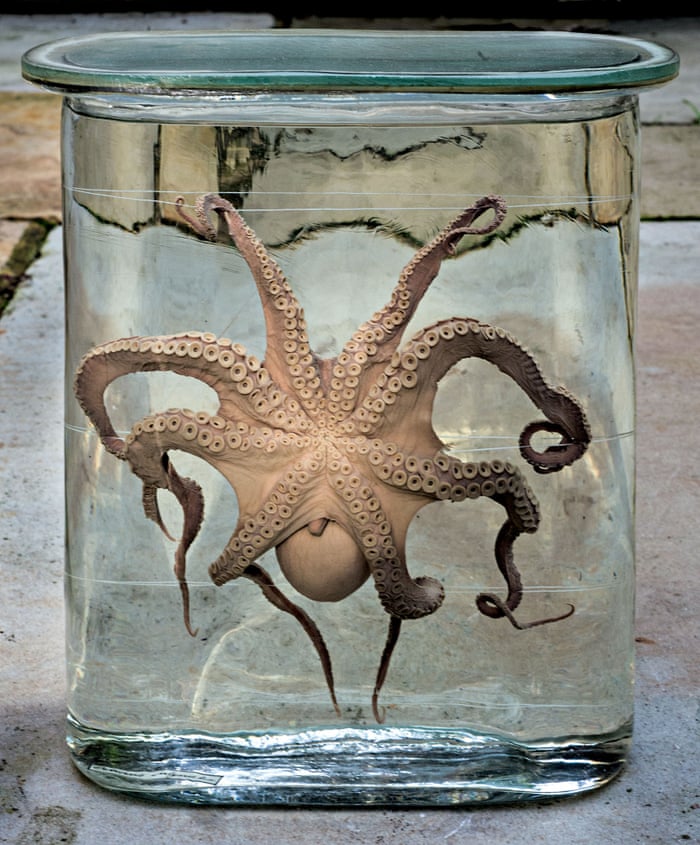
In the 19th century, bodies (both human and animal) were hard to come by, so medical and veterinary schools abandoned many dissections and taught their students using remarkably odd objects like waxwork embryos and exploded skulls as well as preserved specimens like this octopus.


The Guardian has a gallery of more interesting examples at www.theguardian.com/artanddesign/gallery/2015/jul/09/victorian-oddities-two-faced-kittens-conjoined-piglets-in-pictures
Enjoy your lunch!

Orchid Instructions

Yesterday I posted a photo of a Denbrobium orchid, and in the past I’ve posted images of Phalaenopsis orchids. Yesterday I also made the comment that orchids are very easy to get back into flower, but realised afterwards that most people aren’t going to have a clue how to do this. So instead of throwing out that beautiful orchid once it has finished flowering, this is what you do …
Phalaenopsis orchids, which is most of what are in the shops, are actually surprisingly easy if you do a few simple things. You will also sometimes find Dendrobiums and in my experience they can be treated in much the same way. (There are many other species of orchid but these are the ones you will normally find on general sale, eg. in supermarkets, in the UK.)

Purple Orchid
Phalaenopsis orchid

Orchids are epiphytes which grow in trees using their roots only to hold them lightly in place and to pick up water. They will also grow extra aerial roots to absorb any moisture in the air; these roots should not be buried in the compost. Good roots are essential for flowering.
Make sure your orchid is potted in bark chippings and NOT in soil or moss. Orchids must not stand in water or be waterlogged; their roots have to be free-draining. If your orchid is planted in anything other than bark chippings, get some orchid compost (which is basically bark chips) and repot it. Being waterlogged is the quickest way to kill an orchid.
Dendrobium
Dendrobium orchid

You’ll notice that most orchids are planted in transparent or translucent plastic pots. This is because their roots like light just as the leaves do. If possible keep the orchid in a light place and in a clear container.
Do not put your orchid in bright sunlight as this is likely to scorch the leaves. They are plants which grow in amongst the branches of trees so although they need good light they would only naturally get dappled sun.
Orchids also need to be warm (20-25°C) most of the time. Avoid putting them somewhere where the temperature fluctuates a lot and keep them out of draughts. However a few weeks of slightly cooler temperatures (maybe down to 15°C at night) and reduced watering forces them to rest and is almost essential to get them to come back into flower.
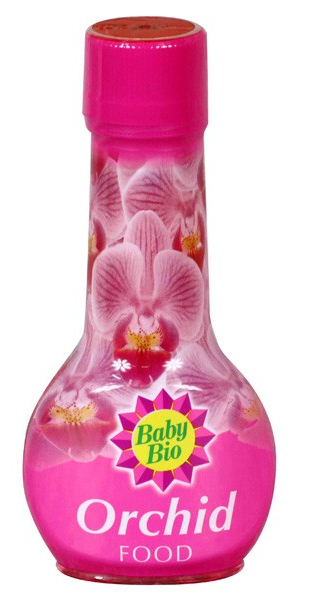
bboIt is a good idea to get some orchid feed. There is a “Baby Bio” orchid feed in a pink bottle; it is easily available — many supermarkets sell it — and is probably as good as anything specialist. A bottle will last a long time.
Now about watering. Your orchid needs watering once a week but it must NOT stand in water all the time. Each week put your orchid (in its plastic pot) in a bowl and fill it with water almost up to the level of the compost. If you have orchid feed add a small squirt of this to the water (read the directions on the bottle) although this should not be done every time they are watered. Let the orchid soak for an hour or two (but no more). Then take it out, put it back in its outer container and return it to its normal place.
Watering time is also a good opportunity to give the plant the once over. Remove any dead/dying leaves, dead flower spikes and dry shrivelled roots with a pair of sharp scissors. Try to make sure the leaves are clean and dust free. Keep an eye out for pests like scale insects — if you spot them I’ve found that unfortunately the only reliable way to get rid of them is with a houseplant insecticide spray.
When your orchid has finished flowering — hopefully after many weeks as the flowers can last 6 weeks or more — remove the dead flowers and cut off the flower stem of Phalaenopsis (with Dendrobiums you should only remove the flowering stem when it dies and withers). Keep the cane which was supporting the flower and any clips or ties. If it needs it this is a good time to repot your orchid.
Phalaenopsis Orchid
Another of my Phalaenopsis orchids

Don’t worry if your orchid isn’t growing lots of new leaves. Phalaenopsis grow very slowly, usually only one or two new leaves a year. Dendrobiums will throw up new stems quite easily; these may need staking and they should eventually flower.
Your orchid will flower again but normally it needs those few cool nights to trigger this. As the spike grows you should stake it (that’s why you kept the old stake and clips). Although the stems themselves are quite robust, they do tend to fall over with the final weight of the flowers and it is easier to keep stems upright if they are staked early and trained upwards.
Then just sit back and enjoy the wonderful flowers!

Weekly Photograph

This week’s photograph is a wild flower, Red Campion, which was growing in the woodland burial site where we interred my mother last week. It is just a small taste of how delightful a place this is.

Red Campion
Red Campion
Colney, Norwich; June 2015
Click the image for larger views on Flickr

Weekly Photograph

Noreen found these two feathers in the garden yesterday afternoon. They are from a Greater Spotted Woodpecker. The top one, a secondary wing feather, is about 8.5cm in total length. The lower is a primary feather. Note the feathers come from different wings, as they curve in opposite directions.

GSW Feather
GSW Feather
Greenford, June 2015
Click the image for larger views on Flickr

Fruit Fly

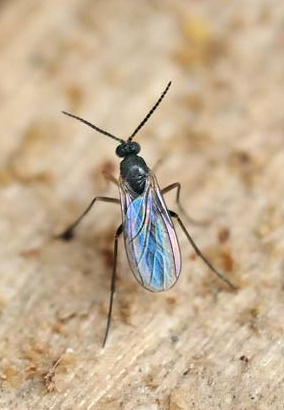
I was looking at a fruit fly (actually probably more likely a fungus gnat or sciarid fly) a couple of days ago. It was about 2mm long walking up the side of my tea mug.
flyAside from the ability of flies to walk up vertical, shiny surfaces (and indeed walk upside down on the ceiling) I marvelled at how Nature can make something so tiny which can function at all.
Look at the legs. They’re as fine as silk. How do you pack into such a tiny diameter an exoskeleton, muscles, nerve fibres and some rudimentary circulation? It defies belief.
And the antennae are much the same. And the wings.
What’s more … How on earth does anyone dissect such a leg or wing to understand the structure? I just cannot get my head round that. Just how do you do such delicate work?
It does make one see how people can believe in intelligent design — for surely engineering something this intricate just isn’t possible. And yet that is exactly the marvel Nature has achieved via evolution.
Incredible!

Oddity of the Week: Bats

Bats roost in big groups in caves. Wrong! If you’re a Hardwicke’s woolly bat, you prefer to sleep in a more luxurious — and private — place.
Kerivoula hardwickii roosts inside tropical pitcher plants. These carnivorous plants usually attract insects, but Nepenthes hemsleyana lacks the scents that others have, so few bugs are lured in. Instead, it benefits from the faeces of this tiny bat, which provides more than a third of its nitrogen and may be crucial to the plant’s survival.
These bats found a niche that no-one else was occupying; they are the only bat species known to roost in pitcher plants.


To take [the image above, and others] Merlin Tuttle waded through tropical forest peat swamps on Borneo. Once he had found an occupied plant, he would spend a few hours taming a bat before snapping it from his portable studio, which provided protection from heavy rains. “It only takes a small fraction of a second for a bat to either enter or emerge, so capturing the action at just the right moment is a real challenge,” says Tuttle.
Within a few days, the bats had learned to bump against his nose when they wanted him to give them some mealworms. “We were quite amazed at the intelligence of such tiny animals,” Tuttle says. “Contrary to common misconceptions, bats in general are gentle, highly intelligent and trainable.”
It is the fact that wild bats are so easily trainable that really struck me!
From New Scientist, 21 February 2015 and at www.newscientist.com/article/mg22530090.100-tiny-bat-makes-home-in-a-carnivorous-plant.htm.

Weekly Photograph

This week, another photograph I took some years ago. This Red Shoveller Duck, a native of South America, was part of the collection at Kew Gardens. I love those spotted feathers!

Click the image for larger views on Flickr
Red Shoveller Duck
Red Shoveller Duck
Kew Gardens; June 2008

Oddity of the Week: Frilled Shark

‘Living fossil’ caught in Australia
A group of fishermen got a bit of a shock when they pulled a rare Frilled shark out of the water.
The Frilled Shark, Chlamydoselachus anguineus, which looks like a cross between an eel and a shark, was caught near Lakes Entrance in Victoria in water 700m deep.
It was estimated to be around 2m in length. The common name of Frilled Shark comes from its six frill-like gill slits, the first pair of which meet across the throat, giving the appearance of a collar. It’s seldom seen, and may capture prey by bending its body and lunging forward like a snake.
The origins of the species are thought to date back 80 million years.


Simon Boag, of the South East Trawl Fishing Association (SETFA), told ABC News: “It has 300 teeth over 25 rows, so once you’re in that mouth, you’re not coming out. I don’t think you would want to show it to little children before they went to bed”.
He added that it was the first time in living memory that the species has been seen alive by humans.

From Practical Fishkeeping, www.practicalfishkeeping.co.uk.

Word: Gynandromorph

Gynandromorph
An organism that contains both male and female characteristics.
The term is mainly used in the field of entomology where butterflies occasionally occur displaying both male and female characteristics because of sexual dimorphism.
A gynandromorph can have bilateral asymmetry, one side female and one side male, or they can be mosaic, a case in which the two sexes aren’t defined as clearly (as in the calico lobster below).
As well as insects, cases of gynandromorphism have also been reported in crustaceans, especially lobsters, in birds and very occasionally in mammals.


Gynandromorph is derived from the Greek gyne female + andro male + morph form.
Note that gynandromorphism is different from hermaphroditism where only male and female reproductive organs are present as in, for example, some slugs and snails.